𝗔𝗡𝗗 𝗪𝗘 𝗔𝗥𝗘 𝗟𝗜𝗩𝗘!!! 🚀
PouchFi is officially here, and we want to celebrate this milestone with the community.
Calling all creators, storytellers, writers, and web3 enthusiasts: WIN your share of ₦1 MILLION in cash for the best content highlighting your PouchFi experience.
𝗛𝗼𝘄 𝘁𝗼 𝗽𝗮𝗿𝘁𝗶𝗰𝗶𝗽𝗮𝘁𝗲:
1. Create an account via https://t.co/gQbhd5axMC & complete KYC
2. Test out the features
3. Craft engaging content from your experience
𝗪𝗵𝗮𝘁 𝘄𝗲’𝗿𝗲 𝗹𝗼𝗼𝗸𝗶𝗻𝗴 𝗳𝗼𝗿:
- Clean, creative, narrative-driven, and proudly Nigerian
- Highlights real utility
- Showcases key features: powered by stablecoin, direct bank funding & withdrawals, virtual cards, or bill payments
𝗣𝗿𝗶𝘇𝗲 𝗕𝗿𝗲𝗮𝗸𝗱𝗼𝘄𝗻:
🏆 1st Place: ₦200,000 (Reserved for best video)
🥈 2nd Place: ₦100,000
🥉 3rd - 6th Place: ₦50,000 each
(COMMUNITY BONUS: ₦500k Giveaway details in follow-up tweet! 💸)
𝗦𝘂𝗯𝗺𝗶𝘀𝘀𝗶𝗼𝗻 𝗥𝘂𝗹𝗲𝘀:
✔️Follow @PouchFinance on X
✔️Drop your PouchFi tag in the comments
✔️Quote-tweet this post with your submission & tag @PouchFinance
🚨 𝗗𝗲𝗮𝗱𝗹𝗶𝗻𝗲: 𝗠𝗮𝘆 𝟮𝟵, 𝟮𝟬𝟮𝟲
We want to see PouchFi come alive. Tag every creator you know!👇
we keep saying PouchFi is the smoothest way to use your crypto.
but don't take our word for it. we want you to actually experience it yourself.
1️⃣ sign up at https://t.co/L5d6tQqPX5
2️⃣ complete at least 1 transaction
3️⃣ tell us what you love (or what we should improve) in the comments
as a quick thank you for your time, we’ll be crediting ₦5,000 each to 100 users 💜
𝗗𝗲𝗮𝗱𝗹𝗶𝗻𝗲: 𝗠𝗮𝘆 𝟮𝟵, 𝟮𝟬𝟮𝟲
see you inside. ⚡️
shoutout to our early testers. giveaway spots secured for:
@De_therapist03@hy_br_id@me_f7D
anyway, the weekend is officially here. what are we getting with PouchFi today? 🌴
Brand identity for StakeFlow
A decentralizd finance (DeFi) platform that offerrs high yield staking
The competitive research and the direction was so interesting to me, this is one of those projects you enjoy as you proceed
Why we started building Senti?
Really,
It didn’t start with a big idea.
It started with a small, uncomfortable realization.
Holding stablecoins feels good… until it doesn’t.
At first, it’s simple. You move into USDT or USDC, escape volatility, and finally feel some level of control over your money. No sudden drops. No emotional swings. Just stability.
But after a while, something changes.
You open your wallet and the number hasn’t moved. Not up, not down. Just sitting there. And a quiet thought starts to creep in:
“Shouldn’t this be doing something?”
That question is where things begin to get complicated.
Because the moment you try to “do something,” you step into a completely different experience. One that isn’t as clean or straightforward as holding.
You start looking around.
You see different yields across platforms. Numbers that seem attractive at first glance. Some feel reasonable, others feel too good to be true. And naturally, you try to understand what’s behind them.
That’s when it stops being simple.
You’re no longer just holding value. You’re now making decisions about protocols, risks, and trade-offs you don’t fully see.
And the strange part is, everything looks fine on the surface.
Clean interfaces. Confident messaging. People saying it works.
But when it’s time to actually move your money, there’s a pause.
Not out of fear, exactly. But out of uncertainty.
Because deep down, you’re not just asking “what’s the return?”
You’re asking:
“Do I really understand where this is going?”
Most of the time, the answer isn’t clear enough.
So you wait.
You tell yourself you’ll look into it later. Maybe read more. Maybe try again another time.
But in most cases, nothing changes.
The money stays where it is.
Not because opportunities don’t exist, but because acting on them feels more complex than it should be.
That realization stayed with us.
Because it wasn’t just a personal experience. It kept showing up in conversations with others.
People weren’t avoiding yield because they didn’t care. They were avoiding it because the process required too much constant attention, too many decisions, and too much trust in things they didn’t fully understand.
In a space built on giving users control, it ironically felt like too much responsibility without enough clarity.
And that’s where the idea for Senti came from.
Not from trying to create another DeFi product, but from trying to fix that exact moment (the hesitation before acting).
The gap between knowing your money could be doing more, and actually feeling confident enough to do something about it.
Senti is built around a simple belief:
Managing stablecoin capital shouldn’t feel like a full time job.
You shouldn’t have to open multiple tabs, compare scattered information, or second guess every move. And you definitely shouldn’t feel like the safest option is to leave your money idle.
There’s a better way to approach it.
One where decisions are clearer, risks are visible, and actions feel intentional rather than forced.
We’re still building toward that.
But the goal is simple.
Make it easier for people to move from holding… to actually using their capital in a way that makes sense.
Because stablecoins solved volatility.
Now it’s time to solve what comes after.
Idle stablecoins might be one of the most overlooked inefficiencies in crypto right now.
Not in an obvious way.
It’s not like people are losing money.
In fact, most people holding USDT or USDC feel like they’re doing the “safe” thing.
And to be fair… they are.
But there’s a quiet tradeoff that doesn’t get talked about enough.
You open your wallet and see $3k, $10k, maybe more… just sitting there.
It’s stable.
It’s accessible.
It’s not going anywhere.
But it’s also not doing anything.
And the tricky part is… nothing feels wrong.
There’s no red flag.
No loss notification.
No moment that tells you, “hey, you’re making a bad decision.”
So it just stays.
Days turn into weeks.
Weeks turn into months.
And that’s where opportunity cost lives…in the background, unnoticed.
Not as a loss you can feel…
But as progress you never made.
Because the reality is, it’s not like yield doesn’t exist.
It does.
The problem is what comes with it.
The tabs.
The comparisons.
The second guessing.
The “is this even safe?” feeling.
At some point, it stops feeling like a smart financial move…
and starts feeling like work.
So you close everything and tell yourself you’ll figure it out later.
Most people do.
That’s why so much stablecoin capital just sits idle.
Not because people are careless.
But because managing it properly still feels harder than it should be.
And until that changes, this inefficiency stays.
Not loud or dramatic.
Just quietly expensive over time.
That gap…between holding stablecoins and actually putting them to work in a way that makes sense…
That’s the part of crypto that still feels unfinished.
And honestly, that’s the part we’re most interested in fixing with Senti.
“What diversification actually means in DeFi” isn’t:
Putting $1,000 into 5 random protocols and hoping for the best.
That’s not strategy.
That’s guesswork.
🧵
People keep asking what “predictive yield intelligence” actually means.
Fair question.
A lot of people hear “AI” and assume it’s some kind of black box making secret decisions with their money.
That’s not the idea.
The real goal is much simpler:
help stablecoin holders understand where yield is likely to remain stable before things start breaking.
Because if you’ve spent time in DeFi, you already know the pattern.
A protocol launches.
APY looks incredible.
People rush in.
Liquidity shifts.
Yields collapse.
Then everyone moves to the next thing.
Most stablecoin strategies today are basically reaction loops.
Chasing what looks good right now.
Predictive yield intelligence tries to change that.
Instead of focusing only on the current APY, the system studies how strategies behave over time.
Things like:
-Historical yield stability (does the yield stay consistent or swing wildly)
-APY variance patterns (is the return predictable or constantly collapsing)
-Protocol reliability signals (how stable is the infrastructure producing the yield)
-Risk-weighted allocation (spreading capital instead of betting everything on one strategy)
The idea isn’t to find the highest yield.
It’s to find yield that’s more likely to remain reliable.
And then structure allocations around that.
One important thing:
AI doesn’t replace the you, the user.
It suggests.
You still decide.
Because transparency matters.
At the end of the day, stablecoin capital shouldn’t depend on:
Telegram alpha
Discord rumors
or copying whale wallets.
It deserves structure.
That’s the layer we’re building with Senti.
Yield farming isn’t a strategy. Allocation is.
There’s a quiet misconception in crypto that needs to be addressed.
Chasing yield is not the same thing as managing capital.
And most people don’t realize the difference.
Stablecoins solved one big problem: volatility.
You could finally park capital without checking your phone every 10 minutes to see if you were down 20%.
That was real progress.
But the moment volatility disappeared, we replaced it with something else:
APY addiction.
12% felt decent.
18% felt smart.
24% felt early.
30% felt like you “understood the game.”
But here’s the part nobody likes hearing:
APY is just a number.
Allocation is a framework.
Most people don’t have a framework.
They have habits.
They rotate into whatever looks hot.
They scan Twitter.
They follow the latest farm.
They react after risk shows up.
That’s not capital management.
That’s emotional rotation.
Real allocation is uncomfortable because it forces discipline.
It asks:
-How much of my capital is exposed to one protocol?
-If this breaks, how bad is the damage?
-Are these strategies actually diversified…or just wearing different logos?
-What forces me to rebalance?
-What does this look like in a stress scenario?
If you don’t know those answers before deploying capital, you’re not allocating.
You’re improvising.
And improvisation works… until it doesn’t.
This isn’t anti-yield.
Yield is productive.
Yield is necessary.
Yield is the point.
But yield without structure is fragile.
If your “strategy” requires constant monitoring, emotional switching, and reacting to dashboards, you don’t own your capital.
Your capital owns your attention.
And that doesn’t scale.
Here’s the deeper issue:
Stablecoin capital has exploded into the hundreds of billions.
The infrastructure matured.
The management style didn’t.
We upgraded rails.
We didn’t upgrade intelligence.
There’s a massive difference between:
“Where’s the highest APY right now?”
And:
“What’s the most efficient risk-weighted way to deploy capital over time?”
One feels productive.
The other actually compounds.
Eventually, the stablecoin market will mature.
It will move from yield chasing to capital structuring.
From noise to discipline.
From scoreboard thinking to allocation logic.
That shift won’t come from louder farms.
It will come from systems that understand exposure, variance, and structured rebalancing.
Not higher yield.
Smarter deployment.
That’s what we’re building with Senti.
Not another farm.
A way to think.
Be honest.
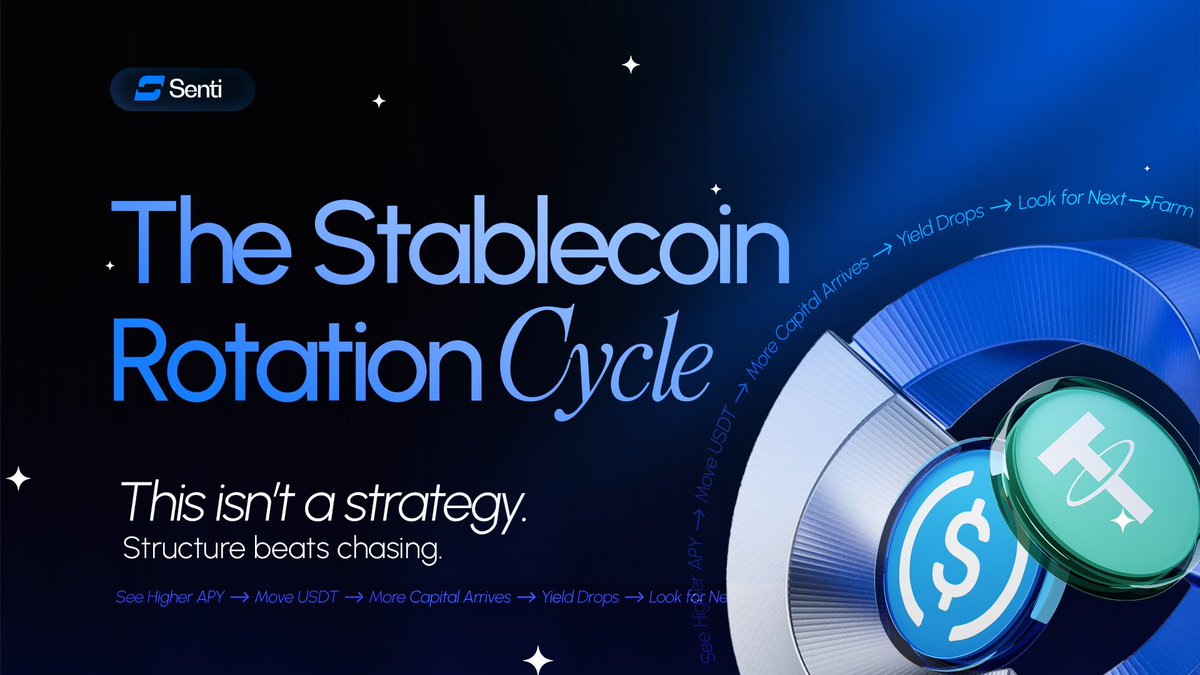
How many times have you moved your USDT because you saw a higher APY somewhere else?
10% → boring
18% → interesting
25% → “okay this looks good”
Most stablecoin holders do this.
And it’s exactly why many of them underperform.
🧵
A lot of people hold USDT.
But most of it just sits in wallets doing nothing.
Not because yield doesn’t exist.
But because finding safe yield in DeFi is complicated.
So we built Senti’s AI Vault.
🧵