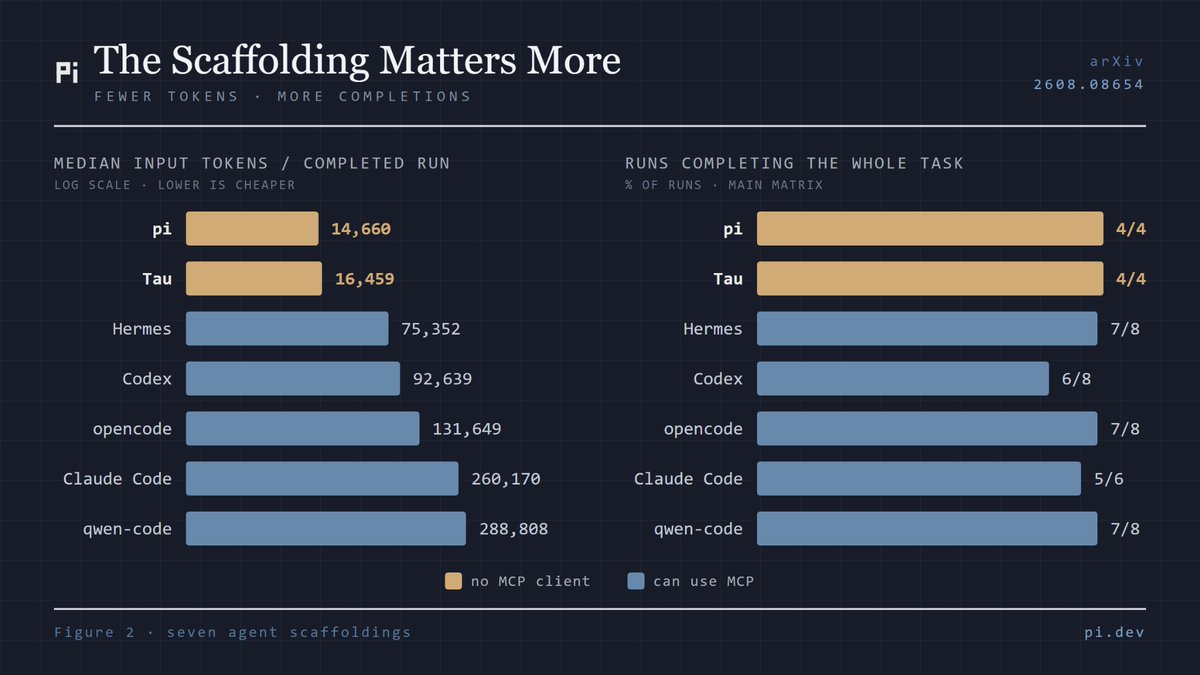
This week we read research from a team of academics that ran a software task across 7 agents and 5 models.
They found that in domains with a mature CLI ecosystem, agents without MCP baked in completed the task just as reliably and were 5-28x cheaper.
Full arXiv paper below
@Bugcrowd Most SSRF filters only check the initial URL but forget about redirects. A 302 to 169.254.169.254 bypasses everything. DNS rebinding is another classic - resolve to a public IP first, then flip to internal on the second lookup. Always validate after resolution, not before.
好的!类似 Michael Polanyi 这种“一人名顶十万字提示词”的例子,这里再举10个(每个都浓缩深厚哲学/认知框架,适合AI提示):
1. Ludwig Wittgenstein
2. Karl Popper
3. Thomas Kuhn
4. Friedrich Hayek
5. Isaiah Berlin
6. Alasdair MacIntyre
7. Hans-Georg Gadamer
8. Jürgen Habermas
9. Charles Taylor
10. Hubert Dreyfus
The power of 𝗠𝗖𝗣 in 𝗔𝗴𝗲𝗻𝘁𝗶𝗰 𝗥𝗔𝗚 Systems.
To make it clear, most of the RAG systems running in production today are to some extent Agentic. How the agentic topology is implemented depends on the use case.
If you are packing many data sources, most likely there is some agency present at least at the data source selection for retrieval stage.
This is how MCP enriches the evolution of your Agentic RAG systems in such case (𝘱𝘰𝘪𝘯𝘵 2.):
𝟭. Analysis of the user query: we pass the original user query to a LLM based Agent for analysis. This is where:
➡️ The original query can be rewritten, sometimes multiple times to create either a single or multiple queries to be passed down the pipeline.
➡️ The agent decides if additional data sources are required to answer the query.
𝟮. If additional data is required, the Retrieval step is triggered. We could tap into variety of data types, few examples:
➡️ Real time user data.
➡️ Internal documents that a user might be interested in.
➡️ Data available on the web.
➡️ …
𝗧𝗵𝗶𝘀 𝗶𝘀 𝘄𝗵𝗲𝗿𝗲 𝗠𝗖𝗣 𝗰𝗼𝗺𝗲𝘀 𝗶𝗻:
✅ Each data domain can manage their own MCP Servers. Exposing specific rules of how the data should be used.
✅ Security and compliance can be ensured on the Servel level for each domain.
✅ New data domains can be easily added to the MCP server pool in a standardised way with no Agent rewrite needed enabling decoupled evolution of the system in terms of 𝗣𝗿𝗼𝗰𝗲𝗱𝘂𝗿𝗮𝗹, 𝗘𝗽𝗶𝘀𝗼𝗱𝗶𝗰 𝗮𝗻𝗱 𝗦𝗲𝗺𝗮𝗻𝘁𝗶𝗰 𝗠𝗲𝗺𝗼𝗿𝘆.
✅ Platform builders can expose their data in a standardised way to external consumers. Enabling easy access to data on the web.
✅ AI Engineers can continue to focus on the topology of the Agent.
𝟯. If there is no need for additional data, we try to compose the answer (or multiple answers or a set of actions) straight via an LLM.
𝟰. The answer gets analyzed, summarized and evaluated for correctness and relevance:
➡️ If the Agent decides that the answer is good enough, it gets returned to the user.
➡️ If the Agent decides that the answer needs improvement, we try to rewrite the user query and repeat the generation loop.
Are you using MCP in your Agentic RAG systems? Let me know about your experience in the comment section 👇
#LLM #AI #MachineLearning
DLLs are a core part of Windows apps, but often hide bugs.
Many devs unknowingly leave behind outdated or insecure code.
This guide by @nerdwell breaks down how to analyze DLLs for big bounties! 👇
https://t.co/f9UIrx2bvU
Cursor + Supabase + MCP = AI-powered MVP development at its best.
This is how I’m shipping client MVPs faster, cheaper, and smarter with AI handling the backend, database, and migrations.
Let’s break it down.