Call for Papers:
Together with the Swiss National Bank, we will hold our 6th annual research conference on #Cryptoassets and #FinancialInnovation. We look forward to receiving your best #DeFi and #blockchain submissions. Please share. See you in Zürich!
https://t.co/9TMXWKueSk
In it, I explore the effects of a retail CBDC on bank intermediation, with a particular focus on how its impact might differ when used as a medium of exchange or as a savings vehicle. You can read more about it here: https://t.co/b2pIKxzCZm.
My single-author job market paper "Central Bank Digital Currency and Bank Intermediation: Medium of Exchange vs. Savings Vehicle" was accepted for publication in the European Economic Review.
🔓 You have full access to this #OpenAccess article from Digital Finance!
Enjoy reading: A proposal for a layer-2 CBDC on a rollup
https://t.co/rjZmPbBHde
@ny_remo
These intermediaries will offer tokenized deposits on the layer-1 blockchain, which are technologically similar to stablecoins and economically similar to bank deposits.
Read more here: https://t.co/mGUVlvHzNs
(5/5)
Additionally, my proposal aims to mirror the existing two-tiered financial system by fostering a partnership between the central bank and licensed private institutions responsible for intermediating CBDC to the public.
(4/5)
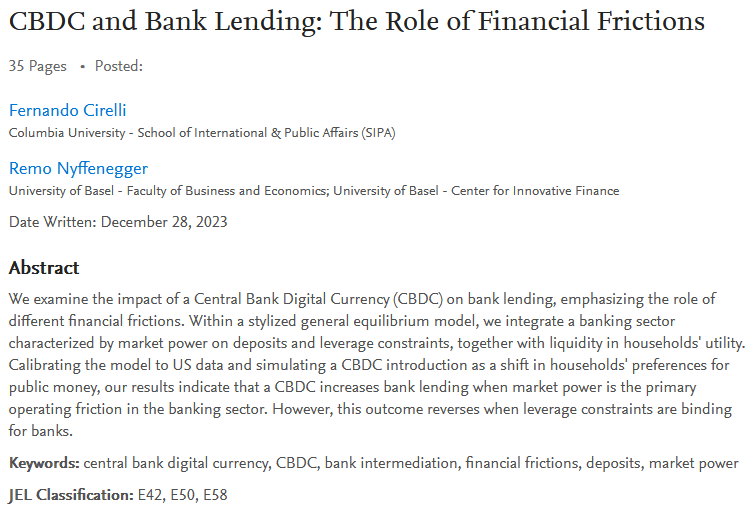
When market power causes spreads in the banking sector, CBDCs might increase bank lending. However, this outcome reverses when leverage constraints are binding for banks. Read more here:
https://t.co/xmNsQns5Y0 (3/3)
Happy to wrap up the year with a new working paper! This is joint work with @fercirelli. In a short paper, we analyze the impact of a CBDC on bank lending. The paper is motivated by the observation that there are spreads between loan and deposit rates in the banking sector. (1/3)
These could stem from either market power or binding leverage constraints. We then show that the risk of disintermediation depends on which financial friction causes these rate gaps. (2/3)
How can a #CBDC be implemented on a public #DLT and which benefits could it bring? @ny_remo suggests a CBDC design on a layer-2 zero-knowledge (#ZK) rollup.
Diving into some details 👇👇 (1/9)
Excited to share my latest paper, which discusses a proposal for issuing a central bank digital currency (CBDC) within a public blockchain environment. While one might initially consider a direct issuance of CBDC on the blockchain, my paper suggests an innovative approach: (1/2)
Implementing a CBDC through a layer 2 rollup design. In this paper, I delve into the economic and technical intricacies of this design and discuss the benefits and caveats of the proposal. You can access the paper here: (2/2)
https://t.co/BUDyedG23c
Excited to share my latest paper, which discusses a proposal for issuing a central bank digital currency (CBDC) within a public blockchain environment. While one might initially consider a direct issuance of CBDC on the blockchain, my paper suggests an innovative approach: (1/2)
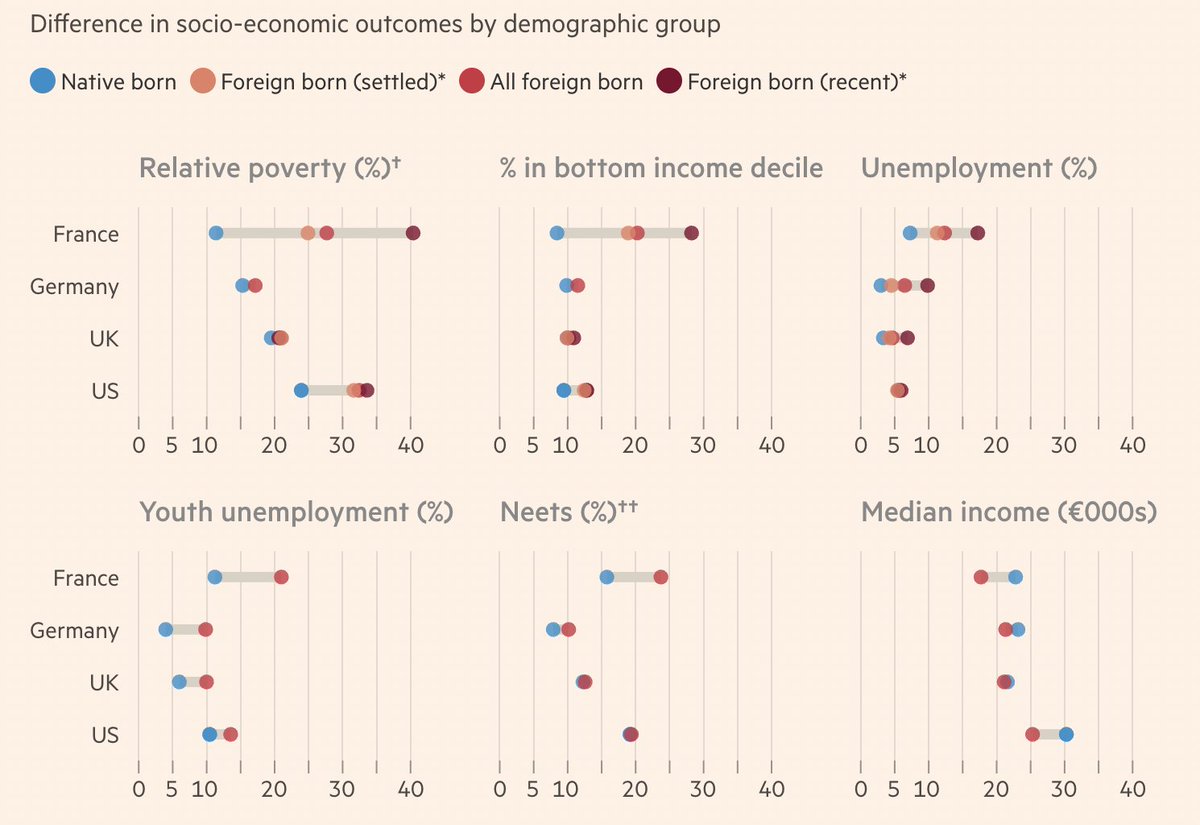
NEW: France’s riots may be subsiding, but their underlying causes persist
In France, immigrants face social exclusion, faring *far* worse than the native-born on almost every socio-economic indicator.
Far less integration than in UK, Germany even the US
https://t.co/t1mnk4ZiPc
A Canadian judge has ruled that the “thumbs-up” emoji is just as valid as a signature, arguing that courts need to adapt to the “new reality” of how people communicate as he ordered a farmer to pay C$82,000 ($61,442) for an unfulfilled contract.
@Jonas__Gross@EU_Commission Thanks for the summary Jonas. I find it especially surprising that the digital Euro would need to be accepted by payees. E.g. in the US and in Switzerland, legal tender status does not imply mandatory acceptance. In the EU it apparently does. This is quite a strong requirement.