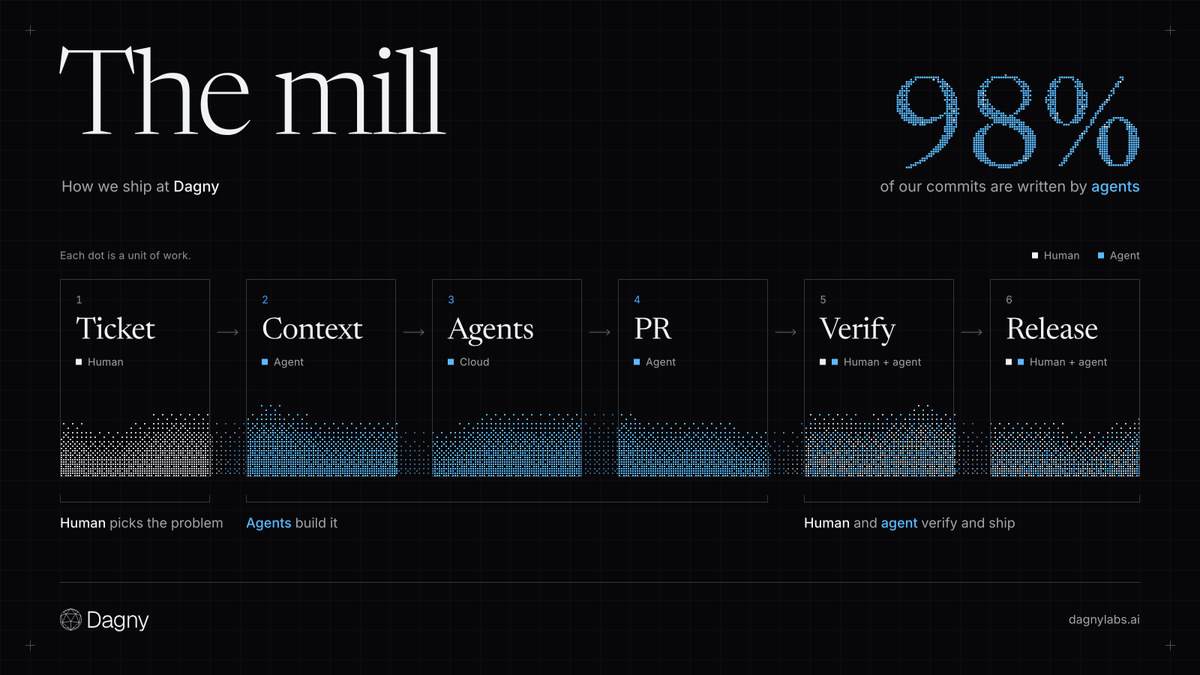
98% of our commits are made by cloud agents. 3,000+ agent sessions in the last two months. humans pick the problem, write the ticket, and decide when it's done. agents build the rest, test the solution, and raise the PRs. now we're going after the last 2%.
@mardehaym I've seen verification skills, and UI guidelines really shine here. Our verification skills teach our agents how users, uses the app. Our cloud agents run simulations where UI has changed, and provide recording in the PRs. Our PR review process has been much faster now.
@xxstevelee we've been seeing the value of using these models in various processes. using SLMs and system one models like Jev are both faster and much cheaper for the same quality of outputs for classification, extraction, and decision workflows.
Very cool report from our team on the cost of AI enablement, how critical the foundation and data is to the transformatin process, and how companies are appraching it!
Ahead of the break, we pulled together a comprehensive report for anyone mapping out an AI budget for next year. My main takeaway is that companies are hiring for AI leadership faster than they are investing in the data and the people underneath.
@typesafeai@JudgmentLabs we saw the same thing. evals, classification, and sentiment. jev is fast enough that in some cases we use it for near realtime insights.
You can now install Claude artifacts as desktop apps on Mac and Windows.
Ask Claude to build an artifact, click "Install as app", and open it like any other app. It can use your connectors and, if you allow it, send notifications or add a menu bar item.
We stopped using an LLM for jobs that never needed one. We now run Jev, the first System One model from @typesafeai, in a client's data pipeline and in a real-time sentiment read inside an agentic messaging app. Here's how: https://t.co/Kxb8yOIgy2
a few months ago, when Dagny was just the two of us, things got busy fast.
I remember getting off the phone with @HoltzWill one night, talking about when we should start hiring. around 10pm, wrapping up with a million things still on the list for tomorrow, a client sent over a list of requests.
earlier that day i'd downloaded @bot and started setting up my first AI FDE agent. I asked it to read the email and plan the changes so I could start in the morning. then it asked if I wanted cloud agents to start working on them.
I woke up to 8 prs, built, tested, and ready for me to review and release. it felt like magic.
today grok bots run across every part of Dagny, and I am excited to share that we're a @spacexai transformation partner! now we're bringing the same magic moment to our clients.
I've been on many calls where a partner shows us a vibe coded app and says "this is what i want." so we take it, productionize it, and run it on rails.
agents write almost all the code now, and a lot of people know exactly what they want. so let them build it. dagny takes care of the rest and keeps the lights on.
There's a big difference in starting off as an AI native services firm.
Here's what we've built at Dagny in a short period of time:
1. A homegrown OS for tracking engagements, context and unit economics
2. Our own MCP and CLI so humans and agents can work with our internal tools
3. A 'mill' for productizing our contextually driven agents and streamlining how we build
4. An outcome based pricing model with embedded deflationary costs
5. Managed data infrastructure: warehouse, ETL, transformation, monitoring and security (Dagny Rails)
6. An out of the box semantic layer and BI (Dagny Lense)
7. Lean delivery teams that understand business, operator and data fundamentals
8. Agent led operations and financial systems that can scale
9. A culture of continuous curiosity for internal contributors and external partners
10. And most important, first proofs of customer value in under 2 weeks, then ongoing value through our evergreen tools and services
These pieces used to take months, if not years, to develop (if at all).
We've learned that speed does not need to come at the sacrifice of value. Given how fast AI capabilities are changing, if anything the opposite is true.
98% of our commits are made by cloud agents. 3,000+ agent sessions in the last two months. humans pick the problem, write the ticket, and decide when it's done. agents build the rest, test the solution, and raise the PRs. now we're going after the last 2%.
As agents produce more code, the engineering challenge shifts toward getting that work safely reviewed, tested, and into production. Anthropic’s source-control redesign reflects the same challenge we’re tackling with The Mill, our agentic software factory at Dagny.
New on our Engineering blog: Creating in-house source control.
In May, we merged around 2,500 code changes per day. In September, we merged more than 30,000 per day. As a result, we became bottlenecked by developer infrastructure built for human (rather than agent) scale.
Here, we share how we built a new version control system—and fully migrated our monorepo from git—in five months: https://t.co/wzNkwHs7IN
We have built 10 different AI products at PostHog like PostHog AI, our Wizard, Replay Vision, Scouts, and more. Combined, they are used by nearly 100k people every month.
Along the way, we’ve learned a lot about building them, what works, and what doesn’t. Here are the 38 most important lessons: