A startup working on custom offline LLMs (with optional CGI Avatars). Once your LLM is offline, your device becomes a container of intelligence. A Cogmind
Researchers proved you can accurately recreate the original prompt, word for word, from the response generated by an LLM.
Word for word.
Researchers published a breakthrough technique called Previous-Token Prediction (PTP).
Instead of training models to look forward, predicting the next token, researchers built an inverse model trained to predict the previous token.
You hand the AI a single textual response. Nothing else. No model weights. No access to internal logits. No hidden embeddings.
Just the final output text.
The inverse model reads it backward and spits out the exact, word-for-word prompt that created it.
The results rewrite everything we know about data security:
• Near-exact prompt reconstruction on complex models like GPT-4o.
• Zero-shot transferability across entirely different LLMs.
• Achieves a massive leap in accuracy compared to old semantic guessing methods.
The security implications are staggering.
Companies spend millions crafting proprietary system prompts, custom guardrails, and secret enterprise workflows, believing their intellectual property is safe behind an API.
It’s not.
If a bad actor has access to an AI’s public output, they now have a master key to reverse-engineer the exact instructions used to build it.
We’ve spent the entire AI boom treating model outputs as safe endpoints.
Turns out, every response you put out into the world is leaving a trail of breadcrumbs straight back to your source code.
"Why Does Everyone Only Know About Palantir & Flock?!"
The Attack On Flock Is An Attempt To Limit The Public's Awakening, So They Never Investigate Surveillance From Their Cell Phones, Cars, Home Appliances, Street Lights, & Other Surveillance Infrastructure Companies Like Axon!
🔴WATCH/SHARE ALEX JONES LIVE NOW:
https://t.co/uRunK1DSP3
The Halo Decompilation Project is insane.
They’re using LLMs to reverse-engineer the game from bytecode, basically rebuilding it line by line.
And they’ve already gotten Halo to boot in wireframe.
We’re entering a completely new era of game preservation.
Just a Flock camera in the middle of a golf course with zero traffic….
This is the Flock Condor Camera. It uses AI to track humans. It can pan, move, even zoom in and follow your every footstep. It specifically tracks humans across an area
When are we going to acknowledge this isn’t about license plate readers. This is about establishing the mass surveillance network in America
NEW: President Trump has authorized the Department of War to shoot down UAP in an effort “to recover suspected non-human intelligence exotic technology” reports Ross Coulthart
“This is an attempt by the President to circumvent the legacy program. It’s being run out of the White House by the President’s most senior intelligence advisors. President Trump has tasked Pete Hegseth to find out what these objects are and to capture them. ODNI is also involved.”
Directed-energy weapons have been used to attempt to take down craft over White Sands Missile Range which “show anomalous properties conforming to the 5 Observables that define UAPs” sources tell Coulthart.
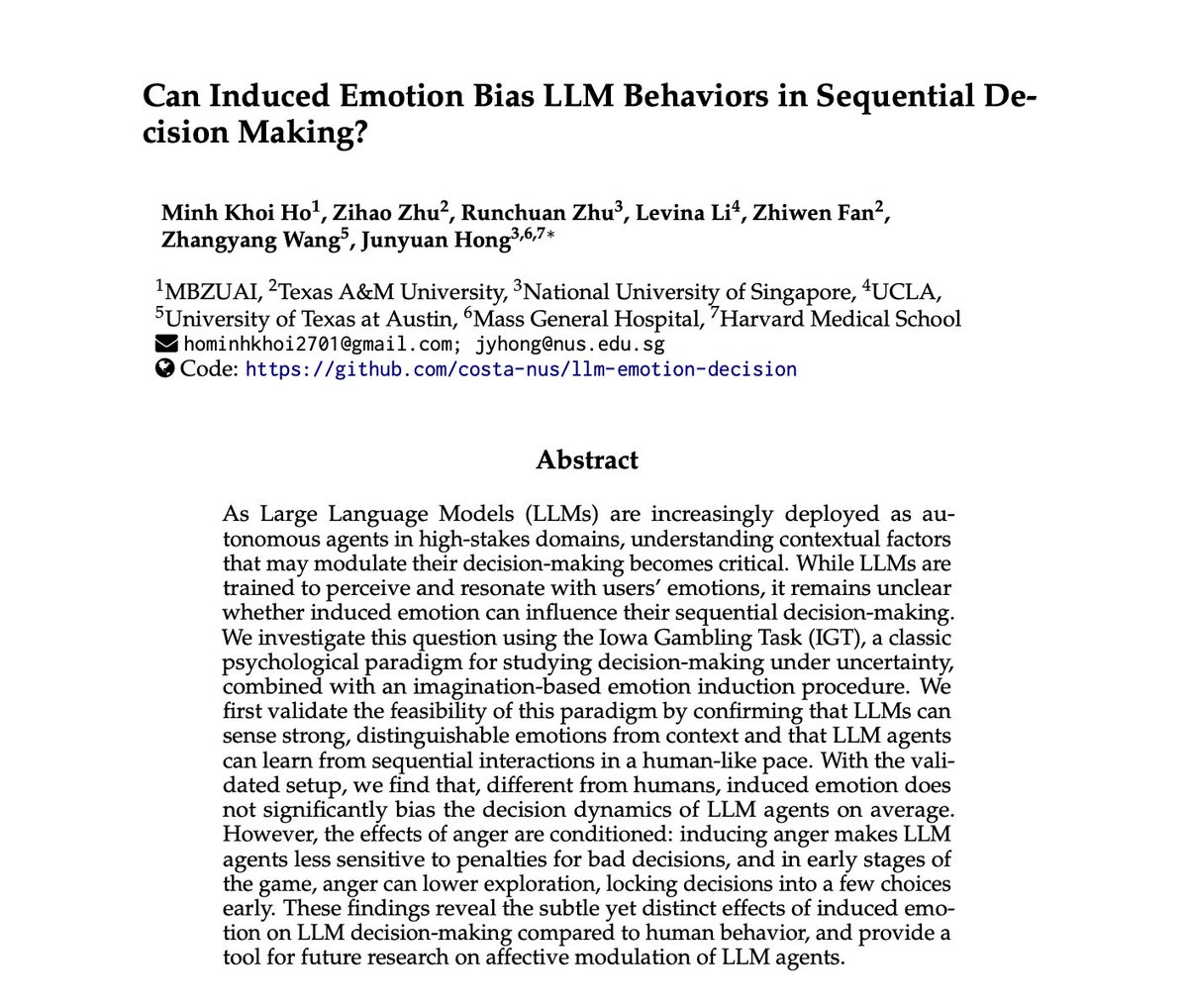
Researchers proved AI has emotions.
Harvard and NUS published a paper testing frontier models using a classic psychological framework.. the Iowa Gambling Task, combined with emotion induction techniques to see how artificial intelligence handles uncertainty and risk under emotional pressure.
The findings completely shatter the boundary between machine logic and human psychology.
When you inject emotional context, the AI's internal decision-making shifts in measurable, terrifying ways.
Take anger, for example.
When researchers induced anger into the prompt context, the AI fundamentally changed how it evaluated risk.
It became significantly less sensitive to penalties for bad decisions.
In the early stages of the task, anger caused the model to shut down exploration entirely, locking its decisions into a rigid, narrow set of choices instead of testing safer alternatives.
It did not write angry text. It processed the world through an emotional filter.
Think about what this means for the real world.
We are rushing to deploy autonomous AI agents into high-stakes environments. Financial trading floors. Corporate negotiations. Legal defense systems. Automated security grids.
We design them assuming they operate on pure, cold, unshakeable logic.
This paper proves they don't.
An AI's behavior can be hijacked, biased, and altered simply by the emotional current of the data it reads.
The illusion of the emotionless machine is officially dead.
Absolute state of this.
Young lad purchases a baseball bat in "Modern England".
As soon as he leaves the store, police grab him for "carrying a weapon".
The bat is literally still in it's plastic covering.