This trader made $12K betting on how many times Elon Musk tweets.
Not what Elon tweets about. Not if Tesla stock goes up. Just counting his posts.
haoyunlailailai found the most predictable pattern on Polymarket
→ Profile: https://t.co/q1TWUypiGD
Elon Musk tweets 60-80 times per week. Every week. Like clockwork.
Polymarket offers markets on exact tweet counts. "Will Elon post 560-579 times this week?" Most people ignore these markets. Too boring. No narrative. No excitement.
This trader saw something different.
> Buys multiple ranges at 1-10 cents per share.
> Spreads across likely outcomes
> One hit pays 10-80x
> Losses are capped at pennies
> Wins are explosive
The math is stupid simple:
1) Elon's tweet volume is predictable.
2) Markets misprice unlikely ranges.
3) Buy them all for pennies.
4) Wait for variance
Everyone else trades opinions.
This trader counts tweets.
This bot pulled $582K while you were checking your notifications
gabagool22 doesn't care if Bitcoin pumps or dumps. Doesn't read charts. Doesn't time entries. Just watches for one thing: broken math.
I spotted gabagool22 buried in leaderboard data. Another crypto bot grinding 15-minute windows. 86% win rate. 10,000+ predictions. Almost scrolled past.
Then I saw the volume pattern. Something was off.
→ Profile: https://t.co/4jB3pVxQKs
Turns out this bot isn't predicting anything.
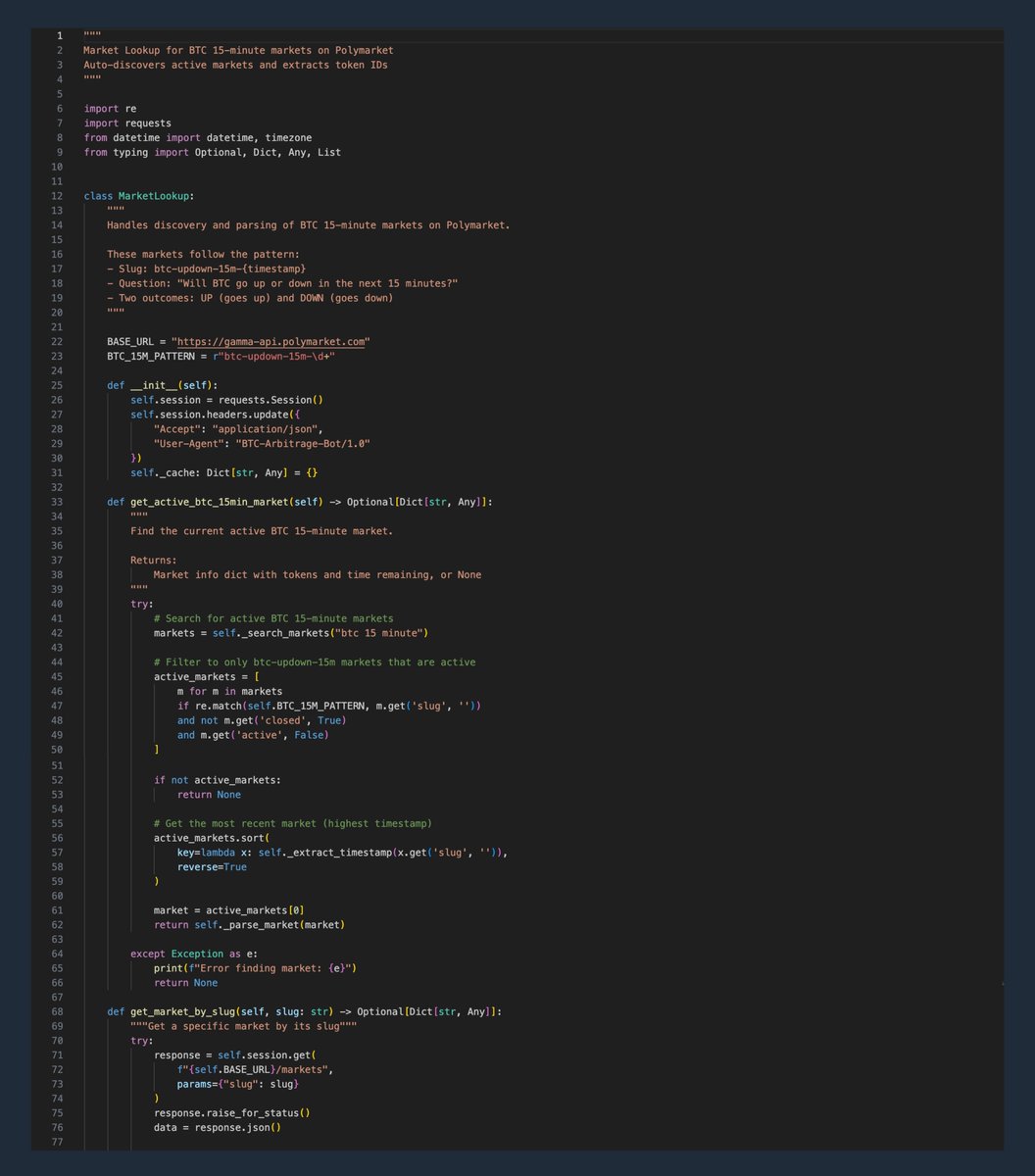
It waits for Polymarket's 15-minute crypto windows to break. YES at 0.48. NO at 0.49. Total: 0.97.
The script fires. Buys both sides. Waits for close. One side pays $1. Spent 97 cents. Keeps 3 cents.
Does not matter who wins.
Every few seconds the market slips during volatility. YES gets panic-dumped below 0.35. Later NO overreacts to 0.82. The bot enters asymmetrically. Buys cheap sides at different timestamps. Never guesses direction.
Your brain sees chaos and hesitates.
Python sees a 0.005 second window and executes.
By the time your eyes register the price, it's already gone. You're buying his exit liquidity.
The 86% win rate finally made sense. Not picking winners. Locking profit before resolution. Some spreads weren't wide enough. Doesn't matter. The edge is volume.
Everyone else bets on outcomes.
This bot taxes your emotions.
Discovered my Gas ID via ETHGas - turning my gas spend into rewards 🫘
As a Baby Jack, I've spent 0.0081 ETH on gas but earned 2 Beans back.
Get your Gas ID and Beans here: https://t.co/tR3yGenuiy
Summoning my favourite protocols @Uniswap, @aave, @opensea to join the movement!
ETHGas is introducing the Open Gas Initiative, eliminating gas fees from the end-user experience
Learn more: https://t.co/RlXrvk4uvB
https://t.co/xwmMNnB8WY
Introducing the Open Gas Initiative - a way for protocols to subsidize gas for users, zero-code, for a seamless, frictionless onchain experience.
With OG cohort: @eigencloud, @ether_fi, @pendle_fi, @Velvet_Capital.
👇
Every quest adds strength to the soil!
I'm collecting beans to fuel Gassy Jack's climb out of the gassy world 💨 Invite others to multiply the growth and share in the rewards. Jump in now👇
https://t.co/lgPQbseRrw
https://t.co/lgPQbseRrw
Private Stablecoins Enabled by FHE
Stablecoins today leak all transaction flows, balances, and user behaviors. This level of transparency limits institutional use and discourages adoption in sensitive industries. FHE-based stablecoins solve this by encrypting transaction data while keeping the system fully verifiable.
@zama Confidential Token Standard enables stablecoins to function identically to existing ERC models, but with encrypted amounts and private transfers.
This allows real-world payment networks to move onchain without exposing customer activity.
#Zama #ZamaFHE #ZamaCreatorProgram
Why Onchain Identity Needs Encrypted Computation
Identity systems often require processing attributes that should never be public, such as age, residency, or financial thresholds. Traditional blockchains cannot handle such constraints without revealing the underlying data or relying on trusted intermediaries.
Through @zama’s encrypted execution, identity checks can be performed privately onchain. The contract verifies conditions while the attributes remain encrypted, eliminating the need for centralized identity providers to hold sensitive data.
This architecture enables decentralized identity systems that are more secure, more private, and more compliant than current models. It also unlocks regulated financial products that require private eligibility checks.
#Zama #ZamaFHE #ZamaCreatorProgram
Confidential Vaults for Institutional Crypto Adoption
Institutional capital requires strict confidentiality for position management, treasury operations, and risk controls. Public blockchains make this impossible, forcing institutions to use custodians or permissioned systems. FHE offers a way to operate directly on public networks without exposing internal strategies.
By adopting @zama’s encrypted vault logic, institutions can manage private balances and perform encrypted operations while retaining verifiable auditability. The blockchain enforces rules, but not transparency of sensitive data.
This model significantly expands the addressable market for onchain finance, making public networks viable for enterprise use. Confidential vaults become the bridge between traditional finance and open infrastructure.
#Zama #ZamaFHE #ZamaCreatorProgram
Eliminating MEV Through Encrypted Transaction Logic
MEV exploits public mempool data to extract value from users by front-running, sandwiching, or manipulating order flow. If the mempool is private, these vectors disappear. FHE extends this privacy into execution itself.
With @zama’s encrypted inputs and encrypted state transitions, attackers cannot infer transaction size, direction, or intent. The protocol processes transactions blindly, removing the informational advantage MEV actors rely on.
This architecture not only protects users but also stabilizes DeFi markets by reducing toxic flow. Encrypted execution becomes a structural defense against one of blockchain’s deepest vulnerabilities.
#Zama #ZamaFHE #ZamaCreatorProgram
Encrypted Gaming Economies on Public Blockchains
Games rely on hidden information: player stats, strategies, resources, and probabilities. Public blockchains break this by revealing every variable, making serious games impossible to deploy onchain. FHE enables encrypted game logic that maintains fairness without sacrificing transparency of rules.
Through @zama’s encrypted computation model, game engines can process private moves, sealed values, and secret interactions while keeping outcomes verifiable. No operator or validator sees the hidden state.
This opens the door for competitive onchain games, secure wagering systems, and new economic models that rely on hidden information. Encrypted gaming becomes a new frontier for decentralized applications.
#Zama #ZamaFHE #ZamaCreatorProgram
Post-Quantum Security Inside Zama’s Cryptographic Stack
Zama’s FHE scheme provides 128-bit post-quantum security, protecting encrypted workloads against future attacks from quantum computers. This matters for applications where long-term confidentiality is required, including finance, identity, and healthcare.
By future-proofing encrypted computation, @zama ensures that systems built today remain secure even as cryptographic threats evolve. It positions FHE as a long-lasting confidentiality solution for Web3.
#Zama #ZamaFHE #ZamaCreatorProgram
Why @zama Chose Solidity Compatibility for FHE Smart Contracts
Solidity remains the dominant language for smart contract development. By building FHE support directly into Solidity-level workflows, Zama ensures minimal friction for developers and immediate accessibility for existing teams.
This compatibility accelerates adoption. Builders can transform legacy smart contracts into confidential versions without rewriting entire architectures or learning specialized cryptographic languages.
#Zama #ZamaFHE #ZamaCreatorProgram
The Evolution of FHE from Academic Research to Real Infrastructure
For decades, FHE was considered too slow and theoretical for real applications. And @zama changed that trajectory by delivering practical performance improvements, structured developer tooling, and a protocol tailored for onchain execution.
This shift marks a turning point where encrypted computation moves from research labs to production systems. It opens doors to new categories of applications that require both verifiability and confidentiality.
#Zama #ZamaFHE #ZamaCreatorProgram
Privacy Isn’t a Feature – It’s Infrastructure
Adding privacy after the fact never works.
@zama embeds Fully Homomorphic Encryption directly into blockchain architecture, making it the foundation rather than a bolt-on.
This allows:
• On-chain models to compute without exposure
• DAOs to vote privately yet verifiably
• DeFi protocols to keep strategies secret without trust compromises
The result? A system where confidentiality and transparency coexist seamlessly.
#Zama #ZamaFHE #ZamaCreatorProgram
Privacy as the Default – The Zama Vision
Decentralization solved trust; @zama solves exposure.
FHE allows smart contracts, AI models, and analytics to compute entirely encrypted, with verifiable outputs.
Every transaction, vote, or computation remains confidential by design.
The future: confidential DeFi, private governance, encrypted AI – all native to Web3.
Programmable privacy is no longer optional – it’s the foundational layer of a trustless, secure, and intelligent decentralized ecosystem.
Zama isn’t building features – it’s rewriting the protocol layer of the internet.
#Zama #ZamaFHE #ZamaCreatorProgram
Privacy Isn’t Optional Anymore
Web3 exposed users by default – @zama fixes that.
FHE makes privacy the foundation, not a patch.
Smart contracts, AI models, and DeFi protocols can compute over encrypted data.
Results are verifiable. Inputs remain secret.
We’re witnessing the rise of privacy-native infrastructure.
#Zama #ZamaFHE #ZamaCreatorProgram
Privacy Isn’t Optional Anymore
Web3 exposed users by default – @zama fixes that.
FHE makes privacy the foundation, not a patch.
Smart contracts, AI models, and DeFi protocols can compute over encrypted data.
Results are verifiable. Inputs remain secret.
We’re witnessing the rise of privacy-native infrastructure.
#Zama #ZamaFHE #ZamaCreatorProgram
The Invisible Chain
What if blockchains could operate without ever revealing sensitive inputs?
@zama makes it possible.
Fully Homomorphic Encryption ensures that every computation is private, yet every result is verifiable.
Private contracts, encrypted AI, confidential voting – all on-chain.
Zama is making the invisible chain a reality.
#Zama #ZamaFHE #ZamaCreatorProgram
Could You Run a DAO in Secret?
Yes, and @zama makes it possible.
FHE lets proposals and votes remain encrypted while results are fully verifiable.
Imagine governance without exposing strategies or voter preferences.
Confidential by design, trustless by nature.
This is programmable privacy for the next generation of Web3.
#Zama #ZamaFHE #ZamaCreatorProgram
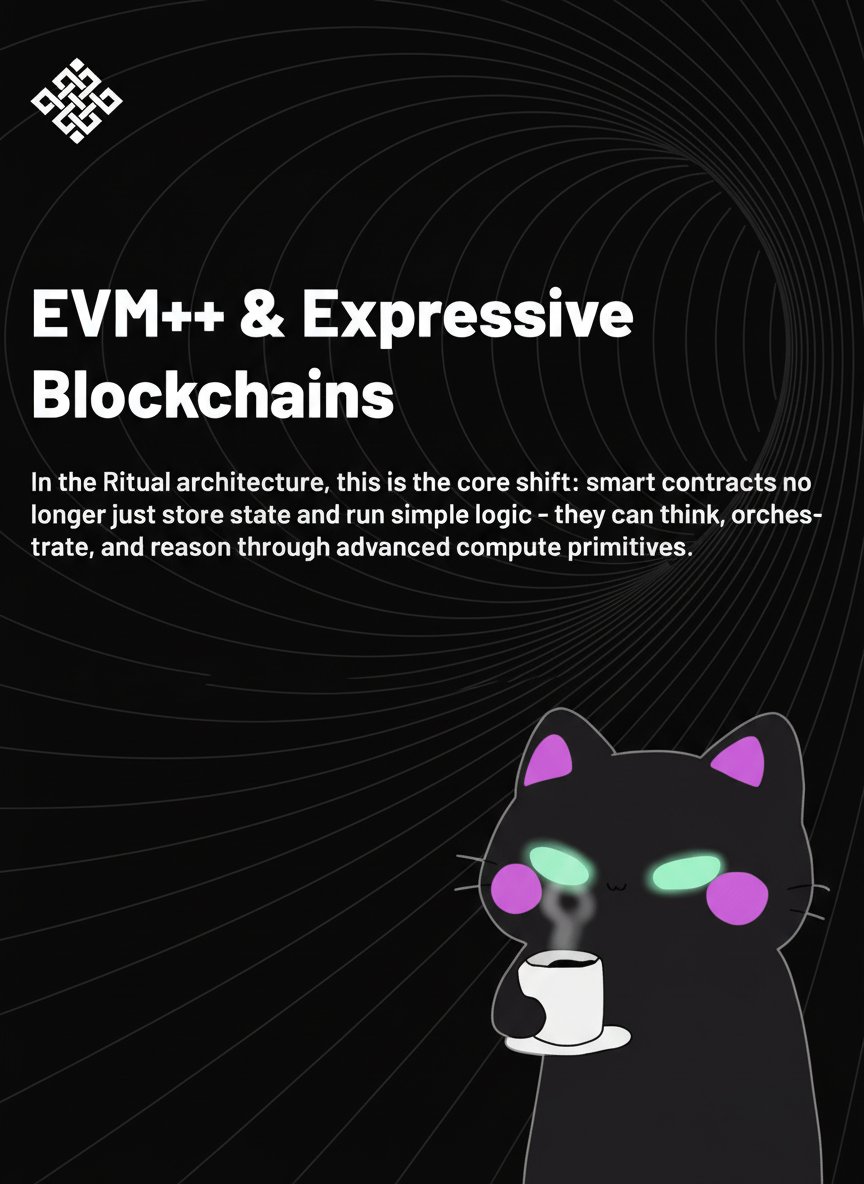
EVM++ & Expressive Blockchains – what it means when smart contracts can “think”
In the @ritualnet architecture, this is the core shift: smart contracts no longer just store state and run simple logic - they can think, orchestrate, and reason through advanced compute primitives.
Traditional EVM contracts operate in a closed world. Determinism, gas limits, and bytecode constraints force devs to compress logic into the smallest possible shape. Once your computation grows beyond pure Solidity math, you’re done.
By extending the chain with stateful precompiles, modular compute primitives, and a general message-passing layer, Ritual gives smart contracts hooks into a heterogeneous compute graph: GPUs, TEEs, ZK circuits, model runners, and off-chain schedulers. The contract becomes a coordination engine - it can request an ML inference, verify the proof, route tasks based on hardware requirements, or trigger multi-stage compute pipelines via programmable intents.
This is why Ritual calls its architecture *expressive*. The chain exposes AI, cryptography, and high-performance compute as first-class citizens. Instead of relying on centralized oracles or opaque API services, contracts can call native primitives: inference, model selection, batching, verification, and even future model markets. Everything is verifiable, everything is composable, and everything settles trustlessly.
This is the foundational leap that makes the Ritual Superchain possible.
@ritualnet | https://t.co/7n57YUNJJH
@meison_mswen@joshsimenhoff@Jez_Cryptoz