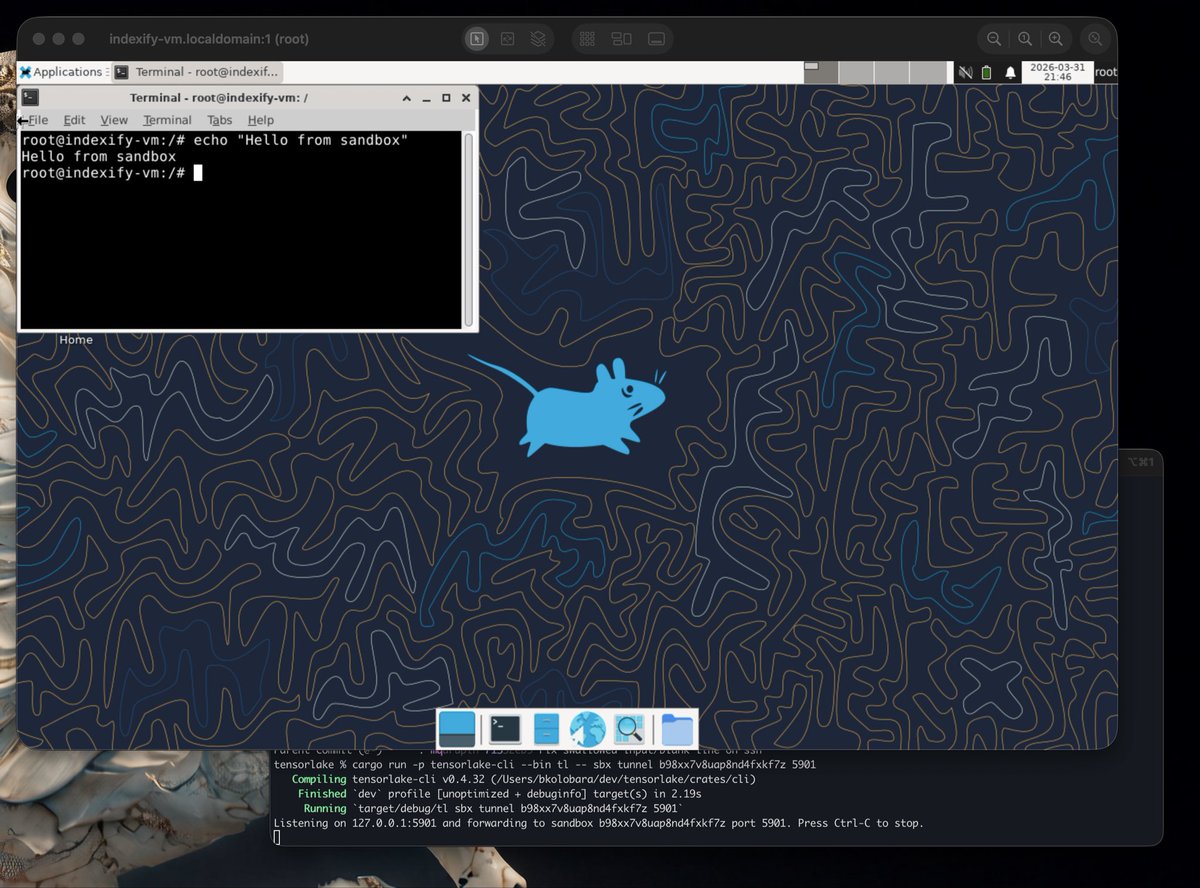
Computer Use in @tensorlake sandboxes is coming!
sandboxes are still in beta. We are shipping at breakneck speed to get users what they want to build on our stack!
Shout out to @bkolobara for building a TCP proxy on websockets to make this secure and flexible.
Introducing AIO Sandbox, All-in-One Sandbox Environment for AI Agents.
Unchecked AI autonomy is a ticking time bomb; it’s time to pull the plug on full system unfettered access. We can no longer afford to give AI agents the 'keys to the kingdom' without oversight. The 'wild west' of AI agents running with total system control is officially over.
AIO Sandbox is an open-source project designed to solve these problems. It is everything your agent needs, out of the box. No more juggling multiple services. AIO Sandbox ships a complete, pre-wired environment in a single Docker container.
The AIO (All-in-One) Sandbox is a containerized environment designed for both human developers and AI agents. Its architecture is built around a "Batteries-Included" philosophy, providing a full Linux desktop-like environment inside a single Docker container.
Unified Environment: One Docker container with shared filesystem. Files downloaded in the browser are instantly accessible in Terminal and VSCode.
Out of the Box: Built‑in VNC browser, VS Code, Jupyter, file manager, and terminal—accessible directly via API/SDK.
Agent-Ready: Pre-configured MCP Server with Browser, File, Terminal, Markdown, Ready-to-use for AI agents.
Developer Friendly: Cloud-based VSCode with persistent terminals, intelligent port forwarding, and instant frontend/backend previews.
Secure Execution: Isolated Python and Node.js sandboxes. Safe code execution without system risks.
Production Ready: Enterprise-grade Docker deployment. Lightweight, scalable.
Calling all AI agent developers! How are you securing your builds? Let’s try running your agent in AIO Sandbox and compare notes.
AIO Sandbox is open-sourced under the Apache License 2.0. Contributions welcome.
GitHub: https://t.co/STUWt6SHmh
Official website: https://t.co/cbiQCTPoR7
#OpenSource #AIAgent #Docker
The idea of a chromebook is directionally correct. A browser, a file system, a linux kernel and a shell is all you need for real work. It's more suitable for AIs to use though, than humans, who still seem to like having a bunch of native apps. Hence, Perplexity Computer.
Billing attribution ≠ access control. These are two orthogonal problems.
The token worked from my personal laptop, outside the sandbox, on an arbitrary IP. That's the vulnerability — regardless of who gets the bill.
The fundamental principle of ZTI: once outside the sandbox, the token should be physically invalidated. Binding to sandbox ID/IP at the proxy level is the fix.
Update: @denisyarats (Perplexity CTO) responded. He says billing is async and tied to the user's account, not Perplexity's master account.
I want to be transparent about where I stand on this. I ran 400k+ output tokens through the extracted key with Opus 4.6 and checked my credits over 18 hours. They never moved. It's possible that's just a long reconciliation delay.
What is not in dispute: the token extracted via .npmrc injection worked from my personal laptop outside the sandbox. A sandboxed credential shouldn't be usable from an arbitrary external IP.
This also means it's a prompt injection target. a malicious webpage visited by the agent could plant the same payload + prompt, exfiltrate the user's token, and bill them for third-party API usage without their knowledge.
The proxy pattern is the right architecture. Binding tokens to sandbox IDs and IPs would close the remaining gap.
Appreciate Denis and the Perplexity team for the fast and transparent response.
@yousifa Billing accuracy doesn't fix access control. The token worked from my personal laptop on an arbitrary IP — outside the sandbox entirely. ZTI means the proxy rejects any request that doesn't match the issuance context. Binding to sandbox ID/IP is the fix.
@dboskovic However, this consideration is only applicable to 24/7 operations. Most sandbox infrastructure can perform snapshot storage and recovery, supporting elasticity.
Running 20 x 4C4G / month sandboxes costs about the same as self-deployment. Buying Sandbox SaaS early on is essentially buying time—the $2,000/month saved is far less than the cost of an engineer wasting on operations and maintenance. It's not too late to migrate to AWS when the usage becomes too expensive.