most cybersecurity careers don’t stall because of skill.
they stall because of positioning.
here are 5 ways i’m leveling up this year and you can too:
1. search job postings for roles that interest you. map the qualifications to what you’re currently capable of and find projects (at work or personal) that close those gaps
2. find out where your team is lacking on AI usage. start with something small like reporting and build a workflow that returns time to your team. a quick win IMO: connect your data sources with MCP servers to slash investigation times up to 60-80%
3. leverage your manager. make sure your manager knows what you’re looking to accomplish. a good manager will help you create a plan to get there within the company. a great manager will help you position yourself for growth inside and outside the company
4. certifications. not random certs, but ones that are widely recognized and will improve your skillset
5. document what you’re learning. write threads, post labs, share lessons from incidents (sanitized). visibility compounds. opportunities find people who are visible
if you want to use AI to accelerate your cybersecurity career instead of being replaced by it, follow for more
Three days ago I left autoresearch tuning nanochat for ~2 days on depth=12 model. It found ~20 changes that improved the validation loss. I tested these changes yesterday and all of them were additive and transferred to larger (depth=24) models. Stacking up all of these changes, today I measured that the leaderboard's "Time to GPT-2" drops from 2.02 hours to 1.80 hours (~11% improvement), this will be the new leaderboard entry. So yes, these are real improvements and they make an actual difference. I am mildly surprised that my very first naive attempt already worked this well on top of what I thought was already a fairly manually well-tuned project.
This is a first for me because I am very used to doing the iterative optimization of neural network training manually. You come up with ideas, you implement them, you check if they work (better validation loss), you come up with new ideas based on that, you read some papers for inspiration, etc etc. This is the bread and butter of what I do daily for 2 decades. Seeing the agent do this entire workflow end-to-end and all by itself as it worked through approx. 700 changes autonomously is wild. It really looked at the sequence of results of experiments and used that to plan the next ones. It's not novel, ground-breaking "research" (yet), but all the adjustments are "real", I didn't find them manually previously, and they stack up and actually improved nanochat. Among the bigger things e.g.:
- It noticed an oversight that my parameterless QKnorm didn't have a scaler multiplier attached, so my attention was too diffuse. The agent found multipliers to sharpen it, pointing to future work.
- It found that the Value Embeddings really like regularization and I wasn't applying any (oops).
- It found that my banded attention was too conservative (i forgot to tune it).
- It found that AdamW betas were all messed up.
- It tuned the weight decay schedule.
- It tuned the network initialization.
This is on top of all the tuning I've already done over a good amount of time. The exact commit is here, from this "round 1" of autoresearch. I am going to kick off "round 2", and in parallel I am looking at how multiple agents can collaborate to unlock parallelism.
https://t.co/WAz8aIztKT
All LLM frontier labs will do this. It's the final boss battle. It's a lot more complex at scale of course - you don't just have a single train. py file to tune. But doing it is "just engineering" and it's going to work. You spin up a swarm of agents, you have them collaborate to tune smaller models, you promote the most promising ideas to increasingly larger scales, and humans (optionally) contribute on the edges.
And more generally, *any* metric you care about that is reasonably efficient to evaluate (or that has more efficient proxy metrics such as training a smaller network) can be autoresearched by an agent swarm. It's worth thinking about whether your problem falls into this bucket too.
@m_schouten facts, even through my manual trading experiences Fridays have always been choppy. appreciate the support! check out my latest update https://t.co/yo4W7dsdPa
after 3.5 weeks, failed my 150k topstep challenge. partly self-inflicted. i jumped in with some manual trades, lost about $2k, and completely messed up the experiment.
then the bot finished the job and blew through the drawdown limit.
but the data was the real prize.
took 270 trades worth of history and ran it through karpathy's autoresearch method. basically had claude code sit in a loop testing thousands of exit strategy variations against real trade data, keeping what improved p&l and reverting what didn't.
the biggest finding that surprised me: i was closing way too much at TP1. locking in 60% of contracts early felt safe but was leaving massive money on the table.
the optimized strategy only closes 30% at TP1 and lets 60% ride as runners with much wider trailing stops (100pt vs 45pt on mnq).
tighter initial stops (35pt vs 45pt) cut losers faster.
wider trails let winners breathe. backtested the same 270 trades and the results went from ~$700 to $22k with better drawdown metrics across the board.
the counterintuitive part: win rate dropped from 63% to 47% but P&L exploded because the average winner got way bigger.
small losses from runners getting stopped near breakeven are worth it when the ones that run actually run.
been running the new setup today and i can already see improvements. i'll be starting a new challenge with the optimized params.
same entries, completely different exit management. let's see if it holds up on live data 🫡
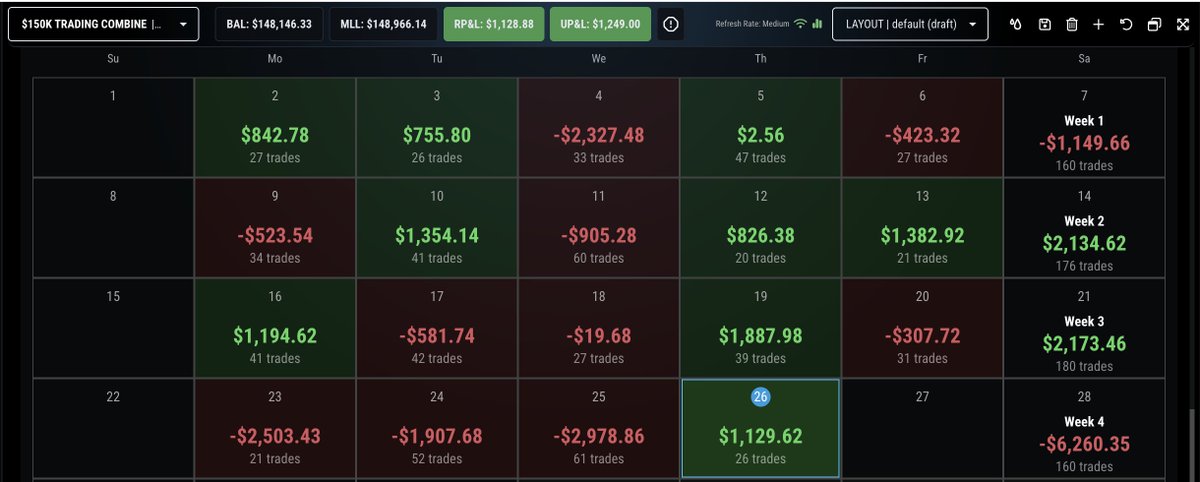
week 1 in the books. thought we were gonna finish the week green, but then the bot got whipsawed on MNQ on Friday and got chopped up
follow to see if my automated trading bot can pass a prop firm challenge for $150k
after 3.5 weeks, failed my 150k topstep challenge. partly self-inflicted. i jumped in with some manual trades, lost about $2k, and completely messed up the experiment.
then the bot finished the job and blew through the drawdown limit.
but the data was the real prize.
took 270 trades worth of history and ran it through karpathy's autoresearch method. basically had claude code sit in a loop testing thousands of exit strategy variations against real trade data, keeping what improved p&l and reverting what didn't.
the biggest finding that surprised me: i was closing way too much at TP1. locking in 60% of contracts early felt safe but was leaving massive money on the table.
the optimized strategy only closes 30% at TP1 and lets 60% ride as runners with much wider trailing stops (100pt vs 45pt on mnq).
tighter initial stops (35pt vs 45pt) cut losers faster.
wider trails let winners breathe. backtested the same 270 trades and the results went from ~$700 to $22k with better drawdown metrics across the board.
the counterintuitive part: win rate dropped from 63% to 47% but P&L exploded because the average winner got way bigger.
small losses from runners getting stopped near breakeven are worth it when the ones that run actually run.
been running the new setup today and i can already see improvements. i'll be starting a new challenge with the optimized params.
same entries, completely different exit management. let's see if it holds up on live data 🫡
i will probably regret leaking this but f*ck it:
full guide on how i create AI ads that generated multi-8-figures in ecom
for 24h, i'm sending it to everyone who likes + comments "AI"
(must be following + RT for priority access)
@tradertheory the strategy itself is never the secret. it's the risk management around the strategy that separates funded traders from blown accounts. most people can copy an entry. almost nobody copies the position sizing and the discipline to sit out
@levelsio it depends on the environment you’re working in. enterprise environments need the extra layers that MCP provides for visibility, logging, authentication and auditing purposes
@NowFrequency@XinoYaps VA has the highest concentration of internet traffic in the world running through its data centers and 13% of data center operations in the world