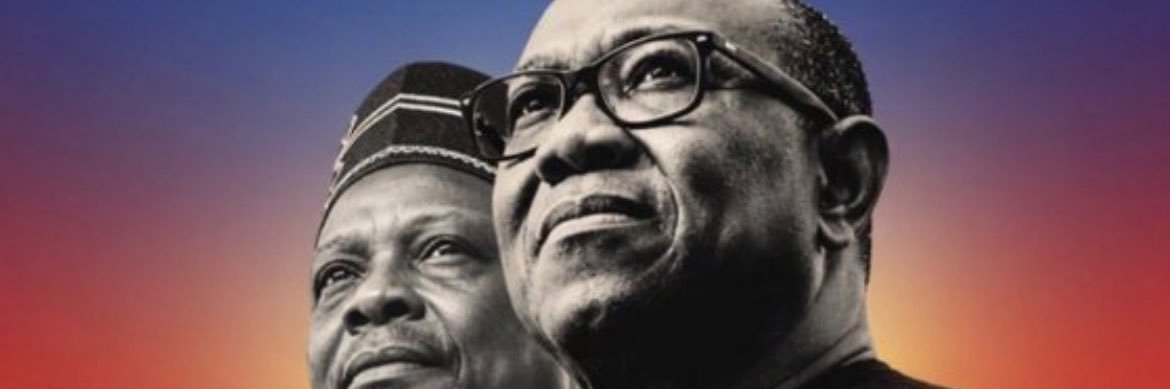
@INEC asked you to go to sleep and come back in the morning for the announcement of the remaining results in 2023,you wake up around 3 in the morning to go have a piee, and then you find out that criminal @Mahmood yakubu has declared drug dealer @officialABAT As your president.
Remember that. #OkMovement ✌🏾
The Anambra experience demonstrated that proper planning, accurate information, prudent management of resources, and genuine commitment to the welfare of citizens can make a meaningful difference.
What we achieved between 2006 and 2014 was not the elimination of poverty, but the establishment of a practical framework for confronting it. We can adapt and expand that experience nationally.
I have consistently spoken about the need to move millions of Nigerians out of poverty. In discussing this challenge, I have often drawn attention to the experiences of China and India, countries that have lifted hundreds of millions of their citizens out of poverty through sustained economic reforms, investment in productive sectors, infrastructure, agriculture, education, and deliberate policies that expanded economic opportunities.
Their experiences demonstrate that mass poverty is not an inevitable condition of a nation. It can be substantially reduced through purposeful leadership, long-term planning, productive investment, and the consistent implementation of policies that place people at the centre of development.
If China and India could undertake such transformations, Nigeria can also do so. We must study what worked in those countries, understand the differences in our circumstances, and adapt the lessons to our own environment. We do not need to reinvent the wheel; we need the commitment to make proven development strategies work here.
A country cannot be prosperous when millions of its citizens go to bed hungry. Our ambition must be to move Nigeria from managing poverty to systematically defeating it.
That is the Nigeria we must build: one where no citizen is abandoned, opportunity is not determined by geography, and the dignity of every Nigerian is protected.
In the next instalment, Series 8, we shall examine what we did in commerce and industry. -PO
NIGERIANS, GO AND VERIFY (6)
SECURING LIVES AND PROPERTY: PARTNERSHIP WITH SECURITY AGENCIES
Peter Obi
In the preceding instalments, I explained how we approached governance under the Anambra Integrated Development Strategy (ANIDS), beginning with strengthening state institutions and investing in education and other critical sectors. Our conviction was that development must rest on strong institutions, capable human beings, and a secure environment.
No meaningful development can take place where lives and property are constantly under threat. Education, commerce, investment, and other productive activities can only flourish when people feel safe. This informed our approach to security. We understood that the responsibility of protecting lives and property could not be discharged through speeches and declarations alone. It required deliberate investment, effective coordination, and sustained partnership with the security agencies.
When we assumed office, Anambra faced serious security challenges. Armed robbery, bank attacks, kidnapping, and other violent criminal activities had created an atmosphere of fear. In 2006, I personally approached the then Inspector-General of Police, Mr Sunday Gabriel Ehindero, to seek urgent intervention. Following our appeal, the police authorities constituted a special team comprising experienced officers, including the late Haruna John, Alhaji Amusa Bello, and others, to confront the security challenges in the state.
We therefore made security a major priority of our administration, recognising that government must provide both the leadership and the resources required to enable security agencies to perform their duties.
EQUIPPING THE SECURITY AGENCIES
We believed that those entrusted with protecting our people must be adequately equipped. Accordingly, our administration, using funds from the security votes, provided over 600 patrol vehicles to various security agencies, including the Police, Army, Civil Defence, Customs, Immigration, NDLEA, Road Safety, Prisons, SSS, Navy, and community vigilante organisations.
Our support went beyond vehicles. We provided Armoured Personnel Carriers (APCs), armoured Hilux patrol vans, communication gadgets, repeater and linker stations, base stations, mobile vehicular radios, walkie-talkies, generators, and other logistical requirements. We also used the same security votes to provide financial support for their operations, including fuel, weekly allowances, and other essential needs of security personnel.
We paid particular attention to community security because we understood that effective policing must have a strong local presence. Again, using funds from the security votes, we provided billions of naira to the 177 communities in Anambra State to strengthen security in their respective areas. We directed traditional rulers and town union presidents to establish vigilante groups under police supervision, with the police providing uniforms for proper identification. We also contributed towards the payment of their salaries.
Additionally, we provided 250 patrol vehicles to communities across Anambra State. These vehicles were manufactured by Innoson Vehicle Manufacturing Company in Nnewi. Some towns received more than one, depending on their size and security needs. This initiative was also extended to universities and other large institutions in the state.
We also recognised that markets were particularly vulnerable because of the volume of commercial activities and the large number of people who visited them daily. Thus, in March 2014, we presented security vehicles to major markets in Onitsha and its environs. The beneficiaries included Bridge Head Market, Ogboefere Market, Building Materials Market, Ogidi, Onitsha Main Market, Marine Modern Market, Ogbaru Main Market, Ose Okwodu Market, Electronics Market, and the Amalgamated Market Traders Association.
My dear big bro, @ruffydfire ,
It costs approximately ₦100 million to build and equip a functional Primary Healthcare Centre (PHC) in Nigeria today.
That means 10,000 functional PHCs would cost:
₦100,000,000 × 10,000 = ₦1 trillion.
The Tinubu/APC administration claims to have saved ₦15.8 trillion from fuel subsidy removal, in addition to accumulating close to $100 billion in loans.
Yet, just ₦1 trillion would be enough to provide 10,000 functional PHCs across Nigeria, bringing essential healthcare closer to millions of Nigerians.
Under a Peter Obi administration, resources recovered from subsidy removal and our national wealth will not disappear into the pockets of those occupying Aso Rock. They will be deployed for the public good.
Beyond the 10,000 PHCs, HE Mr Peter Obi has also committed to building 40,000 new classrooms to address our out-of-school children crisis, alongside establishing cancer treatment and dialysis centres.
These are achievable priorities if we cut government waste, block leakages and end the theft of public resources.
The issue is not that Nigeria lacks resources; it is how those resources are managed and deployed.
Be assured of my highest regards always.
Idris Zekeri Junior
2027. 😂
But here is a fun question: who do you think would find an Obi presidency most difficult to accept?
Some names people might jokingly put on the list include:
@Nyesom Wike
@Yul Edochie
@Daniel Bwala
@you Deji Adeyanju
@ChatGPT
Our Federal, State, and Local Governments must work together. Where roads fall under different levels of government, there should be proper coordination, clear responsibilities, and accountability for delivery.
Above all, every road project must be properly designed, transparently procured, adequately funded, professionally supervised, and subjected to independent quality control.
The experience we acquired in Anambra State provides practical evidence of how these principles can be applied. We connected communities, opened up rural areas, constructed bridges, improved urban transportation, and established an institutional framework for road maintenance.
What we did in Anambra was at the State level. As President, the responsibility will be national, but the principles of planning, prudent management, accountability, and measurable results will remain the same. -PO
At Nwafor Orizu College of Education, Nsugbe, we constructed classrooms and lecture halls, provided staff office complexes, renovated the library, constructed an auditorium, and improved instructional facilities. We also provided boreholes, generators, and security facilities, facilitated programme accreditation, and employed additional academic and non-academic staff.
The College of Agriculture, Mgbakwu, received considerable attention, with approximately 15 buildings constructed during our administration.
We also built the Chukwuemeka Odumegwu Ojukwu Teaching Hospital from scratch, constructing over 25 buildings. In addition, we supported major nursing and health institutions across the state. St Charles Borromeo Hospital and Iyi-Enu Hospital, for instance, have since become teaching hospitals.
Supporting Institutions Beyond Government Ownership
We did not restrict our interventions to government-owned institutions. We believed that every institution educating our people deserved encouragement, irrespective of ownership.
Our administration, therefore, extended financial assistance to Madonna University, Paul University, Tansian University, and Peter University. These institutions received grants of about ₦100 million each at the time, in addition to vehicle support.
We also introduced a policy of rewarding academic excellence by giving every Anambra indigene who graduated with a First Class degree ₦1 million. Over 500 persons benefited. I am delighted by the text messages and posts in which some of the beneficiaries still recall how the money helped them become what they are today. My friend, Dr Uchenna Nze, would always tell me how the money facilitated his further education. He is now the Head of Department of Mass Communication at Tansian University. We wanted our young people to understand that intellectual achievement mattered and deserved recognition.
The Results and Our National Commitment
By the time we left office in 2014, the results of these investments were becoming evident. Anambra had moved from the lower positions in external and national examinations, including WASCE, GCE, NECO, and JAMB, to the topmost positions. Till today, various schools in Anambra State have continued to win awards both locally and internationally. This was the outcome of sustained investments in infrastructure, teachers, technology, and effective supervision.
Such awards and recognitions are encouraging indications of what sustained investment in education, strong institutions, and a culture of academic excellence can produce over time. When we invested in schools, teachers, technology, and learning facilities, our intention was not to produce temporary achievements that would disappear with a change of government. We wanted to establish a foundation upon which successive administrations could build. Seeing Anambra schools continue to excel gives me great satisfaction and reinforces my conviction that investments in education are among the most enduring legacies any government can leave behind.
My commitment to education did not end when I left office. I have continued to support schools and educational institutions across Nigeria as a private citizen through donations, classroom construction, learning materials, and other interventions.
As President, I will bring the same energy, commitment, and political will to bear on education nationally. All agencies responsible for education must function effectively and be held accountable. Taxes and other revenues collected specifically for educational purposes must be properly accounted for. Nigerians must know how much is collected, where the money goes, and what it is used for.