Today we are excited to introduce Objective Labs with the mission to scale DeFi beyond its bubble.
We work with teams to find and execute on asymmetric opportunities. Our first partnership with @eulerfinance helped them scale to $1B in no time.
This is our philosophy:
Today we're sharing some bittersweet news: Objective Labs is closing down.
12 months ago we set out to help crypto teams grow their protocols through data-driven research and advisory. We're proud to have worked shoulder to shoulder with brilliant people on lending, oracles, incentives, tokenomics, and more.
After an honest look at the market and ourselves, we decided to end the journey on a high note. Thank you to everyone who made this possible: clients who trusted us with their growth, our team members who gave everything, and friends who believed in us.
We'll be winding down official channels over the coming weeks. While we aren't sure what's next, you can always reach us at @totomanov and @g_angelchev.
Thank you and godspeed!
With all the focus on risk exposure in lending markets lately, we wanted to share a bit from our work with Euler and how its modular architecture isolates risk by design.
First things first: all Euler DAO markets across all chains, including Euler Prime and Euler Yield, have zero exposure to Stream assets either directly or indirectly. These core markets that most users interact with are completely unaffected.
There is exposure to Stream assets in a few permissionless vaults. However those vaults are isolated islands within the protocol, not systemic risk to all Euler users. This is one of the core design principles of Euler v2.
The Euler Vault Kit allows anyone to permissionlessly deploy entire lending markets and configure them however they like. Critically the EVK places guardrails such that risk decisions in one vault don't cascade across the protocol. Each vault operates as an independent lending facility with its own risk parameters and collateral types.
What does this mean practically? If a vault accepts Stream assets as collateral and that collateral loses value, only lenders in that specific vault face exposure. Lenders in other Euler vaults have zero exposure because they're completely separate contracts.
This is fundamentally different from monolithic lending models where all lenders share exposure to all accepted collateral types. In those systems, one bad collateral decision affects everyone.
The core Euler markets continue operating normally because that's exactly how isolated vault architecture is supposed to work. No assets are "locked" at the protocol layer.
The recent volatility across DeFi resulted in temporary utilisation spikes as users reassessed risk. In these cases, the mechanisms of interest rate models kick in: high utilization drives up borrow rates, incentivizing repayments and new supply, which naturally rebalances the market.
We're already seeing this play out and utilization on key Euler vaults is normalizing.
Lending protocols built on permissionless infrastructure accept a plurality of risk opinions -- some more conservative than others. Euler's infrastructure ensures risk stays contained. That's the tradeoff you must embrace when building truly open financial infrastructure.
.@eulerfinance exceeded $600M total deposits @Plasma in just 5 days.
Over $5B in stablecoins are on Plasma with $XPL incentives pushing yields well above 10%.
The future for Plasma is bright with a @pendle_fi integration on the horizon.
Trillions.
.@redstone_defi Conviction Surge: 12M Staked in August
0 → 14.8M tokens staked in just 6 months (5.3% of circulating supply), with 12M locked in August alone.
RED stakers earn 10-15% APY in both RED and EIGEN tokens and will earn rewards from RedStone data users across hundreds of blockchains. This is how flywheel acceleration looks in practice.
.@eulerfinance has the lowest FDV/Fees ratio among its peers.
Similar to the P/S ratio in traditional finance, a low FDV/Fees ratio signals that the project is undervalued.
Compared to @MorphoLabs and @compoundfinance, Euler's $EUL currently has a 3-5x lower valuation based on the metric.
.@eulerfinance has the lowest FDV/Fees ratio among its peers.
Similar to the P/S ratio in traditional finance, a low FDV/Fees ratio signals that the project is undervalued.
Compared to @MorphoLabs and @compoundfinance, Euler's $EUL currently has a 3-5x lower valuation based on the metric.
.@HypurrFi has unparalleled capital efficiency on HyperEVM with a total utilization rate of 50.4%.
Utilization rate is the ratio of borrows to deposits in the protocol. Higher values mean higher capital efficiency and purrfect yields for everyone.
.@eulerfinance now generates the most revenue per TVL out of the top 5 lending protocols.
Each $1B on Euler translates to $4.34M in annual $EUL buybacks through the FeeFlow auction.
This boost in revenue comes after Euler DAO voted in a fee switch for its flagship markets.
cUSD by @capapp just hit $100M supply.
According to @artemis, cUSD is one of the fastest growing stablecoins right now.
$cUSD is backed by @PayPal's PYUSD, @BlackRock's BUIDL, and @FTI_Global's BENJI with @eigencloud-powered credit underwriting.
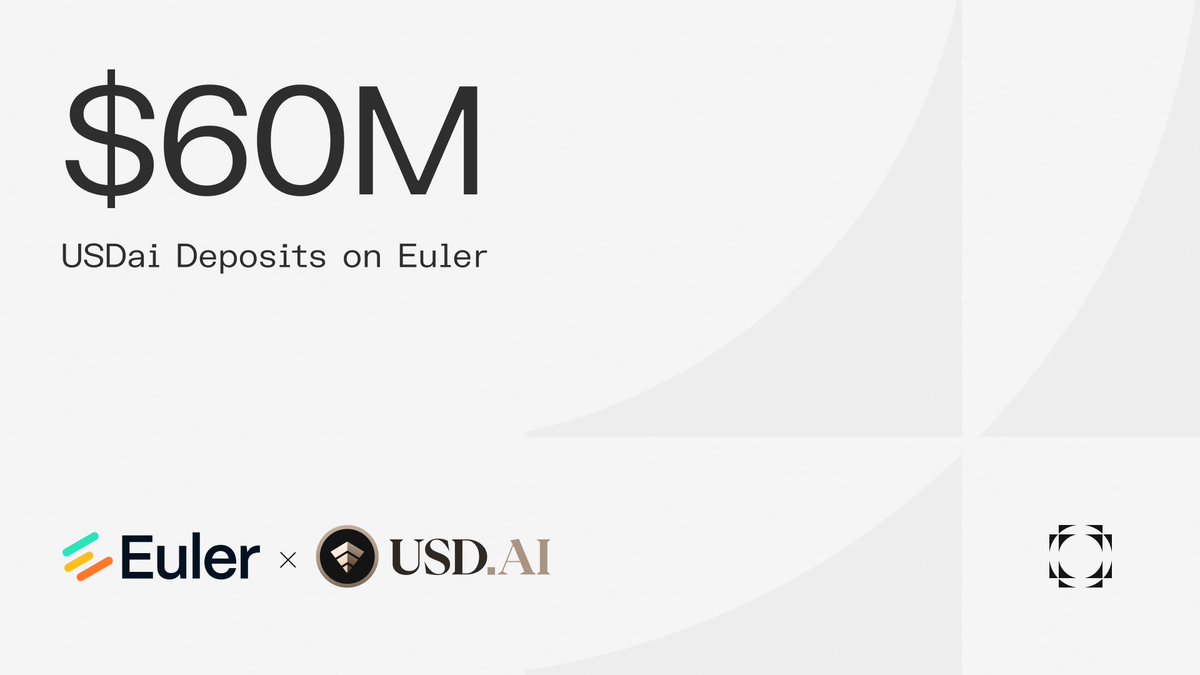
.@USDai_Official, the Arbitrum-native credit protocol for AI infrastructure, has reached $60M TVL on @eulerfinance.
Curated by @k3_capital, this market lets users loop USDai PTs with fixed yields above 20%.
Four scenarios, one clear pattern: every path leads to >$1B in ARR.
"Hyperliquid has evolved from solving the on-chain perpetuals' trilemma into building a full financial operating system."
Read the full piece by Objective and @Sumcap 👇
2/ Why this matters?
Higher fee efficiency translates to better yields for lenders. Protocols that generate 3.5% fees can offer more competitive rates than those at 1.7%.
The efficiency gap suggests specialization with protocols serving different risk appetites. Euler's position indicates strong product-market fit in its niche.
.@eulerfinance dominates lending protocol efficiency!
At a 3.5% fee-to-TVL ratio, Euler shows superior ability to generate fees from locked capital. That's 2x more efficient than @Aave and 1.5x higher than @compoundfinance.
The data shows a clear pattern: mid-size protocols generate fees more efficiently than their larger counterparts.
Let's break down the numbers: 👇
1/ The numbers tell the story:
✦ @Eulerfinance: 3.5% ratio on $1.5B TVL
✦ @KaminoFinance: 2.9% ratio on $3.1B TVL
✦ @Aave: 1.7% ratio on $68B TVL
Limited supply drives higher rates. Euler charges premiums in focused risk segments. Aave competes broadly, pressuring rates down.