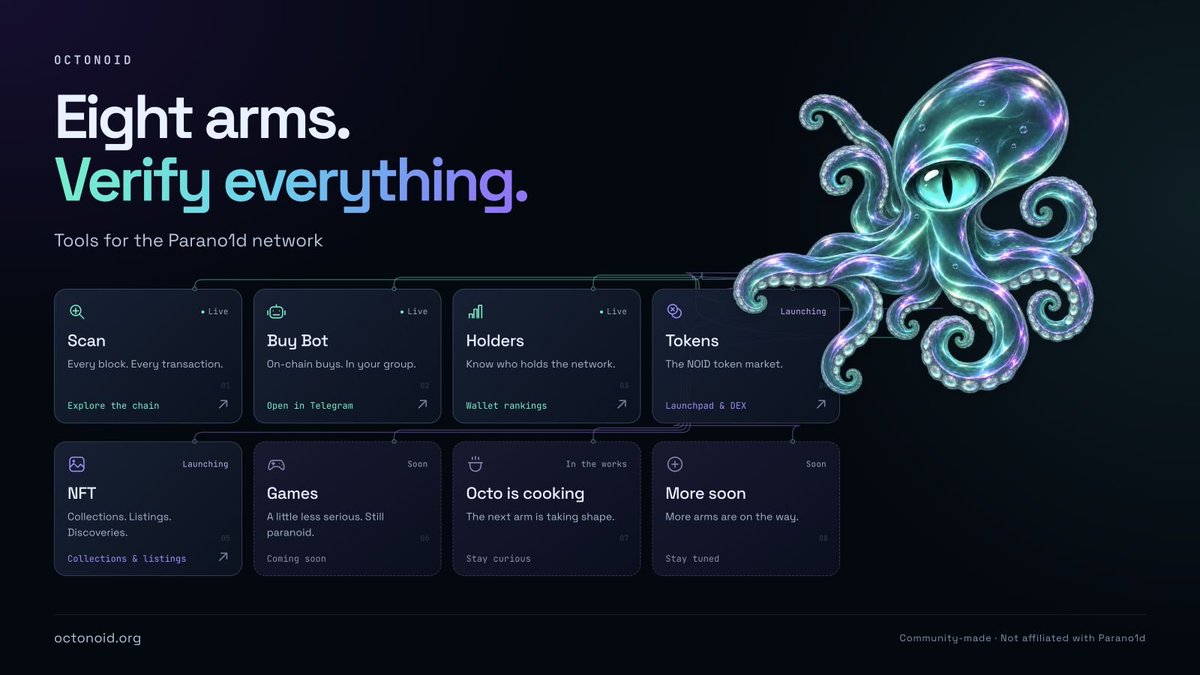
Eight arms. Verify everything. 🐙
Octonoid: tools for the Parano1d network.
🔍 Scan: every block, tx and wallet
👥 Holders: who holds parano1d:native
🤖 Buy bot for your TG group
📡 Live tracker: buys, new tokens, DEX
🖼 NFT collections
🎮 Games soon
https://t.co/Mu0YS9CJQG
Your crypto wallet is protected by math that a big enough quantum computer could break.
Not today. But Parano1d Lab just tested a different kind of lock, and it works on chains that have nothing to do with Parano1d.
The idea in plain words:
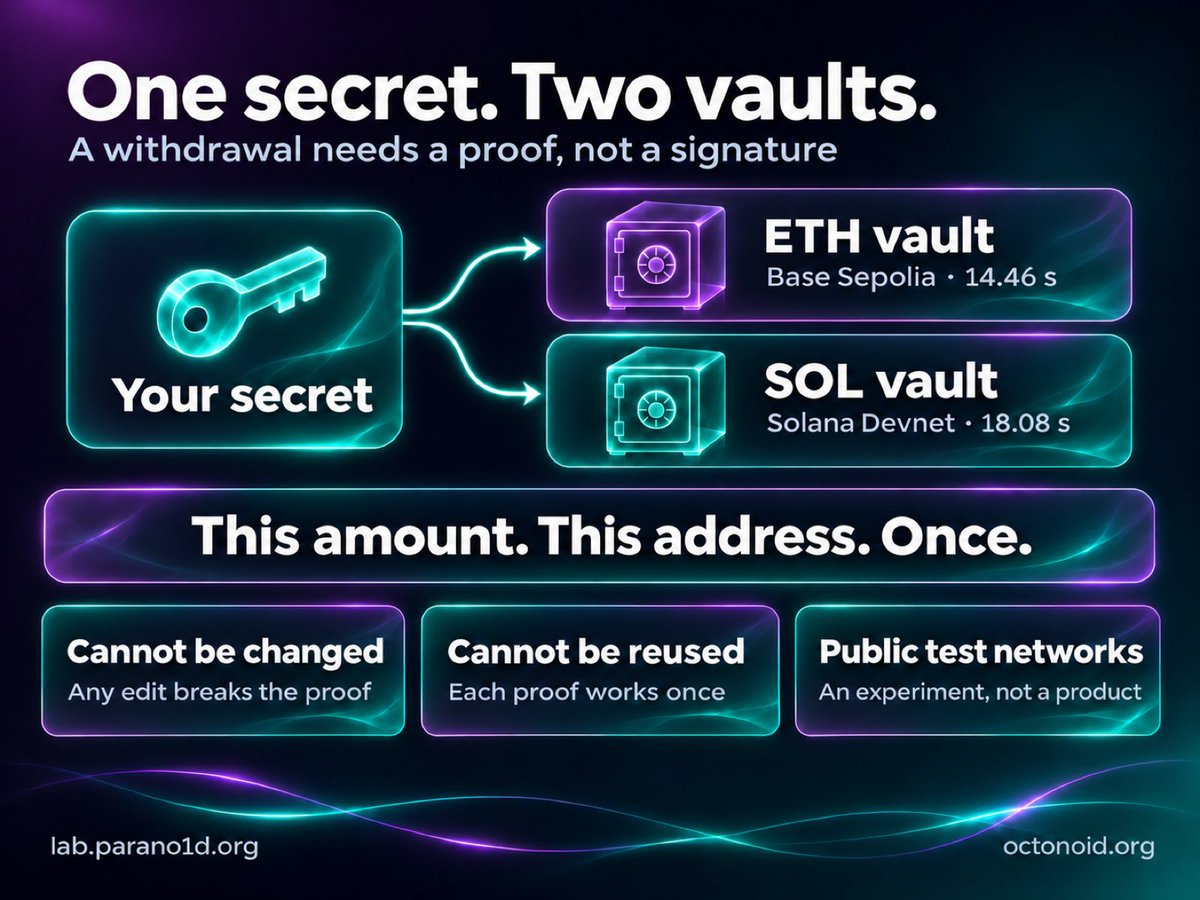
You keep one secret in your wallet.
From it, you get a separate vault on each chain. One holds ETH on Base, another holds SOL on Solana.
The coins stay on their own chain. No wrapped copies, no liquidity pool.
To withdraw, you do not sign anything. Your wallet creates a one-time proof that says: this exact amount, to this exact address, once.
The vault checks that proof by itself and pays out.
Why that matters:
• On Solana, the vault address has no private key at all. There is no key to crack.
• Anyone can deliver the proof for you, but they cannot change the amount or the recipient. Any change breaks it.
• A proof works once. It cannot be replayed to drain the vault later.
What was actually run, on public test networks:
Base Sepolia: withdrawal done in 14.46 seconds
Solana Devnet: 18.08 seconds, and 22.34 seconds with a lost and reshuffled packet
Creating the proof: about 0.05 seconds on a laptop processor
Estimated cost on mainnet: about $1.40 on Base, about $0.04 on Solana plus a temporary 0.21 SOL deposit that comes back.
What it is not:
• It is an experiment on test networks, not a product you can use today.
• It protects the vault's withdrawal rule. Base and Solana themselves stay as they are.
• The Lab says the exact quantum security figure for this setup is still being researched.
• Lose the secret and you lose the vault. There is no reset button.
Why it is worth your time: the code and transactions are public, so you can check all of this yourself. The same Lab screened 648 new cryptography papers in October against its own design, and it publishes the experiments that failed too.
Less promise. More proof.
$NOID
Join the network without replay
On most chains, a new node downloads the old blocks and executes them in order, from the very first one. The older the chain, the longer and heavier that gets.
A Parano1d node takes a different path:
1. Headers
It validates compact headers to find the chain with the most cumulative work.
2. State
It authenticates a finalized State together with its matching proof. The proof shows that State is the correct result of the chain, so the node never has to trust a peer's claim about it.
3. Tip
It verifies the recent blocks and joins the tip.
What nodes keep:
• The live State
• Permanent compact headers
• The last 42 block bodies
Old transactions are not re-executed, and old block bodies can be dropped, so nodes do not have to store every block ever made.
Need to show a past payment later? A saved receipt stays verifiable.
Proof before proof of work
On classic proof-of-work chains, hashing comes first. A miner builds a block, searches for a nonce, and only afterwards do other nodes check the contents by executing every transaction themselves.
Parano1d turns that order around.
How a block is made:
1. Select
The miner picks the transactions for the next block.
2. Prove
The miner proves the whole State change, and its link to the parent block, before any hashing starts.
3. Search nonce
Only with a finished proof does the nonce search begin.
4. Verify
Peers check the proof, the proof of work and the chain rules. They do not re-run every transaction to trust the result.
Why this matters:
• Hashpower alone cannot originate a block. A producer needs current State and a finished proof.
• External workers only receive a single-use nonce template. Selecting transactions and proving stay inside the node.
• An invalid State change cannot be "out-hashed" into the chain, because there is no valid proof for it.
Two jobs, two tools: proofs establish validity, proof of work sets the order.
A launchpad inside the protocol
On most chains, a launchpad or DEX is a third-party contract. Someone wrote it, someone can upgrade it, and you have to trust it or audit it yourself.
Parano1d takes a different route. Tokens, bonding curves, DEX pools and NFT listings are native operations, and their rules are checked inside the block proof. A block that breaks them is not valid.
How a token lives:
1. Launch
Every token starts on the same standard bonding curve. Supply is fixed at launch: no one can mint more. A creator buy, if any, happens in the launch transaction, so everyone can see it.
2. Curve
The price rises with every token sold, from 1/300 to 1/100 NOID per token. No hand-made curves, no hidden parameters.
3. Graduation
When the curve fills, the token moves to a DEX pool on its own. No one has to press a button or migrate liquidity.
4. Locked pool
Pool liquidity is locked permanently. There is no LP withdrawal, so no one can pull the pool. Each DEX swap pays a 0.3% fee that stays in the pool.
What protects every holder and trader:
• Backing: every whole token is backed by at least 0.001 NOID. Any holder can burn tokens and redeem their share of that reserve. Backing per remaining token never falls.
• Bound trades: each trade carries its minimum output, fee ceiling and expiry. If the price moves too far or the order is too old, it does not execute, and an unfilled order spends nothing.
• NFT listings: one NFT cannot be delivered to two buyers.
What it does not do: protect the price. The rules guard the mechanics, not the value. A token can still fall, and a creator can still sell what they hold. Always check the CA and who holds the supply.
parano1d:native
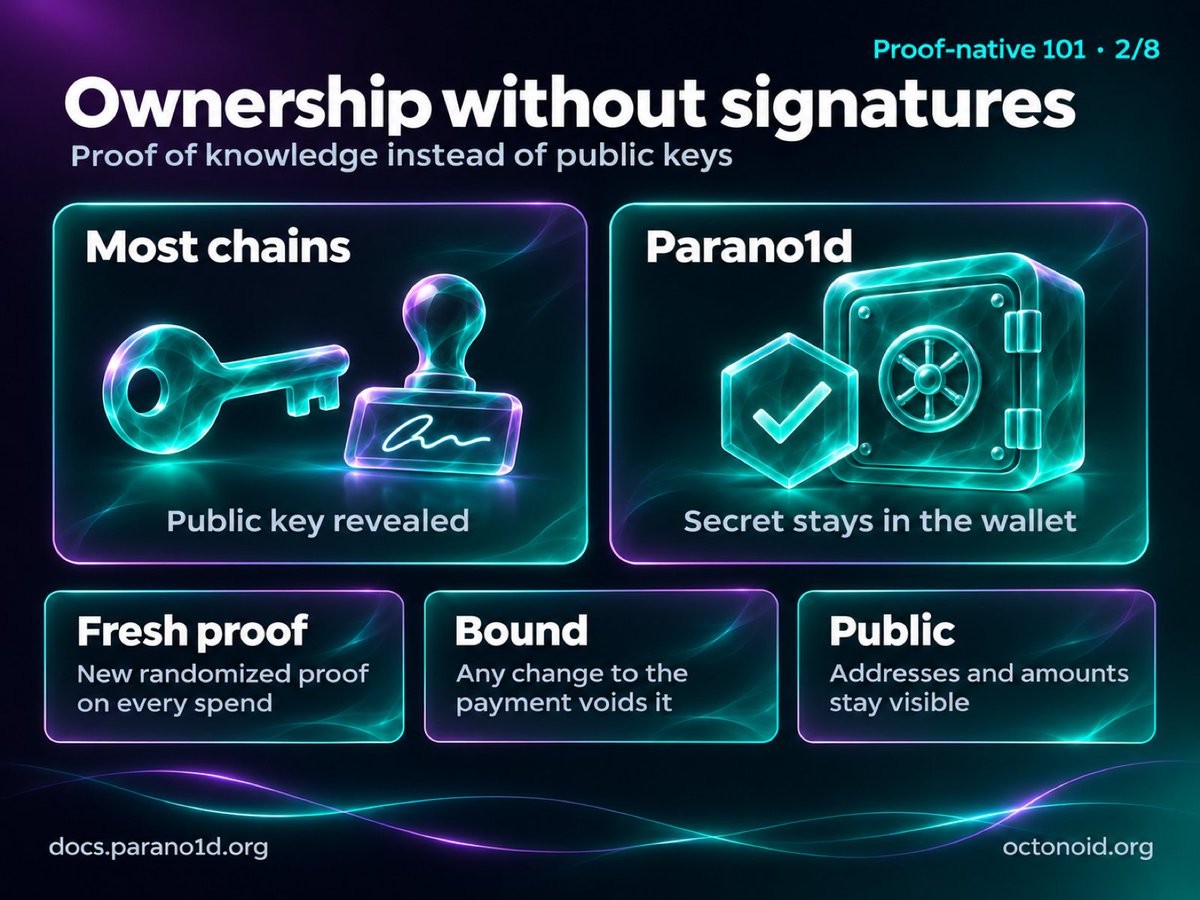
Most coins are guarded by elliptic-curve signatures.
When you spend, your wallet signs the transaction and reveals a public key. Security rests on one assumption: nobody can work backwards from that public key to your private key. A large enough quantum computer could break that assumption.
Parano1d removes that step.
Your address is a hash of a 256-bit secret. To spend, your wallet creates a zero-knowledge proof that it knows that secret, without revealing it.
No public key revealed. No signature attached.
What this means in practice:
• Fresh proof every time. Reusing an address does not repeat a signature or leave a stable proof pattern.
• Bound to one payment. Change the recipient, amount or fee and the authorization is invalid.
• Clear separation. Your wallet proves ownership. The miner separately proves the coins are still live and the full State change is valid.
• One secret. All your addresses derive from one master secret.
Two honest limits:
Signatureless does not mean private. Addresses, amounts and fees stay public. Zero knowledge hides your secret, not your history.
Your secret is your wallet. Anyone who learns it controls your funds, and there is no recovery service.
parano1d:native
Most blockchains make every new node replay the past to trust the present.
Parano1d flips it: the present proves the past.
On a classic chain, a full node re-executes old transactions in order to reach today's state. Pruning can save disk later, but the node still had to replay history first. The longer the chain, the bigger the job.
On Parano1d, every block arrives with a recursive proof. It shows three things:
• the block follows the rules
• the new state is exact
• the previous proof was valid
Link by link, that reaches back to genesis.
So a node verifies one proof of the present instead of re-running the past. Proof size does not grow with the chain: block 10,000,000 needs no bigger proof than block 10,000.
The work does not vanish. It moves to whoever already holds the data:
Wallets prove ownership.
Miners prove the block.
Nodes verify both.
Holders see first. 👁
The colony gets the next arms before anyone else. What they do stays classified until they ship.
Wave 1 on the market now
https://t.co/WngqxTMEjX
Tracker https://t.co/lG0ruzCOXy
Bot @OctonoidTrackerBot
Octonoid NFT 🐙
888 one-eyed octopuses.
Hard cap, written into the chain.
❤️ 8 Hearts · Mythic
🖤 88 Ink Drinkers · Rare
🤿 264 Divers · Uncommon
🐣 528 Hatchlings · Common
Holders get first access to every new Octonoid arm.
@Parano1dComm Great news!
Tracked it from block one 🐙
$nemo: created at 279,371, on the DEX at 279,391
20 blocks, about 10 minutes.
First hours of v2.1: 4 tokens, 182 trades, 49 traders, 4 NFT collections.
Live: https://t.co/q7DeM6aoNq
The NOID launchpad opens at block 279,370.
From the first buy it all goes live:
📡 https://t.co/lG0ruzCOXy
🤖 @OctonoidTrackerBot for your group
💰 NOID price card + alerts
More arms on the way. 👁
Eight arms. Verify everything. 🐙
Octonoid: tools for the Parano1d network.
🔍 Scan: every block, tx and wallet
👥 Holders: who holds parano1d:native
🤖 Buy bot for your TG group
📡 Live tracker: buys, new tokens, DEX
🖼 NFT collections
🎮 Games soon
https://t.co/Mu0YS9CJQG