@TalkinYanks@isaacrudansky Out of the mouth of babes!!!! I try not to gloat but have to laugh at Juan Soto for ditching the Yankees for money. Money isn’t everything! Go Yankees!
Michelle and I loved reading to this bright group of kids today!
We hope this new Chicago Public Library branch at the Obama Presidential Center will be a place where folks come to read, check out books, and connect with one another for years to come.
@hicasamadim 8 if you look at simply a graphic representation. When you take away the 1 image from the 9 image, you are left with the third image. So it’s 9-1 = 8. The 8 and the 1 image over top of each other make the 9 image.
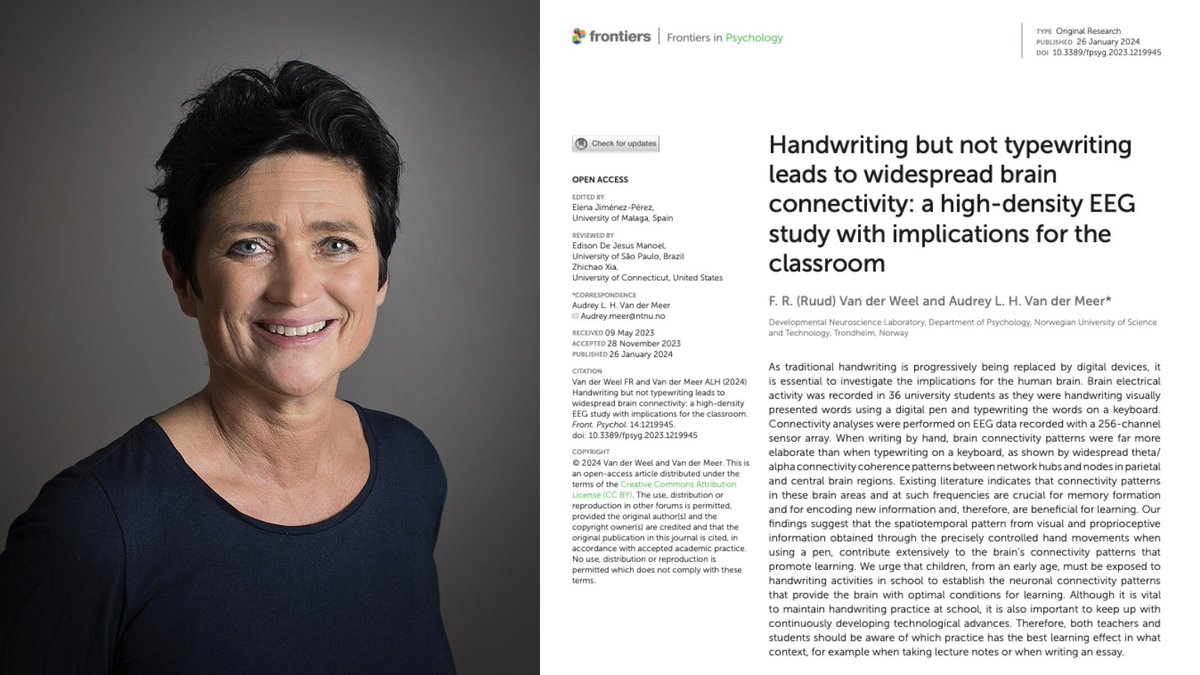
A Norwegian neuroscientist spent 20 years proving that the act of writing by hand changes the human brain in ways typing physically cannot, and almost nobody outside her field has read the paper.
Her name is Audrey van der Meer.
She runs a brain research lab in Trondheim, and the paper that closed the argument was published in 2024 in a journal called Frontiers in Psychology. The finding is brutal enough that it should have changed every classroom on Earth.
The experiment was simple. She recruited 36 university students and put each one in a cap with 256 sensors pressed against their scalp to record brain activity. Words flashed on a screen one at a time.
Sometimes the students wrote the word by hand on a touchscreen using a digital pen, and sometimes they typed the same word on a keyboard. Every neural response was recorded for the full five seconds the word stayed on screen.
Then her team looked at the part of the data most researchers had ignored for years, which is how different parts of the brain were communicating with each other during the task.
When the students wrote by hand, the brain lit up everywhere at once.
The regions responsible for memory, sensory integration, and the encoding of new information were all firing together in a coordinated pattern that spread across the entire cortex. The whole network was awake and connected.
When the same students typed the same word, that pattern collapsed almost completely.
Most of the brain went quiet, and the connections between regions that had been alive seconds earlier were nowhere to be found on the EEG.
Same word, same brain, same person, and two completely different neurological events.
The reason turned out to be something nobody had really paid attention to before her work. Writing by hand is not one motion but a sequence of thousands of tiny micro-movements coordinated with your eyes in real time, where each letter is a different shape that requires the brain to solve a slightly different spatial problem.
Your fingers, wrist, vision, and the parts of your brain that track position in space are all working together to produce one letter, then the next, then the next.
Typing throws all of that away. Every key on a keyboard requires the exact same finger motion regardless of which letter you are pressing, which means the brain has almost nothing to integrate and almost no problem to solve.
Van der Meer said it plainly in her interviews.
Pressing the same key with the same finger over and over does not stimulate the brain in any meaningful way, and she pointed out something that should scare every parent who handed their kid an iPad.
Children who learn to read and write on tablets often cannot tell letters like b and d apart, because they have never physically felt with their bodies what it takes to actually produce those letters on a page.
A decade before her, two researchers at Princeton ran the same fight using a completely different method and ended up at the same answer. Pam Mueller and Daniel Oppenheimer tested 327 students across three experiments, where half took notes on laptops with the internet disabled and half took notes by hand, before testing everyone on what they actually understood from the lectures they had watched.
The handwriting group won by a wide margin on every question that required real understanding rather than surface recall.
The reason was hiding in the transcripts of what the two groups had actually written down.
The laptop students typed almost word for word, capturing more total content but processing almost none of it as they went, while the handwriting students physically could not write fast enough to transcribe a lecture in real time, which forced them to listen carefully, decide what actually mattered, and put it in their own words on the page.
That single act of choosing what to keep was the learning itself, and the keyboard had quietly skipped the choosing and skipped the learning along with it.
Two studies. Two countries. Same answer.
Handwriting makes the brain work. Typing lets it coast.
Every note you have ever typed instead of written went into your brain through a thinner pipe. Every meeting, every book highlight, every idea you captured on your phone instead of on paper was processed at half depth.
You did not forget those things because your memory is bad. You forgot them because typing never woke the part of the brain that would have made them stick.
The fix is the thing your grandmother already knew.
Pick up a pen. Write the thing down. The slower road is the faster one.
@MikeWingerii I listened to Hank Hannegraff, the Bible Answer Man, during my commute years ago. He answered listener questions about the Bible. He also identified counterfeits and exposed the word of faith movement. Some called him divisive but he was identifying flock fleecers. Discernment!
Teachers and parents: if you know anyone on a curriculum selection committee, please send them this tweet, ask them to choose book-and-paper oriented curricula.
Thank you @karenvaites
Parents around the world are hoping their countries will follow Australia's lead and raise the age to 16 for social media accounts.
A global norm of 16 (not 15) would instantly solve the collective action problem, and be easier for companies to enforce.
https://t.co/JLi9y6IqXB
Friends-
This is a tough note to write, but since a bunch of you have started to suspect something, I’ll cut to the chase: Last week I was diagnosed with metastasized, stage-four pancreatic cancer, and am gonna die.
Advanced pancreatic is nasty stuff; it’s a death sentence. But I already had a death sentence before last week too — we all do.
I’m blessed with amazing siblings and half-a-dozen buddies that are genuinely brothers. As one of them put it, “Sure, you’re on the clock, but we’re all on the clock.” Death is a wicked thief, and the bastard pursues us all.
Still, I’ve got less time than I’d prefer. This is hard for someone wired to work and build, but harder still as a husband and a dad. I can’t begin to describe how great my people are. During the past year, as we’d temporarily stepped back from public life and built new family rhythms, Melissa and I have grown even closer — and that on top of three decades of the best friend a man could ever have. Seven months ago, Corrie was commissioned into the Air Force and she’s off at instrument and multi-engine rounds of flight school. Last week, Alex kicked butt graduating from college a semester early even while teaching gen chem, organic, and physics (she’s a freak). This summer, 14-year-old Breck started learning to drive. (Okay, we’ve been driving off-book for six years — but now we’ve got paper to make it street-legal.) I couldn’t be more grateful to constantly get to bear-hug this motley crew of sinners and saints.
There’s not a good time to tell your peeps you’re now marching to the beat of a faster drummer — but the season of advent isn’t the worst. As a Christian, the weeks running up to Christmas are a time to orient our hearts toward the hope of what’s to come.
Not an abstract hope in fanciful human goodness; not hope in vague hallmark-sappy spirituality; not a bootstrapped hope in our own strength (what foolishness is the evaporating-muscle I once prided myself in). Nope — often we lazily say “hope” when what we mean is “optimism.” To be clear, optimism is great, and it’s absolutely necessary, but it’s insufficient. It’s not the kinda thing that holds up when you tell your daughters you’re not going to walk them down the aisle. Nor telling your mom and pops they’re gonna bury their son.
A well-lived life demands more reality — stiffer stuff. That’s why, during advent, even while still walking in darkness, we shout our hope — often properly with a gravelly voice soldiering through tears.
Such is the calling of the pilgrim. Those who know ourselves to need a Physician should dang well look forward to enduring beauty and eventual fulfillment. That is, we hope in a real Deliverer — a rescuing God, born at a real time, in a real place. But the eternal city — with foundations and without cancer — is not yet.
Remembering Isaiah’s prophecies of what’s to come doesn’t dull the pain of current sufferings. But it does put it in eternity’s perspective:
“When we've been there 10,000 years…We've no less days to sing God's praise.”
I’ll have more to say. I’m not going down without a fight. One sub-part of God’s grace is found in the jawdropping advances science has made the past few years in immunotherapy and more. Death and dying aren’t the same — the process of dying is still something to be lived. We’re zealously embracing a lot of gallows humor in our house, and I’ve pledged to do my part to run through the irreverent tape.
But for now, as our family faces the reality of treatments, but more importantly as we celebrate Christmas, we wish you peace: “The people walking in darkness have seen a great light; on those living in the land of deep darkness a light has dawned….For to us a son is given” (Isaiah 9).
With great gratitude, and with gravelly-but-hopeful voices,
Ben — and the Sasses
Jim Carrey's speech inducting Soundgarden into the Rock and Roll Hall of Fame
"You may ask, 'Why would Soundgarden, the heaviest of rock and roll royalty, want Jim Carrey to induct them into the Hall of Fame? Is there some deep, cosmic connection between us? Or was the Spoonman not available?'
The truth is, I grew up inspired by the hard rock era. Every day, I’d spend hours in front of a floodlight in my basement, playing power chords on a goalie stick.
When the Seattle music scene exploded, it resurrected rock and roll for me. Bands like Mudhoney, Mother Love Bone, Alice in Chains, Pearl Jam, and of course, Nirvana, were raw, honest and reaching for something profound.
Soundgarden wasn’t just part of the movement: they helped start it. Guitarist Kim Thayil, bassist Hiro Yamamoto and singer/drummer Chris Cornell were experimenting with a fusion of hard rock, punk, metal and psychedelia that created intricate, powerful soundscapes.
Coupled with Chris’s incredible vocal range, their music could make your heart pound one moment and break the next. When I first heard Soundgarden, I wasn't just excited — I wanted to put on a flannel shirt and run into the street screaming, 'My mother smoked during pregnancy!'
They rose from Seattle bars to worldwide superstardom without fear or compromise. They trusted themselves completely, and trusted their fans to come along for the ride, wherever it led.
Their fourth studio album, Superunknown, changed everything, featuring incredible songs like 'Spoonman,' 'Fell on Black Days,' and their magnum opus, 'Black Hole Sun.'
That track was the ultimate example of Chris Cornell’s songwriting genius. It felt like he had given us access to an apocalyptic dream he was having. His presence was deeply authentic. When you looked into his eyes, it was like eternity was staring back.
I used to talk to him like this: 'Hi, Chris. How you doing? Me? Great, never better. Please look away. Probe no further.'
I met the band in 1996, when I hosted Saturday Night Live for the first time. I insisted that Soundgarden be the musical guest. By then, the lineup was Chris Cornell, Kim Thayil, Matt Cameron on drums and Ben Shepherd on bass.
During rehearsal, they launched into the dark, epic beauty of 'Pretty Noose.' I stood right in front of them, letting the waves of electricity wash over me like an audio baptism. They pushed me under, and when I came up, I was free.
After the show, they handed me one of my most prized possessions: the Fender Telecaster that Chris played on the show, signed by the whole band...
Later that night, Chris showed up at my hotel room with an acoustic guitar and a bucket of Kentucky Fried Chicken, and we wrote some songs. Okay, maybe I dreamt that part, but I’ll never forget that night.
I got to hang with Chris a few times after that. He was always sincere, down to earth, thoughtful, and funny.
When the band split in 1997, Chris went on to make amazing music on his own and with Audioslave. Kim, Matt and Ben continued to blaze their own musical paths. But Soundgarden wasn't done: they reunited in 2010 and gave us a second act of new music and live shows that were as vital as ever.
Sadly, on a shocking night in 2017, Chris left us. We lost a monumental musical artist and a deeply special soul. But for all time, his voice will continue to light up the ether like a Tesla coil.
Tonight, we make sure that Chris Cornell, Kim Thayil, Hiro Yamamoto, Matt Cameron and Ben Shepherd go down as one of the most majestic, powerful and influential bands ever to be inducted into the Rock & Roll Hall of Fame.
Long live Chris Cornell, and long live Soundgarden."
Photo by Kevin Kane/Getty Images for RRHOF