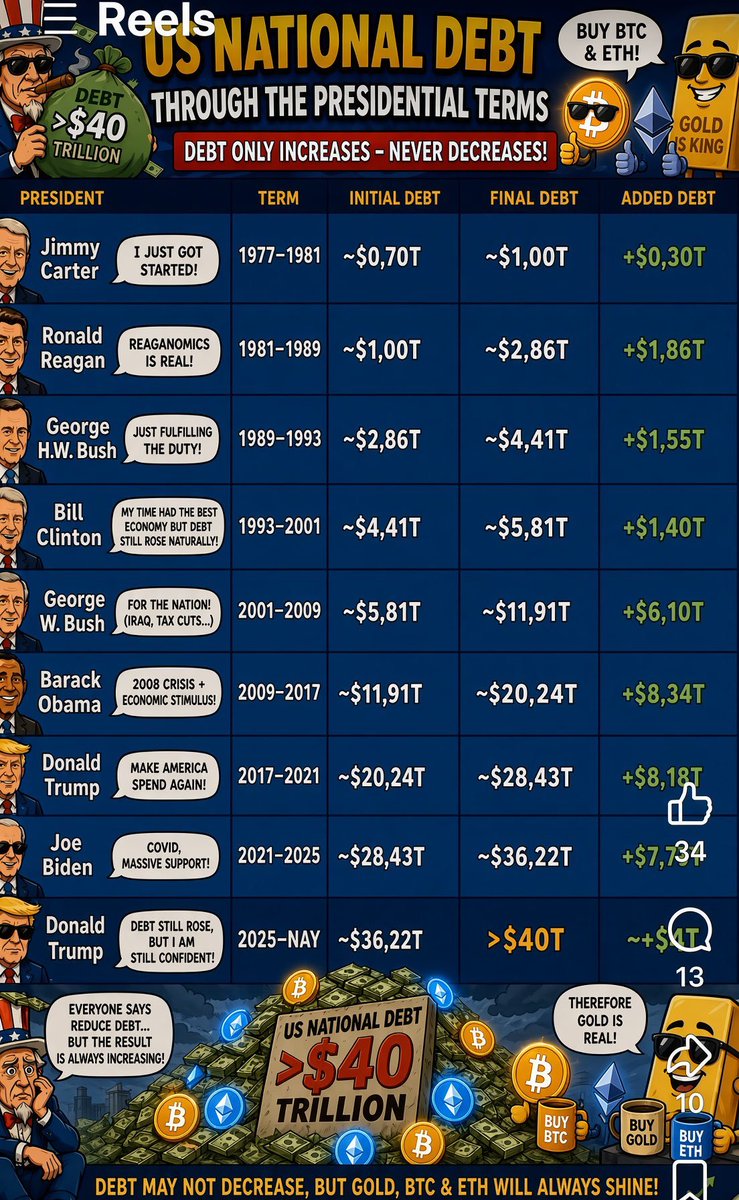
🚨 HISTORIC MILESTONE: US NATIONAL DEBT SURPASSES $40 TRILLION!
Looking back at the US debt trajectory across presidential terms from Jimmy Carter to the present, one brutal truth emerges: Debt only increases. It never decreases!
📊 US NATIONAL DEBT BY PRESIDENTIAL TERM:
• Jimmy Carter (1977–1981): $0.70T ➔ $1.00T (+ $0.30T)
• Ronald Reagan (1981–1989): $1.00T ➔ $2.86T (+ $1.86T)
• George H.W. Bush (1989–1993): $2.86T ➔ $4.41T (+ $1.55T)
• Bill Clinton (1993–2001): $4.41T ➔ $5.81T (+ $1.40T)
• George W. Bush (2001–2009): $5.81T ➔ $11.91T (+ $6.10T) (Wars & financial crisis)
• Barack Obama (2009–2017): $11.91T ➔ $20.24T (+ $8.34T) (Post-crisis stimulus)
• Donald Trump (2017–2021): $20.24T ➔ $28.43T (+ $8.18T)
• Joe Biden (2021–2025): $28.43T ➔ $36.22T (+ $7.73T) (Pandemic spending & relief)
• Donald Trump (2025–Present): $36.22T ➔ Smashes >$40 TRILLION!
💡 THE CASE FOR HARD ASSETS:
Regardless of which party holds office, the money-printing machine never stops. As fiat currency purchasing power degrades under relentless deficit spending, scarce assets like Gold, Bitcoin, and Ethereum stand out as the ultimate hedge against monetary debasement.
With debt hitting $40T, are you holding depreciating fiat or positioning into hard assets? 👇
#USDebt #Bitcoin #BTC bitcoin:native #Gold #Crypto #Macro #Economy
@FinanceLancelot Japan faces two choices:
1) Buy bonds without limit, causing its balance sheet to balloon and triggering inflation.
2) Abandon the peg, leading to higher interest rates and an increased public debt burden.
Japan will not defend the yield curve. They will choose 2.
@Barchart When the Fed raises interest rates this September, 10-year and 30-year rates will climb even higher, causing the public debt to swell further. The Fed will soon print money to purchase T-bills.
@kurtsaltrichter As long as the budget deficit remains unreduced, the U.S. will continue to issue T-bills to cover the shortfall.
It is a death spiral until the system collapses.
Treasury debt has a simple escape route: Let inflation reduce its real value.
The U.S. faces a ~$1.9T deficit, ~$32T of debt held by the public, and roughly $1T in annual net interest costs.
Cutting spending and raising taxes would fix the problem more directly, but politically, that's extremely difficult.
The easier path is financial repression: keep nominal rates below inflation for long enough to erode the debt in real terms.
That shifts the cost to savers.
If the government chooses to inflate away part of its debt, nominal wealth can rise while real purchasing power falls.
That's a very different kind of Bull Market.”
Got $Gold or bitcoin:native or $ETH ?