I recently had the pleasure of joining @StewartalsopIII on Crazy Wisdom again, this time to discuss more explicitly my project of circulatory fidelity and some of the work I've been doing.
It's always great talking with Stewart and I hope you'll take the time to listen.
Advanced spectroscopic investigation of lunar highland simulant (LHS-1) #geopolymer for in-situ resource utilization
By Yanchen Oinam et al.
https://t.co/nbBtrRaVcu
A reactor heated to 1,600°C can melt raw Moon dust into finished solar cells, glass and wire, with nothing launched from Earth. The exact same trick turns cheap desert sand into panels back home, with zero carbon. https://t.co/GidCXXUmgR
And it doesn't stop at the ground. You are an oxide too.
We call ourselves carbon-based. But carbon is even smaller than silicon. We named life after the scaffold and left out the substance. The inversion in you is bigger than the one in stone.
Hardly anyone has an accurate picture of what they are made from or the world they live in. We've been drawing stick figures and calling it science. 🤨
This isn't just a mineral quirk.
Oxide is about 94% of the Earth's crust by volume. We used to call it the oxysphere. The rock under your feet, the glass in your window, the wood that built your home, and the water in a river. Oxygen pulls the electrons off whatever it touches, so it's big and negative everywhere and owns the volume. We just never drew it that way.
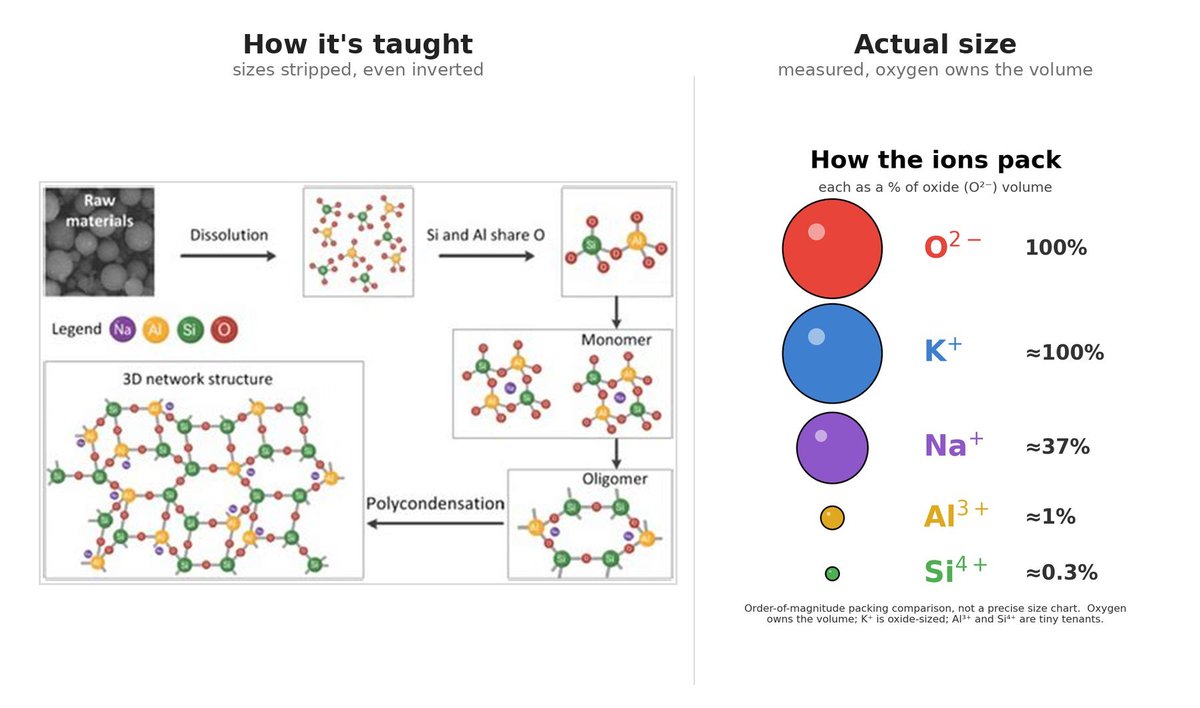
Same atoms, two pictures.
Left is how it's taught. Silicon and aluminum drawn big, oxygen, in its oxide (O²⁻) form, as little red dots. Right is the actual sizes, derived from over 6 million measured metal-to-oxide bonds.
Oxide is roughly 300 times bigger than the silicon the textbook draws larger than it. The diagram didn't lose scale. It inverted it.
And it doesn't stop at the ground. You are an oxide too.
We call ourselves carbon-based. But carbon is even smaller than silicon. We named life after the scaffold and left out the substance. The inversion in you is bigger than the one in stone.
Hardly anyone has an accurate picture of what they are made from or the world they live in. We've been drawing stick figures and calling it science. 🤨
This isn't just a mineral quirk.
Oxide is about 94% of the Earth's crust by volume. We used to call it the oxysphere. The rock under your feet, the glass in your window, the wood that built your home, and the water in a river. Oxygen pulls the electrons off whatever it touches, so it's big and negative everywhere and owns the volume. We just never drew it that way.
Introducing Dr. Edward Dowdye's interpretation on fission, the angle of deflection of colliding radioactive isotopes, the conservation of kinetic energy of inelastic collisions, the misnomer of a literal mass to energy interchange/ energy equivalence... and more.
Dr. Edward Dowdye's "Extinction Shift Principle" - No Relativity!
https://t.co/j1CbwztEOB
The Rebirth of Classical Physics 1
https://t.co/n9PK4DvZ8x
Doppler Effect Misnomer 2:
https://t.co/uxhFBzC0bG
Doppler Effect Misnomer 3:
https://t.co/iyhBGrItGD
Dr. Paul Brown's Resonant Nuclear Battery:
https://t.co/1ntr0P9fOg
@Johnny119934 hey you thieving fαggοτ piece of shit, why are you stealing @NatetheHoofGuy content and trying to pass it off as yours? you need a river of rocks to your face.