Do animals get jealous like people? New @BerkeleyPsych research looks at years of studies into whether non-human animals have a similar sense of fairness. The answer is more nuanced than it may seem. https://t.co/eCsGaaGeOO
Very excited to have this published! No evidence for inequity aversion in nonhuman animals: a meta-analysis of accept/reject paradigms, w/ Christoph Völter, @nicholaraihani , & @JanEngelmann5 : https://t.co/CHLyRO4RwP
Do animals care about fairness? Our new meta-analysis suggests they don't: "Are Nonhuman Animals Inequity Averse? A Meta-Analysis", w\ @cvoelter, @nicholaraihani, and @JanEngelmann5, out now as a pre-print: https://t.co/oYUZW1fvgw 1/11
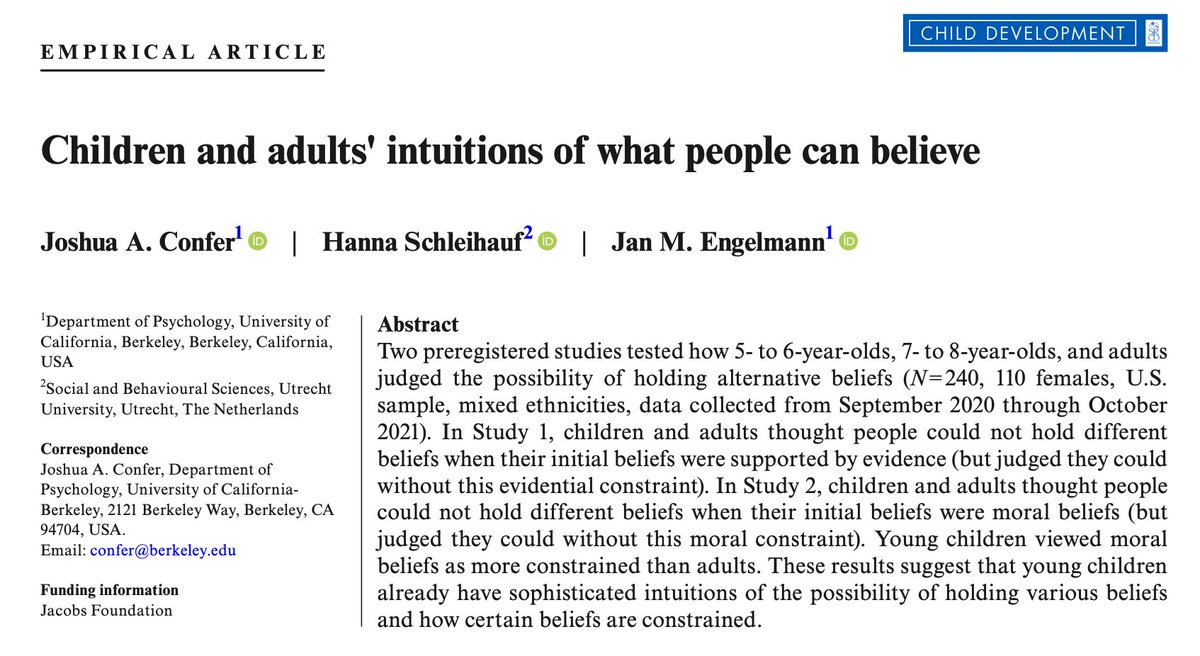
We often blame people for the beliefs they hold.
Does this mean we think people can choose their beliefs, like they can choose their actions?
We find children and adults generally think we can select our beliefs, but think we are restricted by evidence and morality.
Out now!
New paper @CollabraOA@ucpress
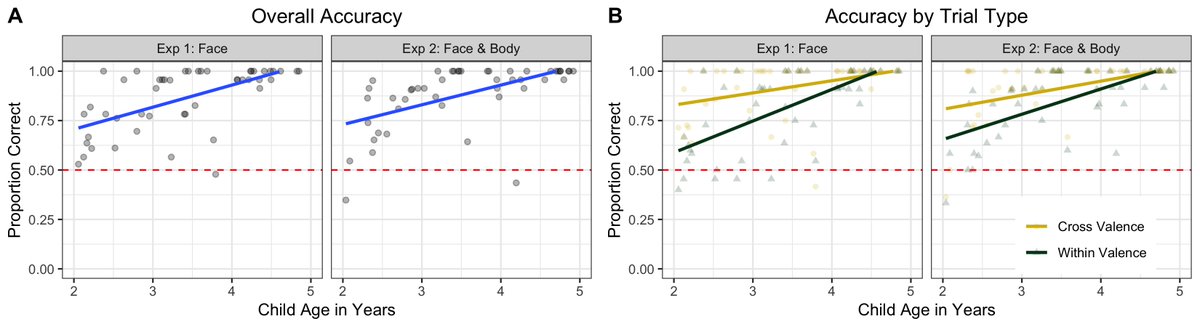
In two online, child-friendly Exps, 2-year-olds mapped emotion words to face & body cues within valence. Mask exposure didn't correlate with performance. The results suggest an early ability to comprehend emotion words! https://t.co/Cg3emlnMnI
@DoctorLockwood Our results are consistent with research on the social disappointment hypothesis, which suggests that rejections do serve as a protest against the human experimenter, but that this is independent of social comparison with the other recipient: https://t.co/3KDCFBhkLt
Do animals care about fairness? Our new meta-analysis suggests they don't: "Are Nonhuman Animals Inequity Averse? A Meta-Analysis", w\ @cvoelter, @nicholaraihani, and @JanEngelmann5, out now as a pre-print: https://t.co/oYUZW1fvgw 1/11
@j2bryson@vishalisairam@VHeddesheimer Impressive paper! While humans may also respond to lower than expected payoffs, there is robust evidence for an early emerging tendency to engage in social comparison and even pay a cost to reject offers that put one at a disadvantage. This form of fairness seems unique to humans
@Oliver_S_Curry Thank you! Great question - while there is work suggesting that chimps, at least, form expectation for how they should be treated (https://t.co/3KDCFBhkLt), I am not aware of any data to suggest that they expect *equal* treatment in second-person settings
@bonobo_style@KristinAndrewz @evan_westra We didn't find any effect of social comparison in our analyses - there was no difference to response whether the higher quality reward was given to a conspecific, handed to an empty cage, or simply held up by the experimenter prior to exchanging
@bonobo_style@KristinAndrewz @evan_westra Since social disappointment involves expectations for how one should be treated, it can well be seen as a precursor to fairness! However, on any account, fairness specifically involves social comparison: how does the reward I got compare to another agent's?
Overall, our meta-analysis finds no evidence that inequity aversion, a hypothesized building block of fairness, is shared with other species - suggesting that a sense of fairness is uniquely human! 11/11
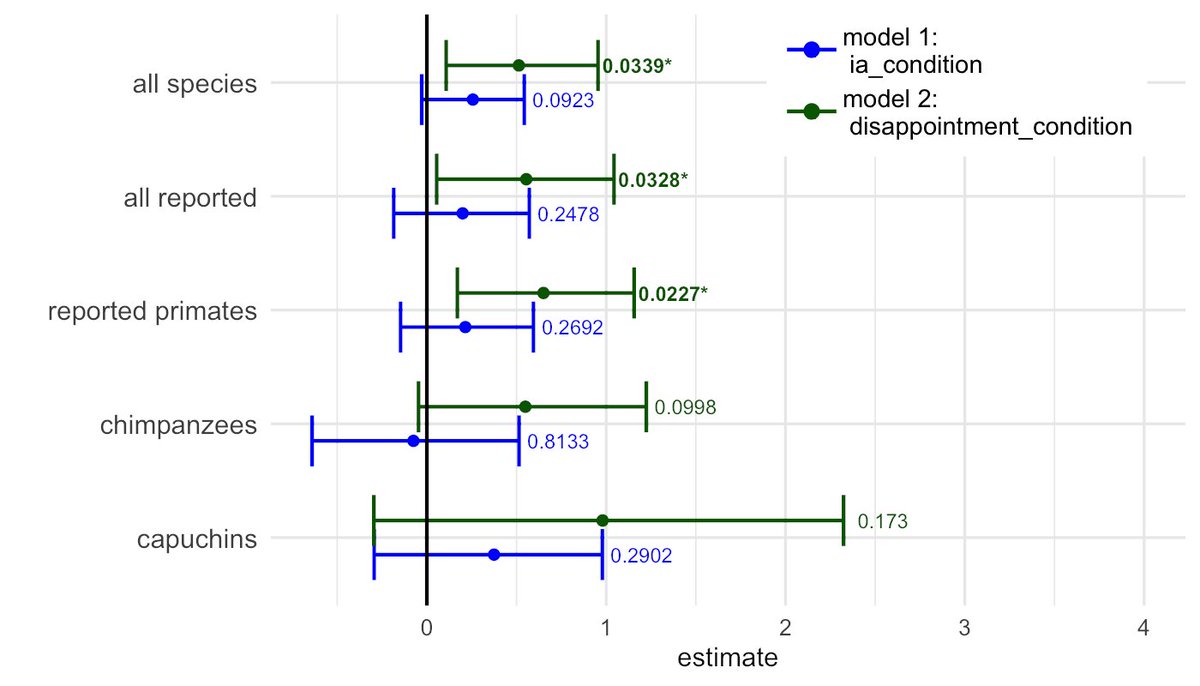
This figure represents the output of the models testing the inequity aversion and disappointment hypotheses. Bars = 95% CI, wherever 0 is included the result is nonsignificant. "Reported" on y-axis refers to species for which inequity aversion was previously reported 10/11