Hi! I bought my Ledger Stax from an authorized reseller in Ukraine, and I also have a Nano X from the same retailer. I actually opened up my Nano X and inspected the internals, and everything looks completely normal. It weighs 36g, even though the official specification says 34g.
My Stax weighs around 47–48g, usually 48g, although my calibrated scale occasionally shows 47g. Before attempting to open it, I decided to look for other owners' measurements, since disassembling a Stax is much more difficult and risky.
So far, almost every actual measurement I've found from other Stax owners has been around 47–48g, including devices reportedly purchased directly from Ledger. That makes me think this might simply be the normal real-world weight, despite the official specifications.
You simply scammed ENA stakers and let your partners down. It costs you nothing to give a few dollars of airdrop to those who provided you with liquidity, but you simply don’t want to do it. I advise those who keep their liquidity in this protocol to think twice. This project does not keep its promises; tomorrow they may simply shut everything down and not even say goodbye. Absolutely useless trash.
YUGE ALPHA: $14 Trillion AUM @BlackRock ENDORSES @chainlink AS THE STANDARD
Sergey held a panel with BlackRock's former Head of strategic ecosystem partnerships Joseph chalom to talk about @chainlink as the immersive standard for interoperability and data.
It's 9 minutes of Audiovisual gold.
First he talks about the 3 most important things that could reshape traditional finance:
- identity
- reliable data
- compliance and corporate action processing
He's literally describing chainlink
He also Points to $LINK economics:
"the economic incentive model that requires Oracles to produce reliable data and get rewarded in $LINK is a massive breakthrough"
The last thing he talks about is interoperability and the need for an orchestration layer that connects these different chains and again he reminds us that @BlackRock can't do it without A partner, while looking at Sergey
BlackRock explaining that @chainlink is the key to the next generation of finance and approving the $Link token as an incentive to set up a DON Exosystem for reliable data might be the most bullish news we've ever heard.
Next post Will also be Alpha about the tokenomics of the $LINK token
LayerZero can't be saved anymore?
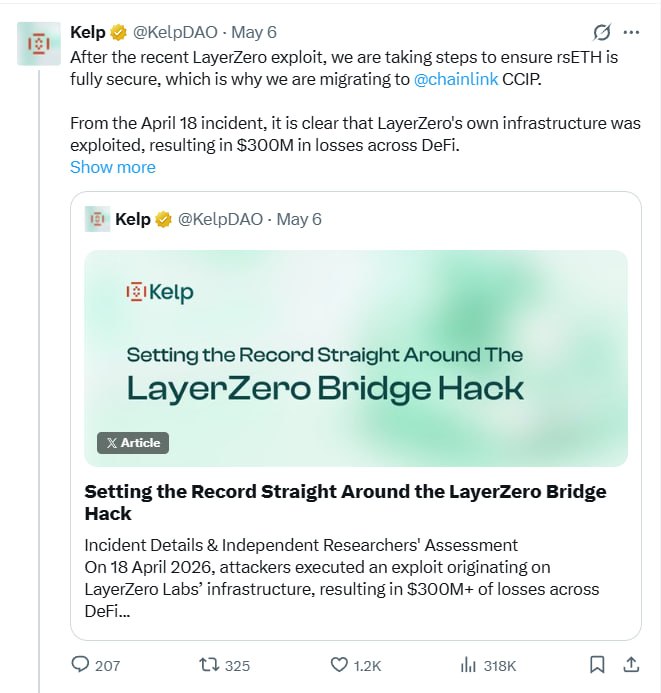
After the ~$300M rsETH exploit, @LayerZero_Core blamed its partners instead of owning it, and they felt the consequences immediately.
@KelpDAO & @SolvProtocol have already left, both migrating to @Chainlink.
Not only that, the projects below are currently pausing or reviewing their partnership with LayerZero:
- Beefy, Ethena, BitGo, Lombard, and more on the way.
The $ZRO damage chain is critical if you don't know:
Partners leave → volume drops → Stargate revenue falls → $ZRO buyback slows → $ZRO loses its only growth engine.
LayerZero did contribute 5,000 ETH to DeFi United and another 5,000 ETH into Aave liquidity, but the way they handled things only made people angrier.
LayerZero's revenue will decrease, and in the current market, a revenue drop is never a good sign for price.
If you're holding $ZRO, you need a clear-eyed risk assessment right now.
Thread👇
Since I've seen the topic of LINK token releases come up often, I wanted to a short thread to clear up some misconceptions around them.
1) Token unlocks are *NOT* the same thing as token sales. 70M LINK is released to the team per year regardless if they’re actually sold or not.
In fact, if you look at the supply of LINK on exchanges (https://t.co/zBc9A88MGQ), it's closing in on a 3 year low, despite the total number of token unlocks we've had being at an all time high (because that's a cumulative number)
It's actually at the lowest level as far back as this tracking tool even goes, but I don't want to overstate it if we can't see it.
2) Unlike other projects, LINK token releases don’t just fund the team, but also fund staking rewards and node oracle rewards, and other forms of network incentives.
Because Chainlink is not a blockchain, it doesn't have programmatic block rewards by which to distribute inflation. Furthermore, because Chainlink is comprised of hundreds of oracle networks, it cannot have a "one size fits all" block reward because different networks have wildly varying costs due to chain gas cost and node count.
Therefore, the manual token unlocks allow Chainlink Labs to use a scalpel to distribute rewards in a fine-tuned way to not overpay for node operations.
3) There is **NO** negative correlation between price and token release. Price has actually gone up after token releases historically + the period of time when LINK perfomed the worst, there was zero token releases happening.
You will see my Lookonchain tweet in my thread with evidence:
"Before this, Chainlink had unlocked 10 times in total, and 9 of them saw price increases 30 days after unlocking."
4) LINK is capped at 1B max supply, so token releases are finite and have an end date (with lowering inflation each year), whereas reserve buybacks will only grow in size tied to network adoption and will continue far beyond when token releases end.
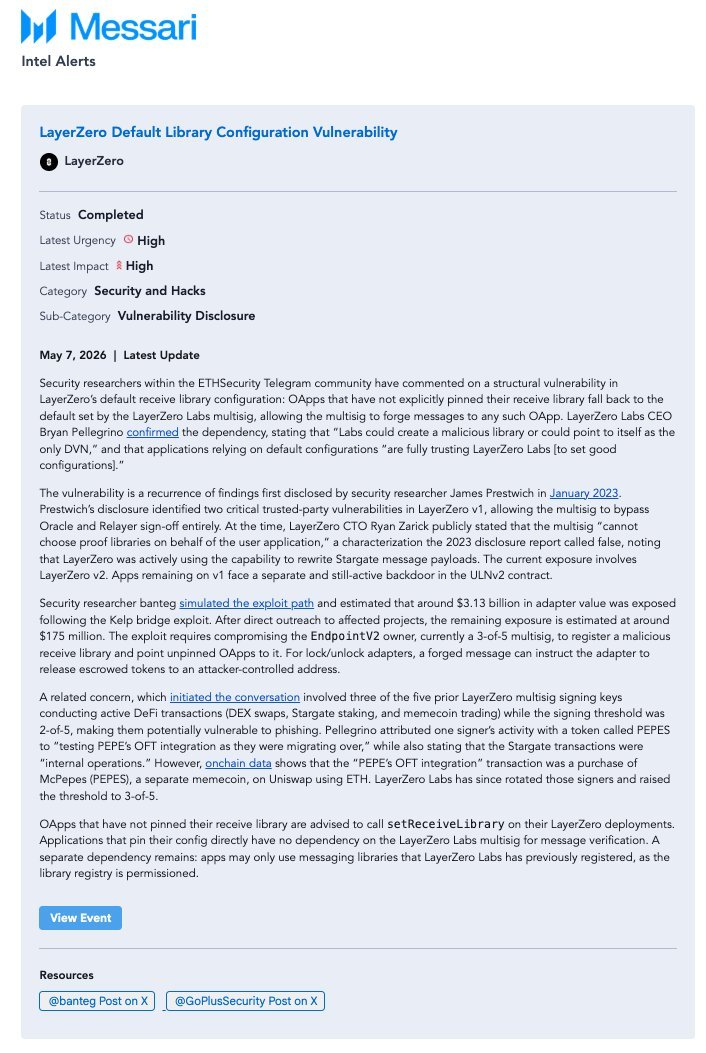
Onchain data shows LZ Labs multisig signers were engaging in non-multisig signing activity like trading memecoins, swapping on DEX, bridging. All major phishing risks as this mean production multisig keys were connected to websites, not just used for signing
Please keep Ethena far away from this team of teenagers.
Heeaaaaaaaaated debate broke out in the ETHSecurity Community Telegram earlier today between LayerZero’s Bryan and security researchers.
TLDR summary:
- $3 billion+ of LZ OFTs were recently at risk of being compromised due to a default library contract that LZ Labs could upgrade instantly with no timelock to forge messages (like what happened with rsETH hack)
-According to Banteg, major projects like Ethena and EtherFi were STILL using this default library contract as of a few weeks ago
- There is still $178 million in value exposed to being compromised from projects using default library (look at quote tweet)
- LZ Labs doesn’t need to be malicious for this be risk, they have history of poor opsec (in addition to being hacked by North Korea):
- Onchain data shows LZ Labs multisig signers were engaging in non-multisig signing activity like trading memecoins, swapping on DEX, bridging. All major phishing risks as this mean production multisig keys were connected to websites, not just used for signing
- LZ Labs handled private keys like a high schooler, trading memecoins on production multisig keys, no wonder they got targeted by North Korea, who knows what other poor opsec they have?
THREAD BELOW
Where is the guarantee that if new issues are discovered in LayerZero’s infrastructure, LayerZero will take responsibility for them instead of crying on social media about someone yelling at them?
It is hard to trust partners when, instead of acknowledging responsibility, they just cry, portray themselves as victims, and avoid taking accountability.
The LayerZero incident raises a serious question: was Ethena’s previous 2/2 DVN setup truly equivalent to two independent security domains?
If reports about 94% admin overlap between certain DVNs are accurate, then “2/2 DVN” can become much closer to 1/1 in practice.
That is not the kind of trust model institutional-grade assets like USDe, USDtb and ENA should rely on without additional independent safeguards.
Institutional-grade assets like USDe, USDtb and ENA should prioritize security-first infrastructure over maximum configurability.
Before the incident, Ethena was using a 2-DVN setup and has now upgraded to a stricter 4/4 configuration. I believe Ethena has taken this seriously, with stronger DVN requirements, rate limits, pinned libraries and route controls.
But the broader LayerZero incident showed that simply saying “multiple DVNs” is not enough unless those DVNs are truly independent across admins, infrastructure, RPC providers and control planes.
The bigger concern is LayerZero’s response after the incident. They still do not appear to have clearly taken responsibility for their role in the failure path, and their contribution to the recovery effort looks very small for a party whose infrastructure was directly involved.
If something happens again inside LayerZero’s infrastructure and Ethena is affected, why should holders believe LayerZero would take real responsibility instead of distancing itself again and blaming configuration choices?
For assets meant to become core financial infrastructure, that trust model is not enough.
Partial CCIP adoption for critical routes would be a major trust signal for both institutional and retail investors.
@ethena Will you be migrating to CCIP, at least partially? After what happened with LayerZero, that would be a major trust boost for both institutional and retail investors.
They still haven’t taken responsibility, which is very bad for trust.
@ethena USDe has really been through a lot and still hasn’t broken — that’s impressive. But after the Aave collapse, TVL will drop very low. Maybe you could give users some ideas on where they can move their USDe instead of Aave?
@0xFishermane @Ethena_Eco@BasedOneX Well, it’s just a side project. At the current FDV, I’d be getting around $1,150 over 1.5 years. But I understand you — given ENA’s current price, it does feel disappointing
@Ethena_Eco@BasedOneX Thank you so much — it’s a great bonus for ENA stakers who haven’t lost faith in the project since November. And this is only the beginning.
@ethena@aave Congratulations! Could you please share any information about the first part of the Based drop? I understand it will only be a small portion of the full drop according to the terms, but some clarity would save me time.
@edison0xyz That’s great, congratulations on such a strong start! Could you please tell me when the first part of the drop for ENA stakers will be distributed? I can’t find any clear information anywhere.