Day 1 of Learning Backend Engineering.
What is Backend Engineering - Core Concepts and Responsibilities.
Grab the Backend Engineering Ebook: https://t.co/HTGzHJIXq0
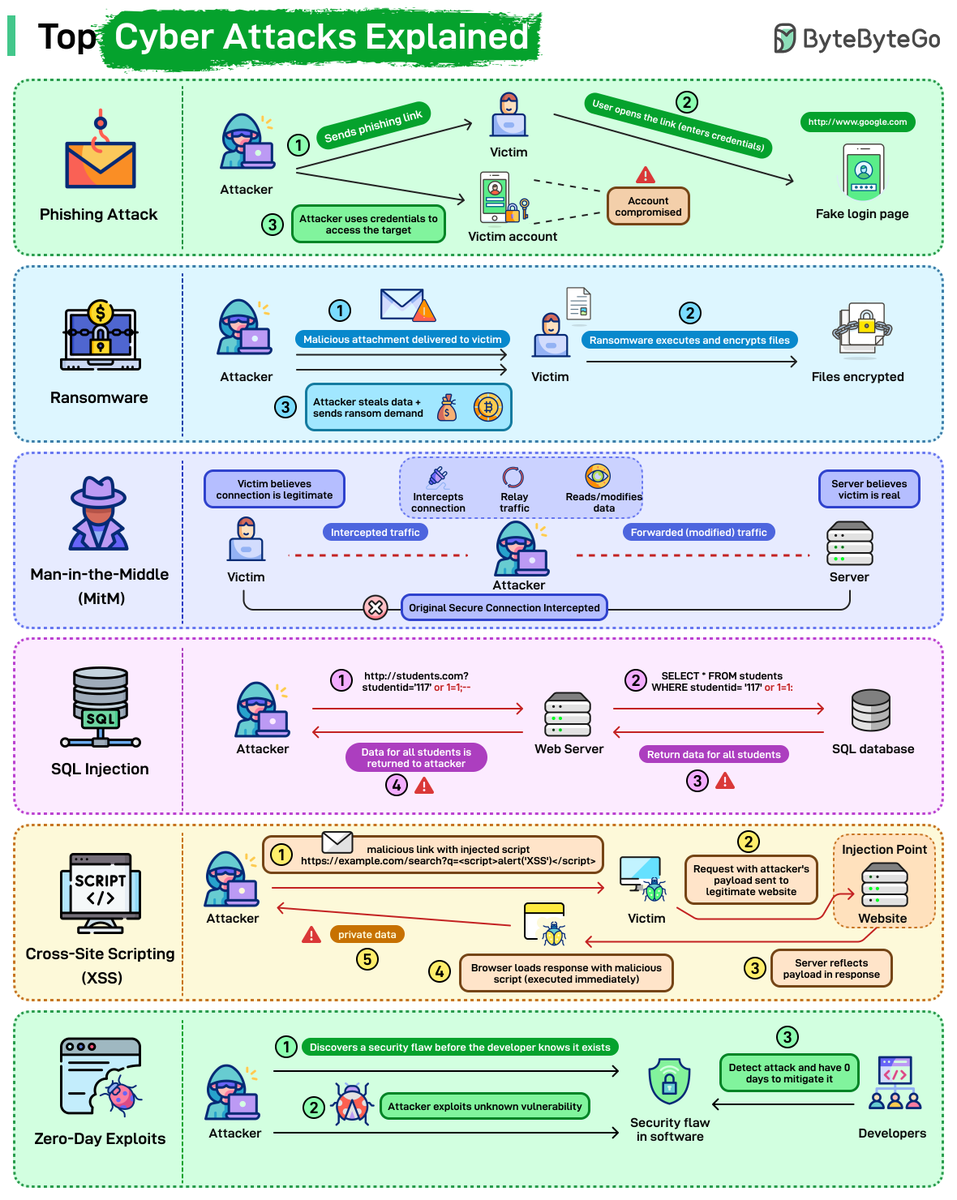
Top Cyber Attacks Explained
Here’s a quick look at how some of the most common attacks work:
Phishing: The attacker sends a fake link pointing to a spoofed login page. The victim enters credentials, the attacker captures them, and uses them to access the real system.
Ransomware: The victim opens a malicious attachment or file. The ransomware encrypts local data and demands payment to restore access. Files stay locked until the ransom is paid or a backup is restored.
Man-in-the-Middle (MitM): The attacker positions themselves between the victim and the server, intercepting traffic in both directions. Neither side detects the interception. The attacker can read or modify data as it passes through.
SQL Injection: Malicious SQL gets inserted into an input field, for example, studentId=117 OR 1=1. The database executes it as a valid query and returns data it shouldn't. A single vulnerable input field can expose an entire table.
Cross-Site Scripting (XSS): A malicious script gets injected into a legitimate page. When another user loads that page, their browser executes the script. Session tokens, cookies, and private data can be stolen this way.
Zero-Day Exploits: The attacker finds a vulnerability the vendor hasn't discovered yet. No patch exists. The attack runs until the vendor identifies the issue and ships a fix, which can take days or weeks.
Over to you: Which of these attacks have you seen most often in real environments, and which one do you think is the hardest to defend against today?