We have been awarded the Young Innovator of the Year prize by @Entirl! Thank you for the support and guidance. Big things to come! https://t.co/lyTtjoEfvn
What an exciting finale! We're thrilled to announce that the winner of The Ireland Funds Business Plan Competition 2021 is Carbon Harvesters. 2nd goes to
BIONICS and 3rd is ECLIPSE. Huge congratulations and thanks to each fantastic participating team! #IrelandFundsBPC
Irish milk is some of the most sustainable milk in the world - but climate mitigation practices can reduce its carbon footprint even further. We help farmers implement these practices by quantifying potential farm-specific environmental and economic impacts.
@MrSuperFibre@GillwallyO That is a great question, David. We aim to maintain productivity as we believe sustainability must not compromise profitability. For example, when reducing chemical fertiliser, we determine how we can provide the missing nitrogen through strategies such as clover or multispecies.
@jdkaroa Hi Juan David! Thanks for the question. Our LCA was modelled using inputs from the Irish National Inventory Report, IPCC tier 2 and 3, Central Statistics Office, FAO, Teagasc, GaBi, and Ecoinvent among others.
Two startups, Carbon Harvesters and Cano-ela, won a personalized training day with the Venturelab team on the @EPFL_en campus and industrial visits in the area, during the Global Food Venture Programme (GFVP) Pre-Incubation Bootcamp from @EITFood https://t.co/LTiBq4es5Y #EITFood
@HannahEDaly Hi Hannah, fertiliser inputs are constant with some decrease in emissions due to low emissions slurry spreading and protected urea. Imported feed inputs oscillate with time. There was a big drop after 2013 and started to increase again in 2016. We are now at 2013 levels again.
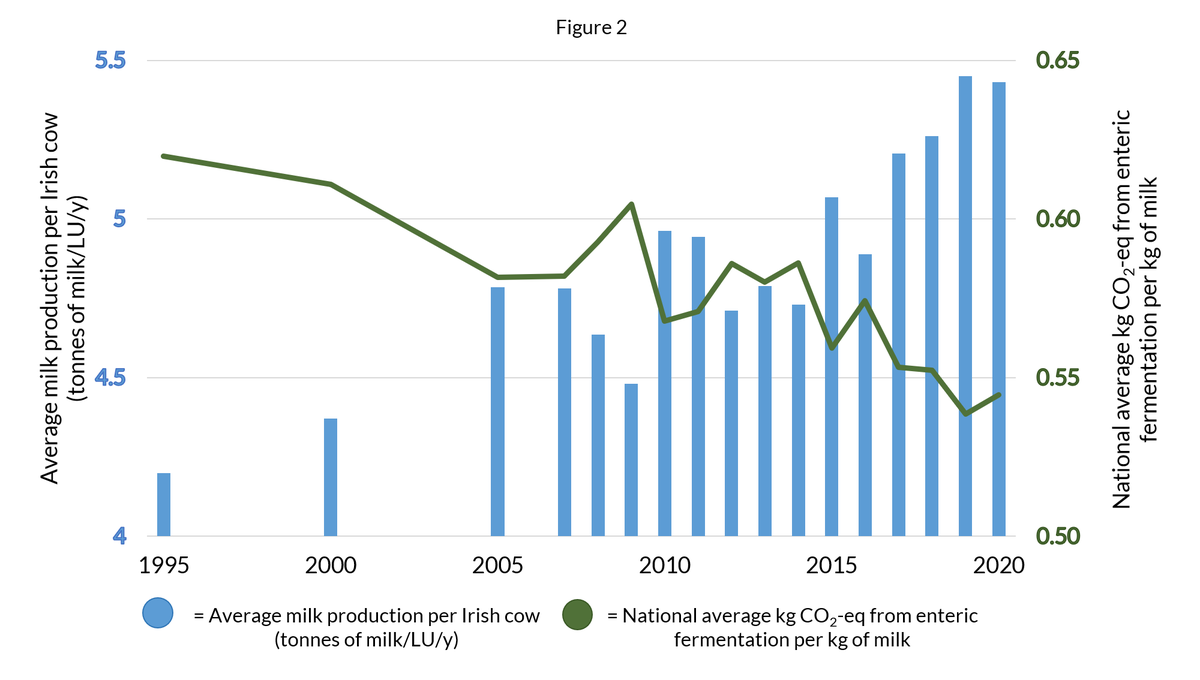
Irish milk production is increasing, but the management efficiency of farmers is causing a significant reduction in the intensity of the main GHG emitter from the dairy industry, enteric fermentation. We aim to monetise those reductions for the farmer.
@HannahEDaly@GHGGuru@Mr_T_Pot Milk production has increased by 5% since 2012. Fertiliser inputs are roughly constant and now farmers use low emissions slurry spreading and some protected urea. Concentrate usage has increased by an average of 3% per unit product. Manure emissions have increased.
@HannahEDaly@GHGGuru@Mr_T_Pot Hi Hannah, we agree (Fig 1). We are not saying total emissions are decreasing but that the rate of CH4 emissions per unit product is decreasing. This is because milk production per cow is increasing at a higher rate (Fig 2) due to N inputs but also improved management.
Welcome to our Twitter account! Our goal is to increase the resilience of rural communities by facilitating the cost-effective decarbonisation of the dairy sector. It's time that farmers get the credit they deserve for the hard work they put into their green practices.