Enough of war.
Ukraine proposes to end this war.
This must be done honestly, with dignity, and with guarantees that the war will not be reignited.
We see that the United States is fully focused on the issue of Iran, and it would be wrong to simply wait until the war in Europe returns to the center of its attention.
Ukraine proposes ending this war through direct engagement between us — and you.
🚨🚨 Iran deal NEARLY finalized. Last sticking points are Iran's insistence on destroying West, killing all infidels and imposing Islam on the world. Fingers crossed!
Multiculturalism has failed.
Even the politicians who pursued it now admit it. That's because diversity is not a strength, unity is.
The solution to the failure of multiculturalism is monoculturalism, where all citizens subscribe to a shared national identity which is more important than their individual differences.
Exitskatt och Berlinmuren har likheter.
De försökte båda hålla kvar medborgare som ville fly från socialismen.
Kanske vi ska kalla det "Berlinmursskatt" istället, så alla förstår?
“America isn’t ready”
America invented the hot dog.
Sweden perfected it.
This is a Tunnbrödsrulle.
A Nordic tactical food delivery system.
Sausage.
Mashed potatoes.
Shrimp salad.
Wrapped for maximum battlefield mobility.
The US isn’t emotionally prepared for this yet.
Fact: “The ratio of civilian to fighters killed in the Gaza War is better than most other comparable situations.” @GadSaad That precision of the statement is key. Civilian (noncombatant) fighter (combatant participating in the hostilities). Actually one of the lowest of urban warfare history against anything comparable. Lower than any comparable battle/war (very few even close to the situation but those like battles of Manila, Seoul, Mosul or Iraq/Korean War). Yes 1:1. Yes, Hamas (and other fighters participating in the war) had over 35,000 militants. @joerogan@joeroganhq I’m more than happy to discuss where the numbers come from, any comparable situation, why all the destruction in Gaza, what else could have been done, no genocide, and more based on a decade of research and now 7 (about to be 8) trips into Gaza to directly observe the IDF during their operations against Hamas.
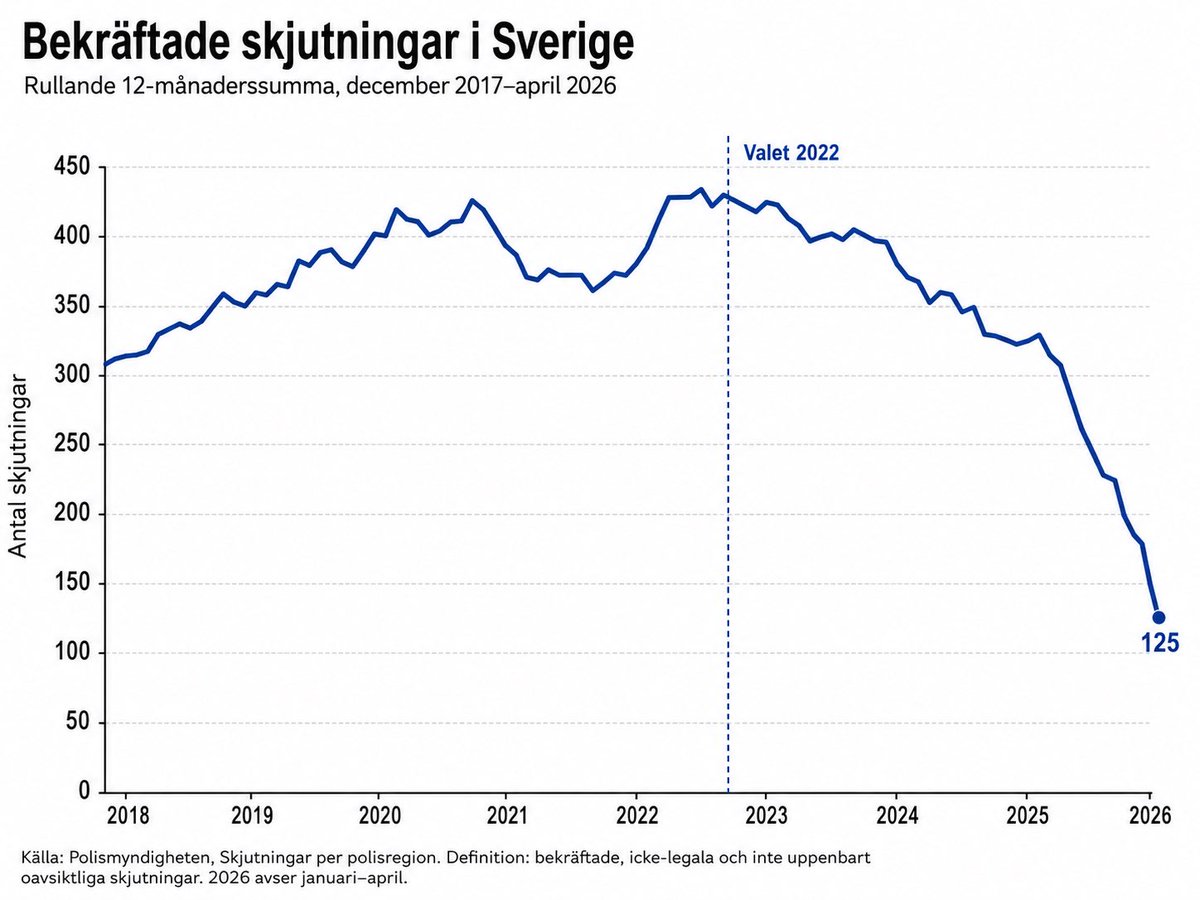
Tänk att lite hårdare straff, lite fler poliser och lite fler befogenheter kunde förhindra brott.
Ingen är förvånad, med undantag för Sveriges samlade kriminologkår.
Våld/hot i nära relation, inte mäns våld/hot mot kvinnor. Sånt språk döljer bara att många kvinnor också är förövare. Att göra allt till våld urvattnar ordet, bara lägg ner sånt här… Våld är våld, ekonomiskt/psykiskt våld är inte våld. Trakasserier, hot, mobbing, utpressning, det saknas inte begrepp som täcker samma sak?
Man har nödvärn mot brottsligt angrepp. Hur många som slagit en partner säger inte att ”hxn knäckte mig, psykade ner mig till jag tappade det?” Kan de hävda nödvärn mot psykiskt våld nu?
Män som hotar kvinnor ska inte komma undan.
Därför inför vi nu ett nytt brott: psykiskt våld.
👉Det innebär att upprepade kränkningar som hot, tvång och kontrollerande beteenden kan ge upp till fyra års fängelse.
👉 Vi stärker också skyddet genom att det nya brottet kan ingå som del i grov kvinnofridskränkning, hedersförtryck och olaga förföljelse.
Kvinnor i Sverige ska få upprättelse även när våldet inte lämnar synliga märken. Det handlar om rättvisa.
Lagändringarna föreslås träda i kraft den 1 juli 2026.
Kan någon hämta en psykolog till Volvofabriken? Det har spårat ur 🏥
Kolla klippet. Ebba Busch förklarar marknadsläget på Volvo som en vuxen människa, men sen får Magda frågan och man kan verkligen se sekunden hon får total kortslutning. ”SD:s kulturkrig!” Det är hennes svar på ALLT nu. Punktering på bilen? SD. Regn på semestern? SD.
Det är fascinerande att se en människa gå från noll till hundra i aggression på två sekunder bara för att hon inte kan förklara marknadsekonomi. Tragikomiskt på hög nivå.
Finns det någon fråga kvar som hon faktiskt kan svara på utan att nämna SD?
Jag fått frågan från många journalister, varför bjöd vi in @PahlaviReza till riksdagshuset? Svaret är enkelt, nämligen av samma anledning som Amir Vafa lyfter i slutet av sin insändare, Jag vill se ett fritt Iran där folket själva avgör sin framtid.
”Årtionden av värderelativism - ett förminskande och förnekande av den kristna etiken - det har försvagat grunden för vårt samhällsbygge. Det blir så smärtsamt synbart i mötet med politisk islam.
Jag har valt att kalla detta hot för en kamp mellan burkakrati och demokrati.
Burkan är nämligen symbolen för ett system som kontrollerar kvinnan. Begränsar hennes rörelser och definierar vad som är tillåtet.”
- Ebba Busch, KD-dagarna 2026.
عزیزان پادشاهی خواه، اگر این مرد نبود به شما قول میدم شاه رضا پهلوی، پایش به این زودی به پارلمان سوئد نمیرسید.
بقیه عزیزان هم بسیار زحمت کشیدند اما همه سر نخها به این مرد برمیگرده. به همین دلیل هم خوشامدگویی به عهده ایشان بود.
ازش تشکر کنیم و خواستید اکانتش را فالو کنید.
@MagnusBerntsson
#KingRezaPahlaviForIran
#KingRezaPahlavi
#DigitalBlackOutIran
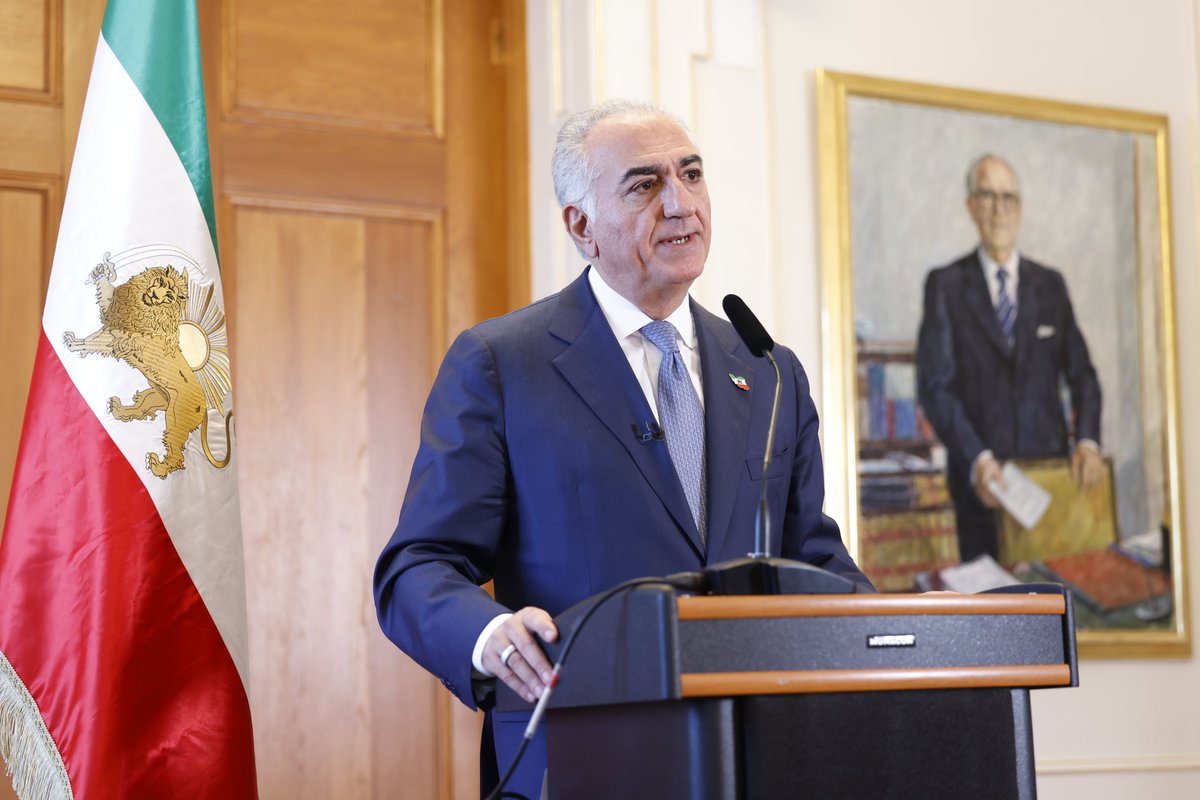
Idag hade jag äran att välkomna HKH kronprins Reza Pahlavi till riksdagen. Han mötte ett brett politiskt deltagande och fick både skarpa och kritiska frågor om sin vision för Iran. Vi kristdemokrater vill se ett fritt, demokratiskt och fredligt Iran och @PahlaviReza presenterar det mest seriösa alternativet för en sådan övergång. Dagens samtal stärkte den bilden. Fler borde lyssna.
My remarks today at the Swedish Parliament:
"Esteemed Members of the Riksdag, Ladies and Gentlemen,
I stand before you today, not to speak of policy abstractions or diplomatic courtesies. I stand before you to speak of a people — a great, ancient, and proud people — who at mortal cost, are fighting for freedom.
What is unfolding across Iran is not simply a political dispute. It is not a contest between factions within a system. It is something far more elemental: a national reckoning between a civilization, and a ruthless regime that has occupied it for nearly half a century.
Since inception, the Islamic Republic has not behaved as a state among states. It has operated as a revolutionary enterprise — exporting instability through proxies, subverting its neighbors' sovereignty, fueling conflict from Baghdad to Beirut, from Sanaa to Damascus, and advancing its nuclear ambitions beneath a fog of denial. It has not sought a place in the community of nations. It has sought to overturn that community.
Yet something irreversible has now changed inside Iran. The battle in my country today is not between reformers and hardliners. It is between occupation and liberation. It is a battle for the soul of a nation.
What we are witnessing is not a fleeting protest movement. It is a generational revolt — the most profound uprising in Iran since 1979 — uniting workers and students, women and minorities, professionals and poets, and yes, even elements within the state apparatus itself. Together, they have rendered their verdict: this regime has forfeited all legitimacy. Indeed, it is a revolt against the 1979 revolution itself.
When legitimacy dies, power begins to crumble. The regime understands this — which is precisely why it silences voices, shuts down the internet, and turns weapons against unarmed citizens.
And the cost has been heartbreaking — a cost that demands this noble chamber bear witness.
Men and women are being slaughtered in the streets and in their homes. More than 40,000 Iranians were massacred in a single week. The regime's operatives hunted wounded protesters in hospitals and executed them in cold blood. Bodies were collected by dump trucks. Families were forced to search through rows of unmarked body bags.
40,000…
The number is almost too large to comprehend. Too abstract. It allows too many in the outside world to look at it like a mere statistic. So let me tell you some of their names and stories.
Consider Hamid Mahdavi, the 38-year-old firefighter from Mashhad, who spent his final moments carrying wounded protesters to safety—only to be shot dead by regime forces for the crime of saving lives.
Think of Sina Kazemi, 22 years old. He was in his final term of engineering school. He had a lifelong passion for music and technology. He chose to fight for his and his nation’s dignity. He was looking forward. Security forces shot him in the back of the head.
In Bushehr, nurse Mansoureh Heydari and her husband, teacher Behrouz Mansouri, were shot dead side by side while protesting peacefully. They left behind two young children, ages 8 and 10 — a family destroyed for daring to dream of freedom.
Twenty-eight-year-old biotechnology student Negin Ghadimi went out to protest despite her father’s pleas. Mortally wounded, she died in his arms whispering, ‘Dad, I’m burning’— a bright future stolen in a single night of terror.
But the terror is not over. It continues every day. Access to the Internet is still blocked. And while the people of Iran are disconnected from the world, the regime continues to kill. Today the media speak of a ceasefire. What ceasefire? There has been no ceasefire in the Islamic Republic’s war on the people of Iran. At check points that mark most every street, regime thugs and their imported terrorists harass, beat, and murder innocent Iranians.
For those who cry of war and its costs, this is the war you should be speaking of: the Islamic Republic’s war on my compatriots. That war that rages on everyday, far from the headlines of your Western newspapers, and the minds of your television producers.
But they are not far from my mind. My brave compatriots continue to resist. Many stand with broken bodies but unbreakable wills. They would rather die standing than live kneeling. So would I.
Churchill understood such a people when he said that nations do not die when their soldiers fall — they die only when their spirit surrenders. I am here to tell you, Iran’s spirit has not surrendered and it never will!
Despite its brutality, the Islamic Republic is closer to collapse today than at any point since 1979.
And one fact is now beyond dispute: the Iranian people will never accept a repackaged version of this regime. Too much blood has been spilled. Too many graves have been dug. The demand is not for a kinder jailer. The demand is for freedom.
There is a military dimension to these events that this chamber is watching closely, and I will not pretend otherwise. But I say to you: however the military operation currently on pause turns — whether it accelerates the Islamic Republic's fall or merely deepens the fractures within it — the outcome of Iran's revolution will not be determined by any force from the outside. It will be determined by the Iranian people themselves.
The Lion and Sun Revolution — the uprising that the people of Iran ignited in January with their own blood and their own courage — cannot be extinguished by any regime calculation, any diplomatic maneuver, or any military result. The people started it. The people will finish it.
If the military operation pushes the Islamic Republic into the historical abyss where it belongs, we will be there — ready, organized, and determined — to build what comes after. And if the regime survives the immediate storm, we will continue the revolution until it is complete. We began this journey. We will see it to its end. History has given us no other choice.
When I look at Europe, I see ambivalence and a continued inability to see the reality of the streets of Iran. I am disappointed, yet not surprised, at the rush to engage this criminal regime. The regime that has murdered tens of thousands of its own citizens. The regime is sponsoring terrorism on the streets of Europe, including in Sweden. The regime is threatening and blackmailing European Governments with hostages and violence.
The Europe I believe in is supposed to stand for human rights, democracy, and equality.
It has a proud record in previous struggles - fighting apartheid in South Africa, supporting the Solidarity movement in Poland, and now in backing Ukrainians in the fight for sovereignty.
So why should Iran be different? Are Iranians’ human rights less important? Are their lives worth less?
Perhaps to some, but not to us.
Sadly this is not new. For decades Europe has appeased and emboldened this terrorist regime. It has been a policy that has helped this Regime survive and kill its own people.
I hope the Swedish Government will press the European Union and other countries to stand with the people of Iran and their struggle for liberty. I am pleased and heartened that so many members of the Riksdag, across multiple parties, are here today to hear a message from the people of Iran. On behalf of my compatriots who are far too often silenced, thank you.
Esteemed members of this Riksdag, this is no longer distant geopolitics — it is a security emergency on Swedish soil.
The Swedish Security Service, SÄPO, together with the Swedish Police Authority, has confirmed that the Islamic Republic of Iran operates within Sweden through criminal proxy networks. These are not surveillance operations alone. They carry out acts of intimidation and violence — targeting Jewish communities, Iranian dissidents, and Swedish citizens at large.
On the third of March this year, shortly after the outbreak of the current conflict in the Middle East, SÄPO issued an urgent public warning of a heightened threat level.This is not speculation. This is a statement from your own security services.
And here is what makes this threat particularly corrosive: the criminal networks that Tehran employs do not cease to exist between assignments. They are embedded in Swedish society. They are the same networks already identified as a major internal threat to public safety.
Sweden has responded with resolve. You have restricted visas for Iranian embassy staff. You prosecuted Hamid Noury for crimes against humanity under universal jurisdiction — setting a historic precedent. But it did not last.
Sweden returned Noury to Tehran where he was given a hero's welcome by his fellow murderers. While he was allowed to return to boast of his crimes on state television, Dr. Ahmadreza Djalali was forced to continue to suffer in the regime’s torture chambers. It was ten years ago that he was taken. And he is still captive.
Decisions like this embolden the Islamic Republic to take more hostages, to commit more crimes, and to further defy the world. A French senator told me a few months ago: our governments have become hostages to our hostages.
But governments still have a choice whether to give in to blackmail or not.
Václav Havel once said that the only genuine security in the world is a security rooted in truth. The truth is, as long as this regime remains in power, Sweden and the free world will not be safe.
Why did Sweden join NATO? Because of Putin’s war of aggression against Ukraine. That decision was correct. And it was necessary.
Let us not forget that the Islamic Republic is not a bystander to Russia's war. Tehran has supplied drones and missile technology to Moscow. Iranian-manufactured weapons have struck Ukrainian cities. Regime technical cooperation has sustained Putin’s capacity to wage war against a democratic neighbor.
As President Zelenskyy and I have discussed and stated together: the Russian threat to Europe and the Islamic Republic’s threat to Europe are not two separate problems. They are two manifestations of a single challenge.
Sweden now stands inside NATO's collective defense. But collective defense is not only military. It is political, economic, and moral. It requires that democratic nations recognize threats in their totality — and treat the Islamic regime's support for Russian aggression as the direct security concern that it is.
Let me now speak, not of present dangers, but of future possibilities.
The relationship between Sweden and Iran has deep roots. In the early decades of the twentieth century, Swedish experts and businesses built strong ties in Iran. During the celebrations of 2,500 years of Iranian civilization at Persepolis, Sweden was represented by then-Crown Prince Carl Gustaf. His Majesty and I sat together and spoke of the future of our nations and people.
That future, with a democratic Iran, would change the security calculus of the entire region — and of Europe. It would immediately dismantle the proxy networks operating on Swedish soil. It would end the hostage diplomacy that has poisoned relations with Western nations for decades. It would cooperate on intelligence and the rule of law. It would cease its support for Russia's war machine. It would secure Europe’s energy needs for decades to come.
It would emerge as a natural partner — a nation of 90 million people with extraordinary human capital, a rich civilization, and a desire to rebuild after decades of misrule.
Sweden has every reason to be part of that future. Your excellence in information technology and digital infrastructure, your defense industry — Saab's world-class capabilities in aerospace and defense — your engineering heritage through Volvo and Scania, your commitment to culture, your tradition of precision manufacturing and industrial innovation: these are precisely what a rebuilding Iran will need. This is not charity. This is partnership between equals, between nations with complementary strengths and shared values.
At this historic moment, as Iranians call upon me to help provide leadership toward a democratic transition, I reaffirm the commitment I have made throughout my life: to serve as a unifying national figure — not a partisan one, not a claimant to power — but a facilitator of stability, of national unity, and of a peaceful transfer to democratic governance.
I am not alone in believing this is possible. Together with economists, legal experts, security professionals, and civil society leaders from across the Iranian political spectrum, we have developed detailed transition frameworks — the Iran Prosperity Project — to ensure institutional continuity, prevent instability, and allow rapid national recovery after the regime's end. There is a plan. There is a path. There is a responsible alternative.
Even within the state apparatus, the fractures are deepening. Reports indicate that members of the armed forces and security institutions are increasingly refusing orders to participate in violence against civilians. Many have quietly signaled where their true loyalties lie: with the nation, not with those who repress it. When the path emerges, I am confident they will act.
No government can survive once it loses the willingness of its own institutions to enforce repression. We are approaching that moment.
Let me conclude, esteemed members of this Riksdag, with what I believe is the simplest and most important truth of this address.
The Iranian people are not asking you to fight their revolution. They are already risking their lives doing that themselves — with a courage that should humble all of us.
They are asking something far more modest:
Do not legitimize those who oppress them.
Do not strengthen those who terrorize them.
Protect those who have sought refuge among you.
Prepare for the day when Iran stands free.
There are moments in history when neutrality is not a position — it is a decision. When caution is not prudence — it is complicity. When history quietly presents a question and waits, with terrible patience, for an answer.
Churchill faced such a moment in 1940. Havel faced it in 1989. Zelenskyy faces it today. And in their own way — with no aircraft, no armies, no diplomatic immunity — the people of Iran face it in every street, every prison cell, every unmarked grave.
The Iranian people have already answered. They have answered in the streets and in their prisons. They have answered with their lives. They have chosen freedom.
History now asks the democratic world a simpler question, and Europe in particular:
Will you stand with a free people? Or will you accommodate those who oppress them?
Future generations will not read your statements. They will assess your actions. They will not ask what you said. They will ask what you did — and what you refused to do when it mattered.
And one day soon — and I say this, not as sentiment but as strategic conviction — when Iran is free, when its people stand again among the free nations of the world, when its children inherit a country without fear, we will all know that this was the moment when history turned. The moment when a great people refused to kneel. The moment when free nations chose not to look away.
Let it be written that when that day came, Sweden was ready.
When the Iranian people stood for freedom, Sweden stood with them.
Thank you."
Stockholm, Sweden
April 13, 2026
Absolutely MASSIVE crowd in Stockholm, Sweden right now as the Shah of Iran delivers a speech to the Swedish Parliament.
Amazing to see.
While our people inside Iran are held hostage under a blackout, we will be their voices.