It’s kind of funny that John Adams is left entirely out of the Hamilton musical. It probably would have undermined the central character too much.
Meanwhile we have this scene from the HBO series.
🇬🇧 THEY TOLD YOU A STORY. 🇬🇧
Colonisers. Slavers. Oppressors. And you were supposed to feel ashamed.
Not for what you done... But for WHO YOU ARE. 🇬🇧
So we tested it. Britain wrote everything down, so we opened the books. 📖
Turns out fewer than 1 man in 10 could vote in the year Britain banned the slave trade. No woman could. Your ancestors could hang for stealing a sheep, get shipped across the world for petty theft, or go down a mine at 8 years old. In Manchester, the average age of death in a labouring family was 17.
They weren't running the slave trade. They were underneath it too.
Which is what makes what happened next worth knowing.
In 1772 an enslaved man named James Somerset walked free from an English court, because English law couldn't hold a slave.
In 1791, 300,000 families just stopped buying slave sugar. No march, no riot, just a decision made at 300,000 kitchen tables.
In 1792, 519 petitions carrying 390,000 names hit Parliament, most signed by people who couldn't vote themselves.
In 1807, Britain banned the trade.
Then the slave owners sent Britain a bill for the 800,000 people they still held. 💷 £20 million. About 40% of the entire government budget at the time.
The Treasury says it wasn't paid off until 2015. So if your family paid British tax before then, they helped buy 800,000 people their freedom.
From 1808 the Royal Navy spent 60 years hunting slave ships at sea: 1,600 stopped, 150,000 people freed, and 1,600 British sailors dead, mostly of disease, buried thousands of miles from home. ⚓
In 1816 they ended two centuries of Barbary corsairs enslaving Europeans.
In 1896 a war that lasted 38 minutes ended slavery in Zanzibar. 🇹🇿
Almost every country on Earth outlaws slavery today.
That fight was paid for largely at British expense, by British hands.🇬🇧
So why haven't you heard any of this?
Because within living memory, someone rewrote the story. You got taught the crime. Not the cure.
The powerful exploited the world. They exploited their own people first. It was those people who ended slavery. 🇬🇧
━━━━━━━━━━━━━━
History got rewritten once, in living memory, by no one who was ever named or held to account.
We are ordinary people doing what ordinary people have always done. Opening the books. Refusing to look away.
This is how we fight back. Fact by fact. Story by story. Name by name.
We are the home of British heroes. There is a place for you in it.
If you can afford to support what we do: https://t.co/rih7iKwnvf
Be part of us. ☝️🇬🇧 Be Proud Of Us. 🙏🇬🇧
When you escape from all the pageantry and hagiography, the story of the Founding Fathers and the American Revolution is one of the most outstanding stories out there. A ragtag army permanently on the brink of bankruptcy and collapse brought the world’s greatest power to its knees
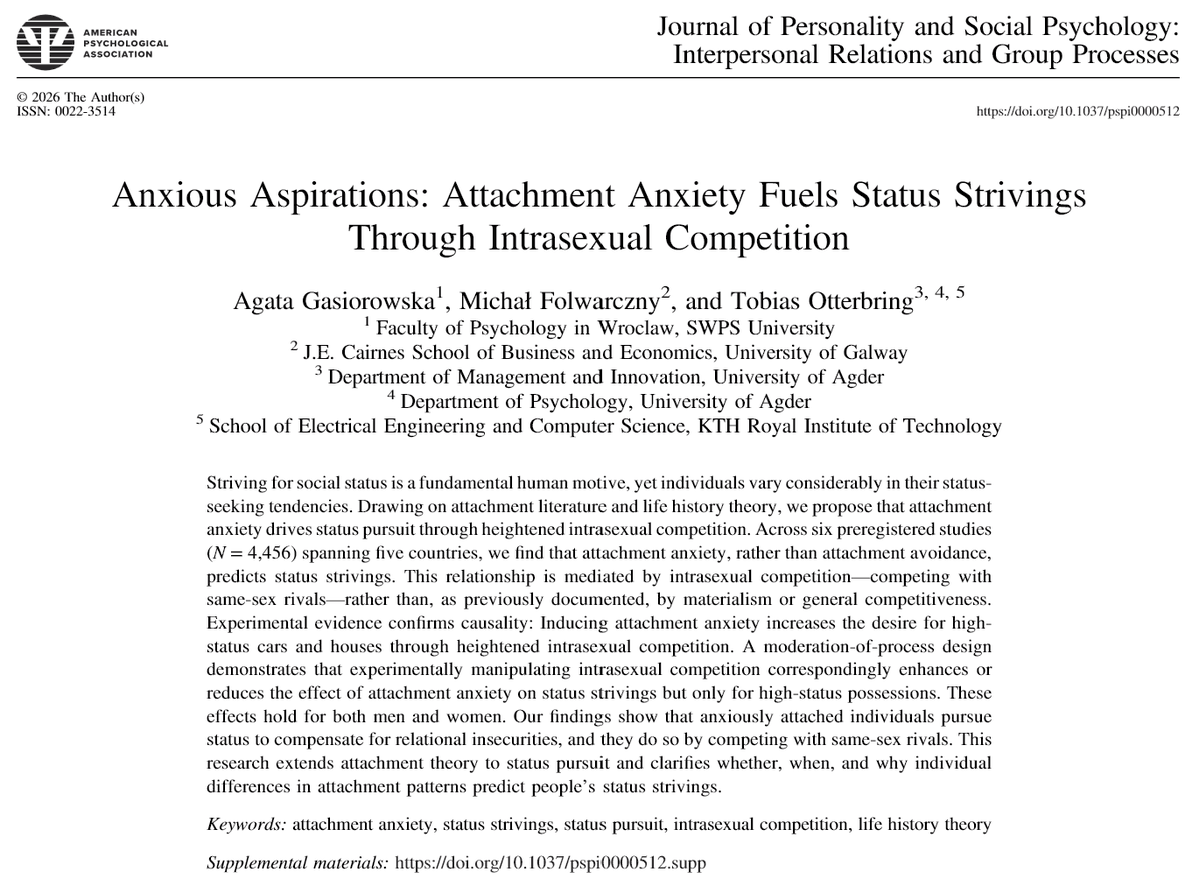
Buying a fancy car is not a sign of a midlife crisis. It’s a mark of relationship insecurity.
6 studies: When men and women have attachment anxiety, they seek status symbols to compensate and stand out among their peers.
Belonging and connection are antidotes to materialism.
This is false on more than one level:
1. Congress cannot legislate in violation of the Constitution.
2. Congress has no authority to ratify changes to the Constitution; it can only propose changes. The Constitution can only be amended upon the ratification of 3/4s of the states.
As a Native American I’m a little offended that the 14th Amendment didn’t grant us citizenship until Congress passed an exception for us. Meanwhile, a CCP spy can fly to Guam, drop a baby and fly home with the baby who qualifies to run for president 35 years later.
I think the biggest thing that gets lost is that you can't really understand the Second Amendment by itself. You have to look at the entire Constitution and the Bill of Rights.
One of the unusual things about the U.S. Constitution is that it's primarily a document telling the federal government what powers it has. The Founders assumed that if a power wasn't granted, the federal government didn't have it. Then the Bill of Rights comes along and says, "And here are some things you are definitely not allowed to do."
Compare these two.
The Canadian Charter basically says:
"Everyone has the following fundamental freedoms..."
The U.S. First Amendment begins:
"Congress shall make no law..."
Notice the difference in emphasis?
The Charter gives you certain rights. The bill of rights says the government can't take them away.
The First Amendment is written as a restriction on government power. It doesn't say, "Americans may speak freely." It says, in effect, "Congress, you don't get to stop them."
The Second Amendment follows that same pattern:
"A well regulated Militia, being necessary to the security of a free State, the right of the people to keep and bear Arms, shall not be infringed."
Whether people agree on every detail of that sentence is a debate that's been going on for centuries, but the structure is consistent with the rest of the Bill of Rights.
It's not written as, "Citizens are hereby granted permission to own guns." It's written as, "The government shall not infringe the right of the people."
The militia clause gets most of the attention today, but notice that the actual operative language refers to "the right of the people." the same phrase used elsewhere in the Bill of Rights.
Whether you agree with the amendment or not, it's easier to understand if you read it the same way you'd read the First Amendment: as a limit on what the federal government is allowed to do, not as a list of permissions granted by the government.
That's also why there are amendments that seem oddly specific today, like the Third Amendment's prohibition on quartering soldiers in private homes. That wasn't random, it addressed an abuse the Founders had actually experienced and wanted to make sure the new federal government could never repeat.
Whether you ultimately agree with the Second Amendment or not, I think it makes much more sense once you realize the Bill of Rights is mostly written in the voice of, "Government, here are the lines you may not cross."
As to WHY the second amendment exists? There are lots of philosophical reasons as to why it exists, and why it's good, but the fact is, the revolutionary war started when King George told the military governor of Boston to seize colonial guns and gunpower at Concord.
Much like a specific practice inspired the 3rd amendment, this directly inspired the 2nd amendment.
From the Introduction to his dissent - Justice Thomas summarizes why children born to people passing through the USA (like someone on a birth tourism trip) are not citizens:
🚨 WOW! Justice Alito is absolutely FUMING over SCOTUS giving the green light to birthright citizenship
"In my judgment, the court has made a mistake that will seriously affect the country's future."
"Suppose that a person's only connection to this country is that he was born here to a mother who was present just long enough to give birth and then quickly return to her native country.
Suppose that country is a strategic adversary or enemy of the United States. Suppose the child NEVER visited the United States while grow and was inculcated with hatred of this country.
According to this court, now, that person is a citizen of the United States. He can enter and leave the country as he pleases. He can travel the world on a United States passport.
Even if he plots to harm this country, he cannot be deprived of his status as a citizen, at least under current precedent." — Justice Samuel Alito in his dissent
The *author* of the Citizenship Clause of the 14th Amendment, Senator Jacob Howard, literally explained during the debates that it would obviously not apply to illegal aliens or foreigners not allegiant to the United States…
It was for the children of former slaves.
Woman: ”I am a woman of color, daughter of immigrants, Muslim feminist, lefty liberal. Am I your enemy?”
Jared Taylor: ”You're not subjectively my enemy. But what you are promoting will lead to the disappearance of my people and my culture.
And I'll tell you this: It annoys me tremendously when I'm told by some immigrant or a child of immigrants that the only reason my country is worthwhile is because people like them have come here. It's as if to say my ancestors built a dung heap.
And I don't doubt your good will, but your goodwill is objectively going to lead to the oblivion of my people. I'm sorry, there is no other way to see it.”
I tear up thinking about the Marquis de Lafayette's return tour of the United States. He saw that President James Monroe was in plain clothes and that the White House was unguarded and knew that he had fought for a worthy cause. He kissed five year old Walt Whitman on the cheek.