Twenty-five years ago, the Massachusetts Institute of Technology made a bold move that most universities would never dare.
Instead of locking its world-class course materials behind campus walls, MIT decided to put nearly its entire curriculum online, completely free for anyone with an internet connection.
That decision gave birth to MIT OpenCourseWare (OCW).
What began as a bold experiment in 2001 has become one of the most significant educational initiatives in history.
Today, OCW provides materials from more than 2,500 undergraduate and graduate courses across virtually every discipline: physics, engineering, artificial intelligence, economics, biology, mathematics, computer science, and many more.
Anyone can access lecture notes, problem sets, exams, syllabi, and a growing library of video lectures, with no tuition, no application, and no account required.
According to MIT, more than 500 million people worldwide have used these resources over the past 25 years.
The impact has been profound. Students use it to ace exams, explore new fields, and launch careers. Educators around the globe integrate the materials into their own teaching. Many learners credit OCW with helping them pass professional certifications and unlock new opportunities.
Beyond its direct benefits, OpenCourseWare helped spark the global open education movement, inspiring dozens of other universities to share their knowledge freely online.
Even more impressive: the project was originally planned as a 10-year initiative. A quarter-century later, it's still expanding.
MIT now aims to reach 1 billion learners in the coming decade, while enhancing the experience with powerful new AI-powered learning tools.
Once you know, you can't unknow
It's all within you
Be love
Spread the love
Don't let the love get corrupted
Be pour Truth with yourself
Fight for the Light, and let's level up our field of Awareness:Consciousness
☮️❤️♾️
Those who seem truly in the know with legit backgrounds in military intel, psi, etc, are often cryptic, inaccessible, cagey, bound to NDAs, may even be trying to misdirect through disinfo
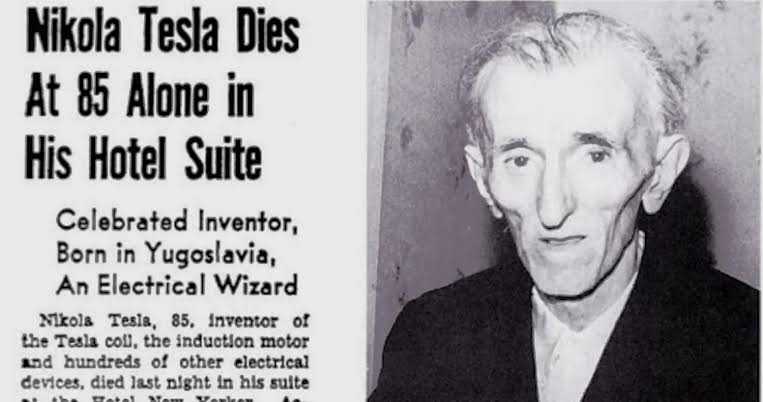
On January 7 in 1943, in Room 3327 of the New Yorker Hotel, Nikola Tesla died alone. He was eighty-six years old. The room was quiet. There were no relatives at his bedside, no admirers. In his pocket lay thirty-three cents. Around him, stacks of papers—calculations, sketches, fragments of visions unfinished—shared space with photographs of pigeons he had fed and named. The man who had bent waterfalls to human purpose and imagined a world joined by invisible currents slipped away seemingly unnoticed.
Nearly sixty years earlier, Tesla had arrived in America with little more than confidence and ideas too large to carry. He spoke in abstractions—fields, waves, forces unseen—and worked with a speed that unsettled those around him. In time, he shattered the limits of Edison’s world, replacing flickering direct current with a system powerful enough to light cities and carry energy across continents. Alternating current became the bloodstream of the modern age. Others grew wealthy from it. Tesla moved on.
His mind ranged far ahead of his century. He described radio before it had a name, control at a distance before wires were cut, communication without cables before the air itself seemed usable. He talked of energy transmitted through the earth, of signals leaping oceans. To investors, he was brilliant but impractical. To rivals, dangerous. To himself, compelled—unable to stop reaching.
By the interwar years, the future he had imagined had arrived without him. His great tower on Long Island stood abandoned, its promise unfinished. He drifted from hotel to hotel, increasingly solitary, increasingly eccentric, feeding pigeons in the park and dictating theories about cosmic forces to reporters who half-believed him. He still worked. He always worked. But the world no longer waited.
Five days after his death, New York noticed.
More than two thousand people gathered beneath the vaults of the Cathedral of Saint John the Divine. Scientists and engineers came. Government officials came. Messages arrived from across the world. Eleanor Roosevelt sent her respects. Those who spoke did not argue over his failures. They spoke of illumination—of a man who had altered the trajectory of civilization and paid for it in isolation.
Soon after, federal agents sealed his papers, uncertain what dangers—or possibilities—might lie within them. Some remain locked away still, the last echoes of a mind that appeared to move faster than history could follow.
Tesla left almost nothing behind that could be counted. But he left something greater than wealth. Every room lit after sunset, every device charged and humming, every signal leaping invisibly through the air carries a trace of his work. The world runs on ideas he once sketched alone in rented rooms.
Genius is rarely rewarded on schedule. Vision often arrives before permission. Tesla did not live to see the full reach of what he set in motion. But the current he released never stopped. It still moves—through wires, through air, through the modern world itself—long after the room where it began fell silent.
#archaeohistories
Earth’s slow wobble through the heavens...known as precession... takes about 25,920 years to complete a full cycle through the zodiac. Ancient astronomers called it the Great Year, dividing it into twelve cosmic months and four vast seasons spanning millennia.
The rhythms of the planet mirror the cosmos itself...a celestial clock marking time on a scale far beyond a single lifetime.
🚨BREAKING: IF Elon Musk says "I'm making the greatest phone in history, and anyone who likes this post and gives him a thumbs up 👍🏻will get the first edition for free!"
What's your response?
Don't miss the chance!!