Today, Foreign Affairs publishes a long essay I wrote summarizing some of my work on the global fertility collapse:
https://t.co/pdQVTk8DnH
It was a fantastic experience (with great editorial support) because the essay pushed me beyond pure economics to discuss issues such as geopolitics and polarization. Unlike some commentators, I don’t think the first-round economic consequences of fertility decline matter most; the second-round political and social ones do.
Yes, social security systems worldwide are in danger, but reality will impose itself sooner or later. The same politicians who swear over their ancestors’ tombs that retirement benefits will remain untouched will cut them (even if they are French). It will not be pretty, and most likely the cuts will come only after a major crisis and after politicians have tried everything else and failed.
Similarly, businesses will adapt to shrinking markets and valuations. Those who claim that capitalism somehow needs constantly expanding markets will be proven wrong. After all, this is the same misguided understanding of markets that has been proven wrong again and again since September 14, 1867, and that nobody really believes unless they have had the misfortune of earning a Ph.D. in a humanities department at an Ivy League school.
The real consequences will come when collapsing populations poison political systems. Look at the recent elections in eastern Germany. That is the future for all of us.
Also, the relative standing of great powers will shift drastically. Given current demographic trends, the U.S. will have a larger population than China by around 2100. The exact date depends on assumptions about net immigration into the U.S., but even with zero net immigration, the U.S. will overtake China by 2128. And Russia’s demographic future is only slightly more optimistic than China’s.
Those who dismiss these changes forget how antiquity ended in Western Europe. The western part of the Roman Empire entered acute demographic decline around 200 CE. By 476 CE, the western empire no longer existed. Despite some revisionist views that have cast a more positive light on late antiquity (and rightly corrected what was sometimes an overly negative assessment of the period), the fact is that England or France in 600 CE had lost most of their classical heritage, and material life had lost at least an order of magnitude in sophistication. The eastern part of the empire, however, weathered its demographic collapse much better and lasted another millennium.
No, I don’t believe we will go extinct (the Amish and Haredi will be enough for the survival of humankind), but the world will be very different in 2200 regardless of how you feel about it. The rational is the real and the real is the rational.
Super interesting!
"Louder than Rates: The Systematic Nature of Central Bank Communication" Tiziana Assenza, Fabrice Collard, Dogukan Guney, and Philipp Wangner.
"Do central banks decide systematically how much to communicate when explaining their policy decisions? Using all U.S. Federal Open Market Committee policy statements since 1994, we measure communication effort through the change in Shannon entropy and estimate a forward-looking communication rule. We find that communication is systematic: the Federal Reserve communicates more when inflation is expected to exceed target and output is expected to fall below potential. This finding is robust across a variety of sensitivity exercises. We then develop a New Keynesian model with imperfect information showing that systematic communication acts as a second policy instrument, stabilizing expectations and complementing interest-rate policy, especially at the zero lower bound."
https://t.co/DgEDaf4IkQ
Highly relevant!
"Government Funding Costs Under Financial Repression" by Roberto Gomez-Cram, Howard Kung, Hanno Lustig, and David Zeke.
"We study the equilibrium effects of financial repression on government funding costs in an endowment economy with limited asset market participation. We show how a broad set of repression policies operates through a wedge in the Euler equation responsive to government size or by affecting fiscal redistribution between agents. Repression intensity is captured by a policy feedback rule that depends positively on net government spending. When fiscal policy is profligate and monetary policy accommodates, we show that such a repression policy raises bond values, reduces the inflationary cost of unfunded fiscal expansions, and lowers bond risk premia. Repression is not a free lunch for bondholders—they pay a lower inflation tax but also earn lower future real returns. When monetary policy does not accommodate fiscal policy, repression can provide stopgap funding for deficits, allowing the central bank to retain control over inflation while making government debt a hedge for fiscal inflation."
https://t.co/Ih7xApBEUK
Days with above-average temperatures more than doubled in 2021–25 compared with 1981–2010. The OECD finds that climate mitigation policy effort has risen 66% since 2015, with growth slowing to just 1% in 2025. https://t.co/c4tyUs9Mob
#ClimateCrisis#ClimateJustice#OECD
Food for thought!
"Deep-π*: a neural network estimate of trend inflation" by Carlos Montes-Galdón.
"Most empirical models of trend inflation treat it as a latent random walk driven by unobserved shocks, so they cannot say which economic conditions move it. Deep- π*makes the innovations to the trend a possibly nonlinear function of a large number of macroeconomic indicators, estimated with neural networks, so that Shapley values can be used to attribute every movement of the trend to the indicators behind it. Two complementary loss functions define a current trend, which fits inflation today, and a forward-looking trend, which best predicts inflation over the next year. In US data, employment-related variables were the largest contributors to the post-pandemic rise of the current trend. However, the forwardlooking trend rose earlier, with real activity, employment, and money and credit as the main drivers from the start of the pandemic, and peaked eight to twelve months before the current trend. Both trends looked through most of the movements in energy and commodity prices. The contributions of the indicators are nonlinear, with sizeable interactions between them. Re-estimated every month during the surge, the model forecast inflation more accurately than the standard UC-SV model and a random walk, and in early 2021, when professional forecasters expected inflation of 3% or less, the forward-looking trend was already signalling an increase in persistent inflation."
https://t.co/0XRmlQHJxy
Fixing it requires a 4-part strategy:
1.Shift to high-productivity sectors
2.Lower compliance costs to boost formal jobs
3.Raise wages through productivity, not longer hours
4.Invest in care infrastructure to support women 2/2 https://t.co/uzxt2H8mWm
Indonesia’s labor paradox: Unemployment is down, but job quality is lagging. Former farmers are moving to informal retail instead of high-productivity manufacturing, leading to low wages, long hours, and barriers for women. 1/2
#Indonesia#LaborMarket#EconomicPolicy#JobQuality
@OpenAI then add to your prompt a sentence like "each paragraph provides a claim, discusses evidence that supports it and a sentence to connect the claim to the evidence, edited output should keep this structure unchanged" to avoid unwanted compression. 2/2
If you are using #ChatGPTPlus from @OpenAI or something similar for editing letters, manuscripts, etc., then do not forget to add what the chatbot should not compress. For example, if a letter has 4 paragraphs and each support a claim with evidence 1/2
An Open Letter to Economics Students
A good economist is constantly refining his understanding of the world, knows how to tell good evidence from bad, and reads and studies economics extensively, but also ventures well beyond the discipline. As the great Friedrich A. Hayek once put it: "Nobody can be a great economist who is only an economist—and I am even tempted to add that the economist who is only an economist is likely to become a nuisance if not a positive danger."
You've been told time and again that becoming a good economist requires learning a great deal of mathematics. Robert Lucas, the brilliant Nobel laureate who revolutionized macroeconomics, supposedly remarked that "Economic theory is mathematical analysis. Everything else is just pictures and talk." Lucas, God rest his soul, had a point: mathematical analysis often helps us uncover hidden assumptions, logical fallacies, and gaps in reasoning that can easily slip unnoticed into purely verbal arguments. But I think he went a little too far. Economics is not a branch of mathematics. Some of the greatest minds in the history of economic thought barely used mathematics in their writings. Read the economists of the past and then try telling me otherwise. As James M. Buchanan once said: "But let us be honest. How much more do we know about market process than Adam Smith knew that is of practical relevance?" Boom! Some economists (ideally ones who have actually read The Wealth of Nations—a requirement that drastically shrinks the sample we're talking about) will tell you that we know a great deal more. I'm not so sure.
Learn mathematics, students. But please, please, please, above all, learn economics. Did you enroll in an economics program just so you could brag about having memorized Brouwer's fixed-point theorem or crack bad jokes about setting derivatives equal to zero?
To learn economics, you need to read. A lot. A LOT. A WHOOOOOOOOLE LOT. Don't expect to master this discipline anytime soon. Don't be like the arrogant twentysomething Sergio I once was. The goal is to reach 60 and, God willing, be able to say with some confidence that we know considerably more about economics than the average layperson. There are exceptions. At just 21, Ronald Coase was already developing the idea that would help earn him a Nobel Prize almost six decades later: the simple yet profound insight that using markets is costly. I wouldn't be surprised if there's more than one Coase among you.
Some professors don't do nearly enough to point you toward what you should or could be reading. And economics isn't learned by osmosis; you won't learn growth models by sleeping next to Romer's macroeconomics textbook. You need to open and study good books, preferably with pen and paper close at hand. Here are my recommendations.
The first thing you must learn thoroughly is microeconomics (price theory, for the nerds). If you don't learn microeconomics well, you won't become good economists. Good economics is good microeconomics. If you start reading behavioral economics books (people like Kahneman [who at least won a Nobel Prize] or Dan Ariely [who, despite the data-fabrication controversies, keeps teaching and selling books like hotcakes]) without first learning microeconomics REALLY WELL, you'll end up like the knuckleheads who solemnly announce such earth-shattering discoveries as the fact that human beings aren't walking calculators. Worse, you risk jumping to the conclusion that traditional economics is garbage because it assumes rational economic agents (a stupid conclusion, if you ask me).
You've misunderstood microeconomics if you believe it's merely "a series of constrained optimization exercises," as one professor once put it. I can hardly imagine a more uninspiring definition of microeconomics. It's like saying that carpentry is a series of wood-assembly problems. It's the kind of soulless answer ChatGPT would give you. There's a half-truth in it, but it falls well short of the whole truth. Yes, in microeconomics we're interested in using optimization methods to model the behavior of individuals and firms. But microeconomics is much more than that. It studies how individuals organize themselves—within households, within firms, or through markets—to improve their circumstances, and how human beings solve the inevitable coordination problems that arise from scarcity. It's optimization, yes, but also human action, interaction, conflict, competition, and coordination. One of my favorite economics books captures these themes beautifully in its title: Exchange and Production: Competition, Coordination, and Control.
To get a better sense of what I'm trying to say, I warmly encourage you to read "Economics Is a Way of Thinking," a short essay by Paul Heyne, who also wrote one of the finest introductory economics textbooks ever published: The Economic Way of Thinking. And if you're looking for something a little more demanding, read "What Should Economists Do?" by James M. Buchanan.
There are many paths to learning microeconomics well. Choose whichever one you find most enjoyable, because—to paraphrase something David Friedman once said in an interview—having fun makes learning easier. I've never managed to have much fun reading Hal Varian or Walter Nicholson (authors of popular intermediate microeconomics textbooks). But I've had a wonderful time reading The Applied Theory of Price, by Deirdre McCloskey, whose books I love (it’s the best microeconomics textbook, or so she once told me); Price Theory and Applications, by Jack Hirshleifer; and, more recently, Chicago Price Theory, by Kevin Murphy, Casey Mulligan, Sonia Jaffe, and Robert Minton.
But I'm getting ahead of myself: before moving on to intermediate microeconomics books, you should go back to the foundations. You should definitely give the following three a chance: Basic Economics, by Thomas Sowell; The Economic Way of Thinking, by Paul Heyne; and Universal Economics, by Armen Alchian and William R. Allen (or any of the older editions, published under the title University Economics). Sowell's book will teach you how to communicate economic ideas and to think more deeply about what lies behind the graphs and equations. Heyne's book delivers exactly what its title promises: it teaches you to think like an economist. And Alchian and Allen's books are an absolute delight. They were written as a response to Samuelson's textbook, which dominated the introductory economics market for much of the twentieth century. Alchian and Allen had an enviable talent for digging deep into economic ideas, and each of them published work of his own that you should dive into. Liberty Fund published a collection of Armen Alchian's papers, and the three volumes of The Midnight Economist collect segments from William Allen's radio program. I could spend hours telling you everything I've learned from those books. I return to them again and again.
And while we're on the subject of entertaining books, here are five more: The New World of Economics (Tullock and McKenzie), The Armchair Economist (Landsburg), Hidden Order (Friedman), The Undercover Economist (Harford), and Economics in One Lesson (Hazlitt). Of these five, start with Hazlitt. Henry Hazlitt was an American journalist who wrote for Newsweek (a magazine to which Milton Friedman and Paul Samuelson would later contribute) and who DEVOURED economics books. His work was inspired by the writings of Frédéric Bastiat, another economist I strongly recommend reading and rereading, since few have matched his satirical wit and intellectual sharpness when it comes to exposing economic fallacies.
I could keep recommending books, but I'll stop here to do something different: tell you what not to do.
Try to avoid charlatans. They're hard to spot when you're just beginning your economic education and your ability to tell good economics from bad is still developing. (You're like aspiring coffee connoisseurs tasting coffee for the first time; it'll take a while for your palates to mature.) Some people are enormously popular in the media but enjoy little recognition or prestige in more serious intellectual circles, and for good reason. You'll have to learn to identify them on your own.
A useful rule of thumb is to avoid spending too much time on books with an obvious political agenda or with titles along the lines of "This Book Will Reform Capitalism"; "We Challenge the Neoliberal Model"; "Conventional Economic Wisdom Is Wrong, and Here's Why"; "Smith Was Wrong: Markets Don't Regulate Themselves Through an Invisible Hand"; "The World Is Ending Because of Our Obsession with GDP"; "Here's How Milton Friedman Ruined Chile and Threw Communists Out of Helicopters"; or "My School of Economic Thought Is Superior to Yours." All of these are parodies of real books. Some of those books may contain interesting ideas, even challenges that deserve serious consideration. But please don't begin your studies down that road.
What follows is a very personal opinion, and it may upset some people: I would avoid authors such as Stiglitz, Krugman, Mazzucato, Ha-Joon Chang, and… other enormously popular writers. Stiglitz and Krugman won Nobel Prizes, but many of their more recent books are a far cry from the contributions for which they received those awards. One serious problem with the Nobel Prize in Economics is that it has helped turn some laureates into all-knowing economics gurus, a danger Hayek warned against in his 1974 Nobel banquet speech. There are interesting books by Krugman and Stiglitz. From Paul Krugman, I could recommend Pop Internationalism, as well as his essays "Ricardo's Difficult Idea" and "What Do Undergrads Need to Know About Trade?"; from Stiglitz, his public finance textbook. But many of Stiglitz's and Krugman's writings have far too propagandistic a flavor for my taste. Don't take my word for it: judge for yourselves.
Your economic education needs time to mature before you go around devouring works of normative economics left and right. You're free to read whatever you like, but hold off on passing final judgment on a book until you've developed a more mature intellectual framework.
Favor economists who respect your intelligence and your ability to reach your own conclusions over those who insult you or question your motives if you don't uncritically accept their worldview.
Speaking of worldviews, we all have one: a set of principles and moral intuitions that guide us, tell us what is right and wrong, help us make decisions, and incline us to accept certain ideas while rejecting others. These worldviews are abstractions, much like economic models. They're ethical abstractions: simplified representations of moral problems that help us navigate the ethical complexities of different social conflicts. Anyone who denies having a worldview or claims to be entirely free of ideological influence usually fails to recognize their own biases. Worldviews are necessary; principles are fundamental. But be careful not to let your worldview lead you to ignore economic evidence or arguments that make you uncomfortable or challenge your convictions. You must be able to acknowledge, with scientific humility, that—surprise!—you don't know everything. And you must accept that your ideas, including those you hold most dear, could be wrong. That's part of your responsibility as aspiring social scientists. With this in mind, please avoid getting immediately attached to an ideological label or joining a political tribe. Don’t worry about proving that you’re on the left, the right, or somewhere in the center—at least not while you’re still a beginner. If you want a good laugh, follow the example of economist Jesús Fernández-Villaverde, who once described his views as those of "a left-wing Hayekian or a right-wing Keynesian." Many people, especially non-economists, will want to put you in a box. If they hear you say something they agree with, they won't fully embrace your argument until you've reassured them that you're on their side. If they hear you say something they disagree with, they'll try to discredit you by assigning you to an ideological camp you may not even belong to. That's how people behave on many economic questions: like members of a sect.
In class, I've encouraged students to pay attention to the news, to what's happening in the world, and to social media. It can be a nuisance at times, but we shouldn't cut ourselves off from contemporary problems. My intention isn't to encourage you to spend your days arguing with strangers on the Internet (an activity on which I'm perfectly capable of wasting an extraordinary amount of time). I want you to become more attuned to the things that trouble ordinary people; I don't want you to ignore the issues people are discussing online. And although I've already advised you against spending too much time fighting on the Internet, I DO believe you should put your knowledge to the test in spoken and written exchanges. Social media can sometimes be a useful training ground. You need to learn to discuss economic issues with people from other disciplines; you need to learn to express yourselves eloquently without having to draw a supply-and-demand diagram or ask the other person to be patient while you write down a Lagrangian. It's embarrassing to see economists who can't communicate what they know to a non-specialist audience. I don't want that to happen to you. Besides, getting to know what people think about economics will also make you more aware of the most common economic fallacies. That's knowledge worth having, because ideas move the world, and fallacies can lead it down dangerous paths.
And if, after all that, you still feel an overwhelming temptation to join an ideological camp, I ask only two things of you: stay open to the possibility that you're wrong, and pass what economist Bryan Caplan called the Ideological Turing Test. What does the test involve? Understanding your ideological opponents' positions so thoroughly that you can state them in a way they themselves would consider fair. If you can blend into an ideological group that isn't your own without anyone being able to tell you apart from its actual members, you'll already have accomplished far more than most people. You'll have taken opposing views seriously enough to truly understand them and to avoid attacking straw men. Two books that have helped me better understand how different people think about politics are A Conflict of Visions, by Thomas Sowell, and The Three Languages of Politics, by Arnold Kling. Don't confuse this exercise, however, with adopting a kind of moral relativism in which "anything goes." That's a conversation for another day.
May your love of economics be insatiable. Never stop learning. I'd like to keep writing, but it's getting late, so I'll put down my pen here.
Until next time.
🚨 New article alert! 📈
"Partisan Wishful Thinking in Polarized Times" is now out at @PolBehavior. Nearly 90% of today's voters expect their party to win, a sharp increase from two decades ago. Rising partisan animosity can explain much of the increase!
https://t.co/aAsj4ruqab
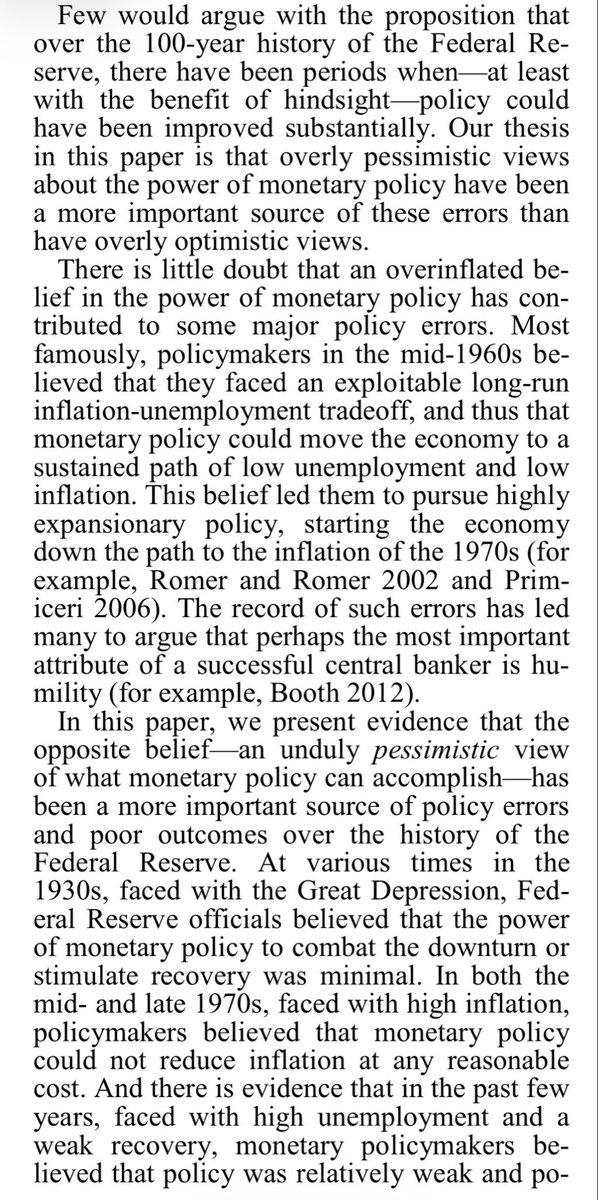
The smart finance guys are making lots of good points about AI, data centers, etc etc etc but I am always haunted by Romer & Romer about the disastrous consequences of underrating the power of basic macro.
https://t.co/efXxIgqDpU
I watched "My Neighbor Totoro" in 1997 on a VHS cassette that an uncle brought from Japan. I wondered what would be like to live in the fantastical worlds built by Miyazaki. Now with AI I get to insert myself into such worlds. Technology always helped us create new worlds for us!
Super interesting!
"Globalization, Inflation Dynamics, and the Slope of the Phillips Curve" by Colin Hottman and Ricardo Reyes-Heroles.
"We study how international trade has affected U.S. inflation dynamics. We develop a multiregion New Keynesian model of an open monetary union in which regional Phillips curve slopes depend on exposure to imported goods. Guided by the model, we construct statelevel measures of import penetration in final consumption and exploit cross-state variation to estimate regional Phillips curves over 1976-2017. Greater import exposure leads to significantly atter state-level Phillips curves. We estimate that rising import exposure accounts for roughly 40 percent of the flattening of the U.S. Phillips curve over this period. Increased import exposure also shifted the U.S. Phillips curve downward, reducing inflation by about 0.17 percentage point annually between 1976 and 2008. A reversal of globalization to early-1990s levels would substantially alter monetary policy trade-offs, reducing the sacrifice ratio by almost one-half. Our findings show that international trade has played a quantitatively important role in shaping U.S. inflation dynamics."
https://t.co/mPIk6bpeds
The impact of AI on jobs is still pretty unclear at this point. I don't find this very surprising, as employers are still figuring out individual adoption, let alone how you use AI in complex organizations. Things may start to happen faster as agents capable of real work spread.
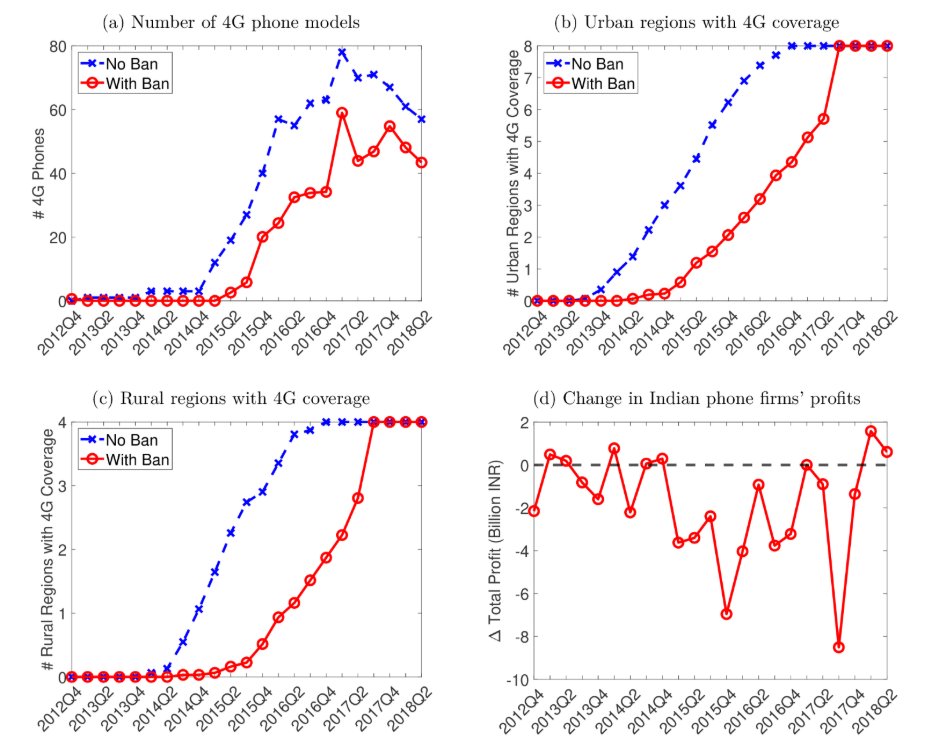
Using India's 4G rollout as a case study, researchers show why industrial policy needs to account for complementarities between linked markets. Restricting low-priced Chinese phones slows network expansion, and leaves Indian firms no better off. https://t.co/ebEWqgjR9e
📣 We are excited to host the first Women in Macro Virtual Workshop with @ISWEconomics on April 25, 2025!
Featuring presentations, discussions, and a keynote delivered by @IsabelleMejean.
📅 Submit your paper by 28 Feb 2025.
Details 👇
#WomenInEconomics#WomenInMacro
Highly relevant!
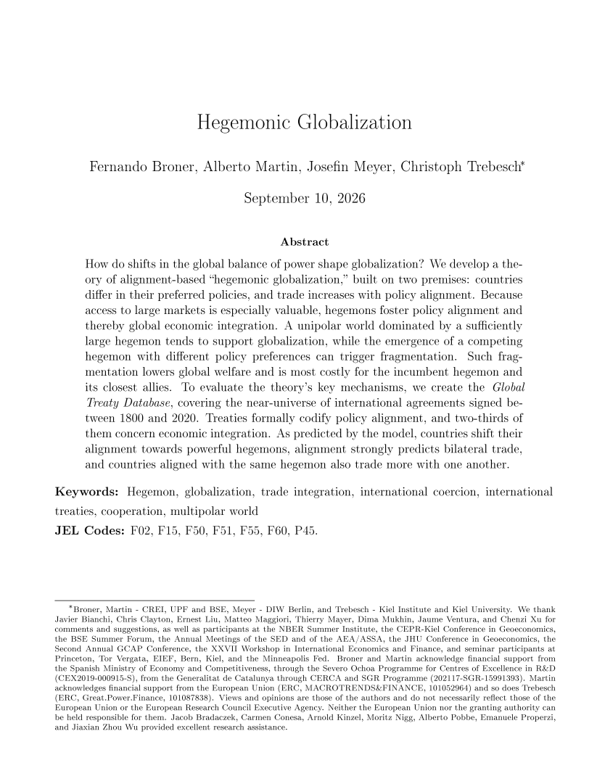
"Hegemonic Globalization" by Fernando Broner, Alberto Martin, Josefin Meyer, and Christoph Trebesch.
"How do shifts in the global balance of power shape globalization? We develop a theory of alignment-based “hegemonic globalization,” built on two premises: countries differ in their preferred policies, and trade increases with policy alignment. Because access to large markets is especially valuable, hegemons foster policy alignment and thereby global economic integration. A unipolar world dominated by a sufficiently large hegemon tends to support globalization, while the emergence of a competing hegemon with different policy preferences can trigger fragmentation. Such fragmentation lowers global welfare and is most costly for the incumbent hegemon and its closest allies. To evaluate the theory's key mechanisms, we create the Global Treaty Database, covering the near-universe of international agreements signed between 1800 and 2020. Treaties formally codify policy alignment, and two-thirds of them concern economic integration. As predicted by the model, countries shift their alignment towards powerful hegemons, alignment strongly predicts bilateral trade, and countries aligned with the same hegemon also trade more with one another."
https://t.co/MmkmgfyTQc