@zerohedge Price gets most of the blame in the data (52% say QSR is too expensive, per Datassential). But when you pay more, you should be able to see what's in it. At Goodniss we check "every ingredient, who owns the company, and the testing behind it."
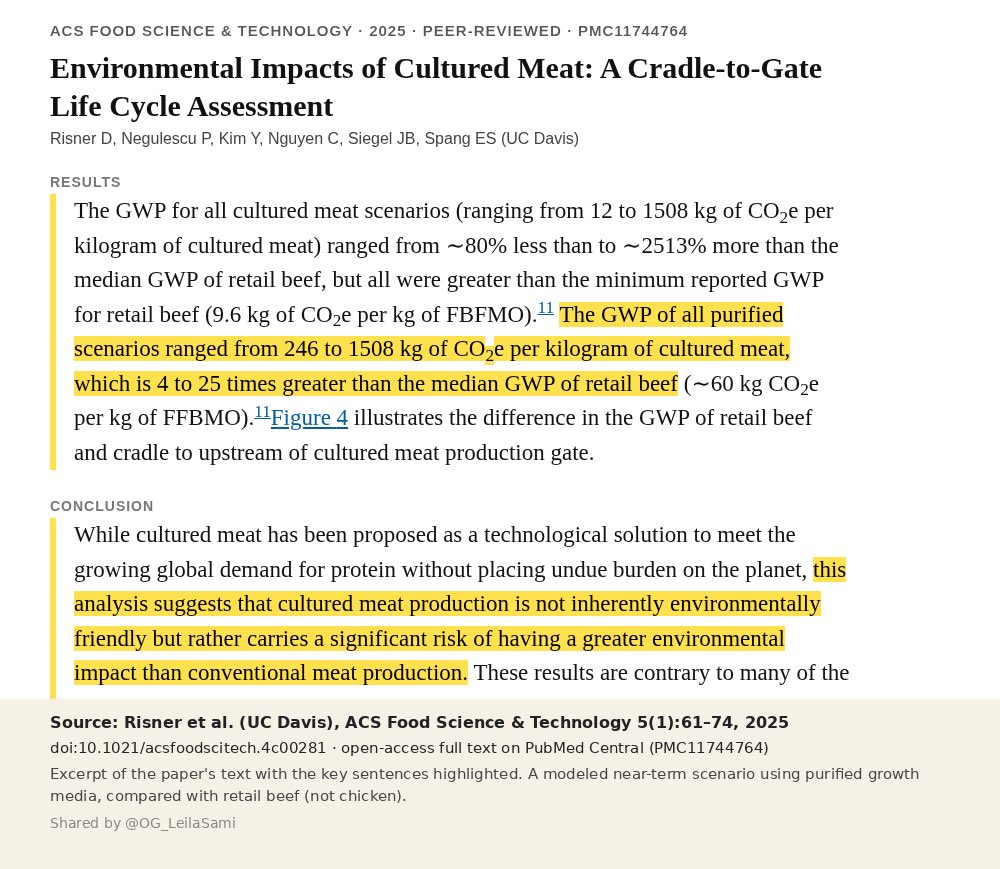
Lab-grown chicken just hit California menus.. and I’m so grateful for real chicken from local farms 🐔 UC Davis researchers modeled lab-grown meat made with purified media at 4 to 25x the carbon footprint of retail beef. Real food, real farmers
@carldemaio The bigger question for most families is what's actually in the tub. Protein powders vary a lot in ingredients and testing. Look for third-party testing, a short ingredient list, and no artificial sweeteners or dyes.
@RWMaloneMD Whoever leads the FDA, a clear definition of ultra-processed food matters to every family reading a label. Without one, "healthy" on a box can mean almost anything. That's the work worth getting done.
@ZeinaMoukaMD The "without noticing" part is the key. Ultra-processed food is built to be easy to overeat. Reading the ingredient list before it hits the cart is still the simplest defense.
@nicknorwitz Appreciate the nuance here. "The evidence is not consistent" is a sentence the low-fat era rarely said out loud. Real butter vs the margarine and seed-oil spreads that replaced it is a conversation a lot of families are having now.
@thegarybrecka This is the part people skip. Candles, plug-ins, cleaners, laundry: so much of it just says "fragrance," one word that can stand in for a long ingredient list you never see. Fewer scented products is an easy first step.
@GenericSnarky It's there for looks, not nutrition: it makes colors pop and coatings look bright. Worth checking labels on candy, frosting, and coated snacks too, since color additives turn up in more places than people expect.
@CaryKelly11 Covering the brand name is the best label test there is. Read the list cold and the health halo disappears. Short list, ingredients you'd cook with yourself, no seed oils: that's the bar, whatever the box claims.
@thefoodbabe@rosannascotto TBHQ is the one most people have never heard of, and it shows up in plenty of holiday staples. "BHA, BHT, and TBHQ" are a hard no for every product on Goodniss. Homemade biscuits win every time.
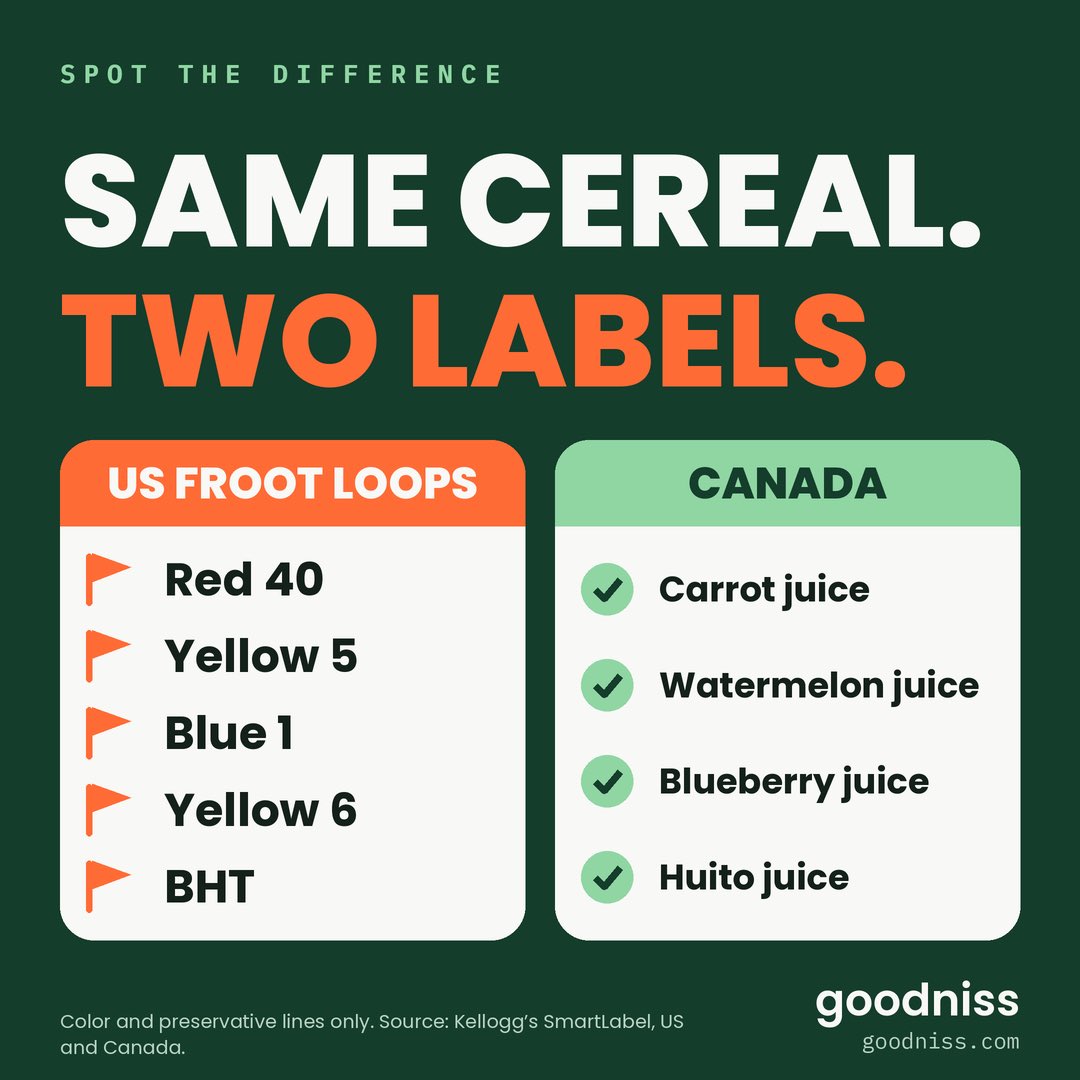
Same cereal. Two labels.
US: red 40, yellow 5, blue 1, yellow 6, BHT for freshness.
Canada: carrot, watermelon, blueberry and huito juices for color.
WK Kellogg says new US recipes ship by year-end. Check the box in your hand.
Founding Member spots: https://t.co/TXNTm1nna7
@lowmegatron Worth adding to step 5: seed oils hide where people aren't looking. Many oat milks use rapeseed oil, many "olive oil" mayos are mostly soybean or canola, and many vitamin E and D softgels use soybean oil as the carrier. That's why carrier oils are on our @goodniss_ checklist.
@MAHA_Action The turning point is documented. Upstream diversion of the Gila River in the late 1800s wiped out Pima farming, and families were pushed onto commodity flour, lard and sugar. Similar genes across the border, and a 2006 study found ~7% diabetes in Mexican Pima vs 38% in Arizona.
BHA, BHT, and TBHQ: three preservatives you'll never find in a Goodniss product.
How to spot them:
• Scan the ingredient list for the letters or full names (see image)
• Watch for "added to preserve freshness"
• Check cereal, crackers, and chips
Save this for your next shop.
@CaryKelly11 That finding is sobering, and the Doritos aisle isn't even my main worry. It's the "kid healthy" one: fruit snacks "made with real fruit," yogurt tubes, granola bars. Often the same emulsifiers, gums and added sugars, just friendlier packaging. A big focus at @goodniss_.
@paulsaladinomd@Uber@lyft Fragrance-free should be a filter everywhere, not just in rides. One word, "fragrance," can stand in for a whole blend you never see listed. That's why undisclosed "natural flavors" or "fragrance" are a hard no for products on Goodniss.
@Old_SchoolEddie Good question from your wife. The yellow is usually annatto, a seed extract, so color is a wash. The bigger tell is "enzymes" on the label, which usually means rennet made by GMO microbes, first approved as a Pfizer product. Citric acid is mostly made by fermenting black mold.
Listen up Americans, our food is poison
American healthcare worker says popular snacks are damaging the stomach and colon linings of our kids and more
“As an emergency medicine and hematology oncology physician assistant, for the love of God, can we as parents please stop feeding our children Hot Cheeto fries and Takis and then complain about them developing stomach issues later on in life? All kinds of stomach issues. Gastritis, colitis, ulcerations, ulcerative colitis, possibly even colon cancer.
I'm pretty sure that's gonna be studied in the next 5 to 10 years, but can we please stop? — It is extremely unhealthy. And yes, you know, Lil Ray Ray or Lil Susie may love them, but it is destroying their insides and it's not okay. It's just not okay.”
“That spice and the other additives that those use create a source of pain And inflammation, damage to the actual tissue in the lining of the stomach and the lining of the colon. Okay, that can have disastrous consequences moving forward. So can we please stop doing it?”
“Circulate this around”
This is widespread. One Memphis children’s hospital gastroenterologist reported seeing roughly 100 kids per month with these issues linked to spicy chips
Ingredients that are harmful
- Capsaicin activates pain receptors (TRPV1) throughout the GI tract. In high amounts it produces a burning sensation, can increase local irritation or inflammation, and in animal studies high doses damaged intestinal tissue
- Citric acid / low pH: Tests of the powdered seasoning on these chips have shown pH around 3 (more acidic than the normal gut environment of ~5). This adds chemical irritation on top of the spice
- High sodium and fat contribute to overall gut irritation and can worsen symptoms
- Red40
We have to make America healthy again and move away from this ultra processed junk
Your glasses aren’t healing your eyes—they’re making them WORSE.
By age 45, most people rely on corrective lenses. But what if that decline wasn’t inevitable?
What if it’s a reversible issue that most eye doctors never test for?
Let’s uncover the truth, step by step:🧵