DOES OPEC+ NEED TO CUT?
There is a flurry of news around OPEC meeting including WAF countres’ quotas and potential production cut. Is it needed? Or would OPEC (Saudi Arabia) simply yield their market share to Permian?
Big Picture
Let us review the big picture and understand why we are even having this discussion after all the “massive OPEC+ cuts”.
* 2022 was a surplus year (even counting SPR draws) the current estimates range between 0 and 830 kbd surplus. OPEC’s own estimate is +410 kbd. Q1 2023 was also a (larger) surplus quarter. Saudi Arabia wants to both keep the prices higher (probably above $80) and put the curve into a more solid backwardation – which is more difficult with interest rates at 5.5% then when they are at 0 (I will discuss backwardation later). For that it needed to engineer draws – i.e. keep the market in deficit for several quarters.
* Demand growth has outperformed in 2023 – OPEC’s own estimate is +2.46mbd YoY, IEA is +2.1mbd, GS is +2mbd.
* Non-OPEC supply grew YoY by +2mbd (OPEC), +1.9mbd (IEA), +2.2mbd (GS), basically meeting all the demand growth.
* Now question – what happened to OPEC+ supply? At the end, the cartel has announced circa 5mbd of cuts (2mbd in Oct 22 / 1.65mbd in April / 1mbd – Saudi lollipop and 300kbd “extra” Russian “exports” cut). Well, as per IEA OPEC+ total liquids production for 2022 was 52.2mbd. As of October 2023, OPEC+ was producing 43.16mbd in crude and NGLs/non-conventionals/condensate are around 8mbd. So the total is around 51.2mbd –just 1mbd below the 2022 level. To be fair the cut is higher vs OPEC+ peak production last October, but is still far from 5mbd: it is around 1.6mbd.
To summarize: the market was in a surplus in 2022 (around 0.4mbd) and in Q1 2023 (higher), demand growth was met by non-OPEC and OPEC+ has collectively cut only by 1mbd vs 2022 average production. As a result, the market -with current OPEC+ production levels - is only in a small deficit on an annual basis and can go into surplus because of seasonality (which may happen in Q1 2024).
Why OPEC+ production decrease is so small?
2 reasons:
* Not all OPEC+’s are equal: exempt members that are not subject to quotas as their production levels are already impaired (Iran, Libya, Venezuela) are currently producing circa 0.9mbd more than in 2022 and around 0.75mbd above Oct 2022. In addition some non-exempt members (Nigeria and Angola) which were severely underperforming their quotas were able to increase production by 0.45mbd and still remains below the quota level.
So, comparing to peak Oct 2022 production, the rest of OPEC+ did cut around 2.95mbd.
* Big part of the cuts is virtual – as they happen against artificially high production levels that were never achieved.
Note that I am jumping around between total liquids and crude – but this is because demand is normally assessed in total liquids and OPEC+ quotas are in crude. OPEC+ NGL/condensate production is fairly stable though, so it is ok for big picture.
Is Saudi Arabia carrying all the weight of the cuts?
Most of it, but there are nuances: out of 2.95mbd cut (Oct 2023 vs Oct 2022) by non-exempt, non-underperforming OPEC+ members 2mbd were delivered by KSA.
But we need to keep in mind that October 2022 KSA crude production of 11mbd and 2022 average 2022 of 10.5mbd was very high – at peak on an annual basis. On a monthly basis it exceeded the Oct 2022 level of 11mbd only during the brief price war in April 2020. Also, 11mbd is probably not that far from KSA sustainable production capacity for crude production: in April 2020 it was around 11.6mbd (OPEC MOMR – 2dary sources and IEA). Currently IEA assesses sustainable KSA capacity at 12.16mbd.
This high production at the start of the cuts vs capacity/history was not the case for all other members (e.g UAE) – so KSA’s burden is high, but not as high as it seems just looking at cut sizes.
Why does OPEC+ wants backwardation?
Two reasons:
* US producers �� which net-net delivered pretty much all the world production growth since the start of shale revolution and are still expected to deliver more than 50% of liquids production growth in 2023-27 as per most forecasts, do hedge (the hedging program was as high as 1.4bln bbl at some point) – so a backwardated curve gives an advantage to national OilCos which do not and cannot hedge (as their volumes are too big) vs shale producers.
Now public US E&Ps are much less levered and a lot of consolidations have happened leaving more production with larger playerswho have lower hedging requirements from lenders, but hedging is still a factor.
Also, it is important to keep in mind that futures curve does not provide the full picture – when inventories are tight, physical premiums for actual oil also typically shoot up (Dated Brent vs ICE future and various grade vs dated) – so actual OPEC+ producers’ advantage is even higher than the curve suggests.
* Curve in backwardation makes staying long a positive carry trade, favoring longs; curve in contango does the opposite. This is relevant for speculative flow (and OPEC wants the market to be long and create a cost for shorts).
Funnily enough, at the end of September, a combination of strong draws, low Cushing positioning and flows have engineered a fierce rally and have put WTI/Brent curves into extreme backwardation (1y forward spread reached $15.4 and 22% in terms of interest-rate adjusted spread). Back then we were talking about Saudi Arabia releasing some barrels to alleviate extreme shortage….
As I explained several times before, higher interest rates make OPEC’s job of engineering backwardation harder.
Theoretical logic is that a hypothetical non-dividend paying financial asset grows in line with risk-free interest rates – this follows from no-arbitrage argument. Moving futures lower vs this hypothetical level takes more effort (with rates at 0% your starting point is a flat curve, with rates at 5.5% - it is a curve in contango). A more practical explanation is that higher cost of capital makes holding inventory more expensive and creates more incentives for inventory optimization; attempts to quantify the effect (e.g. by GS) based on inventory-backwardation data yielded an effect that is similar to the theoretical one.
Anyway, the bottom line is: the market – based on current demand - is probably in a small deficit – on an annual basis. However, the deficit is not pronounced enough to engineer a stable and strong backwardation especially when demand is seasonally weak. In October, elevated OPEC+ exports, a drop in refinery runs , positioning going back to the lows (based on renewed recession worries) and negative gamma from Mexico option hedges resulted in a large selloff.
Is cheating a big problem this time? OPEC+ overproduced, but (probably) not by a ton.
* IEA shows UAE production 0.38mbd above the target, although other sources- e.g. Argus show only a small overproduction. I imagine UAE situation is tricky since their production capacity is high (IEA estimates it at 4.2mbd) and output relative to capacity is one of the lowest if not the lowest in alliance.
* Iraq is overproducing by 0.12-0.16mbd (partially due to KRG production revival – oil is still not flowing via Ceyhan-Kirkuk, but most of the production volumes have returned and are being sold/used locally or trucked)
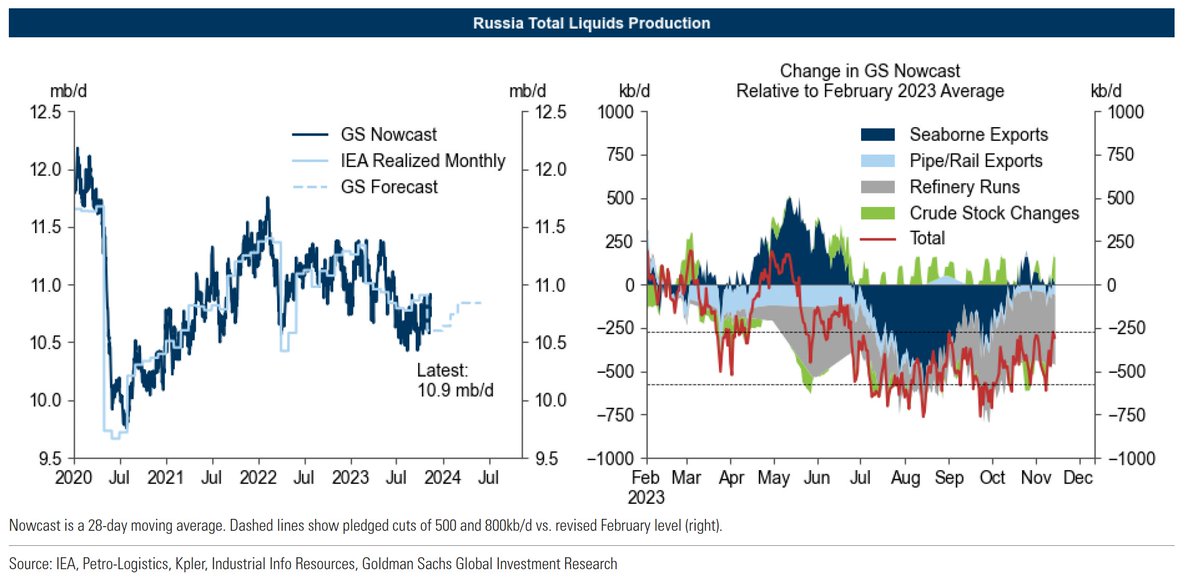
* Russia has committed to 0.5mbd cut vs February levels (9.87mbd in crude as per IEA). Crude production has stayed in 9.45-9.53 range since June as per IEA: so roughly 400kbd below committed number (hence 100kbd overproduction). In addition, Russia has committed to reduce net exports by 300kbd from September. Looking at GS high-frequency production tracker it seems that RU has been fulfilling the 500kbd cut pledge (higher dotted line on the right), but not the 800kbd.
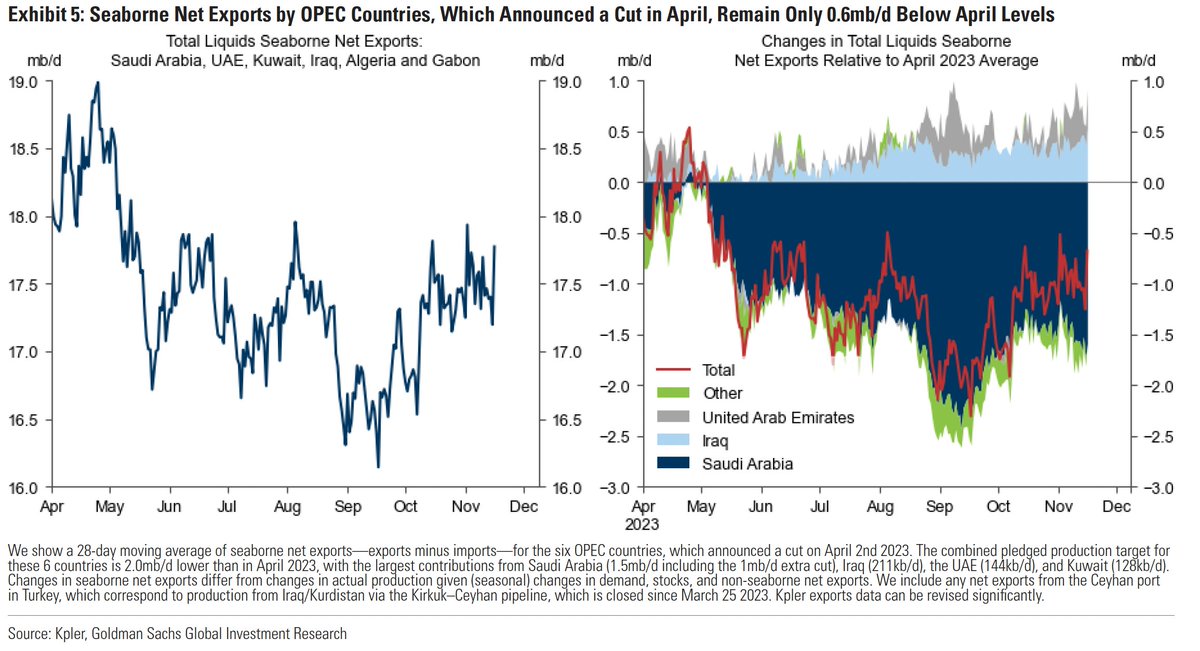
It looks like OPEC over-exported more – including KSA
Part of it is seasonality, but part is probably destocking.
So, should OPEC cut or not?
IEA and some agencies (e.g. Energy Intelligence) see Q1 in a small (0.5mbd) surplus – even without recession or any unexpected demand weakening and with stable OPEC+ production. Others, including OPEC itself see the deficit.
OPEC could just roll the current cuts over and try to enforce better compliance. The prices could end up at the lower end of acceptable range (even below $80 for Brent on average), but won’t go crazy low. Such steps would not attract speculative flow and getting into stable backwardation could get delayed until Q2 or the middle of next year.
But on the bonus side the life of non-OPEC would be a bit harder: US E&Ps, which have circa 55% of crude in their product stack would have “meh” oil prices on top of low NGL and gas prices (for U.S. natural gas, it looks like monster U.S. production gains “arranged” for low prices for the whole of 2024 – until new LNG facilities are commissioned).
Cutting more to sort out inventories for Q1 and bringing production back after that is also a possibility. I do not think it is necessarily a losing game: U.S. – having shed 20% of rigs from the peak and going into year-end probably won’t react with a massive production boost anyway.
And longer-term everything will depend on which outlook for U.S. production would prove to be right – i.e. if U.S. won’t grow total liquids production more than 300-400kbd a year at $80-100 price OPEC will most likely end up in control. If U.S. will continue to surprise again and again – and will grow much more than that, it means that the floor OPEC seems to be aiming for ($80) is not defensible without surrendering market share.
To be clear – while U.S. indeed outperformed in 2023 (see the previous note) I think the jury is still out: this outperformance comes on the back of efficiency gains, that are not going to repeat every time and a year of high prices (Brent average was close to $100 ) and panic about energy security. It should be noted that OPEC’s own forecast for U.S. production from 1 y ago was pretty spot on.
Of course, if OPEC+ goes for a cut it would need to be socialized among the members.
@ira_joseph - fyi (sort of an expanded writeup triggered in part by our comments' exchange:).
These guys built an acquisition empire in Chicago.
It started with the purchase of a struggling bicycle manufacturer for $95k.
And grew to $8 billion in sales and sold to Warren Buffett.
Here is their playbook...
BREAKING NEWS
#GBP#TRP
World beater: TotalEnergies' vast Venus discovery in Namibia may be biggest ever deep-water field,sources
Brazil's Buzios with 11.3 billion boe of recoverable reserves - tops the table of premier league deep-water finds, but that position now threatened
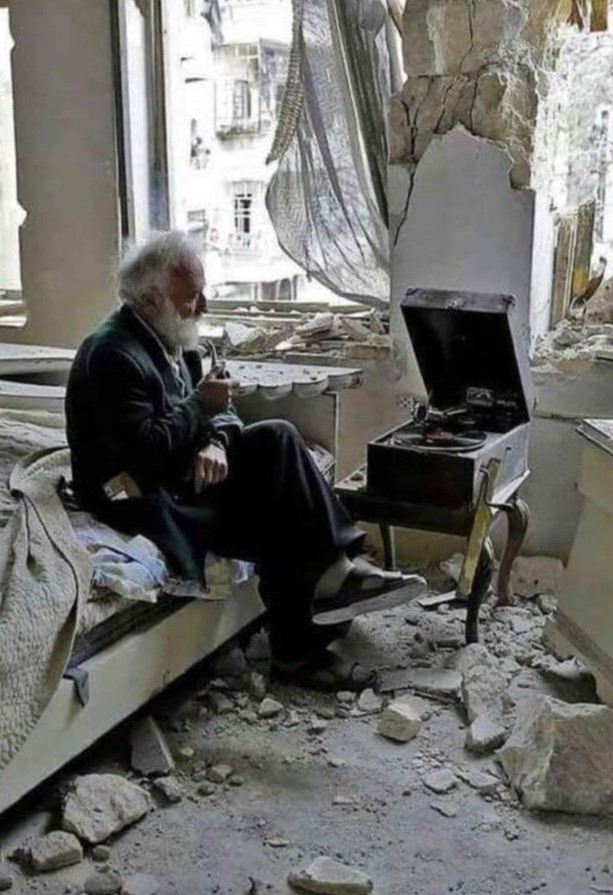
Ukraine, Syria, Yemen, Afghanistan, it doesn't matter. War is war. Our condolences to those who lost everything without having a choice. Having more empathy would be an achievement for humanity
KREMLIN SPOKESMAN SAYS UKRAINE MUST AMEND CONSTITUTION AND REJECT CLAIMS TO ENTER ANY BLOC
UKRAINE MUST RECOGNISE CRIMEA AS RUSSIAN, AND DONETSK AND LUGANSK AS INDEPENDENT STATES
IF THESE CONDITIONS ARE MET, THEN RUSSIAN MILITARY ACTION WILL ‘STOP IN A MOMENT’ - SPOKESMAN
KREMLIN SPOKESMAN SAYS UKRAINE MUST AMEND CONSTITUTION AND REJECT CLAIMS TO ENTER ANY BLOC
UKRAINE MUST RECOGNISE CRIMEA AS RUSSIAN, AND DONETSK AND LUGANSK AS INDEPENDENT STATES
IF THESE CONDITIONS ARE MET, THEN RUSSIAN MILITARY ACTION WILL ‘STOP IN A MOMENT’ - SPOKESMAN
Glad I opened a Long on #IHG via IG last Thursday! £150 @ 116.8. In terms of bottoms I think I have nailed it! This is going to be spectacluar! MM is out for blood and will roast the Short Funds from 8am Monday!
@piersmorgan Bloody Disgrace! I was horrified by this yesterday and can confirm this was real! @Harrods was horrific, for many months this has been a problem and the store is losing what was so great about it.
@TheMoneySponge@sadaatumar@bagger_aim Hi @TheMoneySponge OMI & GRL had the same setup as #PVR (double squeeze breakout). OMI did a 3.5x from 1.4 lows to reach ~5p when the double squeeze broke out (big news) to hit 46p (9x). 7p is equivalent to when OMI was at 5p. The setup present is rare & one of the strongest.