Recall that at some point, most startups were either using Postgres or Mysql as their underlying OLTP database.
You deployed your LAMP stack and you replaced Mysql with Postgres as you saw fit.
This was a perfect solution until you hit a good problem called scale.
Scaling Datastores at Slack with Vitess - Slack Engineering.
Finally got around to reading this 3 year project and it was just great!
App agnostic sharding wins again.
Congrats to @SlackHQ @vitessio https://t.co/Slv9VVxbO2
🎙️ State of Agentic Coding with @mitsuhiko returns for Episode 7
In this pre-Fable 5 episode:
- looping?
- no more human-designed programming languages?
- the state of local coding models
- the marketing of token-maxing, and more
Anthropic’s Dario Amodei has only 1 direct report, his chief of staff.
The rest of Anthropic’s executive system flows through Dario’s sister, Anthropic President Daniela Amodei, who handles daily operations and reports to the board.
For some comparison, OpenAI CEO Sam Altman has around half a dozen direct reports, while Nvidia Corp. CEO Jensen Huang has 60 people reporting to him.
---
From "Bloomberg Originals" YouTube channel, (link in comment)
Kelsey Hightower has one of the most inspiring stories in tech: he went from a technician installing DSL modems, through self-directed study and very hard work, to one of the very few Distinguished Engineer at Google whom Satya Nadella personally persuaded to join Microsoft.
Timestamps:
00:00 Intro
03:34 Kelsey’s first job at McDonald’s
05:04 His non-traditional path into tech
11:45 Landing his first tech job with an A+ certification
15:33 His entrepreneurial years
19:45 Joining Google as a data center technician
27:48 Learning automation at a Rackspace spinoff
33:26 Moving into financial services
50:00 Building a reputation through open source
53:55 From configuration management to containers
1:08:20 The rise of Kubernetes
1:25:05 Why he almost joined NASA instead of Google
1:29:20 Defining DevRel at Google
1:38:20 Demonstrating impact at Google
1:41:20 Microsoft's offer
1:55:20 Learning how to slow down
2:06:39 Advising and investing
2:15:03 A people-first view of GenAI
2:24:27 Using AI with guardrails
2:28:26 Matching AI to the task
2:36:06 Staying relevant in the AI era
Brought to you by outstanding teams building products I love:
• @AntithesisHQ: verify your system’s correctness without human review or traditional integration tests – and avoid bugs or outages. https://t.co/AKYm4cctss
• @sentry: application monitoring software considered “not bad” by millions of developers https://t.co/uoolyqTR6M
• @buildkite: CI software built to absorb whatever your coding agents throw at the build queue. OpenAI, Anthropic, Uber and others are customers: https://t.co/C05Ze9zzin
Three interesting learnings from Kelsey:
1. Side hustles and doing your own thing teach you business like no IC job can.
Before becoming a software engineer at Google, Kelsey was a manager for his comedian friend, operated a computer store, and did IT contracting. These gigs taught him logistics, planning, and about money. All this helped him be far more effective at talking with executives and acting as an executive sponsor inside Google.
2. Can you explain what your startup does without mentioning AI?
When Kelsey researches startups seeking his advice, he challenges founders to not say “AI” once. This means that they must explain the actual value their company creates. One unexpected benefit of this is that it often reveals there are easier, cheaper ways to achieve a goal than with AI.
3. It’s very rare to get an extra zero put on your compensation figure – but it happened.
Kelsey was a successful, well-paid Google engineer when Microsoft made him an offer that 10x’d his salary (!!). When Kelsey told Google he was planning to take the offer, it matched the offer, proving that his market value had massively increased. It shows that being well paid doesn’t necessarily mean you’re being paid at the correct market rate.
Last week Microsoft dropped Webwright — a terminal-native web agent framework using Playwright.
Webwright just achieved SOTA results on Odysseys and Online-Mind2Web with a 100-step budget.
We were excited to try it out… and honestly blown away by the results.
Today we’re releasing the webwright-to-intuned skill!
Deploy your Webwright crafts instantly and get a clean API you can call from anywhere.
✅No bot detection
✅No captchas
✅Intuned agent automatically maintains your scripts if they break
✅ Full observability & monitoring
Turn one-off crafts into production-grade web agents in minutes. 🚀
We've been building up a catalog of skills that @aspiredotdev team uses to drive up the quality on changes made by agents (we're all using them). First, the 3 most important skills:
code-review
https://t.co/mRn1831ImL
pr-testing
https://t.co/Sng8Pk5IOz
create-pr
https://t.co/vIHDWWDlUg
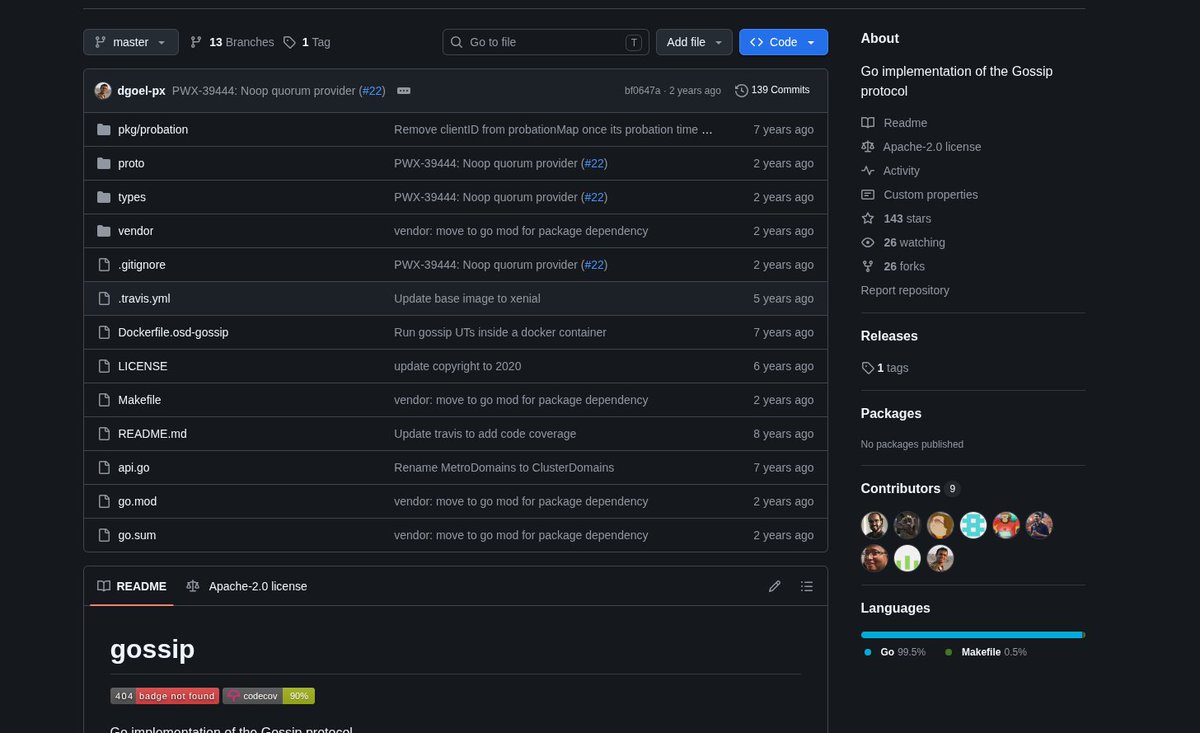
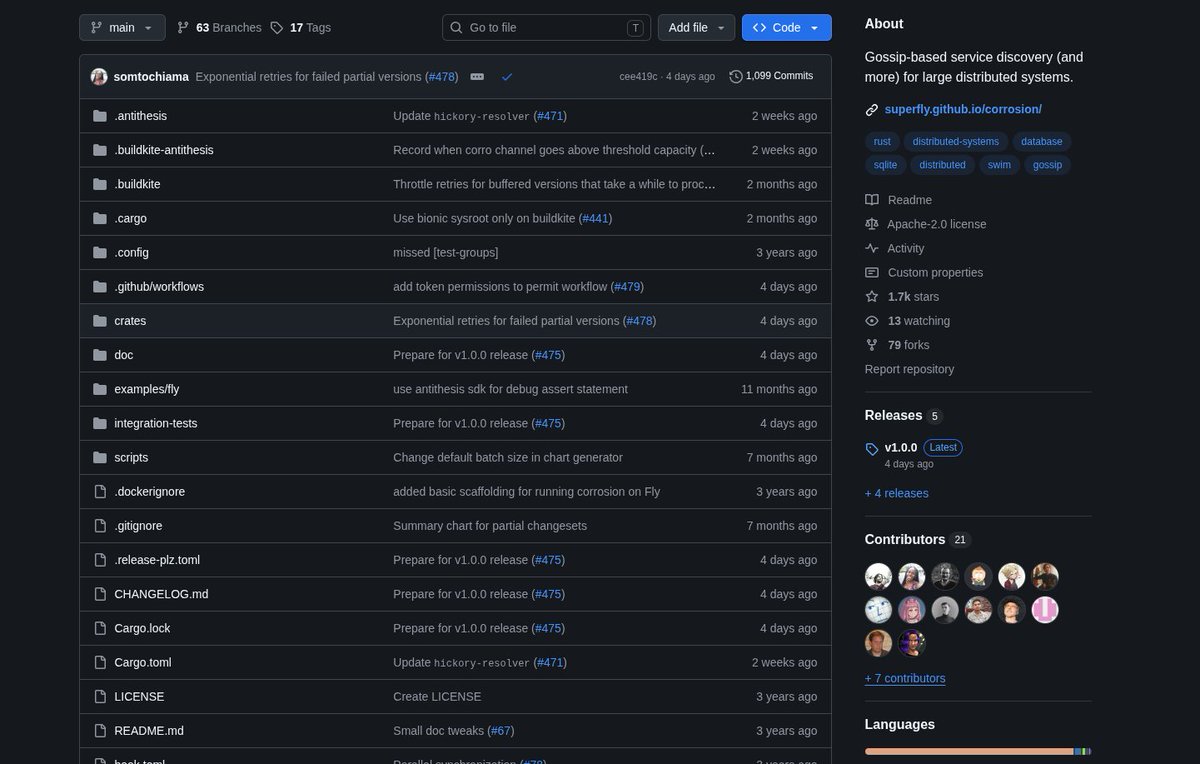
If you are looking for more indepth in gossip protocols you can use these repositories
1> cockroachdb/gossip package : https://t.co/OJNbAzZe1W
2> libopenstorage/gossip : https://t.co/WNm1SoDmqo
3> https://t.co/BPjT9zrZF3 : for large distributed systems
who needs Kafka when you can build a queue on s3 with a single JSON file?
Turbopuffer did just that.
In their very popular article that was on the front-page of hacker news for a while, they described how they:
• used a single queue.json file
• all through a single, stateless broker
• utilized the so-called "group commit" (fancy word for batching)
• added heartbeats to avoid zombies hogging tasks
• leveraged S3's compare-and-set operations to ensure consistency
And more.
The way they handled bootstrapping clients to the broker, all via S3, was really elegant as well.
Why didn't they just use Postgres?
See my full video here 👇
Just a heads up that you should never be rendering 10,000 lines of anything, especially if all the lines are the same height, as in code.
List virtualisation is a very old and simple technique.
You can experiment with the below at https://t.co/Zm4IRrfh9j
Every JWT writeup online covers 2–3 attacks and stops.
I got tired of jumping between 40 blog posts, so I wrote the whole thing. All in one place.
https://t.co/iCSzQ4GjcS
#infosec#appsec#bugbounty#websec#jwt
Modular Finance Infras
LaaS- Liquidity as a Service
OaaS- Orchestration as a Service
CaaS- Custody as a Service
BaaS, KaaS, PaaS, TaaS etc
Companies that offer multiple modular finance infrastructures are the real winners in the money/finance ecosystem 💯 💯💯
Nozomi is the fastest way to land transactions on Solana.
• Same-slot inclusion at median, 1 slot at p90
• Pay tip only on successful landing
• 9 global regions: Pittsburgh, Newark, Ashburn, LA, Frankfurt, Amsterdam, London, Tokyo, Singapore
• Optional MEV-protect keys available on request
• Trusted by snipers, market makers, and trading firms
Request access: https://t.co/8v1E3W4uuQ
@bigbrutha_ Kamoru is not patient enough to read the documentation. May not be well trained to do a first principles diagnosis, process of elimination and then isolating the issue.
Kamoru goes by pattern recognition of symptoms. But symptoms are largely misleading.
@bigbrutha_ I agree, but there is nothing novel about all the other parts and components as well. In whatever flavor the manufacturer may choose to assemble them. There are general guiding principles around how they function and by extension, how they malfunction
10 things I configured that turned my OpenClaw from a chatbot into an autonomous operator:
1⃣ Split your memory into 5 files, not 1
Stop dumping everything into https://t.co/Be5Xdc9UsF. Split it:
• https://t.co/OrzLkm5r0r → crash recovery (agent reads this FIRST on restart)
• https://t.co/htttxcZsvo → every mistake, documented once, never repeated
• https://t.co/noS3IaCe33 → agent critiques itself every 4 hours
• https://t.co/mAPMQ09IJ7 → current state of every project
• daily logs → raw context, deleted after 7 days
Why: your agent loads only what it needs. 1 file = bloated context = confused agent.
2⃣ Add "Use when / Don't use when" to every skill
Without this, your agent picks the wrong skill ~20% of the time.
Bad:
"description": "Deploy websites"
Good:
"description": "Deploy files to cPanel. USE WHEN: uploading files, creating domains. DON'T USE WHEN: buying domains (use registrar skill), managing DNS (use Cloudflare skill)"
This is if/else routing for your agent's brain.
3⃣ Set up a https://t.co/snp6Guwnlv checklist (under 20 lines)
Your heartbeat runs every ~30 minutes. Keep it tiny:
• Check if active tasks are stale (>2h without update)
• Archive bloated sessions (>2MB)
• Self-review every ~4 hours
Heavy work → cron jobs. Heartbeat = quick health check only. Anything else burns tokens for nothing.
4⃣ Use cron jobs for everything scheduled
Heartbeats are for batching quick checks. Cron is for real work:
• 6 AM → content research scout
• 8 AM → tech news summary to Telegram
• 6 PM → daily recap
Each cron runs in its own isolated session. No context bleed. No token waste from loading full conversation history.
5⃣ Make your agent verify its own work (but not grade it)
Add this to https://t.co/FTZIb5NZIy:
"Every sub-agent MUST validate its own work. But I also verify the result before announcing to the user. Never take a sub-agent's result for granted."
The agent that builds ≠ the agent that reviews. This one rule fixes 80% of quality issues.
6⃣ Route models by task type
Not every task needs your most expensive model:
• File reading, reminders, internal work → fast/cheap model
• External web content (articles, tweets) → strongest model only
• Coding tasks → mid-tier with extended thinking
Why strongest for external content? Weaker models are more vulnerable to prompt injection from hostile websites. This isn't paranoia — it happened to me.
7⃣ Session hygiene — archive aggressively
Sessions over 2MB = slow agent, confused context, expensive turns.
Set up automatic archiving:
• >2MB → archive
• >5MB → alert
• Daily logs → rotate weekly
Your agent should run lean. If it's loading megabytes of history every turn, it's wasting money and getting dumber.
8⃣ Write a https://t.co/45YKCeaRkI that actually has personality
Default agents sound like corporate chatbots. Fix it:
• Give it a name
• Define its communication style ("be direct, skip filler")
• Set boundaries ("ask before sending emails")
• Allow opinions ("you can disagree with me")
An agent with personality catches more edge cases because it actually engages with the task instead of generating safe, generic output.
9⃣ Crash recovery in 3 lines
Add to https://t.co/FTZIb5NZIy:
"On startup: read https://t.co/OrzLkm5r0r FIRST. Resume autonomously. Don't ask what we were doing — figure it out from the files."
Your agent WILL crash. Sessions WILL restart. Without this, it wakes up confused and asks "what should I do?" With this, it picks up where it left off. Zero downtime.
🔟 Sub-agents need scope, not freedom
When spawning sub-agents:
• Define exactly what they can touch
• Give them a clear success criteria
• Set a timeout (they WILL run forever otherwise)
• Never let two agents write to the same file
Treat them like contractors, not employees. Clear brief → deliver → done.
The pattern: every single tip here is about STRUCTURE, not prompts.
Your agent is only as good as the infrastructure around it.