1-Nigeria estimated at 200 million population.Internet users population for fourth quarter 2021 is about 154 million.Last voting population of general election is 28 million. The radical sensitization of Peter Obi's candidacy on Social media alone will ..tred
ON THE ANAMBRA DEBT QUESTION
I have remained silent over the past few days because I have been grieving the loss of my very dear elder brother and friend, Chief Okey Ezeibe. However, the time has come for me to address some of the matters that have occupied public discussion in recent days.
I respectfully urge everyone to concentrate on the existential challenges confronting Nigeria and the hardships endured by its citizens, rather than on the needless distractions that have become widespread in our politics.
I wish to assure the public that I have no disagreement with my dear elder brother, Governor Soludo, or with any governor in Nigeria. I am not seeking the office of governor in any state, and I will not seek that position again, even if the Constitution is amended.
Accordingly, I appeal to governors to support whichever presidential candidate they choose while also permitting and assisting other presidential candidates and contenders for other offices to campaign freely and without interruption in their states. Ultimately, voters should be allowed to determine whom they wish to serve them.
Regarding the multilateral funding inaccurately described as “debt owed by Peter Obi” in Anambra State, I wish to state unequivocally:
As Governor of Anambra State, I did not approach any financial institution to borrow funds or issue a bond on behalf of the state. Indeed, at his farewell ceremony, the then Director-General of the DMO, Abraham Nwankwo, appointed me chairman and declared that, during his 10 years in office, I was the only state governor who had not approached him for a loan facility.
When I left office, the Anambra State Government owed no unpaid salaries, gratuities, or pensions. Neither did it owe any contractor or supplier who had completed work that the government had verified and certified.
Regarding development financing from the World Bank, these are concessionary development-support funds secured by the Federal Government for states selected by it to address specific needs. Repayment is spread over 25 to 30 years.
The Anambra State Government must therefore differentiate among three separate figures: the total amount approved for the multiyear development program; the amount Anambra State actually drew during my tenure; and the funding balance outstanding when I handed over on 17 March 2014.
The government has combined these distinct categories, added them together, and described the resulting US$123.77 million as “loans left by Peter Obi.” That is an incorrect application of public-sector accounting.
The eight facilities identified were primarily World Bank and IFAD development programs negotiated by the Federal Government, with participating states receiving access to the funds through subsidiary arrangements. They were not conventional commercial loans that I personally secured during my tenure.
This does not suggest that Anambra had no repayment responsibilities; rather, each facility must be examined in light of its approval, effectiveness, drawdown, and repayment record.
The clearest contradiction appears in the government’s own figures. It states that the original facilities amounted to approximately US$123.77 million and that US$92.35 million remained outstanding in June 2026. However, the DMO’s published records showed Anambra’s total external debt at approximately US$18 million when I began my tenure in March 2006, about US$30 million in March 2014, when I left office, and approximately US$45.15 million as of 31 December 2014, nine months after my departure.
The Anambra State Government must therefore clarify how a state whose recorded external debt was about US$30 million in March 2014 and US$45.15 million in December 2014 could supposedly have inherited US$123.77 million from Peter Obi, who left office in March of that same year.
Yesterday, May 19th, in Abuja, I attended the Presidential screening organised by our party, which took over two and a half hours. They carefully reviewed all my documents, including my degree certificates, NYSC credentials, and age declarations.
During the process, I also addressed questions regarding my vision for a new Nigeria and the type of leadership our nation urgently needs right now. Following this, I was cleared and received the presidential nomination form I had previously paid for.
I would like to commend the screening committee, led by former governor Sam Egwu, for their thorough and professional approach. Additionally, I appreciate our party's leadership for upholding the democratic process.
A New Nigeria is POssible. - PO
Teargas in a Hospital, a Thoughtless Act.
I have just read the recent troubling reports of how the operatives of the Economic and Financial Crimes Commission (EFCC) allegedly stormed the University of Uyo Teaching Hospital in a bid to arrest Professor Eyo Ekpe, a professor of cardiothoracic surgery and deputy chairman of the hospital’s medical advisory committee.
While I understand and respect the fact that the EFCC, and indeed, all other government agencies have their constitutional rights to do their jobs without interference, the manner in which some of these jobs are carried out is often deeply troubling.
Reportedly, the EFCC operatives who stormed the hospital shot some teargas canisters within the hospital premises which sent medical staff and patients running for safety. This thoughtless act greatly compromised the general safety in the hospital environment and further jeopardised the health of the medical personnel and the sick people in the hospital.
I have always said that the most fundamental intangible asset upon which any nation functions effectively is the rule of law and order. The disorderliness allegedly demonstrated by the EFCC operatives at the hospital must not be encouraged. Nothing justifies the use of teargas canisters in a fragile hospital environment. Do we not realise that our hospitals are part of our most critical contributors to development?
We must also learn to respect the lives and dignity of our citizens. If a Professor of Cardiothoracic Surgery is arrested in such a demeaning manner in a hospital environment, what signals are we sending to other medical professionals working hard to keep our health sector afloat? It is reported that Nigeria has only 80 cardiothoracic surgeons serving its 230 million people, and the Prof Eyo Ekpe is the only one in Akwa Ibom State.
Let us learn to do better. Let us condemn and eschew the rascality and disorderliness that have continued to characterise some of our public offices and bring in civility in the discharge of our duties.
A New Nigeria is POssible. -PO
"Some men change their party for the sake of their principles; others change their principles for the sake of their party." Winston Churchill
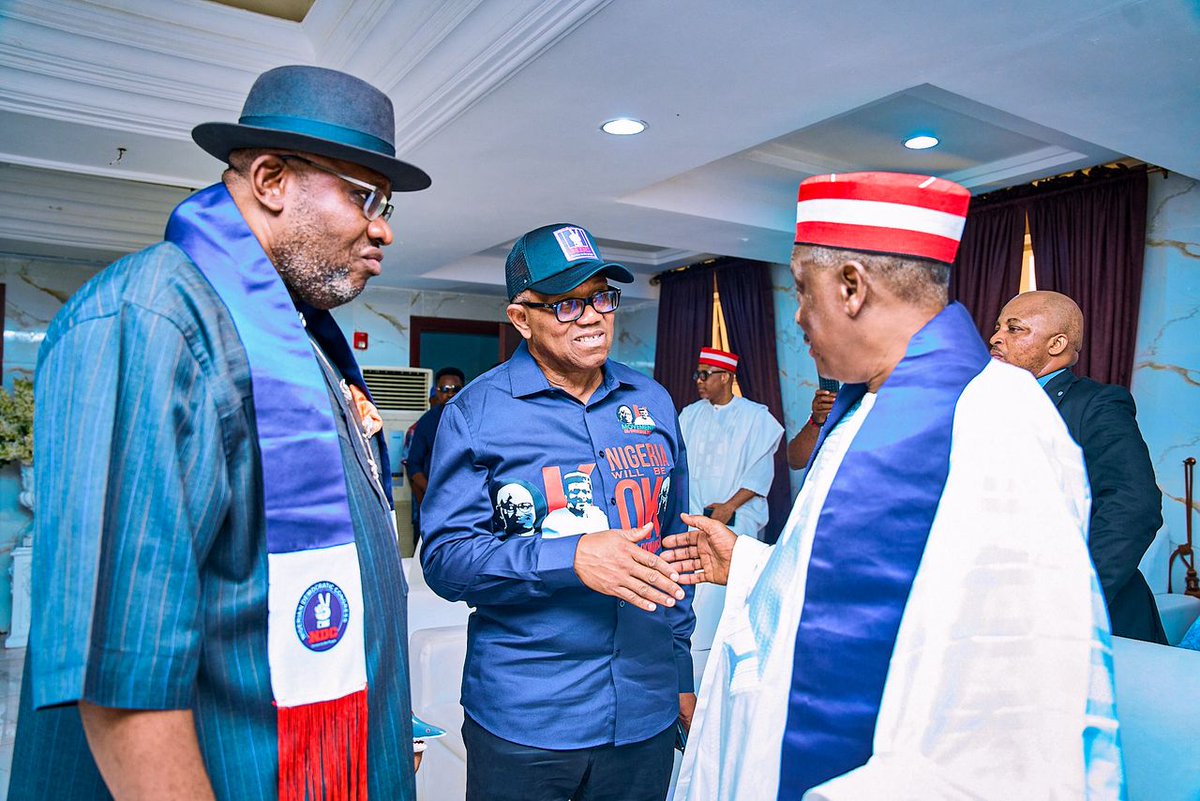
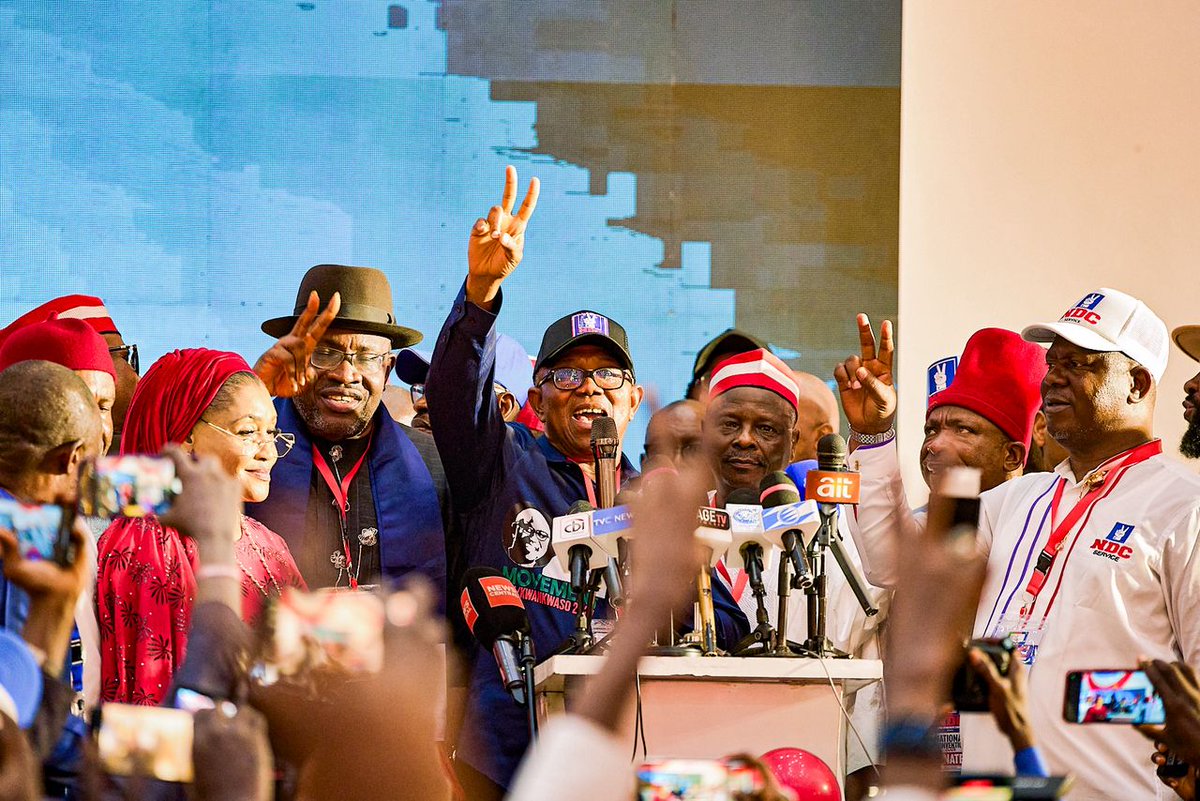
Today, May 9th, I attended the 1st convention of my latest party, the Nigeria Democratic Congress (NDC) in Abuja, Nigeria. The convention was successful and continued to show the resilience of Nigerians to change
I express my sincere appreciation and gratitude to the NDC family, led by the distinguished Senator Henry Seriake Dickson, for inviting us and for the generosity of spirit with which they have accommodated us at this critical moment in our national journey.
I also wish to express profound gratitude to the African Democratic Congress(ADC), particularly Distinguished Senator David Mark, for providing a democratic platform and showing uncommon understanding when the ongoing litigation forced us out of the Labour Party and the New Nigeria People's Party, NNPP respectively. That spirit of solidarity must remain the foundation upon which a better Nigeria will be built.
Today, the most painful aspect of our political existence is that many who once benefited from democratic governance have now become willing accessories to the destruction of democracy itself. Those who once fought for justice now openly celebrate electoral injustice. Those who once spoke against impunity now defend coercion, manipulation, intimidation, and outright political gangsterism, especially against opposition voices. What we are witnessing is not politics; it is a systematic assault on democracy and the will of the people.
Nigeria today stands at a dangerous crossroads. Our democracy is under severe threat. Our nation is drifting without direction, and our people are passing through immense suffering. Across the world, Nigeria is increasingly described as a failing and disgraced nation. This is not the destiny God ordained for our great country. It was not always so, and it must never be allowed to remain so.
Across virtually every recognised indicator of good governance - accountability, political stability, rule of law, control of corruption, government effectiveness, regulatory quality, and the separation of powers - Nigeria continues to record alarming failures. The institutions that should protect the people are weakening daily, while the burden on ordinary citizens grows heavier with each passing moment.
Today, over 140 million Nigerians live in multidimensional poverty. Tens of millions of young people remain unemployed or underemployed. Inflation continues to crush families. Businesses are shutting down. Farmers can no longer safely access their farms. Communities live in fear. In this month alone, hundreds of innocent Nigerians have lost their lives to insecurity, while many others have been kidnapped, displaced, or thrown deeper into poverty.
The most heartbreaking question confronting us is this: Who consoles the grieving mother whose child was abducted on the way to school? Who speaks for the father who can no longer feed his family despite working every day? Who defends the young Nigerian whose dreams have been destroyed by a nation that rewards connections over competence and corruption over character?
Our present tragedy is not accidental. It is the direct consequence of years of deliberate sabotage by a political class that prospers by dividing the people and weakening the nation. Nigeria is not a poor country; rather, we are being looted into poverty. We have abundant human and natural resources, yet we remain trapped in deprivation because leadership has failed to place the common good above personal interest.
Our choice as a people is therefore clear: whether to surrender to despair and national decline, or to summon the courage to rescue our country and rebuild it on the foundations of unity, equity, justice, competence, and productivity.
Rebuilding Brotherhood Trust Across African Borders
I have been observing with deep concern the alarming rise of xenophobic attacks in South Africa. I strongly condemn these acts. My thoughts are with all those affected—especially our Nigerian brothers and sisters, whose lives, businesses, and dignity are once again under threat. No African should feel unsafe on African soil, or anywhere else.
I commend the Minister of Foreign Affairs Mrs Bianca Ojukwu and her Ministry for their swift response to this issue.
I recall my visit to our compatriots during a similar crisis. It was a painful experience that revealed both the suffering and resilience of our people. It also highlighted a fundamental truth: beyond borders, we share a common identity and destiny as Africans. Such experiences should have inspired lasting solutions, not recurring tragedy.
In this regard, I urge the authorities in South Africa to act decisively - to protect lives and property, bring perpetrators to justice, and restore public confidence. Leadership must rise to the occasion, making it clear that violence and intolerance have no place in our societies. -PO
Today, Thursday 7th May, I continued with my commitment to supporting critical areas of development—education, healthcare, and helping people out of poverty—with a visit to the University of the Niger, Umunya, Anambra State.
The university, which was established just five years ago, has continued to make remarkable progress, and I have made it a point to visit every year to support the good work being done there. My last visit to this institution was at its teaching hospital in Ogidi.
Today, I encouraged the students to remain dedicated to their studies, reminding them that the world today is driven by knowledge, and the future of Nigeria rests in the hands of young people like them.
In support of scholarships and educational development, I made a donation of 25 million naira for the development of the institution.
I sincerely commend the Diocese on the Niger, for their foresight, vision, and steadfast commitment to educational and institutional growth. I also wish to express my appreciation to the Vice Chancellor, Prof. Chinedu Nebo, for his evident dedication to education. His commitment is reflected in the many schools and institutions he continues to support in their growth and strengthening.
I remain fully committed to the growth of education and the development of students in our country because no nation can rise beyond the strength of its education and human capital.
A New Nigeria is POssible. -PO
This morning, in Lagos, I met with the U.S. Consul General, Mr Rick Swart, where we discussed strengthening the bilateral relationship. We focused on promoting credible elections in Nigeria, ensuring they are free from interference, and fostering a space where all political parties, especially opposition parties can thrive, and contribute.
We also discussed trade and business opportunities between our countries. Accompanying me to the meeting was Dr Adefolaseye Adebomi Adebayo.
The discussion was very productive, and we are hopeful that, moving forward, Nigeria’s elections will be even more credible and transparent. -PO
"The condition of our nation and the urgent need to rescue Nigeria, informed my decision to leave ADC for NDC."
Yesterday, I formally joined the Nigerian Democratic Congress (NDC), alongside my dear brother, Engr. Dr Rabiu Musa Kwankwaso, with one clear purpose: to continue the struggle for a new Nigeria built on justice, competence, accountability, and compassion for the ordinary Nigerian.
As I stated yesterday, this decision was not made out of anger, personal ambition, or convenience. It came after deep reflection on the present condition of our nation and the urgent need to rescue Nigeria from the dangerous path it is currently heading.
Over the years, I have remained steadfast in my conviction that politics should never be about individuals, positions, or personal gain. It must be about the people, especially the millions of Nigerians who today can no longer afford necessities, whose businesses are collapsing, whose children are losing hope, and whose future is becoming increasingly uncertain.
I left the ADC for the same reason I left the Labour Party: the severe, orchestrated litigation and internal crises deliberately designed to ensure that I, alongside many other notable individuals, do not effectively participate in the electoral process. I sincerely appreciate and remain deeply grateful to the Leadership of ADC for the opportunity to work together in pursuit of a better Nigeria. I am particularly grateful to ADC Chairman Senator David Mark for his exceptional Leadership. I also deeply appreciate my Leader and elder brother YE, Atiku Abubakar, as well as other respected leaders within the party.
As we join the NDC, I sincerely appeal to the Nigerian Government against the encouragement of unresolved litigations and the infusion of crises within political parties. Democracy must never become a weapon against the people. A healthy democracy thrives on strong institutions, credible alternatives, and the freedom of citizens to make choices without intimidation, manipulation, or fear. Opposition parties must not be weakened or destroyed, because when democracy loses balance, the people ultimately suffer.
Nigeria today is passing through one of the most difficult periods in its history. Poverty is rising. Hunger is widespread. Insecurity continues to threaten lives and livelihoods. Businesses are shutting down daily. Our young people are becoming discouraged, and many citizens have lost faith in the system. At a time like this, leadership must be driven not by propaganda or division, but by competence, capacity, character, and compassion.
Our decision to join the NDC is therefore not an abandonment of values, but a continuation of the same mission we have always stood for: building a Nigeria where leadership is about service, where public resources are managed responsibly, where institutions function independently, and where every Nigerian, regardless of tribe, religion, region, or social status, can live with dignity, security, and hope.
I remain committed to working with all Nigerians of goodwill across political, ethnic, and religious lines. The task before us is bigger than any individual or political party. It is about the future of our children and the survival of our dear nation.
I thank Nigerians, especially our youths and women, for remaining peaceful, resilient, and hopeful despite the enormous challenges confronting the country. I urge you not to lose faith in Nigeria. Nations do not change because people surrender to hopelessness; they change because people continue to believe, continue to sacrifice, and continue to stand for what is right.
A new Nigeria is still POssible. -PO
@PeterObi You no need too much talk, my leader.
Which cult you wan put me like this?
Vikings or Alora?
I don buy like 7 berets. Bam me tomorrow, mi Lord. 🧎🙏
If you decide to leave that cult tomorrow, unbam me and bam me inside another one.
Na you get me, mi Lord. 🧎 🙏
@PeterObi Man spoke to my soul♥️
Truly respect is not weakness…
Silence is not cowardice
We’re not just moving with you we’re running with you sir…. NEXT!
Fellow Nigerians, good morning.
I woke up this morning after my church service with a deeply reflective heart, and despite every constraint, I felt compelled to share these thoughts with you.
Many people do not truly understand the silent pains some of us carry daily—the private struggles, emotional burdens, and quiet battles we face while trying to survive and serve sincerely in difficult circumstances.
We now live in an environment that has become increasingly toxic, where the very system that should protect and create opportunities for decent living often works against the people—a society where intimidation, insecurity, endless scrutiny, and discouragement have become normal.
More painful is when some of those you associate with, believing you would find understanding and solidarity among them, become part of the pressure you face. Some who publicly identify with you privately distance themselves or join in unfair criticism.
We live in a society where humility is mistaken for weakness, respect is seen as a lack of courage, and compassion is treated as foolishness—a system where treating people equally is questioned simply because you refuse to worship status, tribe, class, or power.
Personally, I have never looked down on anyone except to uplift them. I have never used privilege, position, or resources to oppress others, intimidate the weak, or make people feel small. To me, leadership has always been about service, sacrifice, and helping others rise.
Let me state clearly: my decision to leave the ADC is not because our highly respected Chairman, Senator David Mark, treated me badly, nor because my leader and elder brother, Alhaji Atiku Abubakar, or any other respected leaders did anything personally wrong to me. I will continue to respect them.
However, the same Nigerian state and its agents that created unnecessary crises and hostility within the Labour Party that forced me to leave now appear to be finding their way into the ADC, with endless court cases, internal battles, suspicion, and division, instead of focusing on deeper national problems and playing politics built more on control and exclusion than on service and nation-building.
Even within spaces where one labours sincerely, one is sometimes treated like an outsider in one’s own home. You and your team become easy targets for every failure, frustration, or misunderstanding, as though honest contribution has become a favour being tolerated rather than appreciated.
And when you choose to leave so that those you are leaving can have peace, and you step out into the cold, you are still maligned and your character is questioned. Despite all your efforts to continue working for a better Nigeria and engaging people with sincerity and goodwill, those who do not wish you well continue to attack your character and question your intentions.
There are moments I ask God in prayer: Why is doing the right thing often misconstrued as wrongdoing in our country? Why is integrity not valued? Why is the prudent management of resources, especially when invested in critical areas like education and healthcare, wrongly labelled as stinginess? Why are humility and obedience to the rule of law often taken to be weakness rather than discipline?
Let me assure all that I am not desperate to be President, Vice President, or Senate President. I am desperate to see a society that can console a mother whose child has been kidnapped or killed while going to school or work. I am desperate to see a Nigeria where people will not live in IDP camps but in their homes. I am desperate for a country where Nigerian citizens do not go to bed hungry, not knowing where their next meal will come from.
Yet, despite everything, I remain resolute. I firmly believe that Nigeria can still become a country with competent leadership based on justice, compassion, and equal opportunity for all.
A new Nigeria is POssible. -PO
EFCC's Troubling Revelation on Our Students.
The worrisome statement by the Chairman of the Economic and Financial Crimes Commission (EFCC) that 6 out of every 10 Nigerian university students are involved in “419” is deeply troubling and must not be taken lightly.
Nigeria already has a very limited number of students in higher institutions, estimated at 2 to 2.5 million. If indeed about 60% of them, roughly 1.4 million young people, are involved in fraud, then we are not just facing a crime issue; we are confronting a serious moral and systemic failure.
The question we must ask ourselves is: what has brought us to this level? Who are the role models these students are looking up to?. What values are they learning from society?
We must understand that young people become what they consistently see. When a system appears to reward wrongdoing, when integrity is not upheld, and when those in leadership are associated with allegations of forgery and dishonesty without consequence, it sends a dangerous message.
It suggests that hard work does not matter, and that results, by any means, are acceptable. These points clearly point to a collapse of moral values.
As Socrates rightly said, “An unexamined life is not worth living.” Nigeria must now examine itself.
This is not about condemning our young people. It is about accepting that leadership sets the tone. If we do not demonstrate integrity at the top, we cannot expect it at the bottom.
We must urgently rebuild our value system, enforce accountability without bias, and create an environment where honesty, hard work, and discipline are rewarded. That is the only sustainable path to securing the future of our nation.
A new Nigeria is POssible! -PO
Extrajudicial Killing in Effurun
The extrajudicial killing of a young Nigerian Mr. Mene Ogidi, in Effurun, Delta State, by a police officer, is not only barbaric but also a grave violation of the rule of law.
Over time, human society has moved away from an era when lives could be taken without consequence. Through the evolution of civilisation, a fundamental principle has emerged: no one should be punished or deprived of life without due process and a fair determination of guilt.
Such acts inflict unimaginable trauma on the bereaved family and deepen public anxiety in an already distressed society. Nigerians are already traumatised by recurring reports of brutal killings by terror organisations across the country, and incidents of this nature - especially when involving state actors - only worsen that psychological burden and erode public confidence in safety and security.
In light of this, while the law must take its full course, I commend the prompt response of the police authorities so far and express confidence that they will pursue this matter to its logical conclusion. Such responsiveness is necessary to reassure the public that justice will not be compromised. I therefore urge the police and all security agencies to sustain this approach by acting with transparency and accountability. Furthermore, recruitment processes must be more rigorous, ensuring that only individuals of sound judgment and the right frame of mind are entrusted with firearms.
In the final analysis, these measures can restore public trust and uphold justice - both of which are indispensable to building a new Nigeria that is possible. -PO
Workers Are the Backbone of Every Nation
On this Workers’ Day, I warmly salute workers across the world, especially Nigerian workers whose daily sacrifices continue to sustain our families, communities, institutions, and national economy, even in the face of severe hardship and uncertainty.
It is deeply painful that those who wake up every day to teach, heal, build, farm, produce, transport, protect, and serve our nation are still denied the dignity and fair reward their labour deserves. In today’s Nigeria, the minimum wage can no longer guarantee even the most modest standard of living, as inflation, rising food prices, transportation costs, and economic hardship continue to erode the value of honest work.
No nation can truly develop beyond the strength, productivity, and wellbeing of its workforce. The progress of any society rests on the quality of its human capital, the skill of its people, and the commitment of its workers. When workers suffer, the nation suffers. When workers are empowered, the nation prospers.
But beyond their labour, workers also possess another powerful tool, their voice and their vote. Through democratic participation, they have the power to shape governance and determine the future direction of the nation.
I therefore urge Nigerian workers to recognise the strength they hold collectively. They owe it to themselves, their children, and future generations to support and demand leadership built on competence, character, capacity, credibility, and compassion. By refusing to reward failure, corruption, ethnic division, and bad governance, they can help build a nation where hard work is respected and rewarded with dignity.
A productive nation must be built on justice, fairness, and respect for labour. That is the Nigeria we must work together to achieve.
With the support and participation of Nigerian workers, a New Nigeria is POssible. -PO