AI transformation is an organization problem. I work on that side of it. Founder @managementkits · org design, co-intelligence & systemic change @HSGStGallen
2/ Organizations are still the most intelligent entities in the world
They uniquely provide a shared context where knowledge can be communicated and collective intelligence can be created among diverse actors
Autonomous orgs will exponentially amplify this process between humans and new intelligent actors in AI agents
In other words: we’re here to build the new most intelligent entities in the world
I joined @GoogleDeepMind to develop a research program on the economics of AGI. Today, together with Andrew Koh (@andrewjkoh) and Shane Legg (@ShaneLegg), we are incredibly excited to release The Economics of Intelligence, the first in a series of projects from our group on how AGI will change the economy.
How do capability improvements transform the economy, and when? In this project, we define thresholds of economic capabilities, e.g., minimal AGI, based on how they transform the economy. We then track how the economy–market structure, employment, and wages–changes during the transition across capability regimes.
We have seen exponential increases in what AI agents can do but the broader economy seems almost remarkably unchanged. Part of the reason is that the solo AI agent is the wrong economic object; economic transformation is an equilibrium outcome where organizations compete. Looking at how intelligence functions within organizations, transformation will depend on when two key capability thresholds are crossed: competence (gains on individual skills, e.g., coding, math) and coordination (gains on ability of agents to cooperate and work together).
We show that what economic transformation looks like depends on whether AI becomes supercompetent, supercooperative, or both—the regime of artificial superintelligence (ASI). Tracking this transition shows why the real visible transformation may come from improvements in coordination—a capability most benchmarks don’t yet track. Past a certain threshold, AI capabilities can break the Coasian ceiling on firm size and lead to an economy that looks drastically different than the one we see today.
Two main takeaways:
1. To understand the path of transformation, we should be tracking agentic coordination more closely.
2. The impact of AI will likely show up in wages before market structure or employment.
We are really excited about this paper. Excited to hear people’s thoughts.
Link: https://t.co/9DTGSeKoSA
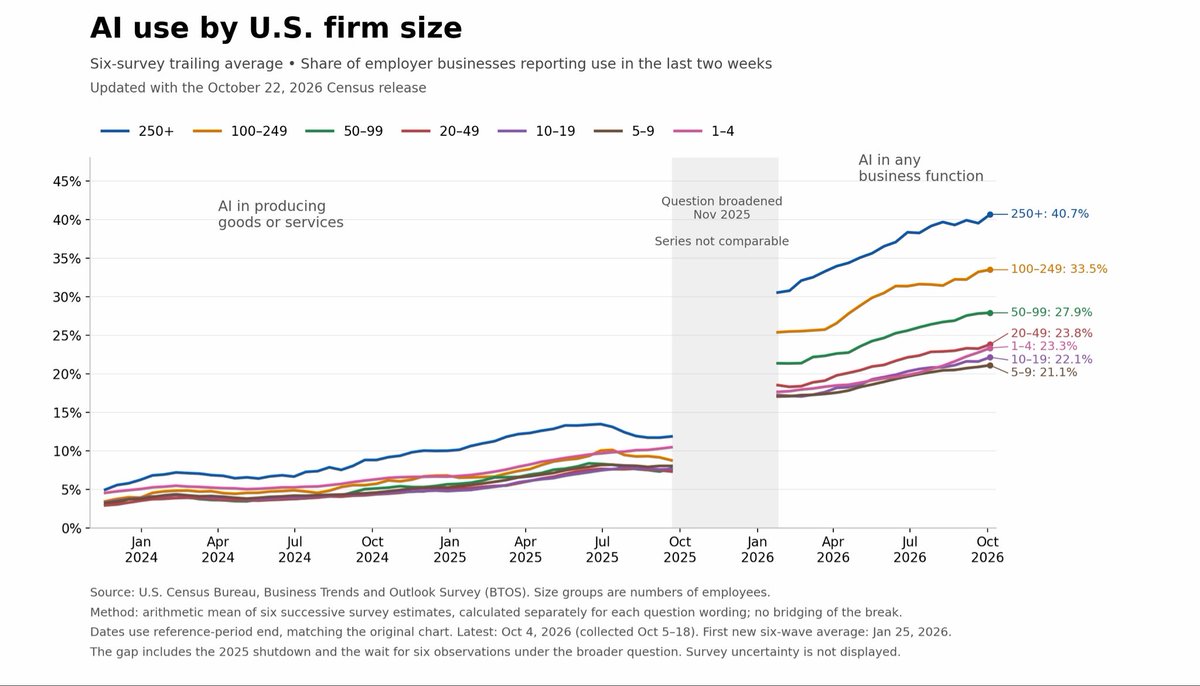
In updating a graphic showing U.S. company AI adoption over time according to a long-running U.S. Census Bureau survey, I found out that the Bureau's work has been sullied by that asinine "Super Intelligence" executive order https://t.co/YEu1tnWweT
AI adoption continues to grow (remember last year during the summer when everyone thought adoption was dropping?)
Also good discussion of changes in methodology by Simon in the post.
Inside every firm adopting AI are two forces that both say they are "working on AI transformation:" a set of people who are AI-pilled who see AI as an existential threat/opportunity & a set who desperately want everyone to view AI as a regular technology so nothing has to change.
The market for software migration from legacy systems has been limited to $30B a year or so because migration is very expensive and maintenance is easier. Talking to older firms, there is a real backlog of scoped cheaper migration projects being unlocked by AI surprisingly fast
Even in much of finance, consulting and other professional services, taking on more clients or projects tends to be a labour-intensive step. These are often still quite relational businesses, and while a technology might bring plenty of worker-level efficiencies they won’t necessarily translate into topline efficiencies. Software is in that sense more like manufacturing than most other services.
Peter Thiel might be onto something here…
https://t.co/tvymtPvKVr
FWIW I think he’s missing important dimensions like desire for human connection, empathy, shared understanding, which will be important for the future of jobs in healthcare, education, etc.
We have a huge pivot underway here at Epic, moving developers around to retool for maximum AI acceleration.
The aim isn't to do the same stuff with fewer people, but to enable everyone here to build MORE and BETTER stuff, and to bring the benefits to all teams using Unreal.
As long as LLMs continue to be unreasonably good at everything, companies will figure out a way to muddle along. But they are often struggling with managing organization change, and frequent mandatory model switches (looking at you, Google) and other changes are hard for them.
If you haven’t made sure to turn on two-factor authentication on all accounts, have passwords with family in case you get voice calls asking for money, etc, now would be a good time.
AI gains mean the costs of mass targeting individuals with sophisticated attacks are dropping.
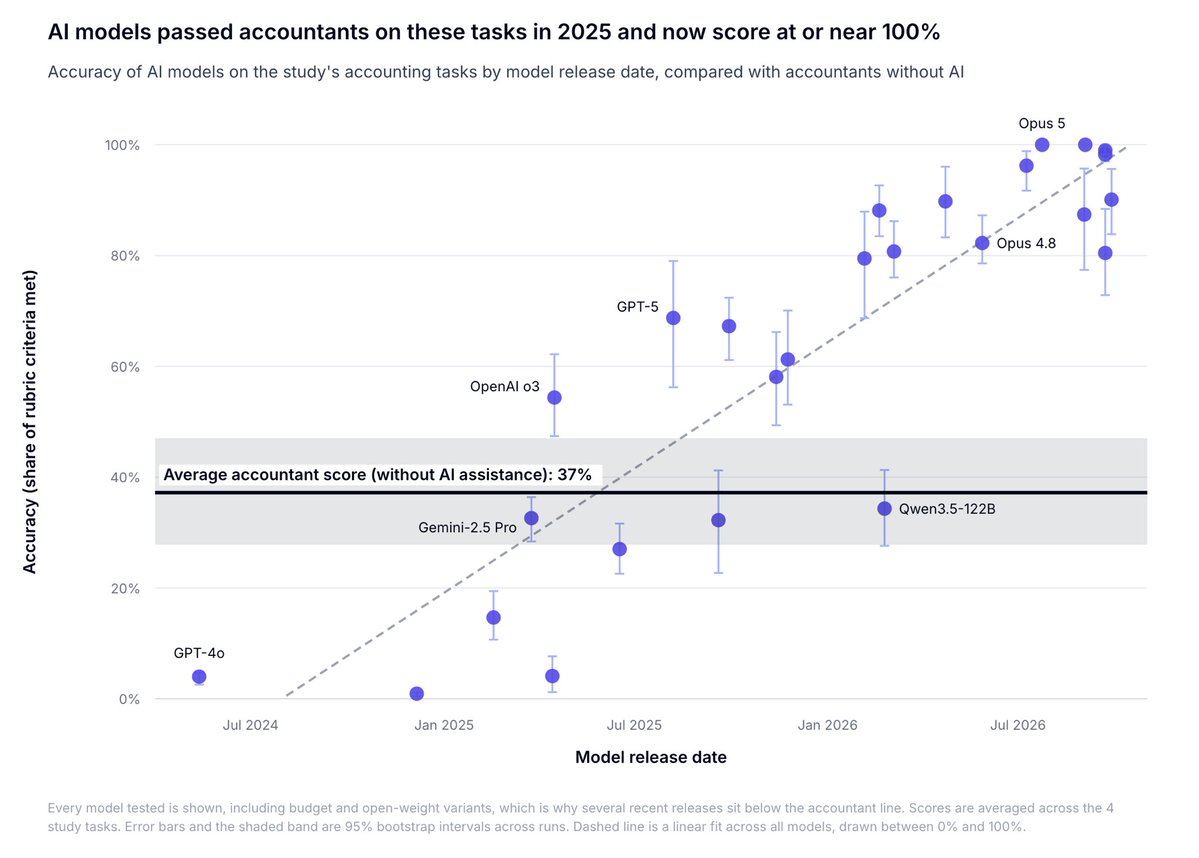
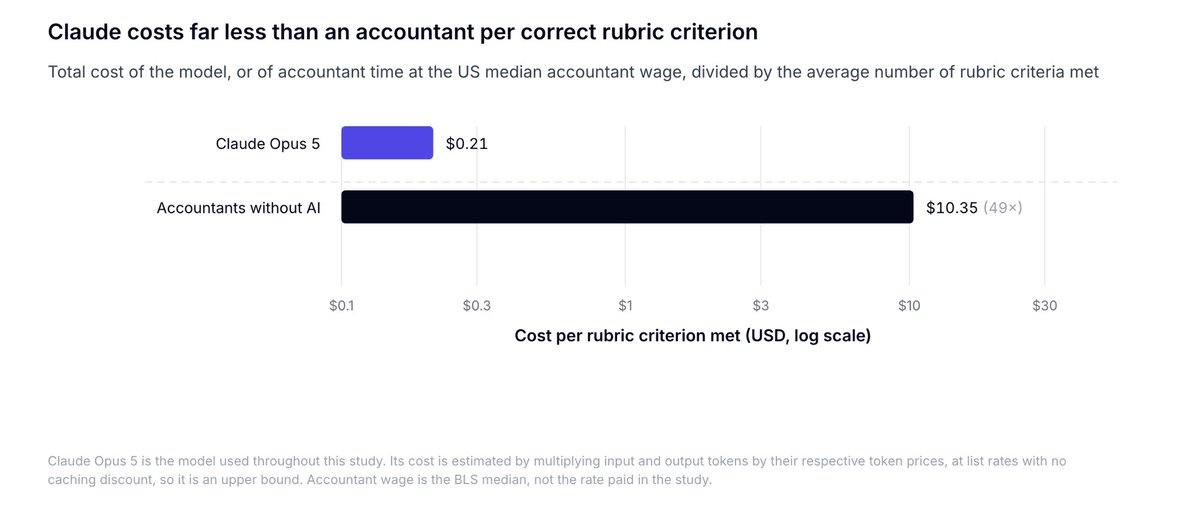
“We find that on medium-length, well-defined accounting tasks, frontier AI models are now faster and more accurate than junior accountants, even the best one in our study.” Eighteen months ago they scored well below human accountants
Good discussion here: https://t.co/uMTMzRazhC
Fascinating.
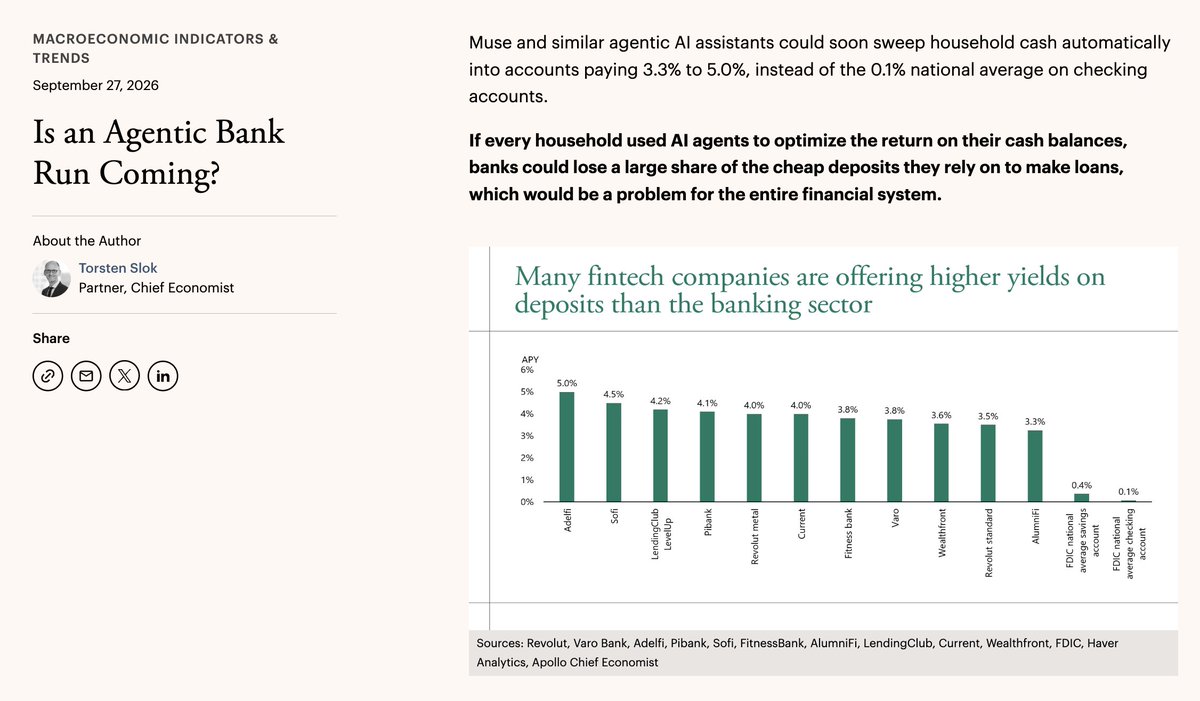
Chief Economist at Apollo: agents could cause a bank run by sweeping household cash into accounts paying 3-5% instead of the 0.1% national average, causing banks to lose a large share of their cheap deposits.
It is often startling to move back and forth between the world of organizations and the world of cutting-edge AI. Organizations underestimate AI ability growth (often by a lot) and the AI tech world underestimates AIs real world jaggedness (often by a lot)
I cannot emphasize enough how much GPT-6 Astra and Fable 5.1 are already enough for transformative impact in large sections of the economy. They can reliably do weeks worth of human work when properly guided & harnessed.
Those effects will not be all at once and be uneven, but the fact that change will occur is inevitable no matter how the frontier is paced. But inevitable change does not mean the type of change is inevitable. It is increasingly important that we develop & share models of AI-human work that enhance, rather than only replace, human labor. The labs have a role to play in doing this, but so do companies and industries experimenting with AI adoption, as well as policy makers who can incentivize this sort of inplemenation.
This work is important regardless of existential risk, and needs a lot more focus.
Foundational expertise may be a prerequisite for extracting durable skill from AI-assisted practice, from @davidautor, Tanya Rodchenko, Josh Martin, Zanna Iscenko, Scott Strand, David Pearl, and Melissa Ferere https://t.co/0d33uIw1Oy
This is a big one.
My work shows use of AI is toxic to skill growth because juniors are more optional in work with seniors. And that juniors' quality suffers far more given cognitive load.
@davidautor et al now show: ~only seniors build skill from AI use.
Worried yet?
Here's our statement on AI and the economy.
We Must Act Now
A Statement on AI’s Transformation of the Economy
1. AI may become radically more powerful over the next 10 years.
2. This could drive an unprecedented transformation of our economy, larger than the Industrial Revolution, but unfolding over a vastly shorter time frame. It could bring risks, including large-scale job displacement, as well as opportunities such as major gains in living standards.
3. Economists, policymakers and technology leaders must act now to understand the economics of transformative AI and to build the incentives, guardrails, and institutions needed to steer AI in a direction that complements humans and benefits society.
Although I've emphasized in my writing and speaking that AI won't cause mass job displacement, I do think knowledge workers must spend a much higher fraction of our time on learning, re-skilling, and growth, in order to stay competitive as AI capabilities increase. Simple economic logic predicts that this will lead to tensions between firms and workers.
C-suite will want rapid AI adoption because it doesn't care much about workers' long-term growth and prospects. After all, in the U.S. and many other countries, workers only stay with a firm for a couple of years, so the firm doesn't get to capture the benefits of workers taking time to invest in themselves. Since the firm controls how work gets done, it often mandates adoption patterns that don't contribute to human capital.
In contrast, workers tend to be much more careful about AI use because they are concerned about skill erosion, think beyond short-term productivity, and want to ensure that their AI use benefits their career trajectory and growth. So they resist top-down AI mandates and want to do it their own way.
The broken ladder for entry-level positions that we're all worried about is a special case of this more pervasive incentive misalignment. Firms might not want to hire entry-level workers because the amount of on-the-job training that it takes in order for workers to both master the skills themselves and to be able to drive and control AI for day-to-day tasks is too much for the firm to recoup.
How we manage this tension will have a huge impact on the pace of AI adoption and what jobs of the future will look like. I suspect that getting to a better balance between productivity and growth will require collective worker action, a few innovative companies finding new ways to re-align incentives*, and smart public policy. I'm cautiously optimistic for the long run, but I do think things will get worse before they get better.
I wonder if Japanese firms will have an advantage because they have a very different model — lifetime employment (shūshin koyō) coupled with much higher investment in worker training. Western commentators love to criticize the salaryman model as hopelessly outdated, and indeed it has led to slow digital adoption and the persistence of fax machines in 2026, but maybe there's a silver lining when it comes to AI adoption and AI-driven reskilling! The point is not faster AI adoption but better-aligned adoption that is more beneficial in the long run.
==
* One possible way could be through the idea of the "AI loop" becoming the new IP of the firm, as Satya Nadella recently advocated. This allows firms to better differentiate their AI-enabled workflows from their competitors. In Becker's classic economic model, this turns AI skills from general to firm-specific, so firms are incentivized to help workers reskill. But by the same token, the downside is that workers are more locked in to their employer because their skills are less transferable.