The decision in Pung v. Isabella County could be released at any moment.
At its core, the case asks a simple constitutional question:
When government takes a person's home to collect a tax debt, how much must it pay back?
The Estate of Timothy Scott Pung asked the United States Supreme Court to enforce a principle older than the Republic itself: government may collect what is owed, but it may not take more than it is entitled to keep.
The Court heard argument on February 25, 2026.
#Pung #PropertyRights #TakingsClause #Constitution #SCOTUS
EGLE Director Phil Roos recently proclaimed that environmental enforcement is “essential” and that inspections are a “key tool.”
The Constitution disagrees when government officials violate the Constitution.
That’s why Outside Legal Counsel PLC has sued Director Roos in Satkowiak v. Roos, challenging unconstitutional government conduct and defending the principle that constitutional rights do not disappear at the property line.
The Fourth, Fifth, Eighth, and Fourteenth Amendments apply to everyone—including state agencies.
#PropertyRights #FourthAmendment #CivilRights #Michigan
In his opening remarks, @EGLEDirector Roos highlighted Michigan’s progress in clean water, clean air, modernized digital tools like MiEnviro, and strong partnerships across the state.
Thank you to the 950+ attendees helping build a healthier, more resilient Michigan.
Today could be the day.
Months ago, I stood before the United States Supreme Court and argued Pung v. Isabella County—a case about a simple constitutional principle: when government takes property, the Constitution requires just compensation.
We are expecting a big decision. But whatever happens, it has been the honor of a lifetime to represent Michael Pung and his family to help bring this important property-rights issue before the Nation’s highest Court.
Now we wait.
#Pung #PropertyRights #TakingsClause #Constitution #SCOTUS #Michigan
Self-executing alert: CA11 agrees to consider Fulton en banc to answer the question: do you need Congress' ok to sue for just compensation for a taking? A split panel said no, but now the entire court will rehear the case.
Here's the order: https://t.co/qZdk99OBvL
Here's the 2-1 panel opinion:
https://t.co/nfnrvAdyxO
This was also the subject of a Harv L Rev Note: https://t.co/eR1PfY4ri8
Cameras in the courtroom make for better prepared lawyers and judges, says a former chief justice of the Texas Supreme Court. The U.S. Supreme Court should listen to him.
https://t.co/FSugYaONDv
The decision is coming soon in Pung v. Isabella County.
There was no mistake here.
The government is intentionally taking people’s homes, selling them for a fraction of their worth, and wiping out years of built-up equity without a second thought.
That’s not an error. That’s the system. And it’s exactly what the Constitution forbids.
The decision is coming soon.
At issue in Pung v. Isabella County is a simple but powerful principle: when the government takes your property, it must pay fair market value—not whatever it happens to recover through a quick and dirty auction.
The Constitution does not tolerate shortcuts. It requires just compensation.
Stay tuned.
⚖️ The Fourth Amendment wins. 🇺🇸
A federal court held Michigan’s warrantless liquor inspection scheme unconstitutional. 🚫
Regulation is not a blank check. ✍️
The Constitution still draws the line. 🛑
MLive is covering our case today.
The Pung family lost a $200,000 home over a $2,242 tax bill that should never have been issued in the first place. Isabella County foreclosed, sold the home for a fraction of its value, and kept the equity. The family spent a decade fighting to get it back.
On February 25, 2026, I stood before the United States Supreme Court and argued that what Isabella County did violated the Fifth and Eighth Amendments. The Constitution does not allow the government to seize a family’s life savings over a disputed tax bill — and pocket the difference.
The opinion is expected soon.
📰 Read the MLive story: https://t.co/UNBTPmMUSF
Michigan quietly joined the growing number of states adopting meaningful anti-SLAPP protections with the Uniform Public Expression Protection Act (UPEPA), effective March 24, 2026.
This is not a minor procedural tweak. It changes litigation leverage.
Early dismissal, a stay of discovery, and mandatory fee-shifting reframe the economics of speech-based claims. Weak claims are no longer just defensible—they’re dangerous to bring.
For practitioners, the takeaway is simple: plead carefully, and think twice before using litigation as a tool to silence public participation.
The First Amendment just picked up real enforcement teeth in Michigan.
Can the government enter your property without a warrant just because it’s “an inspection”?
My answer: No. We’ve proven it. https://t.co/sz0lNDJs9Y
The Constitution draws the line.
If it’s happening to you, I want to hear about it. https://t.co/HcxymiMXgd #FourthAmendment
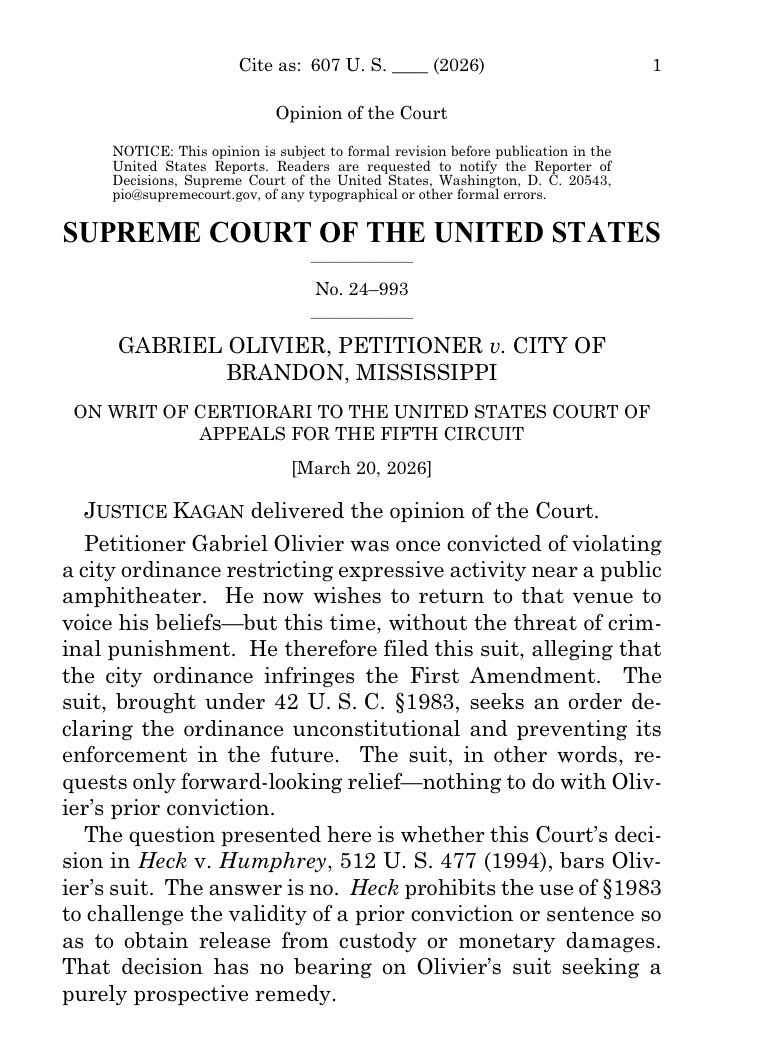
The Supreme Court’s recent decision in Olivier v. City of Brandon makes clear that people can go to court to stop unconstitutional laws from being enforced in the future—even if they were already convicted under those laws in the past. Governments have long tried to end court challenges by misconstruing the “Heck bar.”
For the kinds of cases that OLC handles, this decision greatly strengthens the ability to bring forward-looking lawsuits aimed at fixing bad policies instead of just undoing past harm. It allows lawyers to focus on stopping future enforcement of unconstitutional laws—protecting not just one client, but everyone affected by the same rule. Practically, that means more opportunities to challenge local ordinances, policing practices, or government restrictions before they cause repeated harm, which raises both the impact and visibility of this type of legal work.
If the U.S. Supreme Court rules in favor of the Pung family, attorney Phil Ellison says it could stop local governments from taking far more property than people actually owe in back taxes.