"The humanities would abdicate their function in society if they surrendered to a neutral scientism and indifferent relativism or if they succumbed to the imposition of alien norms required by political indoctrination. Particularly on these two fronts the New Critics
“In the Puritan morality that I remember, it was tacitly assumed that if one was thrifty, enterprising, intelligent, practical and prudent in not violating social conventions, one ought to have a happy and 'successful' life. Failure was due to some weakness or perversity peculiar to the individual; but the decent man need have no nightmares. It is now rather more common to assume that all individual misery is the fault of 'society', and is remediable by alterations from without. Fundamentally, the two philosophies, however different they may appear in operation, are the same. It seems to me that all of us, so far as we attach ourselves to created objects and surrender our wills to temporal ends, are eaten by the same worm.”
—T.S. Eliot, “Introduction” to Nightwood
JUST SIGNED THE CONTRACT
The Poet-Critic after Eliot: On the Twin Life of Poetry and Criticism looks (if all goes well) to be forthcoming from University of Exeter Press (@UExeterPress) in the Contemporary Cultures of Reception series (series editor Brian May; first entry his hybrid 1948). Original poetry and poetics in dialogue with Eliot’s tradition and practical criticism. Grateful to the press and series. More soon. #tseliot #Poetry
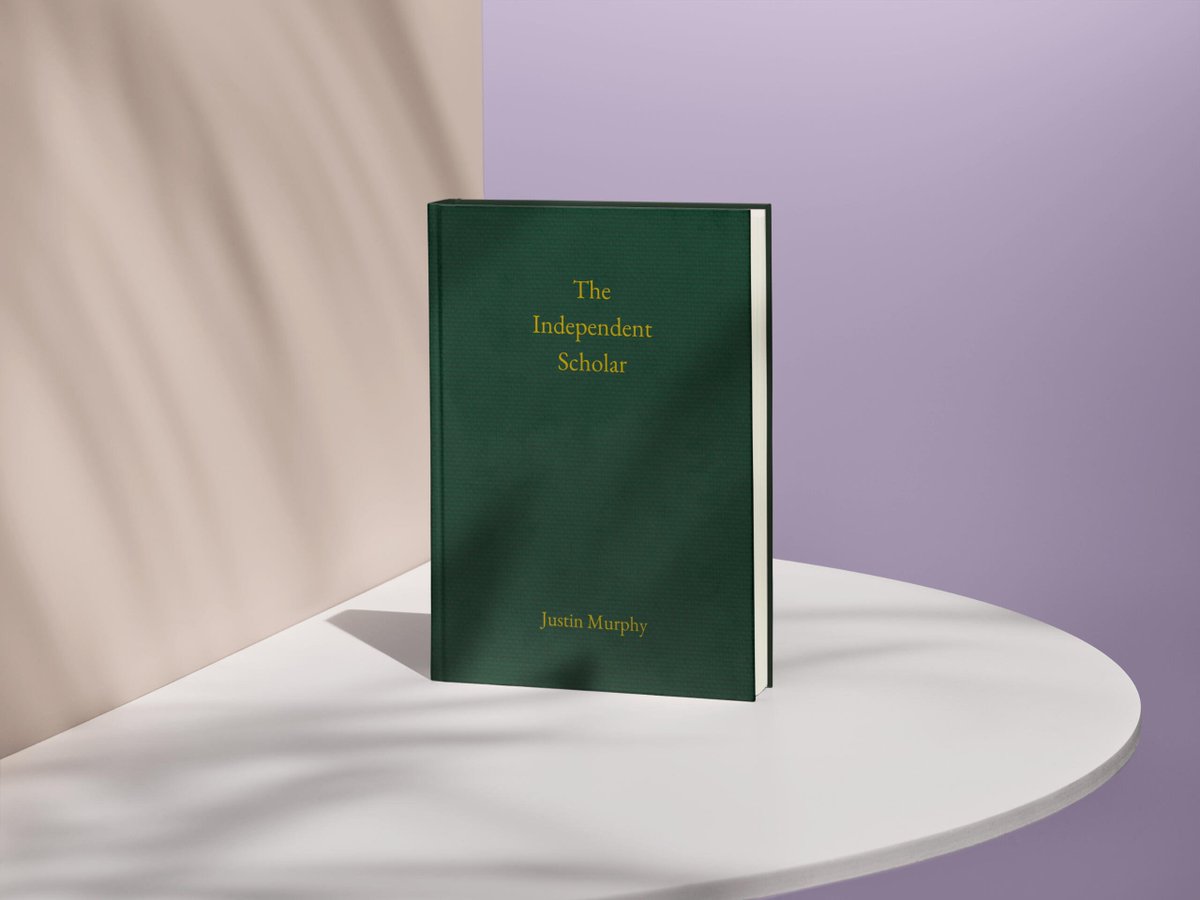
After many false starts and delays, my book The Independent Scholar has now been typeset and is being emailed to all who preordered.
Just about everyone today assumes that to produce a lasting body of work, one must pass through a "credible" institution and secure a certain kind of job, patron, publisher, or grant.
But the historical record shows otherwise.
Twas much harder than I anticipated, and I'm all too aware of its remaining imperfections, but overall I'm pleased with the result.
“Ideological criticism has immense charm. . . . It is the final vindication of the donnish life; the instrument which gives to the teeth-gnashing fantasist his longed-for power over the world of real things. The ideological critic can never stop short at criticism, however.
1/2
https://t.co/LPDmS6yN33
“As in Bloom’s criticism, we find those familiar ex cathedra assertions on a work’s aesthetic power and chances for literary survival. Yet there are also intimate notes of self-doubt, modesty, melancholy, and love.”
Yesterday was the publication day for Folke Leander's book *The Philosophy of Paul Elmer More*.
The first review of the book has now appeared (from @ActonInstitute), and it does a good job demonstrating why More is worth reading today:
https://t.co/Nr7EBANemw
"When man ceases to wander, he will cease to ascend in the scale of being. Physical wandering is still important, but greater still is the power of man's spiritual adventures--adventures of thought, ...of passionate feeling, ...of aesthetic experience."
--A. N. Whitehead (1925)
New in TAPA by me:
"...we must recognize how the elective curriculum shapes students’ souls: It encourages the young to view themselves as customers, who have no way of judging value beyond the criterion of mere popularity."
https://t.co/fRjJyYvn1I
“In making us see our world for what it is, the artist also makes us see ourselves for what we are. . . . When such imaginative vision is not constantly renewed, the very faculty of imagination atrophies. A decisive aspect of man’s dehumanization—perhaps the critical point in his
Gordon Teskey’s The Poetry of John Milton is the first work of literary criticism that I had read that wasn’t by C.S. Lewis, J.R.R. Tolkien, or Harold Bloom. The moving, memorable opening paragraphs of the book have shaped my view of criticism ever since:
“The present book is an exercise in the art of literary criticism, which I take to be the appreciation of quality, of excellence, in art made with words. Literary criticism is not science: it does not prove and discover; it persuades and reveals. But the chances of a work of literary criticism being worth reading outside expert scholarly circles are much increased if it first meets their standards, which often do involve proof and discovery. Philology, in the broad sense of the word, is where criticism starts from, but not where it ends.
That is because criticism has a higher aim, which may be described as moral and humanizing. Literary criticism is the appreciation of verbal art as a power that elevates our ordinary experience in almost every way. Literature cultivates wisdom, courage, generosity, breadth of outlook, intellectual and moral judgment, a reflective passion for justice, and, not the least of these things, pleasure, civilized pleasure as opposed to brutal or trivial pleasures. But literature also enhances our capacity for sympathizing with others, or at least for understanding them, by allowing us to travel into different moral worlds, such as that of Homer, or the authors of Genesis, or the author of Paradise Lost. Literary criticism strives to show why certain works of literature are good, why they have enduring quality, and, however different their values are from our own, why they are not only civilized but civilizing. I should add that I use the word civilizing and civil, civilis ‘of the city,’ with the intention of including politics, concern with the polis, the polity. For it seems to me—l say this as someone who cares all the arts—that literature comes first among them because it is made with our political instrument, language. Certainly John Milton put literature—which for him meant poetry—first among the civilizing arts, and I have written this book in agreement with his judgment on the matter.”
“It was always accounted a virtue in a man to love his country. With us it is now something more than a virtue. It is a necessity, a condition of survival. When an American says that he loves his country, he means not only that he loves the New England hills, the prairies
“The heroism of writing is an unthinkable venture into the unknown, as unmapped and frightening as any voyage to the source of the Amazon, as powerful and daring in its conception as the far gaze of Pascal or the abyss of Wittgensteinian skepticism.”
—Helen Vendler, “The Hunting of Wallace Stevens”