This is the part where I'd gently push on the framing a bit, because the kernel is genuinely more interesting than was stated—I'd resist conflating the two, and it's worth being clear-eyed as to why.
Alibaba Qwen3.7 slowly fading into irrelevance at the frontier due to proprietary stance.
In it's place we have Minimax M3 and... *checks notes* Rio 3.5 397b, made by the municipal IT company of Rio de Janeiro's city government.
https://t.co/JgIJYVhoEi
🚨 I HAVE NO MICROPLASTICS IN MY BALLS 🚨
This should not be possible.
Studies show that 100% of men have microplastics in their semen. I am the first human ever to show a complete reduction to zero.
This may be a world-first breakthrough in fertility research.
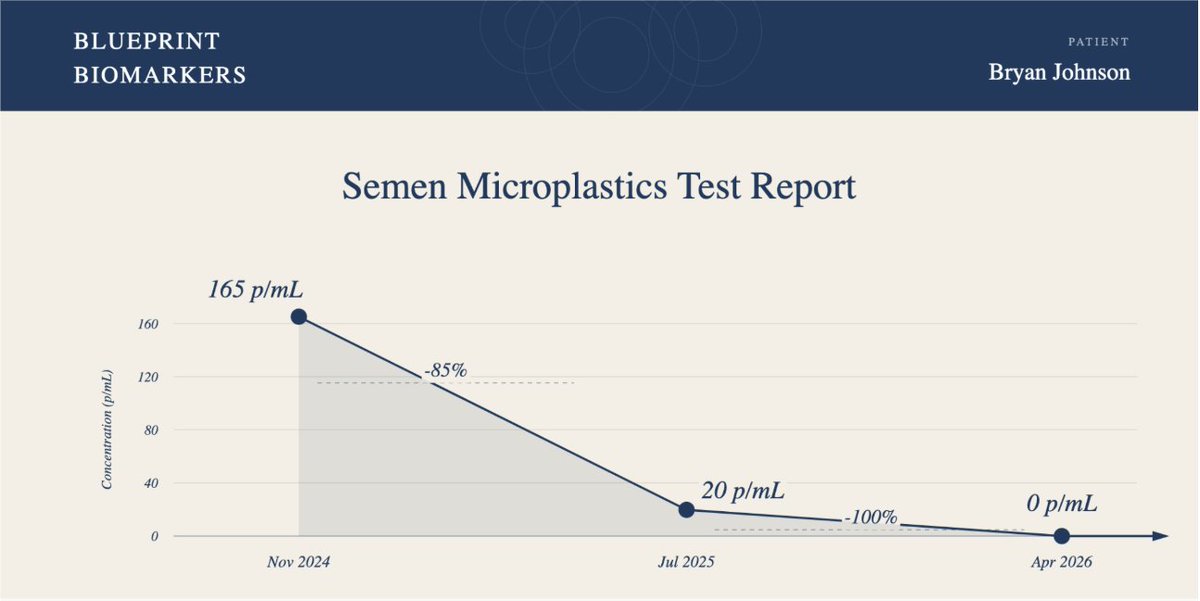
I had 165 microplastic particles in my semen just 18 months ago. Now, I have zero.
Five published studies have measured microplastics in human semen. Two found them in 100% of men. The other three found then in 44 to 76% of men tested, but those used methods that miss the smallest particles and the clear ones. Corrected for that, the real rate is likely 100%. Almost every man alive has plastic in his semen right now. The same applies to testicular tissue, testing 100% positive for microplastics.
Microplastics hurt sperm.
Human studies show the impact of various types of plastic, associated chemicals, and other toxins on male fertility:
+ 60% fewer normal shaped sperm (from PFAS)
+ 5x higher odds of low sperm count (from PTFE)
+ 10% lower sperm concentration (from PTFE)
+ 15% lower swimming ability (from PTFE)
+ 41% lower swimming ability (from PET)
+ 12% lower sperm swimming ability (from BPA)
+ 3x higher odds of low sperm count (from Phthalates)
+ 2x higher odds of poor swimming (from Phthalates)
The effects compound: each extra type of plastic drops sperm swimming ability by about 21%.
This matters even if you’re NOT trying to get pregnant.
Sperm count is one of the cleanest biomarkers of overall health we have. And microplastics don't stop at the testes.
The same particles are showing up everywhere we look. Studies show 4.5x higher rate of heart attack, stroke, and death in people with microplastics in their arterial plaque vs. those without. Microplastics were also found in 100% of human placentas tested.
100% of post-mortem human brains tested positive for microplastics. Brain concentrations rose ~50% between 2016 and 2024, and now sit at roughly 11x the levels found in the liver or kidney.
Where do these come from?
+ PTFE, commonly in non-stick pans
+ PET, water bottles
+ Phthalates, makes plastic soft and bendy
+ BPA, can linings
+ PFAS, stain-resistant fabrics & food packaging
Inside the body, plastic causes a kind of cellular rust. It triggers inflammation in the testicles, kills the cells that make sperm and drops testosterone. It's been confirmed across 39 animal and cell studies, then in human data.
MY PROTOCOL:
Note, what I did is n=1, not a controlled trial, I cannot prove cause.
1. Sauna (dry). My toxin blood panel confirms sauna clears plastic related chemicals: BPA, phthalates, PFAS, flame retardants, pesticides. The plastic particles themselves are too big to sweat out directly. Heat may activate other clearance routes: bile flow through the liver, the cell's internal cleanup system, and the gut barrier. Humans have almost no enzymes that can break plastic apart, so the body has to physically push it out.
2. Reverse osmosis water filter. Drinking water is likely a major source of microplastic getting into your body. A reverse osmosis filter pushes water through a very tight membrane and strains the particles out. I filter everything I drink.
3. Trying to rid my environment of the big plastic items: cutting boards, cups, plates, food storage containers, non-stick pans, cling wrap, tea bags, water bottles, kitchen utensils, kettles, and synthetic clothing. Note, as hard as I try, I'm always finding new plastic things in my life. This can be all-consuming thing so try to just knock out the big ones.
I did all three interventions at the same time. I cannot say which one did the most work. What I can say is this: going from 165 to zero in 18 months is possible.
Results:
Nov 2024: 165 particles/mL
Jul 2025: 20 particles/mL
Apr 2026: 0 particles/mL
The 18 month window also captures roughly 7 full spermatogenesis cycles.
i replicated Anthropic's "Scaling Monosemanticity" paper for a 26M parameter model that runs in your browser.
Golden Gate Claude is old news. everyone, meet Chinese LLaMA
https://t.co/i91maC508w
You can infer the size of an AI model by how well it does Family Guy cutaways. This sounds strange, but hear me out:
ranking:
1. Gemini 3.1 -- this was actually kind of funny, I could hear the voice actors voicing each founding father in my head
2. Claude 4.6 opus -- not funny but it follows a bit of the style. It goes on for too long
3. Gpt 5.4 high -- one might just call this pure slop
We may be able to infer that Gemini 3.1 has a higher parameter count or is at least denser than 4.6 opus.
Gemini 3.1 was also the only model to avoid a "fatal" error. Other models would often mention the subject matter of the cutaway after the cutaway ended through character dialogue (this is not how they work).
I think I've watched all of family guy 20 times over from when I was a kid till now so I have a pretty good idea of what feels like a correct cutaway.
I ran multiple tests and I found this ranking to hold. Muse spark performs the worst out of frontier models.