Measuring the Urban Mine within Solar, BESS & EV infra | CEO & Co-Founder @ BUCKSTOP | Founder of Babylon Micro-Farms Inc. | Forbes 30 Under 30 | TEDx Speaker
I'm excited to introduce the @BuckstopHQ - Urban Mining Intelligence Platform - we made this video to highlight how we will solve the biggest bottleneck in the circular economy.
It isn’t recycling technology - it’s information asymmetry surrounding residual values.
We can leverage this data to measure the raw material feedstock in deployed technology assets, aka "measuring the urban mine".
We're expanding our valuation work across the renewable energy sector, supporting developers, lenders, and insurers in the space to calculate residual values and streamline end-of-life asset management.
If you'd like more information on the platform, please reach out!
Once again highlighting how Labour MPs do not understand basic economics. Yes the pound is up. Why? Because interest rates have risen and inflation is forecast to go higher under Labour. Have a mortgage? Not good. Want to save? Well you be taxed even higher now anyway.
@NiyerEnergy This is really really interesting. If you're open to collaboration, beta testers, or something along those lines please let me know. This overlaps closely with the work I am doing at @BuckstopHQ
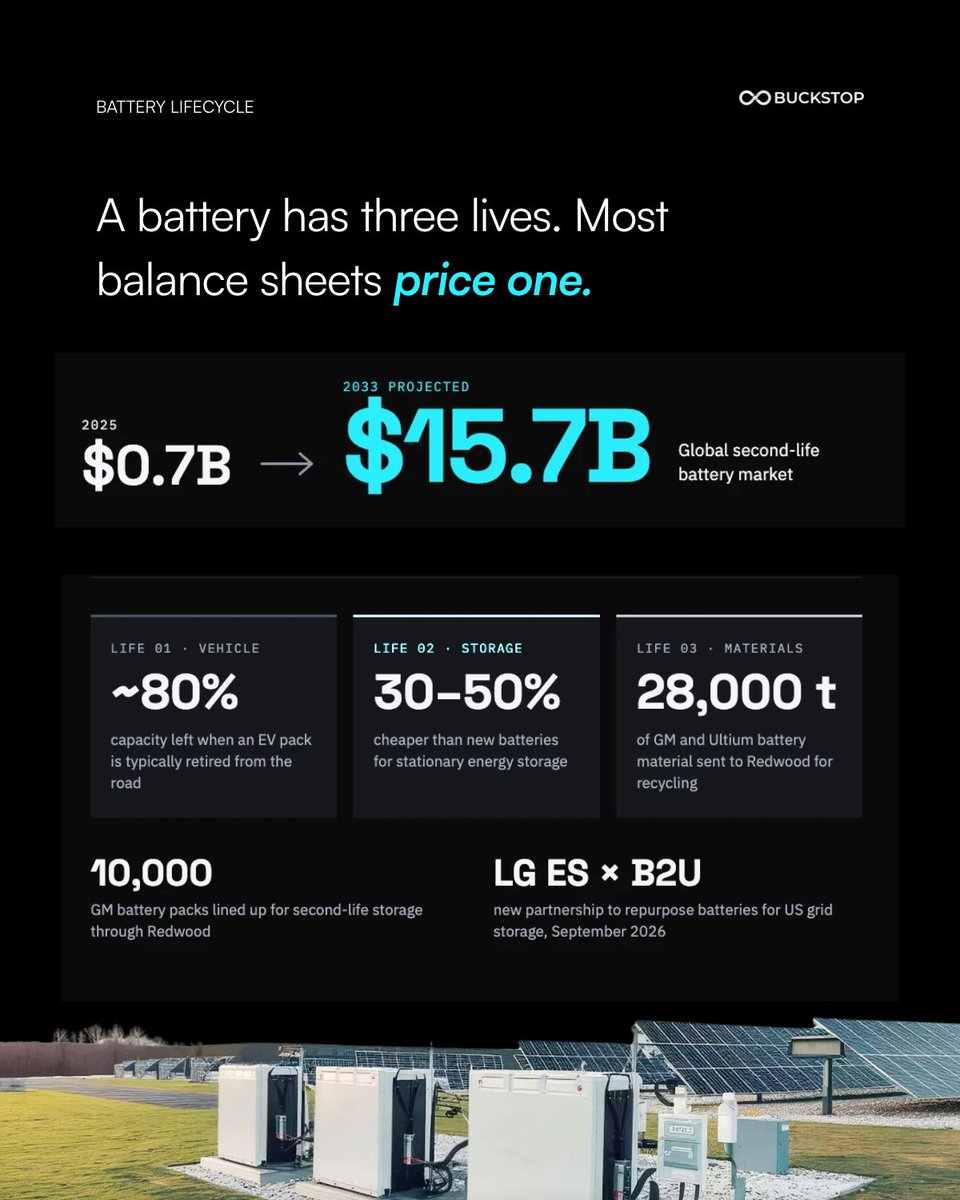
A battery has can have three lives. Most companies don't know this. And almost all balance sheets price only one.
The second life market is no longer a pilot. Redwood Materials Nevada microgrid runs on 792 retired EV packs and delivers 63 MWh, about 80 kWh per pack on average. At a General Motors plant in Michigan, roughly 100 repurposed packs are projected to cut electricity costs by more than $3 million over the system’s life, around $30,000 per pack before system costs. What changes the math is supply.
Redwood says EV packs grew from under 1 GWh of its annual intake in 2023 to more than 5 GWh now, and about 10,000 more GM packs are earmarked for second-life use. Forecasts vary, but some put EV batteries available for reuse above 100-120 GWh a year by 2030. Packs typically retire at 70–80% of original capacity, which is plenty for stationary storage.
They're not alone LG Energy Solution has just partnered with B2U Storage Solutions on second life US grid storage.
That reshapes the aftermarket in three ways:
1. A market is forming, but price discovery is thin. Marketplaces have listed retired packs at roughly $25–75 per kWh, in low volumes.
2. Grading is the bottleneck. Testing costs, patchy usage history, and the lack of harmonized grading and certification standards slow repurposing.
3. Refurbishers and recyclers will compete for the same packs. Planned recycling capacity far exceeds the supply of waste batteries, so each pack’s best use becomes a real decision.
Overall the second-life market for BESS is projected to grow from $0.7 billion in 2025 to $15.7 billion by 2033.
For the companies that own these battery packs (automakers, fleets, energy companies, lessors, insurers), a retired fuel cell has been a disposal problem. It can become a revenue line, but only if the owner knows what each pack is worth and where it should go...second life, remanufacture, or recycling.
That takes a high quality residual value analysis accounting for state of health (SoH), and an auditable record behind it.
Yet many owners still carry a retired battery at scrap or recycling value, which can often be negative depending on the underling chemistry.
The gap between that number and its second-life value is the opportunity, and the risk. Two packs of the same model can retire in very different condition, so value depends on SoH more than on age or mileage.
Making these second life batteries a viable option in the market will require significant infrastructure like warranties and certifications, but above all they needs to be bankable assets. Bankability starts with a residual value a lender or insurer can trust.
That’s the kind of analysis we build at @BuckstopHQ.
Glass is 67.5% of a solar panel's weight, and only about 4% of its recoverable material value. Silver is 0.03% of the weight and roughly two-thirds of the value.
That imbalance explains a lot about end-of-life solar. Recyclers chase the silver and aluminium, and most of the glass ends up in landfill or filler for construction materials.
That may be starting to change. In lab tests, a module built with a 50/50 blend of recycled and new solar glass performed as well as one made entirely with new glass. A plant in Georgia is now planned to make solar glass from retired panels, with first production targeted for 2028.
It's early, and lab scale is not factory scale. But residual value rarely moves because of one breakthrough. It moves when the lowest-value parts of an asset can be extracted and utilized effectively. If extracted solar glass finds a real market, many of today's decommissioning estimates will need a second look.
That's the kind of shift we track closely at @BuckstopHQ.
Next Friday I’m speaking at the Advanced Energy Conference in New York.
I’ll be on the “System Math of the Clean Energy Transition” panel, Friday, Nov 6, 9:30 AM at the Hilton Midtown. The question we’re digging into: where do the numbers on emissions reduction and reliability most often fail to reconcile, and why?
At @BuckstopHQ, we value energy assets and track their residual value, so I’m looking forward to the part of the math that often gets left out: what these assets are worth, and what happens to them, after their first life.
Thanks to @Advanced_Energy for having me. If you’re going to be at AEC, I’d love to connect. Come say hi.
Event Tomorrow!! Session Spotlight: Urban Mining: The Circular Economy of E-Waste
https://t.co/n0AteHi6Ty
📷 October 21, 2026
📷 10:15 am Pacific Time
📷 Online, Two-Day Conference - October 21-22, 2026
📷Find program, keynote, and registration information here: https://t.co/4993Izisef
📷 Visit https://t.co/xus1CSqN9x to get your ticket today!
📷 Speakers: Stephanie Barger (moderator) and Alexander Olesen
The subsidy era asked, “What’s the credit worth?” Now the question is, “What’s the asset worth, today and for the rest of its life?”
Solar’s long-term outlook is as strong as it’s ever been. The players who win will be the ones who can price an asset over its whole life.
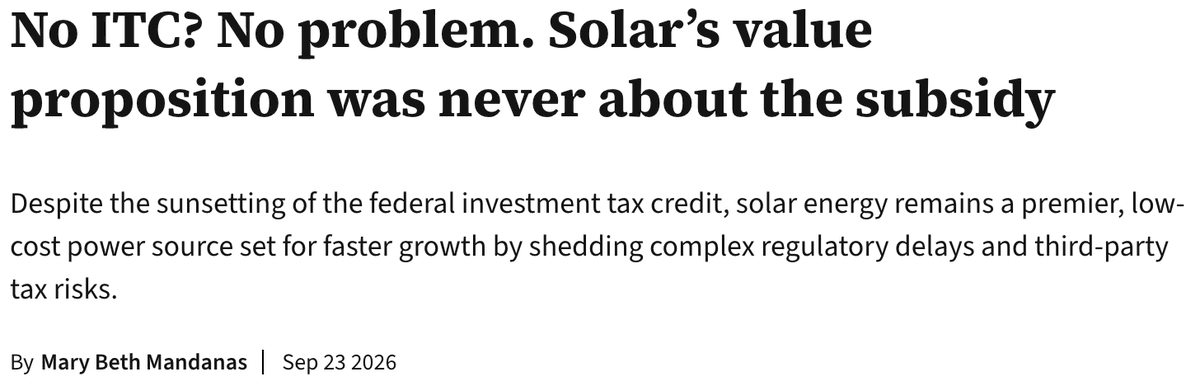
The ITC tax credits are gone. Solar’s value isn’t. But how solar projects get valued has to change. Mary Beth Mandanas of @OnyxRenewables made a strong case in a recent @pvmagazineusa article that solar was never only about the subsidy:
All three need the same thing: a deep, well understood, and trusted secondary market for solar assets. That market can’t run on guesswork. It needs independent, standardized valuation.
Thankfully I made it a cross the finish line at the Chicago Marathon yesterday! Glad to check that one off the bucket list.
I was blown away by the turn out, huge crowds the entire route! What an experience.
A big shout-out to my friend Oliver Ayton for completing his 3rd major…only 5 more to go. Glad I got to join him for this leg of the journey.
Legs are a bit achy today!
Solar and batteries are not only becoming the biggest energy sources, they are also becoming hugely lucrative markets.
We will see a consolidation in solar and batteries that will be similar to how Nat Gas consolidated in the late 2010s.
Many new big energy companies will be birthed over the next several years.