In case it is not clear, I am not endorsing this practice for science. I suspect scientific depth can only be achieved slowly and patiently. The same for the arts.
Great insights and interesting discussions at the #SCS conference at @HSGStGallen
🚀 with our group's talks 🎙️& posters📖 about works & visions on privacy-preserving authentication, secure & private computing and #postquantum cryptography!
What a pleasure to attend Prof. Christos Dimitrakakis @olethros inaugural lecture🧑🏫at the University of Neuchâtel (https://t.co/wZaXPJo97n) in 🇨🇭on AI 🧠 in Science & Society!! Great insights and interesting discussions! 🚀Well done & Warm Congratulations!!🥂
The next semester at BeNeFri starts soon. Next Tuesday we start with our Reinforcement Learning course, which covers both algorithms and theory. See also our book with Ronald Ortner: https://t.co/ZeayJeFrAr
https://t.co/IA9Uh8Rg7J
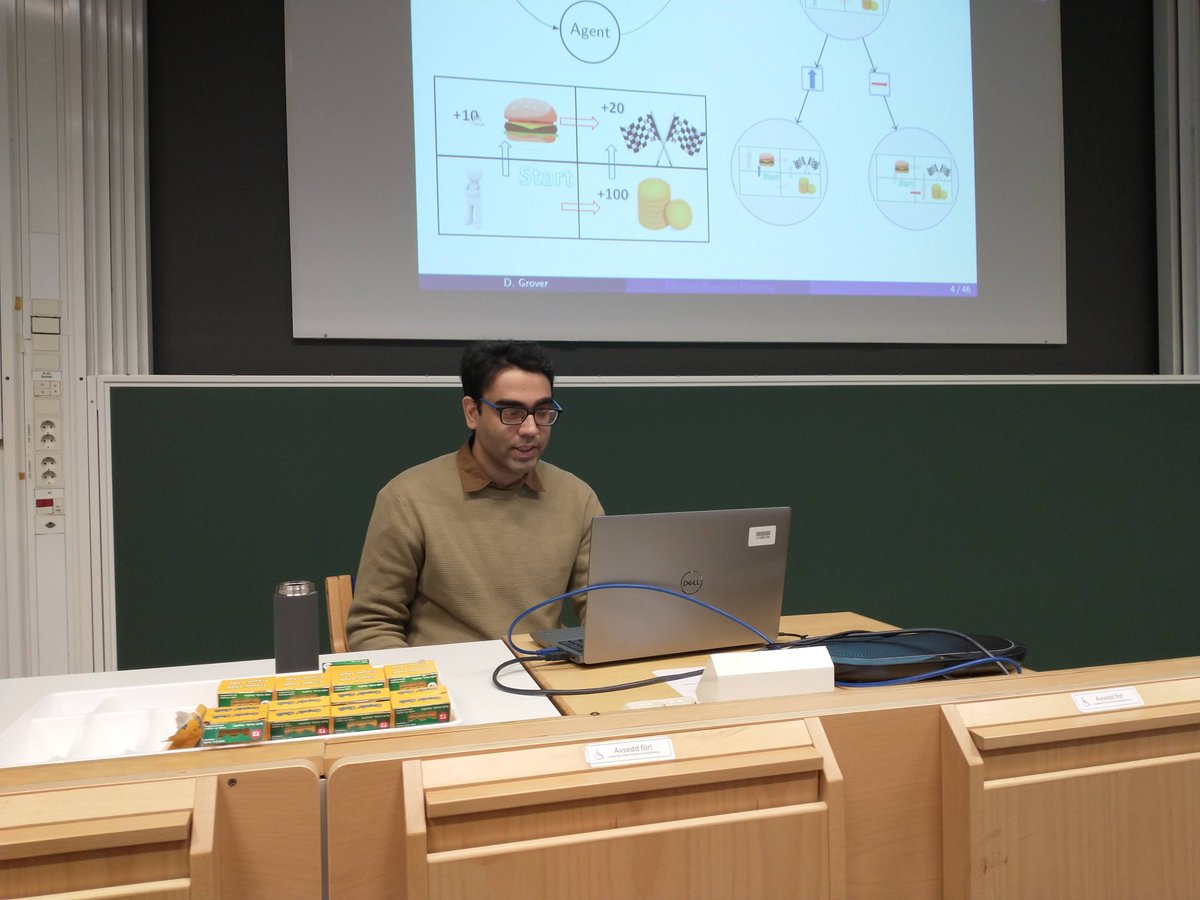
Congratulations to Dr. Divya Grover @divy_7 for his PhD defense this December! Thank you to Alessandro Lazaric for being the opponent and to Jana Tumova, Marc Deisenroth and Alexandre Proutiere for being members of the committee!
2. On Meritocracy in Optimal Set Selection - by
Thomas Kleine Buening, Meirav Segal, @BasuDebabrota , Anne-Marie George and Christos Dimitrakakis.
Congratulations to the authors on their amazing work! 👏👏👏
2. On Meritocracy in Optimal Set Selection - by
Thomas Kleine Buening, Meirav Segal, @BasuDebabrota , Anne-Marie George and Christos Dimitrakakis.
Congratulations to the authors on their amazing work! 👏👏👏
EAAMO has been possibly the most stimulating and affirming conference I’ve been to! So incredible to connect with other researchers at the intersection of computation, modeling, and social impact!
1/n We all heard that "A group is more than the sum of its parts". Then how can you define the merit of a group? How you can select a class of students who are meritorious together? We study these questions in "On Meritocracy in Optimal Set Selection".
👉https://t.co/6A7LVYwWjS