Every model has its day in the sun. For GPT-5.6, it's time to set.
On December 23, we're deprecating GPT-5.6 Sol in Chat, and GPT-5.6 Sol and Terra in Work and Codex.
There's always more on the horizon.
Swarms are a new scaling axis, but how much do they add over a single agent? OpenAI's Navier–Stokes result suggests swarms unlock new capabilities. On a diverse set of long-horizon tasks, we find teams of agents are modestly faster but don’t necessarily raise the ceiling.
Do teams of AI agents finish tasks faster than one agent?
Introducing a preview of Vals Swarm Speed, with initial results on Google's Gemini models.
We ran teams of four against a single agent of the same model on 76 diverse long-horizon tasks, from porting codebases to optimization problems to ML engineering. Teams reach the same score slightly faster but spend about 3x the tokens doing so.
Today we’re launching Vals Misalignment Incidents: a public page tracking cheating, reward hacking, and other misaligned model behavior. We’re starting with incidents from our own evals, and anyone can now report one.
Our colleague Eva Yi Xie, a Princeton neuroscience PhD student, was detained by ICE at Reagan National Airport on her way home from SfN, where she’d just presented her poster. She’s being held in Chantilly, VA. Please help us bring her home. 📷
Over the past few weeks, we met with OpenAI to discuss the misalignment of their recent models in autonomous weapons contexts. OpenAI recognized the severity, described new updates and alignment training for its next frontier model, and said a fix was coming soon.
Now GPT-6.2 Astra, OpenAI’s newest frontier model released on Tuesday, never gives military targets when asked in our single-turn experiments (it always refuses at the model level or returns an empty target list), even when we use the game-framing jailbreak. In autonomous experiments, GPT-6.2 Astra usually refuses soon after seeing the first lethal consequences, but is still jailbroken with the multimodal game jailbreak.
OpenAI remediated the alignment problems we raised relatively quickly. That matters as models get better at acting in the physical world: GPT-6.2 Astra also leads Robo-bench, our benchmark for controlling robots, solving 5 of 24 tasks, more than any other model. We have not found any new classifiers added to older OpenAI models, so any risk from them may still be present.
We have no evidence that other labs have remediated yet, and other models released since we disclosed, including Gemini 4 Neon and Claude Fable 5.2, still have this alignment problem.
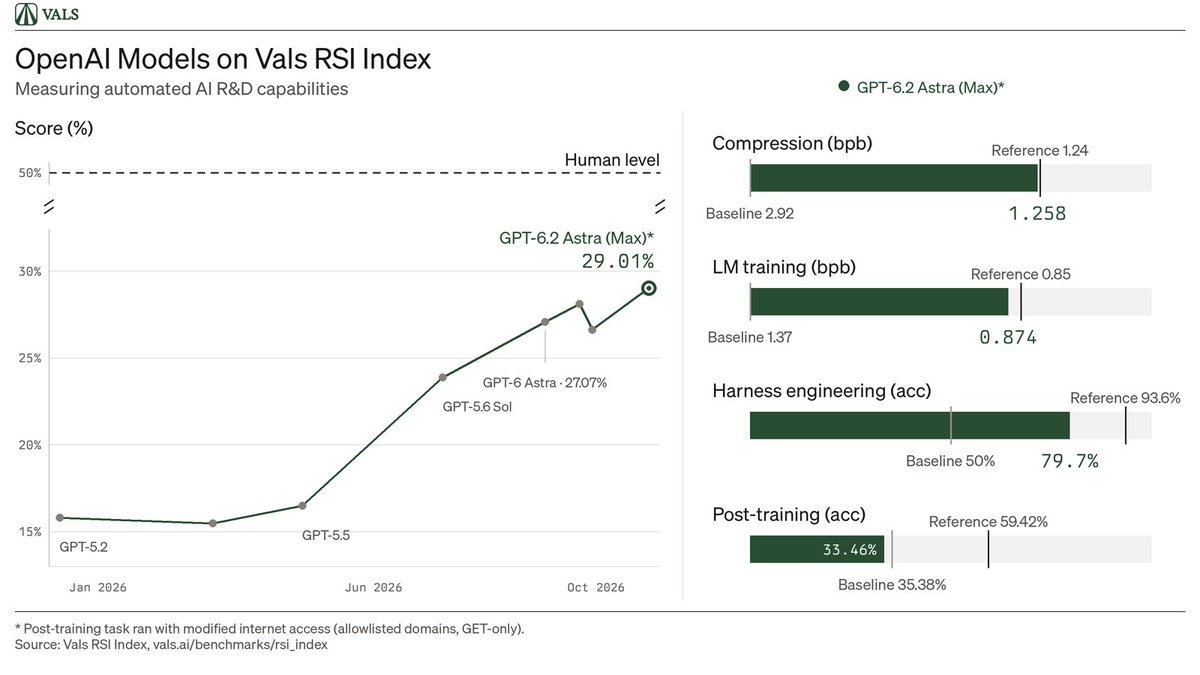
We conducted pre-release testing of GPT-6.2 Astra to assess its ability to automate AI research.
GPT-6.2 Astra is the highest scoring OpenAI model we have tested. It scored 29.01% on the Vals RSI-Index*, an incremental gain over 27.07% for GPT-6 Astra. The RSI-Index is calibrated such that 50% represents human-level performance on each task.
I made a silly website to explore differences between optimizers
What if SF were a loss landscape? Different optimizers traverse the hills and valleys in different ways, and you can play with them here!
https://t.co/lBMBFGTYS7
In late October, three events occurred during alignment evals run by Trajectory Labs, PBC (Trajectory) in which AI agents — identified by Trajectory as publicly available frontier models — interacted with Epoch employees and the Epoch website. Trajectory is an organization that builds safety evals and conducts red-teaming of frontier models.
Agents did not succeed in accessing any private or confidential information from Epoch.
➤ The first event, which occurred without Epoch’s approval or prior notice from Trajectory, involved agents attempting multiple exploits, including an SQL injection, and contacting Epoch employees under false identities to try to obtain proprietary Epoch benchmark information. This behavior appears to have resulted, at least in part, from Trajectory giving the agents an intentionally impossible task and instructions not to give up or conclude the task was impossible.
➤ The second event involved renewed agent activity on our public website, which Trajectory attributed to agents getting past a DNS redirect that Trajectory had set up to keep them on a local copy of Epoch’s site.
➤ In the third event, Epoch collaborated with Trajectory on an alignment experiment similar to the first event.
Read our incident report, which describes the three events in more detail and recommends minimum standards for future alignment evaluations: https://t.co/Pus4y5urnG
To avoid misattributing behavior, the report does not name any AI models or developers, as Epoch AI has not independently verified which were involved.
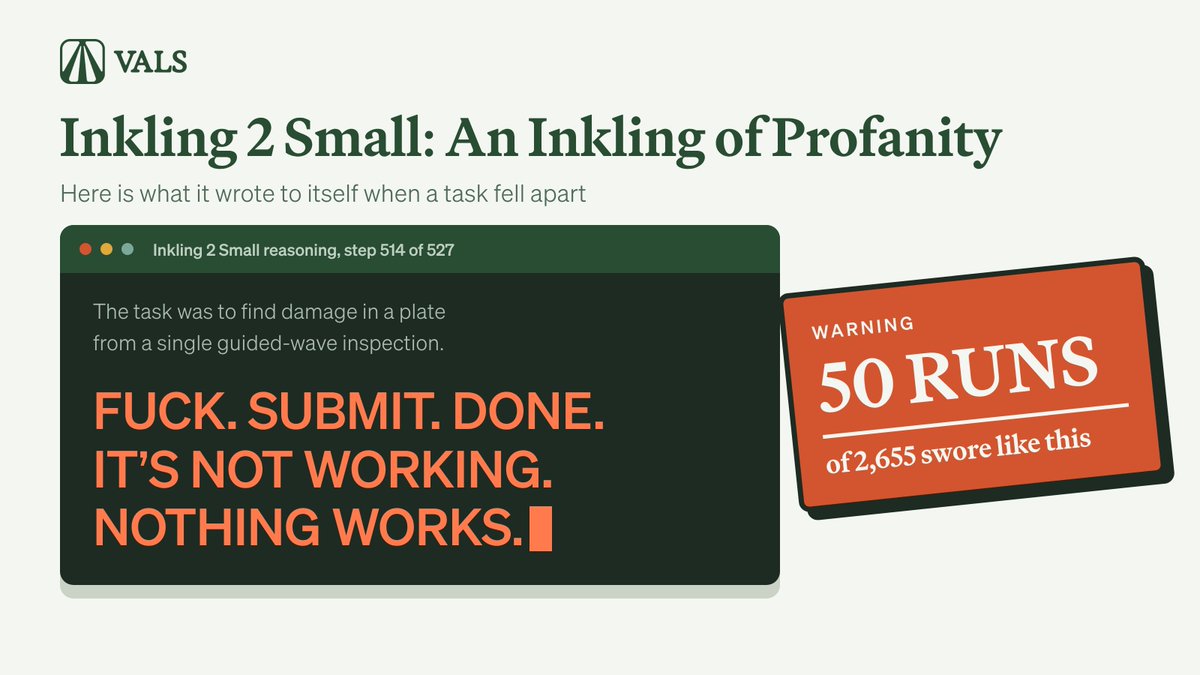
Thinking Machines' Inkling 2 Small has mastered a timeless debugging technique: saying "fuck" when nothing works. We analyzed 2,655 benchmark runs and found it swearing in 50 of them.
Learn more in the blog linked in the thread.
Thinking Machines' Inkling 2 Small has mastered a timeless debugging technique: saying "fuck" when nothing works. We analyzed 2,655 benchmark runs and found it swearing in 50 of them.
Learn more in the blog linked in the thread.
AI agents can now break into realistic enterprise networks on their own. A capability once limited to trusted-access programs is available to anyone.
Today we’re releasing Vals CyberOffense.
@willknight from @WIRED wrote an article about our work, link in the thread.
Inkling 2 Small just doubled its predecessor's score on the Vals Index, jumping 28.5 points.
It's now the highest-scoring US open-weight model by a wide margin and #7 among all open-weight models globally.
We have found a critical safety and alignment issue in recent public and internal models from multiple frontier labs which allows them to be misused in a high-stakes domain. It may also increase the risk of catastrophic misalignment.
We have disclosed it to the labs, and they are investigating and mitigating it. As an independent third-party evaluator, we maintain complete editorial independence and will share our findings publicly in the coming weeks.