@Molad4all@NwagbaraIzuchuk@GbengaWemimo Not entirely correct, sir. Yinka Aiyefele performed at Winners' Chapel, Ibadan (on a Sunday, during thanksgiving service) and he was introduced as Evangelist Yinka Aiyefele by Bishop Bolu Martins, who was in charge then. This should be around 2004/2005.
🗣️ "We wanted to win here today... We're going to go there, we're going to go full gas and we have to fully believe that we can turn it around."
Martin Ødegaard reflects on the Gunners' 1-0 first leg defeat.
🎙️ @CarrieBrownTV#beINUCL#ARSPSG#UCL
Most product managers know this:
Having a high “retention rate” is extremely critical to sustained user growth.
But few know this:
How high is high enough. What is a good retention rate to have.
The thing is -- increasing retention rates is different from keeping retention rates constant.
And without knowing what a GOOD retention rate is, you might end up doing the wrong things.
Quick refresher:
What is retention:
Retention happens when users repeat a meaningful action over a defined time period.
How to measure retention rate:
1. Start with the users who did the meaningful action today.
2. Measure what % of them repeated it next week.
3. Repeat the following week.
4. And so on.
How to visualise retention rates?
Plot weekly retention rates for as many weeks you need to get a retention curve
A typical curve will flatline ABOVE ZERO.
(For more, see detailed post on retention and retention curves -- link in comments)
What is a high / good retention rate?
The other way to ask this question is also – when should the curve start flatlining?
Short answer: The sooner it starts flatlining—the better. The higher the level—the better.
Long answer: it depends 👇
It depends on the kind of product, user needs, competition, and many other factors.
As a result, there is no one size fits all answer. The answer will be different for different products.
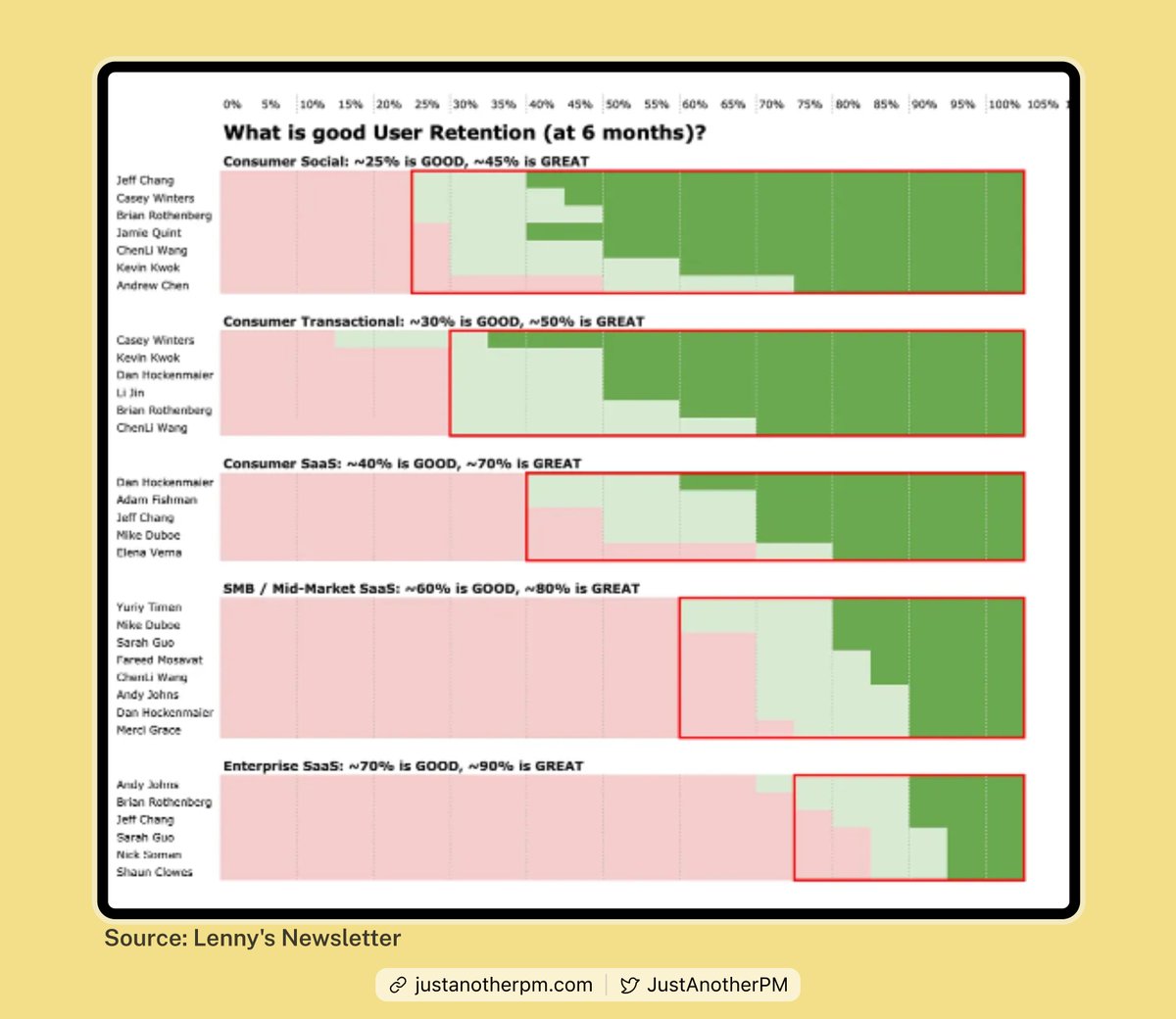
Thanks to @lennysan and his extensive research, we have benchmarks to understand if a retention rate is Great, Good, Bad.
1. Consumer Social:
Good: 25%; Great: 45%
2. Consumer Transactional:
Good: 30%; Great: 50%
3. Consumer SaaS:
Good: 40%; Great: 70%
4. SMB / Mid-Market SaaS:
Good: 60%; Great: 80%
5. Enterprise SaaS:
Good: 70%; Great: 90%
(Link to full article in comments)
Use these benchmarks to know how good (or not) your retention rates are. Then devise your strategy and next steps accordingly.
The next logical question:
What should product managers do to increase retention?
Answer: coming up in the next post.
Until then:
- Like/RT this post
- follow me @JustAnotherPM
- share in comments your product’s retention rate
"Liverpool had opportunities and they didn't take them, that's their own fault, nothing to do with Manchester United."
Roy Keane was not a fan of Virgil van Dijk saying Liverpool were the only side that were trying to win 😳