Excited to have collaborated with @berkeley_ai, @KAIST_AI on SketchSSM.
Write to the full state once per window of multiple steps. Read from a tiny sketch instead of full state in between.
Excited to see how far linear attention can go with SketchSSM. 🚀
State-space and linear-attention models maintain a fixed-size recurrent state, but reading the full state at every decoding step remains a major bottleneck.
How can we overcome this bottleneck without accumulating errors?
Introducing SketchSSM: write to the full state, read from a compact sketch.
🚀 With SketchSSM, get up to 2.8× faster decoding on your favorite state-space and linear-attention models, including Mamba, GDN, and KDA. 🧵
📄 Paper: https://t.co/Z6UOQJNAMG
🌐 Blog: https://t.co/l4sGLhSJ6w
Love this. Linear attention keeps getting better by growing its state, and triadic states make that growth almost free in parameters.
The flip side: every step reads the full state, so the inference bottleneck shifts to state access. But do we really need to read it all? 👀
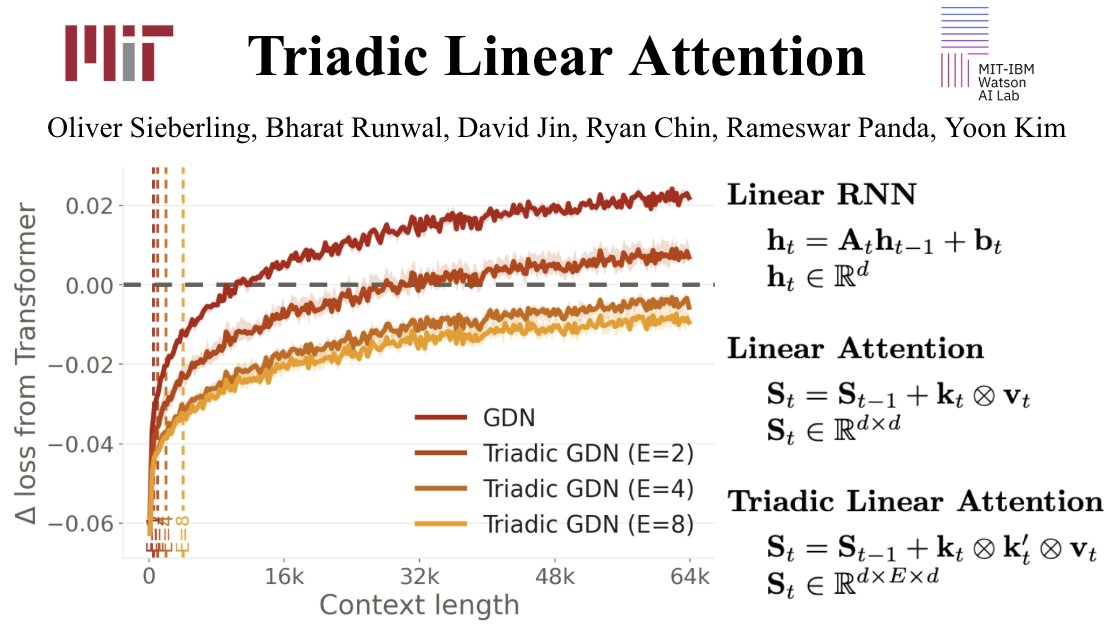
Linear attention is arguably the most naive RNN, but still massively outperforms traditional RNNs by maintaining a matrix state. So... what if we use a (triadic) outer product of three vectors and maintain a three-dimensional state?
Introducing: Triadic Linear Attention 🧵
@osieberling Pretty cool ideas! Since each slice along the second key gets its own decay gate, did you notice whether the slices specialize, say, some keeping long-range memory and others recent context?