most ai tools answer "what is this?" eden answers "what could this become?"
ask that of a hillside, a kid, a neighbourhood, a company, a career.
ai that shows us what is: useful. ai that shows us what could be: the whole game
We’re hiring a Systems Architect for EDEN at OXMAN.
https://t.co/IsFzqWGqcx
What is EDEN?
Most environmental design tools look backward. Remote sensing shows us what’s already on the ground. Traditional simulations test plans someone has already drawn.
EDEN works the other way. It starts from what we hope a piece of land can become (capturing carbon, holding stormwater, cooling the air, welcoming more life) and searches for the earthworks, planting and care that will get us there.
EDEN learns from satellite imagery and public species records: which plants a site can support, and what each one does, how it holds soil, stores carbon, offers shade or feeds wildlife. Physics simulations running on GPUs then model the site, from grading and stormwater to fire and wildlife movement. On top sits a decision engine. AI agents and optimizers search procedural world models, built by our designers, for the interventions that perform best. So decisions about real land rest on outcomes that people and nature can trust.
Imagine asking a hillside what it could become, and having it ‘answer’.
EDEN is already at work on real projects, from residential communities to warehouse parks. Now we’re engineering its research prototypes into one system. Our aim is to make ecosystem design a true engineering discipline, with outcomes we can verify.
If you’d like to help us build it, we’d love to hear from you.
An AI can pass every test we give it and still fail the people it is meant to serve.
“We didn’t code intelligence; we cultured it” is a provocative way to describe how these models develop their capabilities. The biology is a metaphor, but the distinction matters. Researchers design the architecture and training process, while many of the strategies the model learns remain only partially understood. Building the system doesn’t give its creators a complete explanation of everything happening inside it.
That brought me back to Heisenberg’s observation that we encounter “nature exposed to our method of questioning.” He was writing about physics. I think there is a useful management parallel: when we test an AI, we choose the circumstances, the questions and what counts as a good answer. What we learn is shaped by those choices.
Imagine a customer service agent that answers accurately, stays polite and closes conversations quickly. It could look excellent on the dashboard. But what does “resolved” mean? Did the customer accomplish what they came to do, or did they simply stop trying? A conversation can end because the problem was fixed, because the customer accepted an explanation, or because the process exhausted them. Those outcomes deserve very different scores.
The judgment begins before anyone reviews the AI’s answer. It is already present in the cases we selected, the outcomes we measured and the people whose experience we considered. If our tests reward a quick conclusion without checking what happened to the customer, we have built that blind spot into our definition of success. A more capable model could make it harder to notice by producing a better explanation for the same disappointing outcome.
I’d want teams to examine cases the system marked successful but a customer or employee disputed. Follow what happened after the conversation. Look at repeat contacts, unresolved requests and situations where someone had to work around the agent. Use that evidence to revise the tests. A specification gives us expectations to check; experience should keep changing what we think we need to check.
Human judgment needs room to change the system, too. A reviewer who can only approve or reject individual answers has limited influence over a flawed objective. Someone needs the authority to question the score itself, change the instructions, narrow the agent’s responsibilities or pause its use. And the people closest to the consequences need a way to be heard when the dashboard says everything is working.
We will encounter failures nobody anticipated. That is part of working with systems we are still learning to understand. But we should be able to explain why we gave an AI a particular task, whose interests we considered, what evidence justified trusting it and what would make us change course. Those are management decisions. The model’s complexity doesn’t make them any less ours.
Sources and further reading:
Tracing the thoughts of a large language model — Anthropic
https://t.co/sGXIouneYW
Physics and Philosophy — Werner Heisenberg
https://t.co/hofgN4N2bB
Kekius Sage on emergence
https://t.co/Vl2JdzR40v
Heisenberg on our method of questioning — Physics In History
https://t.co/RIucFsOVyK
We have to remember that what we observe is not nature herself, but nature exposed to our method of questioning.
-- W. Heisenberg
(Physics and Philosophy, 1958)
Automate your tedious tasks with North 2.
Our upgraded agentic AI platform comes with improved intelligence features such as reusable agents and skills. Use them yourself and share to your team, meaning you can spend more time on the hard questions and less on the to-dos.
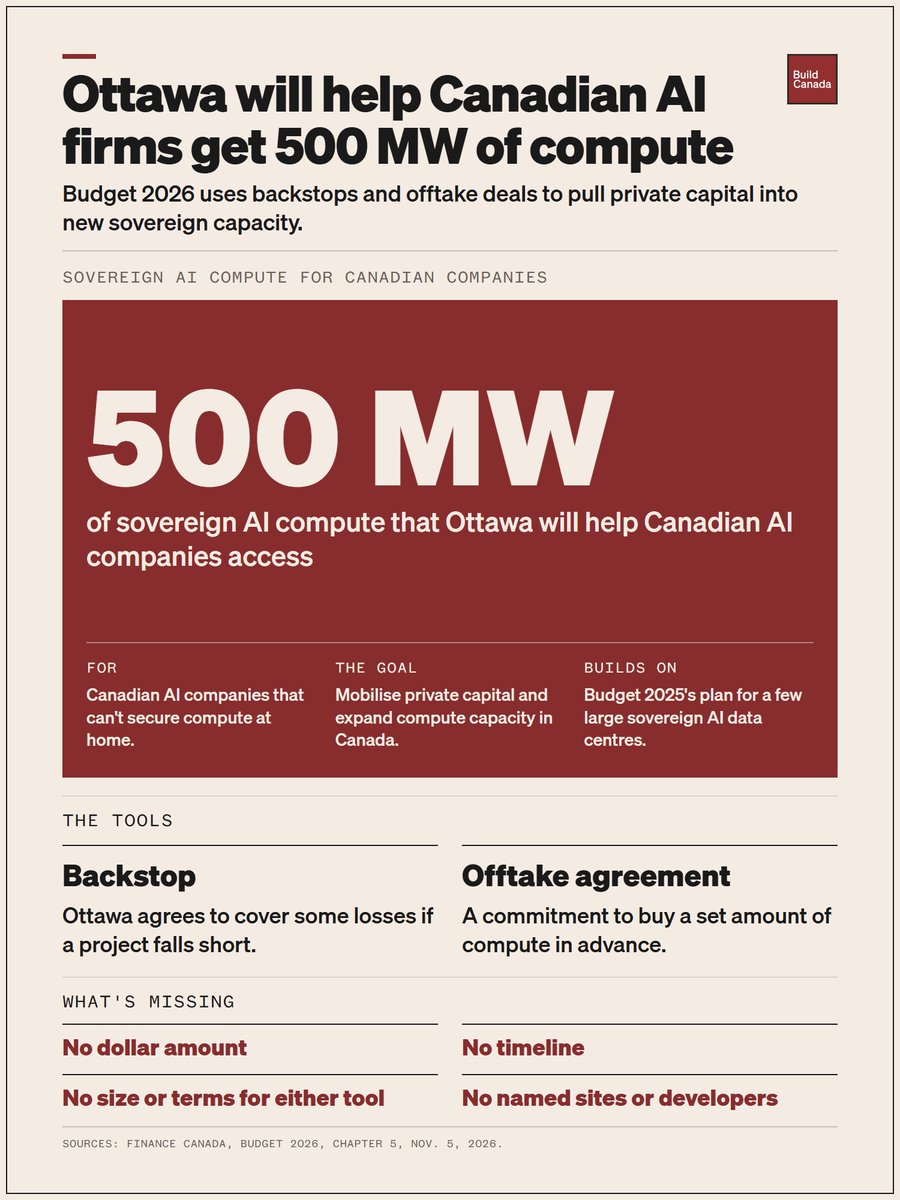
Canadian AI companies often can’t get compute at home. ⚡
Budget 2026’s announces 500 MW of sovereign capacity, built with private capital and backed by federal backstops and offtake agreements.
Canada might've finally gotten it right.
Proposed $15M capital gains exemption for founders AND early employees.
Compared to US QSBS:
→ 36-month min hold 🇨🇦 vs 60-month 🇺🇸
→ No trust stacking in 🇨🇦
Huge upgrade from the old ~$1M cap. Canada's rewarding entrepreneurship!
kinda crazy that most fungi can't grow at 37°C, and every degree above 30 shuts out about 6% more of them, so the temperature your body holds is a wall most of the kingdom that rots whole forests can't climb, and one model puts the best balance between that protection and the energy it costs to stay warm at 36.7°C, which is why you burn food all day just to hold that heat, while as the planet warms, some fungi are probably adapting to the heat, one degree at a time
so yeah, be happy eating that donut cuz it's saving your life
I wouldn’t be surprised if 95%+ of devs spending $10K+ per month on AI, globally, were based in the Bay Area
Nearly everyone I talk here (devs, founders, CTOs etc) are AI-pilled in ways I rarely see outside. AI-pilled as in obsessed building more with agents, running agents when they sleep, designing loops to auto kick-off, running them during their commute. And talking with each other how and what they do and then taking those ideas and trying it
New from me: AMD will pay US$2.9B for Taalas, the three-year-old Toronto chip startup. It’s a blockbuster takeover for a venture-backed private Canadian technology company, part of a rush of deal making in the hot AI inference hardware space.
https://t.co/ZTWX5T6fLv