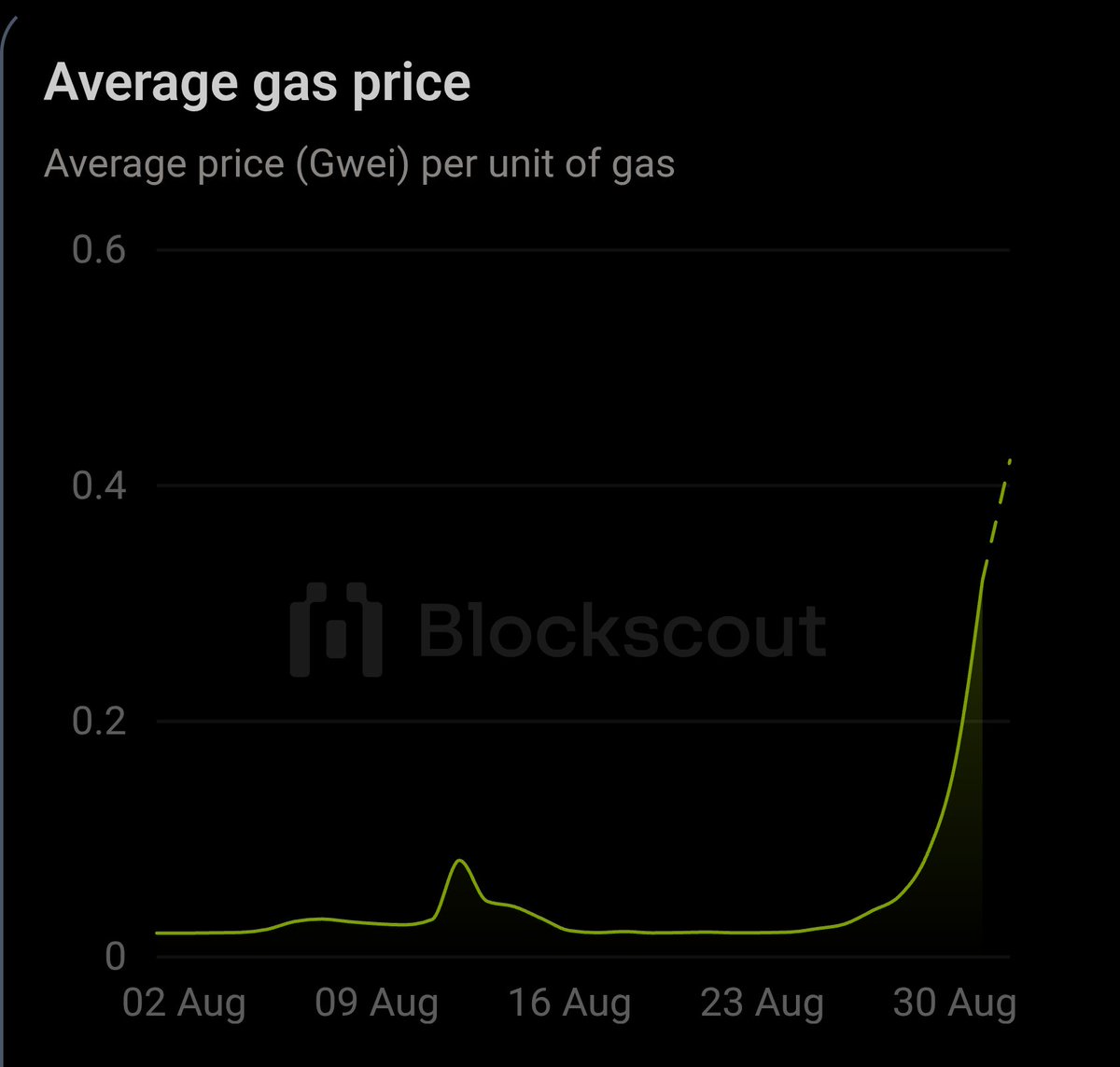
Everyone on @arbitrum shilling how much RH has made in gas fees, but no one is showing the base fee chart!
Soon we will pay 1$ per swap, then 2$ per swap, then 5$ per swap. Ripping off retail and builders.
Can't afford a bigger sequencer, or nitro code can't handle the flow?
@0xJoxes@materkel@arbitrum Both, very aggressive base fee scaling. Min base fee is fixed at 0.02 (4x base's). Either the nitro stack can't handle it or their sequencer is not beefy enough to process the flow.
Robinhood’s gas fees feel like a misconfiguration.
A chain peaking at 8k TPS while averaging ~200 TPS has enough spare capacity, so congestion-based fees should be near zero most of the time.
So, for the sake of users and the reputation of L2s, @arbitrum should look into this.
@sgoldfed Massive overpaying for users and builders! Obviously their sequencer struggles. Or the nitro code cant handle all this flow. Basefee even went above 0.5 for some time.... so are you happy that users pay 1$ for a swap now?
@arbitrum@sgoldfed Yes higher! How long until we start to pay 10$ in gas cost per swap? Very user and builder friendly! Sequencer cant handle the flow...
@sgoldfed Yes at 0.25 gwei base fee... more expensive than eth mainnet to use. Looks like a broken fee scalar or the nitro code cant handle the flow! Why make users pay so much...? Its 2026... you can do better!
@sgoldfed Yes at 0.25 gwei base fee... more expensive than eth mainnet to use. Looks like a broken fee scalar or the nitro code cant handle the flow! Why make users pay so much...?
Cheap, unstoppable private transactions on Ethereum.
Glamsterdam is making progress. At this point, it’s clear that it will help scale Ethereum significantly, from 60M gas/block today to at least 200M/block (so more than 3x).
If you thought gas was cheap on Ethereum today, well you were right but also it’s going to get even cheaper soon.
So what comes next? Next is Hegotá, and I think it is a great opportunity for Ethereum to double down on CROPS.
Censorship Resistance. FOCIL is already scheduled for inclusion in Hegotá. What this means is that all transactions going through the public mempool will benefit from extremely high inclusion guarantees. Ethereum is reliable and unstoppable in part because it gives you strong guarantees that your transaction will be included, no matter where it comes from.
Open Source. Everything about the Ethereum protocol is open source and should stay that way, so not much to add there.
Privacy. Today, transactions from privacy protocols on Ethereum have to be sent to a trusted third party (a relayer/broadcaster) that submits them and pays gas, without linking the activity to the user's account.. This is an obvious censorship vector: if the relayer is not online or doesn’t want to process your transaction, there is no other way for it to go through.
The good news is: Frame transactions (EIP-8141) is already considered for inclusion in Hegotá, and if you add keyed nonces (EIP-8250) you can get rid of relayers altogether and have fully trustless, censorship resistant private transactions going through the public mempool. The last piece is recent roots (EIP-8272), which ensures private transactions can always benefit from FOCIL inclusion guarantees.
But protocol changes alone aren't enough: we also need immutable, permissionless privacy protocols, and wallets that don't leak your identity (Kohaku 👀).
Security. Frame transactions are good for privacy on L1, and they also give us the modularity we need to unlock PQ signatures on the EL, and to build important security features like post-transaction assertions (EIP-7906). I usually think of it as the "last transaction type" you can build on top of.
If we manage to ship all this in Hegotá, Ethereum will consolidate its unique position as a network you can rely on 100% of the time (literally), without having to trust anyone other than the 10,000 nodes distributed across the world to transact, swap, transfer, lend, borrow and trade privately and securely, no matter who you are or where you come from.
What about after Hegotá? We have a lot to do, and I think the best place to capture how we think about priorities is the strawmap but I’ll just mention a few:
- Keep scaling without forcing nodes to hold terabytes of data, which means new ways of storing and serving state
- Accelerate Ethereum’s transition to PQ cryptography across all layers of the protocol (consensus, data and execution)
- Deliver faster finality, so transactions settle in seconds rather than minutes
I don't think people realize the magnitude of these changes for adoption.
Links below 🔗👇
Ser, wtf. https://t.co/A6iiReLerh is a casino of scams called memecoins. Phantom wallet barely works (I had very bad experience trying to connect it to hw wallet - it worked at the end but UX was worse than Metamask).
Solana DOES does ecosystem support very well, but best examples aren't very good tbh
the evm is still the best place to try things
open source and permissionless building as core values have attracted some of the best devs in the world
some of best evm devs I know are coming back to build weird new things onchain again
im seeing them on my TL again, im stoked
im gonna go out on a limb and say ppl want to participate onchain again
theyre fatigued from launchpads and tired of being rinsed
they want new mechanics, new experiments, new reasons to do something onchain, the appetite is there
the products just havent caught up ... yet