The real equity issue in this budget is that Labor are telling us they need to borrow $267 billion of extra debt over the next four years to pay for their out-of-control spending. That is almost identical to the total value of the headline budget deficits that Labor say they will produce between now and 2029-30.
The fairness issue is that Labor is spending hundreds of billions of dollars borrowed from future generations to buy votes in the present. If it kept government spending as a share of the economy, or GDP, at 2007-08 levels, when Australia was doing very well indeed, the budget would swing from a projected $64 billion headline deficit to a surplus of about $23 billion. Rather than borrowing from future taxpayers, we would be reducing their debt burden.
It is un-Australian to overturn all the rules of the economic and investment game — adversely affecting millions of households and businesses in the process— with zero debate, discussion or notice. The accounting and legal costs alone will impose a small fortune on families and firms. How Labor thought they could get away with this daylight robbery is unclear. It must have something to do with dud polling…
https://t.co/tqOqGI6MEi
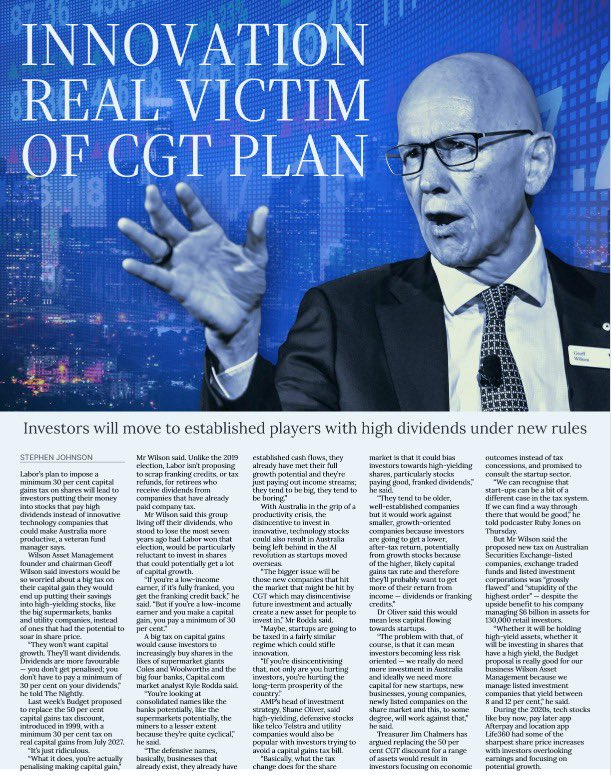
The new CGT must be stopped. It’s war on the aspiration and ambition of all Australians. "If you’re disincentivising investment in growth companies, you’re not only hurting investors — you’re hurting Australia’s long-term prosperity."
Unfortunately, more and more Aussies are falling into the top marginal income tax bracket due to inflation and bracket creep. The highest 47 per cent tax threshold now kicks in at pre-tax income of $190,000, which is its lowest inflation-adjusted level in 20 years. If we had indexed these tax brackets to inflation since 2008-09, the top marginal income tax threshold would be a much higher $281,450.
In trying to explain the cost of these capital gains tax changes, Labor assumed a future inflation rate of 3 per cent annually. Let's adopt that number to quantify the impact of bracket-creep. Back in 2008-09, only 1-in-50 Aussies paid the top marginal tax rate. Today, it is about 1-in-16 people. The bad news is that within 20 years, it will increase to 1-in-5 Aussies paying 47 per cent income tax.
All of this begs the crucial question: what next? If, with literally — and deliberately — zero consultation, Labor is willing to ambush voters with these changes, what will it target in the future? The owner-occupied home, corporates and upper-income earners are obvious targets. All in the name of punishing prosperity and forcing all Aussies back to the mediocre mean. It is regressive socialism in stealth.
Labor has framed this budget around fairness. Yet it is patently inequitable. It is a drive-by shooting to grab tax to pay for the one-quarter increase in the size of the public service since Anthony Albanese was elected prime minister in 2022. Even using its characteristically rosy forecasts, Labor predicts that the cost of Australia's extraordinarily bloated public service will blow out by $19.6 billion over the next four years.
https://t.co/tqOqGI6MEi
This is so incredibly good:
Economist Joseph Schumpeter warned that capitalism weakens when prosperous societies become so comfortable they forget where prosperity came from – and begin resenting the entrepreneurial class that created it.
A country might survive high taxes for periods of time. What becomes dangerous is something deeper: the moral suspicion of ambition itself. The creeping belief that commercial success is inherently exploitative, that profit is morally dubious, or that founders should quietly accept punishment for surviving years of uncertainty.
Prime Minister Anthony Albanese and Treasurer Jim Chalmers should think carefully about the signals embedded in this budget. Tax policy communicates values. This budget signals that founders are not viewed as partners in national prosperity, but simply reservoirs of revenue whose success is viewed with suspicion...
Civilisation advances because some people are willing to bet on tomorrow before tomorrow exists. Australia should be doing everything possible to encourage those people to build businesses here. Because once a society begins treating ambition as something suspect rather than admirable, it eventually discovers that no nation can remain prosperous after teaching its most ambitious people that they are unwelcome.
https://t.co/nxmwyx9aZc
Given the response, I am lifting my column out of the paywall… 1/2
This evil is driven by envy
In the context of the Bondi tragedy, let me start by saying that Australia is not the country I once knew. The Australia I remember during my youth bears little resemblance to the nation that now exists.
I am not sure you can even describe us as a nation – we are more like a heterogeneous agglomeration of vested and frequently colliding interests.
I think there is a fair case to be made that we have traded away our soul. There is no cohesive national identity. There was, once upon a time, a demonstrably visible national character. We knew what it was to be Australian.
We loved our country. Our flag. Our history. Our entrepreneurial and iconoclastic verve. Our disdain of centralised authority. Our willingness to give every person a fair go. Our characteristically intense competitive streak. And our eccentric and larrikin heroes. From Don Bradman to Kerry Packer.
But today it is difficult to discern a unifying crusade or common community. There are, to be sure, redoubts here and there. But across this sunburnt land we have emerged as a nation divided.
Many will claim that their vision of Australia best represents a universal mission. That they know the true Australia. And that there is a silent majority that agrees with them.
But I do not see it. Right now, Australia is a battlefield bloodied by conflicting interests, which this column belaboured seven days ago.
The lucky country has become the lazy land, spoilt by endless resource riches and the seemingly bottomless pit of public money that this has bestowed.
Our wealth has been relentlessly wasted on pet political projects that serve only to perpetuate the reign of those in power. Financially corrupt the voters to win the next election and then rinse and repeat. Until the money runs out.
Australia has become obsessed with the public sector providing answers to its problems. Obsessed with centralised control. Remember the world’s worst lockdowns? Obsessed with censorship: eviscerate parental responsibilities and ban children from access to the internet.
Obsessed with revisionism. We don't even give our kids an opportunity to learn from our historical wins and losses. It is airbrushed in the name of trying to create an alternative political reality.
Obsessed with cutting down tall poppies. That is, we don't just want equality of opportunity, which is a crucial ideal—we increasingly seek equality of outcomes.
A huge amount of the secular racial prejudice projected against Judaism by other creeds and cultures can be attributed to the fact that the Jews have been consistently one of the most successful communities in the countries they have lived in.
The intelligence, innovation, and unmatched professional intensity that Judaism nurtures has been a persistent source of envy and polarisation for as long as the faith has existed.
Whatever academic pursuit or vocation you inspect, you will find Jews dominating. This is true by design because the community defines itself through a purity of purpose that advocates intellectual and professional excellence.
It is a self-selection process that attracts and spawns world-class talent. Yet in a society where you are constantly seeking to manipulate and sate the masses, the ever-tempting reflex is to focus on persecuting the difficult-to-understand anomalies. The exceptions. Those that rank in the 99th percentile. Accordingly, we fall back on handicapping success.
We want to regress everyone back to the mean to create an egalitarian world. The Jews are to blame. It’s the "great vampire squid wrapped around the face of humanity" as Goldman Sachs was once described. Of course, Goldman was founded as a Jewish partnership. Cont’d 1/2 https://t.co/7jgwpw42SM
@MayneReport Key focus should be:
1. Economic growth driven by productivity
2. Tax reform (lower income + company tax, higher GST, simplify the rest)
3. Lower govt spending
4. Lower immigration (some is good, but should not be done to inflate GDP growth!)
That's it. KISS!
@adrianbarich Shorter games, less players on field, and less teams. Would all vastly improve the quality of the game. If all that was implemented - no pay cut required, in fact probably pay rises.
…to boost productivity grth we need a clear reform agenda - fixing the tax system, more flexible industrial relations, more competition etc. Unfortunately there is no sign of this & ever expanding public spending as a share of the economy (now nearly 28%) is making things worse
It is astonishing to think that in the middle of the worst inflation crisis in decades driven by what the RBA characterises as “excess demand”, Australian politicians are running bigger budget deficits than they did during the global financial crisis.
An essential feature of the capitalist system that has powered prosperity for the last century has been the innovation and productivity enabled by using freely functioning market signals to guide the allocation of scarce resources. This necessitates some economic volatility (aka a business cycle).
When politicians and central banks directly intervene in the economy via fiscal and monetary policy, they reject these market signals and seek to impose their own unilateral view of the world.
By trying to save weaker businesses from failure by artificially bolstering demand through public spending and interest rates that are lower than they should otherwise be, they prevent money and people from shifting to more productive firms, which undermines prosperity. Inflation might be the only thing that can really stop this corruption of capitalism by what one might define as a nascent form of neo-socialism.
It is inflation that forces us to choose between the heavy hand of the imperfect political autocrat and the collective wisdom of the crowd as a durable economic engine.
It is inflation that presents the trade-offs between markets and masters; between fake growth and bona fide ingenuity; and between the flawed despot trying to divine our destiny and the chaotic genius of humans competing vigorously with one another to arrive at superior outcomes...
https://t.co/n5vvRPlKF7