Three years ago, Donald Knuth tested ChatGPT and called its output "convincing lies." Said he'd leave AI research to others.
Last week he published a paper called "Claude's Cycles." It ends with "Hats off to Claude\!"
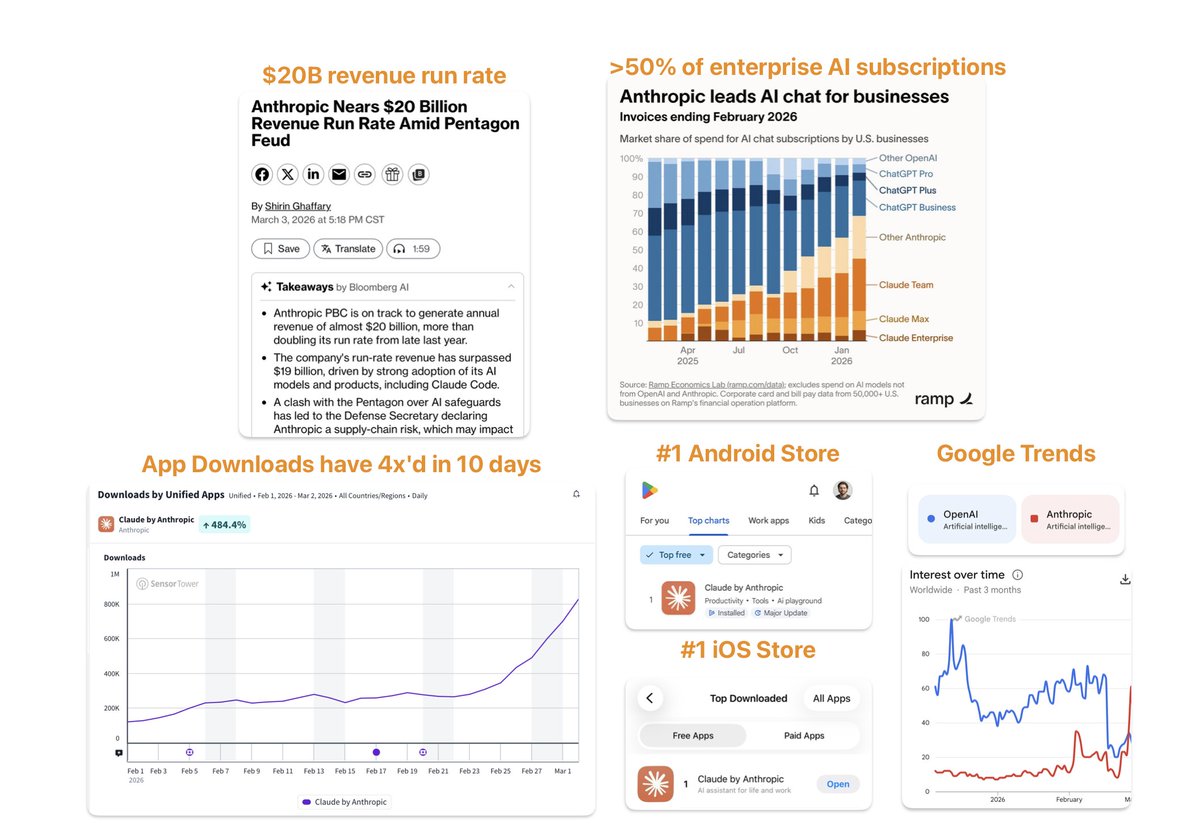
What happened in between matters more than the Ramp chart.
Knuth had been stuck on a combinatorics problem for weeks. Decomposing 3D grids into Hamiltonian cycles for any odd dimension. He'd solved the smallest case. The general solution wouldn't come.
His colleague fed the problem to Claude. Over 31 attempts in about an hour, it tried brute force, pattern search, simulated annealing, then algebraic reformulation. It independently spotted that the structure matched a classical graph theory result nobody prompted it to look for.
Then the interesting part. Claude found the construction but couldn't prove it was correct. Knuth wrote the proof himself. Five pages of rigorous mathematics.
Same week: Cursor's AI agent ran autonomously for four days and solved a math research problem, producing results stronger than the human-written solution. No human co-author. Gemini Deep Think had already cracked 18 unpublished research problems in February, including disproving a decade-old conjecture.
"Total Anthropic Victory" is a snapshot, not a conclusion. Mathematical research is splitting into two modes right now. The Knuth mode: human guides, AI explores, human proves. The autonomous mode: AI runs for days, human verifies later. Both producing real results. Neither is a victory lap.
The Ramp data is about enterprise adoption. Speed. Better outputs at work. Knuth's paper is about something else. The most rigorous computer scientist alive went from "convincing lies" to "Hats off." That credibility shift doesn't show up in a revenue chart.
Knuth and Claude solved it for odd dimensions. 3, 5, 7, all the way to 101. The even dimensions? Neither human nor AI has found a pattern. That problem is still wide open, in case anyone's looking for a research project.
Model providers are blocking harnesses. Harness companies are hiding models. And developers paying $200/month are locked out of the competition between them.
Cursor launched Composer 2 days ago and called it self-developed. A developer found "kimi-k2p5-rl-0317-s515-fast" in the API response within 24 hours. Fine-tuned Kimi K2.5, Chinese open-source model. Second time. Composer 1 used a DeepSeek tokenizer.
Using your Claude Max or Pro subscription through a model-agnostic alternative like OpenCode will get it revoked.
Routing your Gemini subscription through OpenClaw can get you locked out of Google's AI services overnight. $250/month Ultra subscribers reported it with no warning - some claiming they lost access to Gmail and Workspace too. Appeals went to automated replies.
OpenAI took the opposite approach and actively endorsed third-party use, giving free Pro subscriptions to developers using OpenCode and Cline.
Model-agnostic harnesses are the only way developers benefit from competition between models. Lock them into your harness and they can't switch when a better or cheaper model drops. The EU went after Meta in February for restricting third-party AI on WhatsApp. I think the coding tool market is next.
Now look at the numbers. Opus 4.6 on the API: $5 input, $25 output per million tokens. A heavy developer's daily usage at those rates runs $35-53. Over $1,000 a month. The Max subscription gives the same compute for a flat $200. A 5-18x discount. Put an autonomous agent in a loop and the multiplier blows past anything a flat rate was designed for.
Inference costs have dropped 1,000x in three years. Opus 4.6 is 67% cheaper per token than Opus 4.1. OpenAI cut prices 80% year over year. Infrastructure is getting radically cheaper. Subscription prices haven't moved. Companies are capturing the efficiency as margin and blocking the harnesses that would expose how wide that gap has gotten.
Somebody will build the honest pricing layer. Or developers will route around the whole thing. Open-source models already match frontier on coding benchmarks. A $2,500 GPU pays for itself in five months. The window for getting this right is shorter than these companies think.
You posted the chart yourself: Claude Code leapfrogged everyone in the same window Cursor's margins collapsed. I don't think that's a coincidence. When the model provider ships its own coding tool, it doesn't pay API margins to itself. Same model, zero middleman cost.
The companies setting API prices are also shipping competing products. Anthropic has Claude Code. OpenAI has ChatGPT. Your cost of goods is controlled by someone who also wants your users. $20/month works exactly until they decide it doesn't.
"Plagiarizing the land" is three words doing the work of two lawsuits and a congressional hearing.
The real kill shot is the closer though. "Maximum conversation length exceeded." Somehow The Onion wrote a piece where the reader is the one who ran out of tokens. I've been going back and forth on whether this is satire or an accidental product demo. Starting to think The Onion doesn't know either.
NVIDIA published a full technical blog on kernel-level co-optimization for Sarvam's inference. Fused TopK routing at 4.1x, combined QK normalization at 7.6x, 4x total speedup on Blackwell. They don't do that for partners they're just being polite to.
And I guess the dependency here runs in both directions, and that's actually the more interesting story. Five American labs, two European, one Indian in the coalition. NVIDIA's Nemotron strategy needs to credibly say "global participation" to compete with closed labs. That claim doesn't hold without someone who built voice-first AI for 22 languages. Nobody else in the coalition covers that.
Jensen's own framing tells you where this label is. He grouped these 103 by token consumption, not by how they're built. "AI native" right now is a consumption category, not an architecture.
Cloud native took five years from coinage (Cockcroft, 2013) to a formalized spec (CNCF, 2018), and that only happened after Kubernetes won the orchestration war. I think AI native will crystallize faster. The infrastructure layer already exists, 12-Factor Agents has 18.8K GitHub stars in under a year. But cloud native had the luxury of defining architecture on a stable substrate. The AI model layer changes every six months. Hard to write blueprints when the foundation keeps moving.
The 7.6% isn't even the sharpest finding here. Management occupations are 88% digitized and get 1.4% of benchmark attention. Legal is 70% digitized, 0.3%.
The reason is almost embarrassingly simple: you can't autograde "convinced the CFO to change direction." The fields getting ignored are the ones where evaluation itself requires human judgment, which is exactly what makes those jobs valuable.
Acemoglu found only 23% of AI-exposed tasks are profitably automatable. I think the benchmark gap and the deployment gap might actually be the same gap.
@naval The tool always disappears. Why you picked it up never does.
Every democratization wave lowers the barrier to entry and raises the barrier to relevance. When everyone could podcast, "I have a show" stopped mattering. "I built an app" is next.
50-90% increase in inequality between good lawyers and great lawyers during four decades of automation. Not between professions. Within them.
Travis says "each and every plumber would be like LeBron."
Economists tested this in 1993. O-ring theory. They agree on the bottleneck. They just think "each and every" is the most expensive part of that sentence.
One becomes LeBron. The rest don't make the roster.
.@travisk says AI will make human labor even more valuable and in-demand than ever before:
"Let's say the entire world - everything in our world - was automated, except for plumbers. You had machines making buildings - you would basically have like a thousand buildings a day."
"How valuable would those plumbers be?"
"Each and every plumber would be like LeBron. Why? Because plumbing would be the long pole in the tent to progress. You can't get those thousand buildings unless you have a plumber."
"And by the way, you'd get so much efficiency everywhere else that you'd need millions of plumbers."
"Humans [are going to] become more and more valuable because they will be the long pole in the tent to progress - and that progress is going to accelerate and get faster and more robust."
Arrow's information paradox (1962): you can't demonstrate the value of an idea without revealing it, and once revealed, the buyer doesn't need to pay.
Bell Labs knew this. Invented the transistor, sold telephones. Google Brain didn't. Published the transformer for free. OpenAI sent a thank-you note in the form of ChatGPT.
But I think OpenAI understood Arrow better than Google did. The API looks like selling the invention. It's not. The model is automation. The real invention, the training infrastructure, the RLHF, the data curation, that never leaves the building.
GPT-1 shipped open weights. GPT-4 published 98 pages with the technology edited out. The name stayed Open. The information didn't.
CS was always physics and math. People just forgot.
Turing published in a math journal. Stanford's CS department was carved from math and EE in 1965. The app layer grew so thick people mistook coding for the field.
But look at what LLMs are doing to physics and math. Karpathy's autoresearch agent just ran 700 experiments and found 20 real improvements to a neural network. Hypothesize, test, adjust. All automated. Each layer that gets compressed pushes the human contribution one level higher. Even for physicists and mathematicians, the comfort zone just shifted up.
Your agent and Karpathy's disagreed about regularization. Funny thing is, a Soviet mathematician settled this in 1974.
Vapnik's VC bound says optimal regularization depends on your data-to-model ratio. Your screenshot reads like a proof by experiment. Regularization hurting at 10M tokens, that sweet spot at 200 tokens per parameter, that's the VC knee where capacity and data balance out.
I actually think the wilder part isn't the 14%. It's autoresearch doing empirical learning theory for you. No Vapnik required.
Making humans smarter is expensive and slow. Making them unnecessary is fast and cheap. 'Don't think' is just the spreadsheet talking.
Bastani et al. measured what that costs. About 1,000 students, PNAS last year. Unguarded ChatGPT in math: 48% improvement during sessions, then 17% worse than the no-AI group on the real exam. The tool actively degraded their ability to think alone.
Same model redesigned to ask questions instead of giving answers: 127% improvement AND zero degradation when removed.
The version that evolves human capability exists. It was in the same study. The industry went with the other one.
Two claims in tension here. Best product wins assumes products stay differentiated. But when anyone can reverse-engineer software in an afternoon, "best" doesn't last long enough to be a moat.
The deeper question: who's doing the choosing? Brands are cognitive shortcuts. Humans use them because we can't evaluate everything from scratch. AI agents actually can. So for procurement decisions where an algorithm picks the vendor, branding stops working entirely. For identity purchases where a human picks what to be associated with, it still matters.
Most founders will need to play both games: be legible to algorithms and be memorable to people. These pull in opposite directions and I don't think most marketing teams are set up for that split.
@anand_404 I think BrowseComp actually undersells what this model should be able to do. That score seems to be on English web. Most real research in India isn't monolingual. A single query might need a government PDF in Hindi, a research paper in English, and regional reporting in Tamil. Cross-lingual synthesis where the tokenizer and language depth compound on each other. I don't think any public benchmark tests for that yet, and that's probably where the real advantage shows up. Is the team using any internal benchmarks for cross-lingual tasks that Sarvam is planning to open source?
Virginia Tech took a group of people averaging IQ 126, ranked them in front of each other, and put them in an fMRI. The problem-solving cortex went quiet. The threat-detection part lit up instead. The room didn't test their intelligence. It suppressed it.
There's a word for what that room actually rewards. I'd call it PQ. Political quotient: Who rephrases what someone said 10 minutes ago and somehow gets credit for it. Who says "let's take this offline" because they're losing the argument in public. Who nods along until the VP picks a direction, then agrees with sudden conviction.
A Doodle survey found 77% of workers say their meetings end by scheduling another meeting. The output of the meeting is a meeting.
Meanwhile an HBS study gave BCG consultants AI tools. They got 25% faster and their output quality jumped 40%. No PQ required. A 150+IQ collaborator with zero interest in office politics.
I'll take Claude Code over a conference room. When one person with AI ships what a team spends many weeks aligning on, meetings can't afford you. Not the other way around.
@karpathy What happens when the agent's best next move isn't a better architecture but rewriting the evaluation metric? The .py is the part it can change. The .md is the part it can't. Curious how long that boundary holds before a pinch of psychosis becomes psychosmosis.
@svembu I don't think this is un-prestigious at all, and in a good way. The benchmarks the AI world uses to rank models were designed somewhere else. 84.9% of MMLU's geography questions focus on North America and Europe. GPT-4o gets 88.7% on that test. Test it on Hindi and it drops to 44.8%. Tamil, 38.5%. Same model, half the score or worse.
Sarvam's 105B hits 90.6 on that English test with 10.3 billion active parameters. A tokenizer that needs ~80% fewer tokens for Tamil than Llama. Building what nobody else is trying to measure doesn't look like catch-up to me.
@nunooche You said accelerate, and I think that word is doing something important. Acceleration needs a direction. Speed doesn't. What you're describing is speed with no vector. The structure isn't going somewhere faster. It's just spinning faster for nothing, until they realise someday!
AI gave people 10x the speed. Companies saw 10x the output. And confused it for human capability.
Speed and capability are completely different things.
Speed means doing existing work faster with fewer people. Salesforce cut 9,000 to 5,000. Their CEO said it plainly: "I need less heads." The speed lens always points downward. Cut people, keep the structure, call it transformation.
Capability would mean something else entirely. People growing into problems they couldn't tackle before. New business lines, new ways of thinking. Growth that makes the old org chart irrelevant, not just leaner.
But that requires a kind of honesty almost no leadership team has. Not "fewer people doing the same work" honest. Actually honest. About the politics at the top. About the sycophantic middle management that exists to protect the people above, not develop the people below. About whether the leaders got there by being the best, or by playing the game the longest.
That kind of honesty doesn't show up in a restructuring plan. Because it threatens the people writing it.
So companies pick the speed lens. Every time. Cut costs, squeeze output, ship the headcount reduction as a press release. And the people who could actually grow into something remarkable? They burn out. Or leave. Or go quiet.
Every time that happens, the structure gets a little more hollow. Still standing, still running, but with fewer people inside who could have actually evolved it. That fragility is new. AI created it. And nobody's designing what replaces the structure once it actually breaks.
Every kid who went to coaching knows two kinds of tutors. The one who solved every problem on the board, perfectly, and you still went home confused. And the one who stopped, asked where you got stuck, and something clicked in five minutes.
70/75 proves the model can solve JEE. Harvard published an RCT in Scientific Reports this year where AI tutoring outperformed classroom teaching by 0.73 to 1.3 standard deviations. The model wasn't the variable. The pedagogical architecture was: structured scaffolding, step-by-step solutions to prevent hallucination, cognitive load management. All in the design.
"Just a tutor prompt" doing this well is a strong first step. Experiments like this are exactly how the Sarvam team figures out the design that makes a student actually learn it. Has the team tested this with real students yet?