We support this petition, signed by our CEO, several co-founders, and senior staff.
Our own research on recursive self-improvement, published last month, points to the need for tools to deliberately pace the frontier of AI development so society can prepare. We’re glad to see broad agreement across the field. https://t.co/DqwuQfa9xH
10 agent evals for AI engineers:
(explained with usage)
1) golden set
→ a fixed set of cases you never edit, run on every single change.
→ use as the baseline that tells you whether anything moved at all.
2) llm as judge
→ a second model scores the output against a written rubric.
→ use when the answer is open-ended and there is no string to match against.
3) rubric scoring
→ one number per dimension: correctness, tone, safety, cost.
→ use when a single score hides which part actually got worse.
4) trajectory eval
→ grade the path the agent took, not only the answer it landed on.
→ use when the right answer for the wrong reason is going to bite you later.
5) tool unit tests
→ test each tool on its own, with fixtures, no model in the loop.
→ use always. most agent bugs are tool bugs wearing a costume.
6) regression suite
→ replay past runs against the new prompt or model and diff the results.
→ use before every prompt change, because prompts have no type system.
7) a/b in prod
→ split live traffic between two versions and compare outcomes, not vibes.
→ use when offline scores stopped predicting what users actually do.
8) human review
→ sample a slice of runs and have a person grade them honestly.
→ use to calibrate your judge, because a judge nobody checks quietly drifts.
9) shadow run
→ the candidate runs on real traffic in parallel and its output is shown to nobody.
→ use before a risky rollout, when one bad answer would be expensive.
10) red team
→ deliberately attack it: jailbreaks, injection, exfil, tool abuse.
→ use before anyone external can reach it, not after.
offline evals tell you it works. online evals tell you it still works.
both sides matter, but not all ten do. run the two that would have caught your last outage.
save this. then read the full breakdown on loop engineering below.
Anthropic's Member of Technical Staff just dropped a 33-minute masterclass on prompt engineering
useful whether you've never touched AI in your life or have been using it every day for the past year
33 minutes. free. worth more than 100 YouTube videos combined
the masterclass teaches you how Anthropic Engineers prompt and build Claude
make sure to bookmark it before it gets lost in your feed
most people will watch it and still not know how to actually build agents.
here’s the full 6-month roadmap + resources I built to become an expert at agentic coding:
instead of watching 2 hours of Netflix tonight, watch this 40-minute masterclass from the founder of a $20B China AI company
it's the clearest explanation I've seen of how Agent Swarms and AI systems actually work at scale
useful whether you've never built an agent in your life or have been using Claude every day for the past year
I took the key ideas and turned them into a practical guide on how to actually build with Kimi
find it below
Claude Code feels completely different once you install this.
Anthropic quietly released an official plugin called claude-code-setup and it basically turns Claude Code from “pretty good” into an actual AI dev environment.
It scans your project and recommends:
→ hooks
→ skills
→ MCP servers
→ subagents
→ automations
Then sets everything up step-by-step for you.
Most people are using Claude Code completely vanilla…
which is why their experience feels messy.
The real power comes from the ecosystem around it.
Install:
/plugin install claude-code-setup@claude-plugins-official
Bookmark this before you forget it.
Microsoft Senior AI developer just showed how they build AI agents with Claude at Microsoft.
34-minutes. free. By Microsoft team
Opus 4.7 + 1,400+ pre-built MCP tools
plug Claude into agent → give it tools → ship to production
worth more than any $500 vibe-coding course.
in 15 minutes, 2 Senior Staff Engineers at Airbnb gave a Live Lecture on Agentic Coding
Airbnb already shipped one of the most ambitious LLM-agent migrations in production.
Tonight two of their senior engineers shows how they actually build with agents in 2026.
Most builders are guessing. These guys ship.
bookmark & watch this.then read the complete article below.
“I don’t think I’ve typed a line of code since December.”
When Andrej Karpathy said that, most people treated it like a crazy AI quote.
@garrytan treated it like a question:
“What happens when one person operates like an entire software team?”
Then he built gstack.
And honestly… this repo feels less like a dev tool and more like a preview of where software is going.
Not AI as autocomplete.
AI as:
- CEO
- Staff engineer
- QA lead
- Security reviewer
- Designer
- Release manager
- Browser operator
- Parallel execution layer
All coordinated through structured workflows.
The craziest part is the numbers.
Garry says his current pace is ~810× higher than his 2013 output — normalized for logical code changes, not inflated AI LOC.
Same person.
Same brain.
Different tooling.
That’s the shift everyone is underestimating right now.
The winners in the next era probably won’t be the people who code the fastest.
They’ll be the people who can direct, review, and orchestrate AI systems the best.
A few things in gstack that genuinely stood out to me:
→ /office-hours challenges your product assumptions before you build
→ /autoplan runs CEO + design + eng reviews automatically
→ /qa opens a real browser, tests flows, finds bugs, and fixes them
→ /review catches production-level issues before shipping
→ /pair-agent lets multiple AI agents collaborate together
→ parallel AI sprints running at the same time across projects
This is the first open-source repo in a while that actually made me stop and rethink how software teams will work 2–3 years from now.
We’re moving from:
“AI helps developers code”
to
“developers operate systems of AI workers.”
That’s a very different future.
100% Open-source
Link in comments 👇
We’ve agreed to a partnership with @SpaceX that will substantially increase our compute capacity.
This, along with our other recent compute deals, means that we’ve been able to increase our usage limits for Claude Code and the Claude API.
Vendor: "Whatever you build is yours. You have my word."
Contract: all improvements you create → assigned to vendor. Forever.
Built an AI that catches this live, mid-negotiation.
8 alerts fired. Gap report with Indian law citations.
https://t.co/2VHaCcgoSW
#LegalTech#AgenticAI
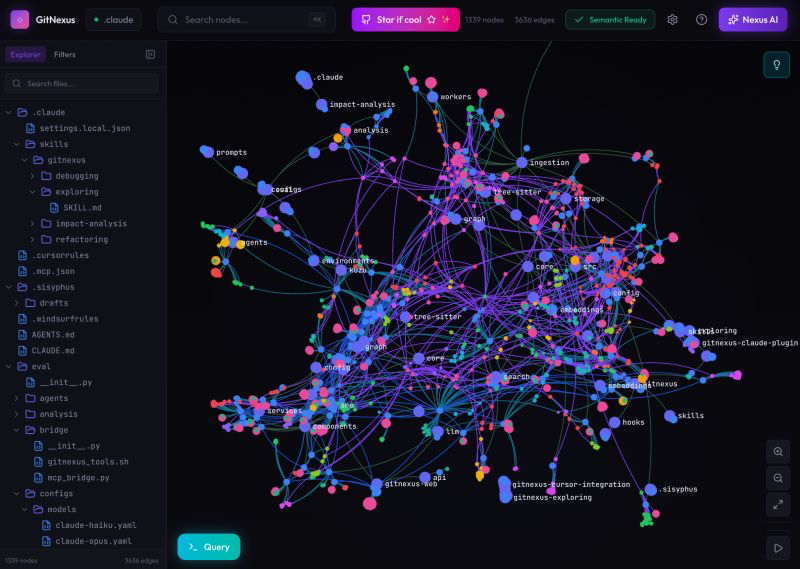
🚨Breaking: Someone open sourced a knowledge graph engine for your codebase and it's terrifying how good it is.
It's called GitNexus. And it's not a documentation tool.
It's a full code intelligence layer that maps every dependency, call chain, and execution flow in your repo -- then plugs directly into Claude Code, Cursor, and Windsurf via MCP.
Here's what this thing does autonomously:
→ Indexes your entire codebase into a graph with Tree-sitter AST parsing
→ Maps every function call, import, class inheritance, and interface
→ Groups related code into functional clusters with cohesion scores
→ Traces execution flows from entry points through full call chains
→ Runs blast radius analysis before you change a single line
→ Detects which processes break when you touch a specific function
→ Renames symbols across 5+ files in one coordinated operation
→ Generates a full codebase wiki from the knowledge graph automatically
Here's the wildest part:
Your AI agent edits UserService.validate().
It doesn't know 47 functions depend on its return type.
Breaking changes ship.
GitNexus pre-computes the entire dependency structure at index time -- so when Claude Code asks "what depends on this?", it gets a complete answer in 1 query instead of 10.
Smaller models get full architectural clarity. Even GPT-4o-mini stops breaking call chains.
One command to set it up:
`npx gitnexus analyze`
That's it. MCP registers automatically. Claude Code hooks install themselves.
Your AI agent has been coding blind. This fixes that.
9.4K GitHub stars. 1.2K forks. Already trending.
100% Open Source.
(Link in the comments)
🚀 Just executed: PageIndex: Vectorless, Reasoning-based RAG.
Document Q&A — no vector DB, no embeddings, no chunking.
📊 98.7% accuracy on FinanceBench vs ~85-90% for traditional RAG.
🔗 https://t.co/2GXuLEl7JZ
#RAG#LLM#AI#OpenSource#GenAI
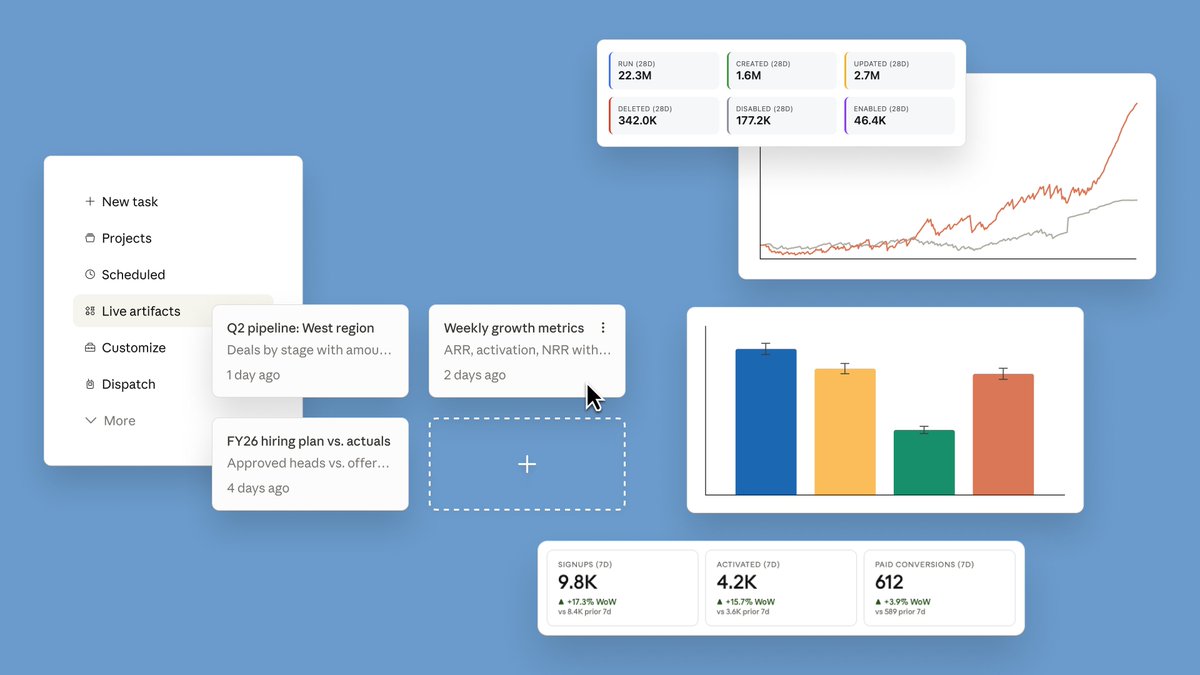
In Cowork, Claude can now build live artifacts: dashboards and trackers connected to your apps and files.
Open one any time and it refreshes with current data.
Cet atelier de 30 minutes, animé par le créateur de Claude Code, vous en apprendra plus sur le
vibe-coding que 100 tutoriels vidéo sur YouTube.
Ajoutez-le à vos favoris et consacrez-y 30 minutes dès aujourd'hui.
Cette vidéo transformera votre utilisation de Claude à jamais.
I ran a local RAG pipeline with zero cloud calls.
No #OpenAI#Anthropic API key. Just LM Studio + AISandbox.
#qwen3.5 4B on my MacBook. Indexed my docs. Asked "What is RAG?" Got a grounded answer with sources in 16s.
Link: https://t.co/GR6NeDCCSn
#LocalAI#RAG#LLM#BuildInPublic