Nice 🔥 This illustrates how you can build true cryptographic privacy on top of the Internet Computer. There are lots of privacy narrative protocols these days where operators have backdoors, or which rely on weaker hardware-based privacy (TEEs). Here, performance + real privacy
With cloud engines, apps run without cycles, and now, deploying to the shared Internet Computer subnets will be a breeze too. Agents can show users QR codes, so they can pay with their credit cards, avoiding token friction.
ICP is becoming mainstream agentic infrastructure.
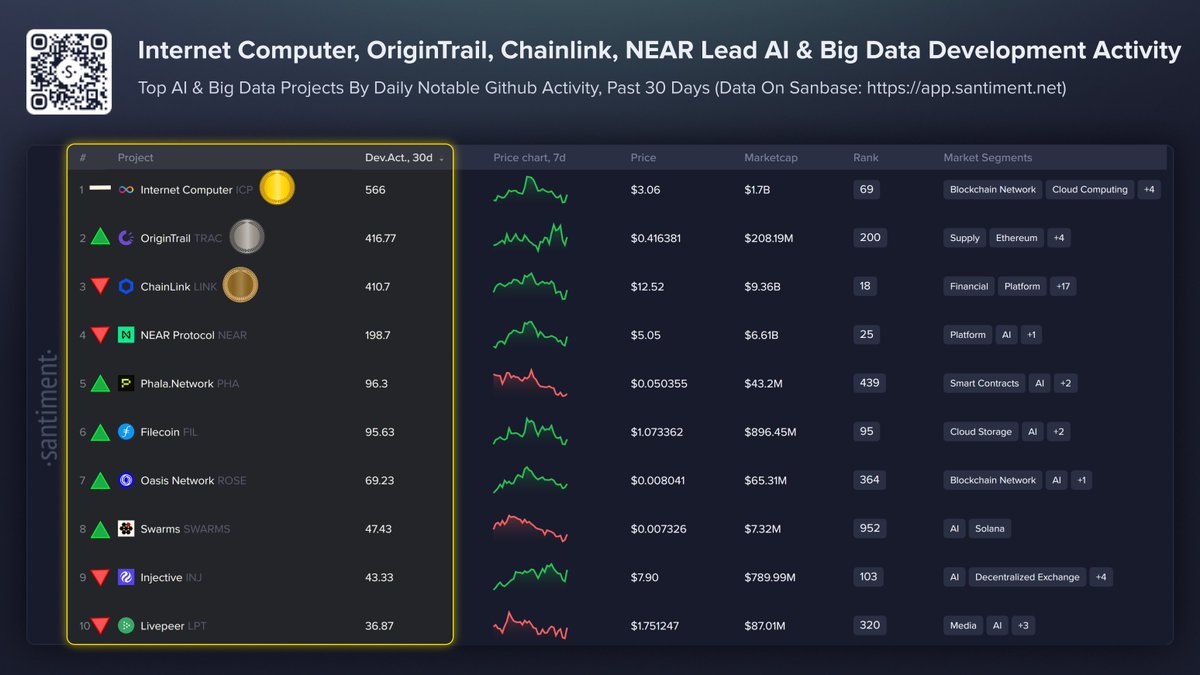
🧑💻 Here are crypto’s top 10 AI & Big Data projects by development. Directional indicators represent each project’s ranking positioning since last update:
📈 1) @dfinity $ICP🥇
📉 2) @origin_trail $TRAC 🥈
📉 3) @chainlink $LINK 🥉
📈 4) @nearprotocol near:native
📈 5) @phalanetwork ethereum:0x6c5ba91642f10282b576d91922ae6448c9d52f4e
📈 6) @filecoin filecoin:native
📈 7) @oasisprotocol $ROSE
📈 8) @swarms_corp $SWARMS
📉 9) @injective $INJ
📉 10) @livepeer ethereum:0x58b6a8a3302369daec383334672404ee733ab239
📖 Read about the @SantimentData methodology for filtering notable github activity data from project repositories, and why it is so useful for crypto trading: https://t.co/hPpga2LHWZ
🔖 Bookmark our AI watchlist here, and see what others in crypto can’t: https://t.co/PlO8Ds5RCE
BREAKING: DFINITY launched ckSOL on the Internet Computer, a token backed 1:1 by SOL that moves between the two chains with no bridge. ICPSwap, Liquidium and MULTI/DEX can now add SOL next to BTC, ETH and ICP.
@dfinity
The Internet Computer now speaks Solana.
ICP apps can read from and write to @solana directly.
And with ckSOL, backed 1:1 by SOL, DeFi apps like @LiquidiumFi, MULTI/DEX and @ICPSwap can integrate SOL natively, next to BTC, ETH and ICP.
No bridge required.
Get off your SaaS.
Introducing OpenSaaS - An entire business software suite, as easy to install as a phone app.
Free forever. No per-seat fees. Remixable. Change any app by describing the change to AI.
AIware: AI agents work across every app, grounded in your live business data.
Sovereign: Your company owns the software and holds the keys.
Runs on Cloud Engines - the tamperproof and always on network.
DFINITY is migrating to Open SaaS:
a) Running on AIware makes enterprises vastly smarter, faster, and more efficient, and;
b) Open SaaS is free and remixable, while ineffective old SaaS costs a fortune.
Super excited to be sharing this ICP cloud engine rocket fuel asap.
Vadim, you've missed nearly every relevant part of the ICP x AI story, so your article works as a straw man argument for misleading uninformed readers. I think you wrote in good faith, and put a lot of effort in, so I'll breakdown ICP x AI for you and readers that got mislead.
1. Onchain AI inference on ICP
As you discovered for yourself, ICP/the Internet Computer network, can run neural networks fully onchain, and even very basic LLMs too.
Important note in the following: when I say "onchain," I mean actually running on the network (here in the form of an asynchronous smart contract with vastly greater capacity, efficiency, speed and capability than has ever been seen anywhere else, which is what makes this is possible). I *never* say that something is "running onchain" when it is actually running offchain, for example on Amazon Web Services, justifying that by the fact there is an associated token that actually is onchain — I understand that the rest of the industry does this, but I never do. I use onchain like "on-cloud." Period.
You also correctly make the case that AI running onchain in its current form cannot satisfy mainstream AI needs, because it comes with limitations, and is too costly.
However, focusing on this, you then pivot, without have enumerated more than a tiny fraction of the whole ICP x AI story, to trying to convince the reader that there is consequently nothing to be seen here. The reader is invited both to conclude that ICP x AI isn't interesting, and misdirected to believe that whenever they hear anything about ICP x AI, that it's probably not anything interesting technologically going on. It works as a classic straw man argument, and potent disinformation, even if you didn't mean it that way (and I really like to believe that NEAR wouldn't engage in that kind of bottom-scraping behavior).
I want to get on to the ICP x AI story, but before ending this point, I should cover why ICP running inference onchain is incredibly significant for anyone interested in general-purpose networks.
When I did the onchain facial recognition demo in 2024, recognizing a few faces probably consumed more compute that NEAR (or any other blockchain) processes in a full year. It reflects the fact that while traditional blockchain is stuck being a pocket calculator, which can only store tokens, little bits of data, and process DeFi/update numbers, the Internet Computer has progressed to offering cloud functionality — in this regard, it is orders of magnitude more capable, and that's a testimony to the army of engineers and researchers who have worked on it over the years. There's simply nothing else like it.
To put this in perspective, creating a service like Caffeine (https://t.co/IfQrVowcTj), which builds apps on the Internet Computer using AI, is out-of-the-question on any other network, because it's not actually possible to build apps onchain, only to give them associated tokens. Very soon, cloud engines (https://t.co/zEYFSKR1E1) will take the Internet Computer into mainstream tech territory — based on pure tech utility, without speculative incentives and token narratives being involved.
You can't run a frontier LLM inside normal code on Amazon Web Services. The fact that inference runs as Internet Computer code is very impressive, and that's something you seem to have missed.
Separately, there are niche uses of onchain inference. For example, onchain neural networks that do facial recognition could be used in automous KYC schemes, helping build out the blockchain vision in another powerful way.
So how should apps on the Internet Computer do frontier-level inference? The following explains.
2. Intelligence Gateway
The Internet Computer ecosystem will soon see something called the Intelligence Gateway, which is roughly similar in concept to OpenRouter, but provides an API that allows onchain code to conduct inference using multiple models and pay with cycles (what's called gas on other networks).
Note that it's already possible for apps on the Internet Computer to use "outcalls" to perform inference on existing AI clouds and services, like Coreweave, or Anthropic, say. For example, while MULTI/DEX (https://t.co/kOLJ0dDiuv) will switch over to the Intelligence Gateway alpha within days, currently it directly calls into Anthropic (it allows users to perform account and book analyses, and to orchestrate trades, through onsite chat, and also through MCP).
Intelligence Gateway helps apps remain fully decentralized by enabling them to pay with cycles, rather than requiring a developer to maintain an account at an AI cloud, say, and adds convenience. But, it will also add *verification* to supported open weights inference run at *any* remote location — in another important worldwide first from the Internet Computer ecosystem.
That means that can app can configure its inference to run on some AI cloud that it doesn't fully trust, and get a guarantee that:
— the input prompt, context, etc, wasn't modified;
— that inference ran on the specified model that was paid for (e.g. on Kimi K3, not some crappy alternative to enable the cloud to make more money), and;
— that the output wasn't modified.
To verify a single inference doubles the cost, but in practice, apps will configure the Intelligence Gateway to spot check 1 in 100 inferences, and have it auto-scale checks up only if problems are detected, such that verification can add just 1% to inference costs.
The value of using Intelligence Gateway verification within a project like MULTI/DEX, where frontier inference can be directing what happens with large amounts of money, is obvious, but we believe traditonal enterprises running on cloud engines, and software like Open SaaS, will choose to use it too: algorithmic blockchain-style security at near standard cost.
3. Cloud engine "AI nodes"
There's a major shift towards sovereign compute around the world, which cloud engines are leaning into. Many enterprises and governments also wish to run sensitive inference workloads on hardware they control that's located in their own jurisdiction (things like the US CLOUD and RISAA Acts are part of the reason).
Cloud engines allow specialized AI nodes of the kind I mentioned earlier to be added (essentially node machines with a bunch of expensive GPUs installed), which allow those running engines to enable their onchain code to run their inference on sovereign hardware.
In the future and if there's sufficient demand, Intelligence Gateway technology will be used to allow multiple AI nodes to verify each other, which some super sensitive workloads warrant in the sovereign setting. For those willing to pay extra for inference, this can allow even huge models like Kimi K3 to be run with blockchain-style security.
4. AIware
The Internet Computer is *designed* for AI in two ways: 1) as a platform where AI can build more effectively, and 2) as a platform where services can be build using a new kind of AIware software.
1—Motoko is a language for writing onchan code on the Internet Computer, and it's the only language in the world that has been developed specifically for use by AI agents that are building, rather than humans per se (try building something with by directing your agent to https://t.co/lloVYiHwhG)
As you may know, on the Internet Computer, code runs in persistent memory ("The Program is The Database") and Motoko surfaces this in the purest way possible. App data lives inside software's logical abstractions in a system of "orthogonal persistence" that strips away much of the complexity of softwre and greatly fuels the modeling power of AI that's writing code by unlocking greater program abstraction, enabling AI to write and update code faster, and with far fewer errors, and at lower cost/fewer tokens.
Of course, it also helps that the code produced is tamperproof and always-on — AI doesn't depend on human security and systems admin teams to be safe.
In the future, and even really already, AI will write all software code and build all our services. That it can already build and update more effectively on the Internet Computer than anywhere else available today is a seminal achievement for our industry.
Ironically, though, I predict that it will go huge in the mainstream world first, as the result of cloud engines.
2—The paradigm enables software to function as AIware, because external AI can be given direct access (through a permissioning system of course) to the realtime data in memory, and to the functionality of apps, without anything special having to be done during the build process.
If you can run your enterprise on the Open SaaS suite, say, you become an agentic enterprise, that's much faster, more efficient and vastly smarter. In the future, teams will only 30% of their time inside the UX of their SaaS apps, and 70% inside agentic chat.
It will be possible to make previously impossible requests like, "make me more profitable." The hidden secret is that AI can already be as good at running companies as it is at writing code.
Very soon, cloud engines will become available, with Open SaaS (an open source suite of ~20 key enterprise apps/platforms). Open SaaS comes preinstalled on evaluation engines and is seeded with dummy data, so readers will be able to test AIware for themselves and make up their own minds, and I will leave off from further explanation here.
TLDR; the Internet Computer ecosystem is pioneering the future of AI—which goes beyond just securely running inference for somebody, into questions about how the services and platforms we will run the world on will be built or customized (now "remixed") and updated in the future, and what the future nature of software will be (we say it will be AIware, and the Internet Computer ecosystem will define that frontier).
The Internet Computer is the bona fide real deal when it comes to the intersection of ICP x AI and is advancing the game on every axis. The network provides a new alternative tech stack for the AI era — again, read that, the Internet Computer is a complete end-to-end tech stack designed for AIware.
Those wishing to build on the Internet Computer don't have to find a craft coding engineer willing to learn new skills. They just have to point their AI agent at https://t.co/xnXa3tAlau.
Tell me I'm wrong — quantum has now become Crypto's Y2K narrative (which enabled scaremongering consultants to make bank in the late 90s).
Hardly a day goes by without some not-very-technical network claiming kudos because it's quantum safe.
As Chief Scientist of DFINITY and someone who has hopefully created some interesting applied cryptography and network designs in the form of the Internet Computer, here's my honest take.
I've spoken to a lot of senior people who don't have an iron in the quantum computing game, and the consensus seems to be that cryptographically-relevant quantum computing (which can break established cryptography) could still be decades away, however...
Let's assume, for the sake of argument, that it is in fact coming in 5 years, which we can theorize AI might help happen — and we should hope it comes quickly, because this kind of quantum computing would be a great thing for humanity, just like AI, and hopefully fusion power.
Even if we assume this, should quantum be what Crypto is focusing on, and should networks be switching over to the latest "quantum-secure" cryptography schemes to impress everyone with how advanced they are, and how unsafe their competitors are?
Sadly, I can tell you, they should not be. Let me explain...
Firstly, the very real problem that Crypto faces, is that AI is getting extremely good at finding holes in open source software code. Running on open source, which reduces the need to trust the developer, is a cornerstone of the Crypto industry (and anyway, AI can find holes in private code too by reverse-engineering binaries, so doing a HyperLiquid doesn't really solve the situation).
Secondly, the vast majority of blockchain projects are really just simple copy/pastes of existing blockchain projects, upon which some unique feature has been grafted or claimed. There isn't really any engineering talent behind them, which creates problems when you have to act quickly in response to real time threats.
What, you may say!!? However, insiders like me understand that the industry mostly departed from first-principles crypto engineering long ago, in search of quick riches from token sales. For that you need a narrative, and since token buyers don't understand much about how these networks actually work, and are not interested in actually verifying technical claims themselves, and don't understand product/market fit, what matters to them is the narrative marketing machinery they can bring to bear (instead of engineers and researchers, they invest in social media bot armies, paid press, partnering with big money that can be used to literally manufacture and establish market prices, and partners who can help spin the narrative flywheel). This is the real situation, and it doesn't put the industry in a good place to address the real emerging threat — AI.
As we've seen from the constant procession of hacks across the industry, the industry's software was already not in a good place before the advent of super smart AI that turbocharge hackers. And AI is getting smarter all the time.
Rather than focusing on quantum, most chains should be focusing on improving the security of their code as quickly as they can, and improving the quality of their engineering. But it gets worse...
Adopting "quantum-safe" cryptography schemes to spin the narrative flywheel is making them even MORE unsafe. Let me explain.
The cryptography schemes that we use today, which are not quantum-safe, have been around for decades. That means we understand the mathematical assumptions that make them work, and armies of researchers have been kicking their tires for a very long time.
The world has a very good understanding of how hard it is to break, e.g., elliptic curve crypto on standard computers, through decades of research. We therefore have high conviction that the parameters used are safe against classical computers.
Unfortunately, we have no such track record for most quantum-safe schemes, apart from the least efficient hash-based signature schemes.
To see this in action, look at what just happened to HAWK, which was under consideration for being made an official US standard (Mythos found the problem): https://t.co/r2Pc1iybXb
We could see improved attacks against other schemes too, like the NIST-standardized Dilithium and Falcon.
Crypto needs to go slow with this, not fast, because cryptographically-relevant quantum computing is not just around the corner (even if new narratives and marketing can be).
We need to go slow and take steps nearer the time, giving all this a chance to shake out.
TLDR; we should not be rushing to implement quantum-safe schemes that could be broken by AI tomorrow, when cryptographically-relevant quantum computers that can break traditional cryptography are years away.
Note that the situation is slightly different for governments and corporations transmitting super secret encrypted communications, because adversaries are recording them so they can decrypt them years from now when cryptographically-relevant quantum computing is real. They need to use stronger ways to encrypt their communications.
However, this is not the situation for Crypto at all. Crypto needs to focus on protecting users from holes in code that AI uncovers. End of.
AI is vastly greater threat, and it's happening NOW.
Stay safe out there.
MULTI/DEX demonstrates 100% decentralized, autonomous onchain DeFi on ICP, can serve CeFi-levels of user experience directly into phone browsers without forcing users to install apps #NextGenDeFi
I definitely think the solution is to ban powerful open source models, they're just too dangerous!!! (Urm, not really, this is a continuation of a dangerous regulatory capture play, and we all need access to powerful models to secure our code against others who have them.)
July watchlist: delivered ✅
caffeine: new branding, business subscription plan, anything functionality, caffeine AI now on AWS marketplace and on Claude MCP connector directory @caffeineai
OISY:
2.5 live with Liquidium loans, OISY Trade, encrypted Notes. ICP is now the #1 asset on Liquidium @oisy
MULTI/DEX:
game mode live, $243M simulated volume in 24h, prizes for Season I leaderboard champions, Season II brings source code + bigger prizes
Cloud Engines: Open SaaS suite incoming with Accounting, HR, Email, CRM, all AI-customizable. General availability very soon.
ICP MCP (beta): one agent, every app. AI agents now act across ICP apps, no app-hopping needed. Claude is already playing on-chain games with it as you can see with @X2worldtech
In other news:
ICP #2 most active chain (133M tx/day),
inflation reduction,
new NNS look,
sovereign chat app in pilot in Pakistan
And the special announcement? Signed. Sealed. Under PR embargo until mid-August. Can't say more yet, but it's worth the wait.
Looking forward to August!
@dfinity and the ICP community in shipping mode with uber productivity.
Someone just asked for a ICP cloud engine and Open SaaS summary for a big firm. This is what I said...
Install every enterprise SaaS service you ever wanted on an cloud engine:
— No more admin than maintaining a phone app
— They are tamperproof (immune to infrastructure hacks) and incredibly resilient
— They are AIware, which means according to the permissions of the user, AI can see all the data inside, and can perform analyses, and initiate actions, across the suite — people spend > 50% of their time inside AI chat rather than traditional UX, and are way faster, more efficient, and smarter
— You can remix/customize the service using AI, and keep benefiting from upstream improvements, which the AI will merge into your customized version
— Open SaaS is open source and free forever
For years, we have used encryption and other math to secure communications over the internet, making them tamperproof, and protecting privacy
ICP (Internet Computer Protocol) is a bet that the same needs to be done for compute and data. Cloud engines will now take it mainstream
Enterprise infrastructure must be urgently migrated from traditional tech stacks onto tamperproof serverless clouds created by mathematical networks. Mythos+ models can't make 2+2=5. AI will make migration painless. Security based on model supremacy assumptions *will* break down.
ICP cloud engines solve so many growing needs: Sovereignty, security, resilience, enabling AI, powering AIware, and... hosting systems that don't fall down when individual data centers are struck. Increasingly, this is a *worldwide* threat.
https://t.co/vZMwPsVtzS
https://t.co/c91gCXdI78 focused on helping people implement AIware on the Internet Computer or an ICP cloud engine (coming soon), where you spend more time in AI chat than you do in the traditional UX. This is the future.
🧑💻 Here are crypto’s top 10 AI & Big Data projects by development. Directional indicators represent each project’s ranking positioning since last update:
📈 1) @dfinity $ICP 🥇
📉 2) @chainlink base:0x88fb150bdc53a65fe94dea0c9ba0a6daf8c6e196 🥈
➡️ 3) @nearprotocol near:native 🥉
➡️ 4) @origin_trail $TRAC
➡️ 5) @livepeer $LPT
➡️ 6) @injective $INJ
📈 7) @aleph_im $ALEPH
📈 8) @runonflux $FLUX
📉 9) @filecoin $FIL
📈 10) @multiversx $EGLD
📖 Read about the @SantimentData methodology for filtering notable github activity data from project repositories, and why it is so useful for crypto trading: https://t.co/hPpga2LHWZ
🔖 Bookmark our AI watchlist here, and see what others in crypto can’t: https://t.co/RtjAx3a8Sq