I just found a Polymarket trader who made over 4,355 trades with a 99% win rate…
He started with just $9 and turned it into more than $2,500 in a single month
Here’s how he trades:
> He focuses only on weather markets
> He always uses the same bet size for every trade
> Most likely, he uses public airport weather data or aviation observations (like METAR) to get the most accurate values
His first trade was on a Paris weather market, where he turned $9 into $256
His positions: https://t.co/TBp8aZPOeQ
This is one of the most successful weather traders I have ever seen on Polymarket
Fortinet $FTNT is one of the highest quality companies in my portfolio.
● Revenue CAGR: 18% ✅
● FCF per share CAGR: 23% ✅
● Cash return on capital: 43% ✅
● Share count down 11% ✅
● SBC less than 10% of operating cash flow ✅
What are your thoughts on Fortinet?
it's been 4 months since i launched my Polymarket bot and uploaded the whole process here
it's using the simplest strategy - sweeps the gap between $99.99 and $100
i make +0.1% PnL per trade, but it's enough to make $10,000 monthly
and the whole guide is public
good luck
The most boring strategy on Polymarket turned out to be the most reliable - and earned this guy $4,782
What's the secret? There isn't one. It's simply:
-> Bets on the weather in Shanghai
-> Buys near-guaranteed outcomes at 70-80 cents when the market is already nearly decided
-> Pockets 20-30% per trade
-> Repeats 592 times
No leverage. No hype. No crypto lottery.
Wins 73% of the time - not always, but often enough to stay consistently profitable.
Same market, day after day: "What will the highest temperature in Shanghai be today?"
While everyone else is chasing a 100x, he quietly collects his profit on trades where the risk is already almost gone.
The most dangerous trader is the one who doesn't mind being boring.
เวลาหุ้นขึ้นลงแรงๆ ก็จะมีคนที่อิจฉาเวลาหุ้นขึ้น และ มีความสุขกับความล้มเหลวของคนอื่น แต่มนุษย์มีความซับซ้อน ประกอบกับ society moral มันสนุกดีนะ ที่เรามาดูกันว่าแต่ละคนมีวิธีแสดงออกยังไงกัน
I found 5 free Polymarket weather trading bots on GitHub (from simple automation to a full machine learning weather model)…
Each of these repos comes with a detailed step by step setup and usage guide in English.
> Beginner level (3-5 min setup)
1. GFS-based weather trading bot.
It uses 31 different forecast scenarios from the Global Forecast System to estimate the most likely temperature for a selected city and day.
After that, it compares this value with current Polymarket prices to find mispriced outcomes.
This bot also has a web dashboard, where you can track its trades, forecasts, pnl and more.
GitHub: https://t.co/MivMwpEw2d
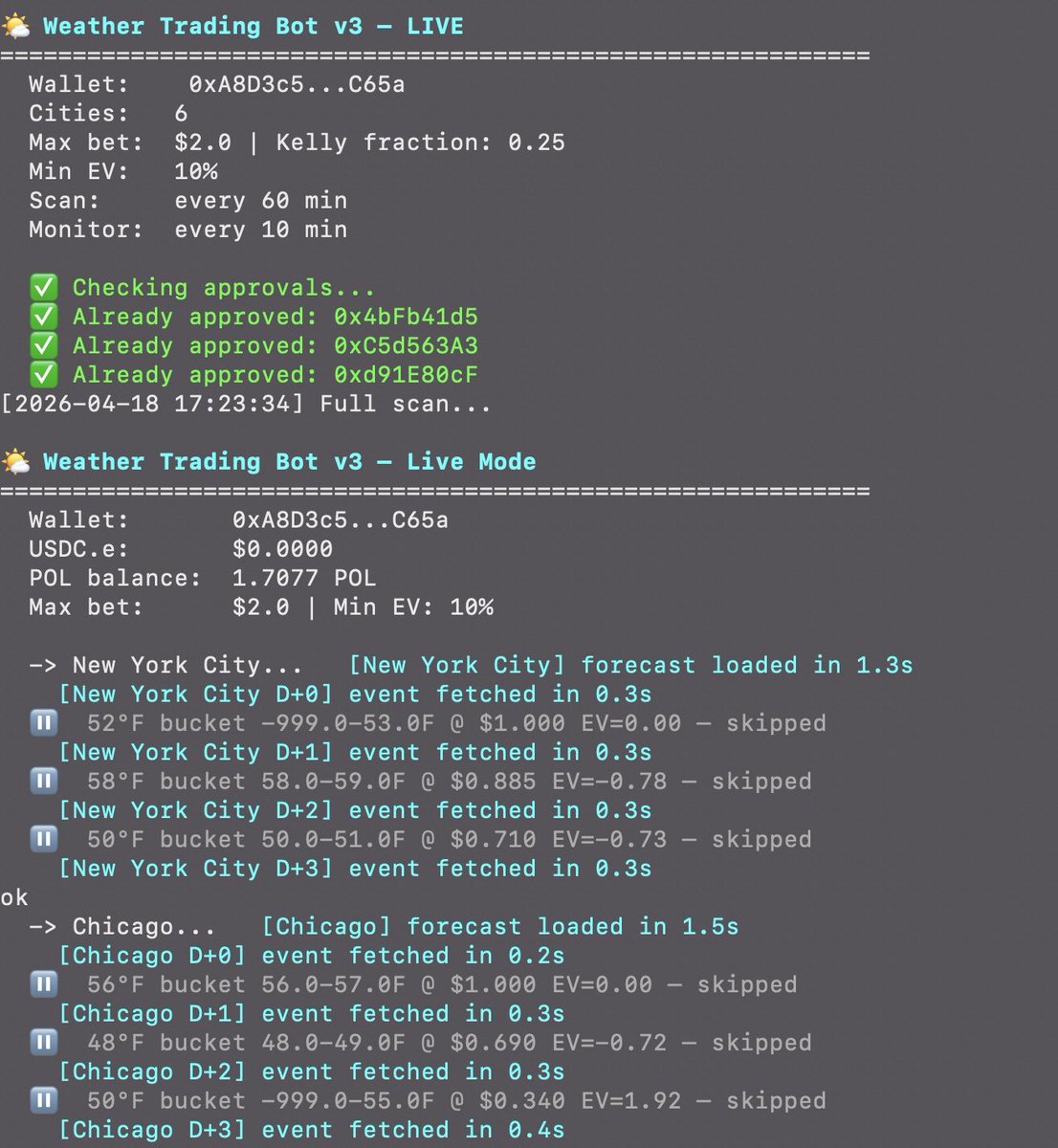
2. NWS forecast bot with a Kelly strategy.
This bot scans the latest NWS temperature data for a selected city and compares it with current prices on Polymarket.
It uses the Kelly sizing strategy to calculate the best trade size based on how strong the edge is and then automatically execute trades.
GitHub: https://t.co/OBdsje9kpU
> Advanced level
3. Trading bot powered by the Hermes Agent.
This autonomous bot collects weather data from multiple sources and uses a Gaussian Bucket strategy - for example, if the forecast is 70F, it estimates that the final temperature will be between 69F and 71F.
Then it compares this range with current Polymarket prices and sends you a trading signal directly to Telegram.
The best feature - this bot can track and analyze its own results, learn from them and improve its strategy over time.
GitHub: https://t.co/OBdsje9kpU
4. Real time weather analysis bot from a Chinese dev.
It scans different sources, including weather forecasts, airport data and aviation observations (like METAR) to get the latest available temperature data.
Then it generates a detailed weather report for a selected city and day.
GitHub: https://t.co/No3sBcrk5z
5. Machine Learning weather model built by a Boston University computer science student for his bachelors thesis.
This model learns from weather forecasting errors by comparing past predictions with the temperatures that actually happened.
How it works:
For example, if the NWS repeatedly predicted a high of 72F in Chicago, while the actual daily high was closer to 69F, the models learns that this source overestimate Chicago temperatures by around 3F under similar conditions.
And when a new forecast comes in, the model doesnt trust it blindly. Instead, it adjusts the prediction based on historical errors and produces a more accurate temperature estimate.
GitHub: https://t.co/9DnTPu5QAc
All of these bots have a simulation mode, so you can test them on real markets without risking any funds.
Ω-HMM. Enhanced Hidden Markov Model
3D probability surface. April 20, 2007. S&P closed +2.6%
the red peak on that heatmap is where the model said probability was concentrated
the x marks where price actually landed
they matched
Markov's math from 1906 predicting Wall Street 101 years later
hidden markov models track invisible states behind visible price
retail sees a green candle. the model sees a state distribution across regime space
each color band is a probability. yellow is likely. blue is nearly impossible
the model doesn't guess direction. it maps the entire distribution of possible next moves and picks the highest expected value trade
Renaissance Technologies built the greatest track record in finance running this class of model
50.75% win rate. 66% gross annual returns. 30 years
they were barely more accurate than a coin flip
they just knew exactly which coin they were flipping every time
> Andrei Markov, 1906
> hidden markov models: Baum-Welch, 1966
> free implementation in hmmlearn, 40 lines of python
> data: yahoo finance, FRED, exchange APIs
retail chases the next candle
quant desks map the probability field around it and only bet where the distribution is asymmetric
full breakdown in the video below
Jane Street pays $750K/year for quants who master large deviations and tail bounds.
82-minutes. free. By MIT professor.
"Markov gives us a really bad bound, Chebyshev is pretty reasonable, Chernoff gives us exponential."
here's what they cover:
• Markov vs Chebyshev vs Chernoff bounds
• bounding tail risk for extreme random variables
• why variance alone fails in high-frequency regimes
• exponential 10x tighter risk modeling
Bookmark it & watch today. Then read the article below.