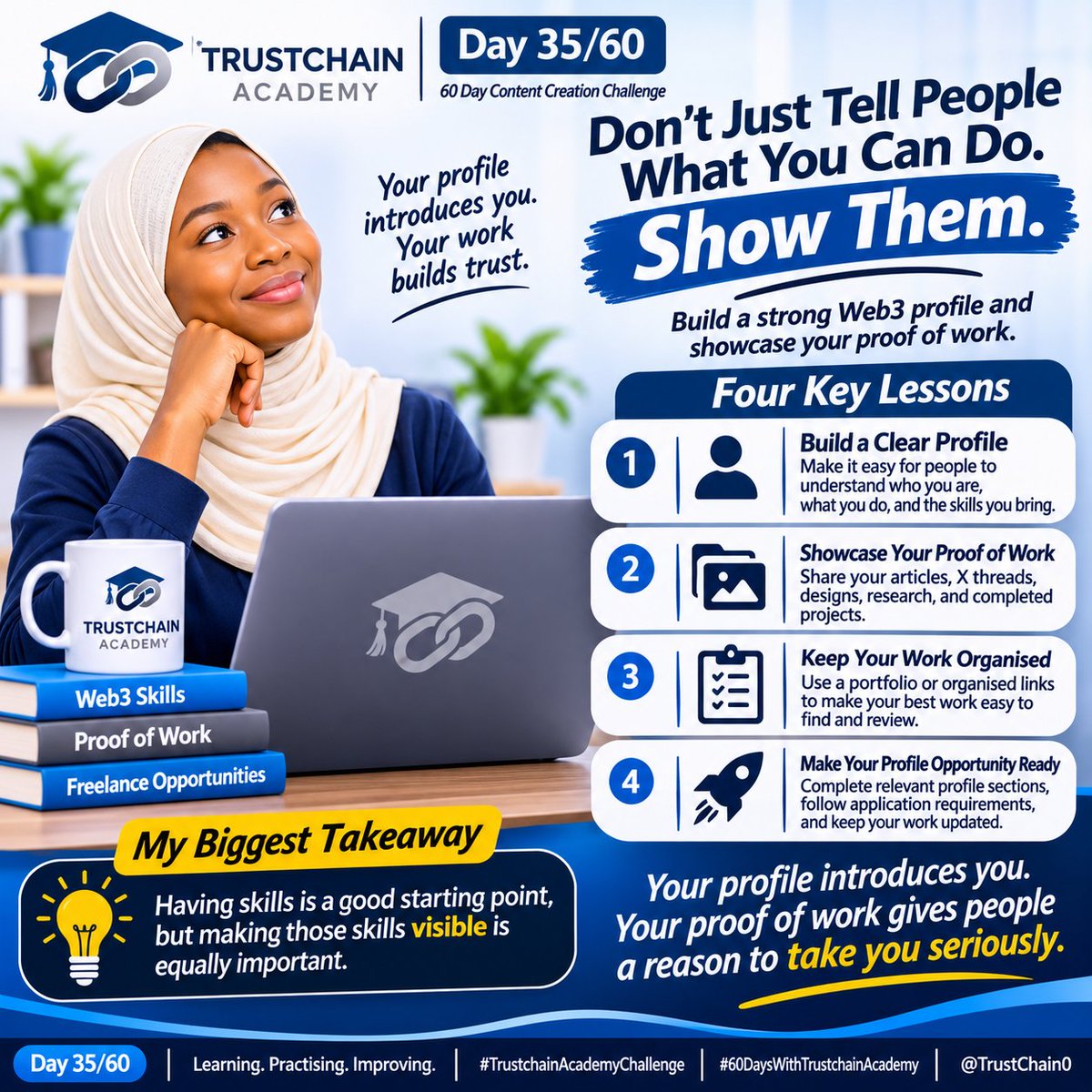
𝗗𝗢𝗡'𝗧 𝗝𝗨𝗦𝗧 𝗧𝗘𝗟𝗟 𝗣𝗘𝗢𝗣𝗟𝗘 𝗪𝗛𝗔𝗧 𝗬𝗢𝗨 𝗖𝗔𝗡 𝗗𝗢. 𝗦𝗛𝗢𝗪 𝗧𝗛𝗘𝗠.
Imagine finding a Web3 opportunity that matches your skills, only to realise you have no organised work samples to demonstrate your experience.
That is why building a professional profile and showcasing proof of work matter.
During our recent classes at TrustChain Academy, we explored platforms like SuperEarn and Scribble DAO, learning how to set up profiles, add our skills, showcase previous work, and participate in bounties.
Here are four lessons I took away:
1. BUILD A CLEAR PROFILE
Make it easy for people to understand who you are, what you do, and the skills you bring.
2. SHOWCASE YOUR PROOF OF WORK
Your published articles, X threads, designs, research and completed projects can demonstrate your abilities.
3. KEEP YOUR WORK ORGANISED
Use a portfolio or organised links to make your best work easy to find and review.
4. MAKE YOUR PROFILE OPPORTUNITY READY
Complete relevant profile sections, follow application requirements, and keep your work updated.
𝗪𝗛𝗔𝗧 𝗜 𝗔𝗠 𝗟𝗘𝗔𝗥𝗡𝗜𝗡𝗚
Having skills is a good starting point, but making those skills visible is equally important.
You don't always need years of professional experience to begin building proof of work.
You can start with practical projects, personal writing samples, educational threads and other work that demonstrates what you can do.
Your profile introduces you. Your proof of work gives people a reason to take you seriously.
Day 35/60.
Learning. Practising. Improving.
#TrustchainAcademyChallenge
#60DaysWithTrustchainAcademy
@TrustChain0
Your crypto wallet could be at risk and you might not even know it.
You check your balance. You monitor your transactions. You celebrate when your portfolio grows.
But are you checking what could put those assets in danger?
Here are 5 wallet security risks every crypto user should understand. 🧵
𝗬𝗢𝗨𝗥 𝗟𝗜𝗡𝗞𝗘𝗗𝗜𝗡 𝗣𝗥𝗢𝗙𝗜𝗟𝗘 𝗦𝗛𝗢𝗨𝗟𝗗 𝗧𝗘𝗟𝗟 𝗣𝗘𝗢𝗣𝗟𝗘 𝗪𝗛𝗔𝗧 𝗬𝗢𝗨 𝗕𝗥𝗜𝗡𝗚 𝗧𝗢 𝗧𝗛𝗘 𝗧𝗔𝗕𝗟𝗘.
In Web3, having skills is important. But can people see those skills through your online presence?
That is one reason I am beginning to appreciate LinkedIn beyond just being a platform for job searching.
During our content creation classes at TrustChain Academy, we explored how to create professional content for LinkedIn.
Here are four lessons that stood out to me.
1. SHARE WHAT YOU KNOW
Create educational posts, explain concepts and share useful industry insights. Let your content demonstrate your understanding.
2. DOCUMENT YOUR LEARNING
You don't have to be an expert before you start sharing.
Your lessons, challenges, practical experiences and progress can also provide value to others.
3. BUILD A CLEAR PROFESSIONAL IDENTITY
Your profile should communicate your skills, interests and the kind of opportunities you are working towards.
4. BE CONSISTENT AND AUTHENTIC
Build a recognisable voice. Share meaningful experiences and engage in conversations within your industry.
𝗠𝗬 𝗕𝗜𝗚𝗚𝗘𝗦𝗧 𝗧𝗔𝗞𝗘𝗔𝗪𝗔𝗬
Building a professional brand is not about pretending to know everything.
It is about making your skills, knowledge, interests and growth visible.
As someone developing a career in Web3 content creation, I want my online presence to reflect not just what I do, but the value I can bring.
Don't wait until you have achieved everything before you start documenting your journey. Your growth is part of your story.
Day 32/60.
Learning. Practising. Improving.
#TrustchainAcademyChallenge
#60DaysWithTrustchainAcademy
@TrustChain0
𝗪𝗥𝗜𝗧𝗜𝗡𝗚 𝗙𝗢𝗥 𝗖𝗥𝗬𝗣𝗧𝗢 𝗣𝗟𝗔𝗧𝗙𝗢𝗥𝗠𝗦 𝗥𝗘𝗤𝗨𝗜𝗥𝗘𝗦 𝗠𝗢𝗥𝗘 𝗧𝗛𝗔𝗡 𝗞𝗡𝗢𝗪𝗜𝗡𝗚 𝗖𝗥𝗬𝗣𝗧𝗢.
You can understand cryptocurrency and still struggle to create content that connects with readers.
Why? Because knowing the subject is only one part of the job. You also need to understand how to communicate it effectively.
During our Web3 content creation classes at TrustChain Academy, we explored writing for platforms such as CoinMarketCap, Binance Square, Bitget Insights, and Byx.
Here are five lessons I took away:
1. UNDERSTAND THE PLATFORM
Before writing, understand its audience, content formats and publishing requirements.
2. RESEARCH BEFORE YOU WRITE
Understand the project, verify information and use reliable sources. Accuracy matters in crypto.
3. EDUCATE, DON'T JUST PROMOTE
Explain concepts, share useful insights and help readers understand what they are learning about.
4. MAKE YOUR CONTENT EASY TO FOLLOW
Use clear language, relatable examples, good structure and relevant explanations. Not every reader is an expert.
5. BUILD CREDIBILITY THROUGH VALUE
Avoid empty hype and unsupported claims. Focus on useful information that readers can learn from.
𝗠𝗬 𝗕𝗜𝗚𝗚𝗘𝗦𝗧 𝗧𝗔𝗞𝗘𝗔𝗪𝗔𝗬
Writing for crypto platforms is not simply about publishing more posts.
It is about combining research, industry knowledge, platform awareness and effective communication.
As I continue developing my Web3 writing skills, I want my content to do more than attract attention.
I want it to help people understand the crypto ecosystem better.
In Web3, credibility is built through what you know, how you communicate it and the value you consistently provide.
Day 31/60.
Learning. Practising. Improving.
#TrustchainAcademyChallenge
#60DaysWithTrustchainAcademy
@TrustChain0
𝗔 𝗚𝗢𝗢𝗗 𝗫 𝗧𝗛𝗥𝗘𝗔𝗗 𝗗𝗢𝗘𝗦𝗡'𝗧 𝗝𝗨𝗦𝗧 𝗔𝗧𝗧𝗥𝗔𝗖𝗧 𝗔𝗧𝗧𝗘𝗡𝗧𝗜𝗢𝗡. 𝗜𝗧 𝗞𝗘𝗘𝗣𝗦 𝗜𝗧.
What makes someone stop scrolling, read your post, and actually want to see what comes next?
I'm learning that writing effective X threads and articles requires more than having a good idea.
During our Web3 content creation classes at TrustChain Academy, we explored the methods behind writing engaging content.
Here are five lessons that stood out to me.
1. START WITH A STRONG HOOK
Your opening determines whether readers continue or scroll past.
A good hook creates curiosity, introduces a problem or challenges an assumption.
2. GIVE YOUR CONTENT A CLEAR STRUCTURE
A thread should feel like a connected journey, not a collection of random posts.
Each section should lead naturally to the next.
3. USE STORYTELLING
Facts educate, but relatable examples and stories can make ideas easier to understand and remember.
4. UNDERSTAND YOUR READER'S PSYCHOLOGY
What does your audience care about?
What problem are they trying to solve?
Understanding these questions helps you create content that feels relevant instead of generic.
5. END WITH A PURPOSEFUL CTA
A call to action should guide readers towards a meaningful next step.
It could encourage them to share their thoughts, explore a topic further or engage in a conversation.
𝗠𝗬 𝗕𝗜𝗚𝗚𝗘𝗦𝗧 𝗧𝗔𝗞𝗘𝗔𝗪𝗔𝗬
Writing a thread is not just about putting information into multiple posts.
It is about guiding the reader from curiosity to understanding.
And writing an article is not simply making a thread longer. It requires depth, structure, research and a clear narrative.
As I continue developing my Web3 writing skills, I want to become intentional about every hook, every paragraph and every CTA.
The goal is not just to make people read. It is to make the reading worthwhile.
Day 29/60.
Learning. Practising. Improving.
#TrustchainAcademyChallenge
#60DaysWithTrustchainAcademy
@TrustChain0
𝗕𝗘𝗜𝗡𝗚 𝗔 𝗪𝗘𝗕𝟯 𝗖𝗢𝗡𝗧𝗘𝗡𝗧 𝗪𝗥𝗜𝗧𝗘𝗥 𝗜𝗦 𝗠𝗢𝗥𝗘 𝗧𝗛𝗔𝗡 𝗝𝗨𝗦𝗧 𝗞𝗡𝗢𝗪𝗜𝗡𝗚 𝗛𝗢𝗪 𝗧𝗢 𝗪𝗥𝗜𝗧𝗘.
You can be an excellent writer and still struggle to create meaningful Web3 content.
Why?
Because writing in Web3 requires more than putting words together.
You need to understand what you are writing about, who you are writing for, where your content will be published, and why it should matter to the reader.
This is one of the important lessons I took away from our recent Web3 content creation classes at TrustChain Academy.
𝗦𝗢, 𝗪𝗛𝗔𝗧 𝗜𝗦 𝗪𝗘𝗕𝟯 𝗖𝗢𝗡𝗧𝗘𝗡𝗧 𝗖𝗥𝗘𝗔𝗧𝗜𝗢𝗡?
It is the process of researching, understanding, explaining and communicating ideas about Web3, blockchain, cryptocurrency and decentralised technologies through different content formats.
These formats can include:
✓ Educational posts and threads
✓ Long form articles
✓ Project reviews and research
✓ Tutorials and beginner guides
✓ Community updates and storytelling
✓ Visual content and infographics
But creating content is only one part of the job.
𝗪𝗛𝗔𝗧 𝗗𝗢𝗘𝗦 𝗜𝗧 𝗧𝗔𝗞𝗘 𝗧𝗢 𝗖𝗥𝗘𝗔𝗧𝗘 𝗚𝗢𝗢𝗗 𝗪𝗘𝗕𝟯 𝗖𝗢𝗡𝗧𝗘𝗡𝗧?
Here are five things I am beginning to understand more deeply.
1. UNDERSTANDING THE SUBJECT
Before explaining a blockchain project, wallet, protocol, or cryptocurrency concept, you need to understand it yourself.
You cannot effectively simplify an idea you do not understand.
Research comes before writing.
2. KNOWING YOUR AUDIENCE
A beginner learning about cryptocurrency does not need the same explanation as an experienced DeFi user.
Your language, examples, depth and approach should reflect the knowledge level of the people you want to reach.
Good content meets readers where they are.
3. UNDERSTANDING THE PLATFORM
A thread on X, an article on Medium and a professional post on LinkedIn should not necessarily sound or look the same.
Every platform has its own audience, content expectations and style.
Learning how to adapt your message is an important part of becoming a better writer.
4. MASTERING THE ART OF COMMUNICATION
A strong hook attracts attention.
A clear structure keeps readers interested.
Storytelling makes ideas relatable.
Good explanations make complex topics easier to understand.
And a thoughtful call to action gives readers a reason to respond or take the next step.
Every element has a purpose.
5. CREATING VALUE, NOT JUST CONTENT
Web3 moves quickly, and it is easy to get caught up in trends, campaigns and promotional posts.
But meaningful content should do more than fill a timeline.
It should educate, clarify, answer questions, encourage informed decisions or help someone understand an opportunity.
That is the kind of content I want to learn how to create.
𝗪𝗛𝗔𝗧 𝗜 𝗔𝗠 𝗧𝗔𝗞𝗜𝗡𝗚 𝗔𝗪𝗔𝗬
Our recent classes at TrustChain Academy helped me see Web3 content creation from a broader perspective.
It is not just about writing more.
It is about researching better, thinking critically, understanding different audiences, choosing the right platform and communicating ideas effectively.
I am learning that a good Web3 writer must first be a curious learner.
Because the better you understand the subject, the better you can explain it to someone else.
My goal is not just to become a writer who creates Web3 content. I want to become a writer whose content helps people understand Web3.
And that is a skill worth developing.
One lesson at a time.
Day 27/60.
Learning. Practising. Improving.
#TrustchainAcademyChallenge
#60DaysWithTrustchainAcademy
@TrustChain0
Good morning
It’s weekend again
Take a breath
Rest if you need to
Learn if you can
Create when you’re ready
Small progress is still progress.
Enjoy your weekend, and don’t forget to be proud of how far you’ve come.
What’s one thing you’re hoping to accomplish this weekend?
🚨 MU KIYAYE!
Idan mutum ya tura maka kuɗi, ya kira ka ya ce kuskure ne, sannan ya turo maka wani sabon account da za ka mayar masa kuɗin...
KAR KA TURAWA SABON ACCOUNT ƊIN!
Ka mayar da kuɗin account ɗin da aka turo maka da su.
Ka saka Narration: “Wrong Transfer” ko “Mistake Transfer.”
⚠️ Wannan zai iya kare ka daga shiga matsalar zamba ko scammers ko ƴan damfara.
Ka tura wa wasu.
Wannan saƙon zai ceci wani.
🚨🔥 TRUTH HAS NO FEAR UMARU BAGO
Sheikh Yusuf Sambo Rigachikun, thank you for speaking out about North and standing with the people.
Thank you for telling the truth about what happened in Niger State. In difficult times, courageous voices matter.
May Allah continue to strengthen you. 🤲🏽