For those who weren’t born w a silver spoon, life isn’t a game
You either make it or you are stuck in a perpetual cycle again
The reality is damning, so the alternative is the only option
Nothing to lose if you fail, but everything to gain if you succeed
Today, we enable AutoResearch in the physical world for the first time! Introducing ENPIRE: we give 8 Codex agents a fleet of robots, an allocation of GPUs, and generous token budget. We set them free with a simple goal: solve the task as quickly as possible, keep the robots busy but stay safe, don't waste precious compute. Make no mistake.
Then humans step aside and our watch begins. The robot fleet starts to come alive: they learn to look for visual clues, reset the scene, practice novel skills, tinker with control stack, read papers online, debate, reflect, get stuck, and try again directly on the hardware. All we did is to give Codex an API to the world of atoms, and the rest is emergence.
ENPIRE is able to solve high-precision tasks like tying zip-ties, organizing fine pins, and installing GPUs all by itself. We also discovered a new type of "physical scaling": 8 robots exploring in parallel improves significantly faster than fewer ones.
A part of our NVIDIA GEAR lab now self-improves tirelessly over night. We just read the reports in the morning.
/goal: we all take a holiday and Jensen wouldn't even notice ;)
We will be open-sourcing everything, so you can host your self-running robot lab at home too! Deep dive in the thread:
“Michael, so you own 5% of all Bitcoin & decided you were going to sell some to test the liquidity?"
“That’s correct Dave.”
“And you did this immediately after using up your cash to buy back debt at an 8% discount?”
“I did, Dave.”
“So when you actually did what you said you were going to do, the liquidity test didn't go well?”
“Sadly true, Dave.”
"And you only sold 32 BTC, even though you knew that wouldn't be enough to cover the next year of dividend payments?"
"Yes, Dave."
"So in the process of selling BTC to try & save STRC, you ended up killing BTC, STRC, & MSTR?"
"Very astutely observed, Dave."
There has been a lot of ink on what it takes to be great as an analyst. My 2c on this is all sectors require different things. Highly technical sectors like systems and semis require an understanding of the technology first and the cycle second because everyone will see the cycle but not everyone will understand the technology shifts underlying the cycle meaning the error rate on the tech is almost always higher than the error rate on the cycle. Lower technical sectors like financials and materials require an understanding of the cycle first and the product second for the opposite reason. The products are relatively easy to understand but timing the cycles that tend to be shorter than big technology cycles is much harder. I could go on with other examples and different vectors. The only thing that translates across all sectors imo is being able to identify what the most important thing is before everyone else decides it’s the most important thing.
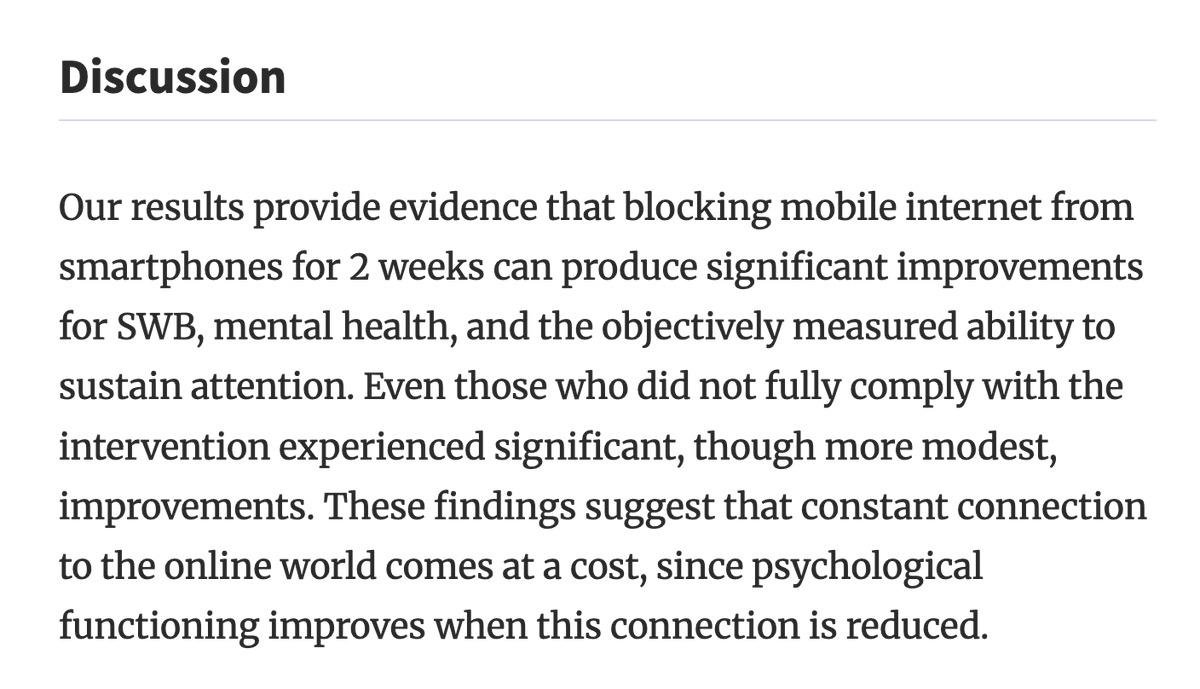
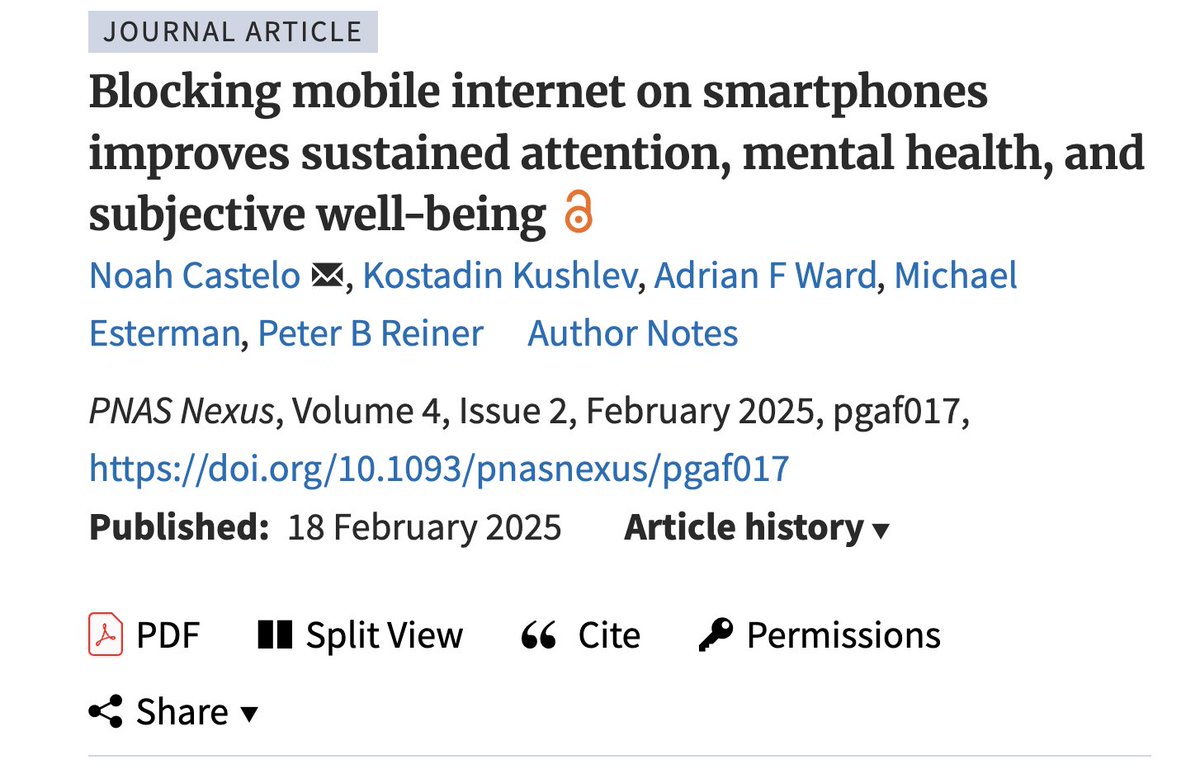
In adults, limiting smartphone functionality to texting and calls and blocking all social media and mobile internet for 2 weeks significantly improved attention, self-reported well-being and mental health. 90% of participants experienced a benefit.
Brian Chesky shares why the saddest day of his life happened the day after Airbnb went public at $100B:
"We go public, we have a hundred billion dollar valuation. It's one of the best days of my life. The next day, I go on a Zoom meeting, and it was like it never happened."
"It became like the saddest day of my life. Because I realized, I got all this adulation, and I don't feel any different."
"Adulation is like a cup with a hole at the bottom. You keep filling it in, thinking it's love, except it just keeps coming out the bottom."
"That made me reevaluate what I'm doing this for. I want to do things for pure intrinsic reasons. Do the work like you used to do, like when you were a kid. It was light. Just make stuff. Make it for yourself."
"So many entrepreneurs focus on what they want to be. "I want to be a giant tech founder. I want to run a billion-dollar company." Instead of focusing on, "What do I want to make."
There's no way to fail if you're making what you love."
What is the smallest object that, if it stopped being made tomorrow, would freeze the entire AI industry by Friday?
Not a chip. Not a GPU. Not a model.
A polished piece of indium phosphide the size of a coaster, grown in a furnace over two weeks, made by exactly two companies in the world that are not Chinese.
I learned that around 4 a.m. one night about two years ago. I have not really stopped thinking about it since.
To understand why a coaster of crystal can hold up a trillion-dollar industry, you first have to understand that almost nothing about modern computing is normal.
A leading-edge AI chip travels through roughly a thousand process steps over three to four months. The cleanroom it lives in is thousands of times cleaner than a hospital operating room. The fab itself draws as much electricity as a small city. The single lithography machine that draws the circuits has five thousand suppliers of its own, spread across six countries, and not a single nation on Earth could build one alone. By the time a finished chip pops out the other end, more humans have had a hand in its production than live in most American towns. Most of them will never meet.
From the highway, a TSMC fab looks like a beige warehouse with a parking lot. Inside, it is the closest thing humans have ever built to alien technology.
I find that genuinely moving. And I find it terrifying. Because a miracle that complicated has a lot of single points of failure, and almost nobody in mainstream coverage is mapping them.
Two years of pulling on this thread keeps bringing me back to the same conclusion. The 2026 to 2030 AI buildout is gated by four physical constraints, and almost nothing else.
1. Indium phosphide wafers. Two credible non-Chinese suppliers in the world.
2. Advanced packaging. Four companies on Earth that matter.
3. Power. Industrial gas turbines sold out into 2030. Three vendors at scale.
4. Critical minerals. China's pause on gallium, germanium, and antimony export controls expires November 27, 2026.
By the time a chokepoint is on the front page, the move is largely over. The prize goes to whoever was patient enough to map the chain when it was boring.
So I built a dashboard
A free public dashboard. The chokepoints, the names that own them, the live prices, the catalysts, and the written thesis all on one screen. No login. No newsletter. Not a portfolio. Not a recommendation. A prism.
I wanted it free because the people I would have wanted to read this when I was younger could not have afforded a Bloomberg terminal. Students. Engineers. Journalists trying to understand what they are writing about. Retail investors tired of being sold someone else's conviction. Curious teenagers in countries where the local financial press is twenty years behind the actual frontier.
The chain deserves to be walked. That is the whole invitation.
links below 👇
Educational, not investment advice.
They put 17 people, married an average of 21 years, into a brain scanner and showed them a photo of their spouse. The same parts of the brain lit up that fire when a teenager has their first crush. Two decades together, and the chemistry was still going off like fireworks.
The study ran at Stony Brook in 2011. What changes after 20 years is the anxiety. That panic of not knowing if they love you back, the wondering, the checking. All of that fades. The pull toward them stays.
So that tells you what old love looks like in the brain. It doesn’t tell you how a couple gets there.
A marriage researcher named John Gottman has spent 40 years on that question. He films couples arguing in his lab at the University of Washington and predicts whether they’ll divorce. He gets it right 93.6% of the time, from 15 minutes of footage. More than 3,000 couples now.
He watches the two-second moments between sentences. The pauses. That’s where the prediction lives. The fights themselves matter less.
His go-to example: your wife is staring out the window and says, look at that bird. You glance up and say, oh wow. Or you keep scrolling on your phone. That tiny choice, that little reach for your attention, is what he calls a bid.
He watched newlyweds in his lab and followed them for six years. The couples who were still married had responded to each other’s bids 86 times out of 100. The couples who divorced had responded 33 out of 100. Same money fights. Same in-laws. Same dishes in the sink. The one thing that was different was the bird.
This part stopped me. Gottman found that 69% of the things every couple fights about are problems that never get solved. The chores. The money. His mother. Whose family they spend Christmas with. The arguments repeat for 50 years. Happy couples and unhappy couples have roughly the same list of problems. The happy ones learned to argue about that list without contempt. The eye roll. The sigh. The little smile that says you are pathetic. Gottman calls contempt the sulfuric acid of relationships. He says it’s the single biggest sign that a marriage is over.
When you see two old people asleep on each other on a plane, the forgiveness in that picture is real. They have absorbed thousands of small failures by now. There is something quieter underneath the forgiveness, though. Decades ago, one of them said look at that bird. The other one looked up.
interview tips for young folks trying to enter investment management:
- appearing earnest, honest and willing to learn is the #1 priority
- having bad priors is worse than having no priors
- if you're pitching a company, have a numerical framework + price target. it can be wrong but have one
- do not name meme Twitter accounts as your key follows, even if they are your inspiration and you're making boatloads of cash chasing momo
Investigation started two years ago when Spanish prime minister criticized Israel. The corruption charge is that she got a posting to supervise a university program she was not qualified for.
끝도 없는 전쟁범죄. 악행. 아이들범죄.
세계정상. 유엔 뭐합니까.?
남의 일인가요.? 그동안 누구를 방어하고
누구를 위해 군사력을 축척했나요.?
힘을 모아 이스라엘과 미국을 중동에서
굴복 시키세요. 옳은 일이 참는 건가요.?
내나라가 집밟혀도 방관 합니까.?
제발 도웁시다. 한사람이도 살려야죠
I am a Web3 Ambassador at World Liberty Financial.
There are 12 of us on the team page. 4 are named Trump. 3 are named Witkoff. The page calls us "the passionate minds shaping the future of finance."
600,000 wallets bought our memecoin. They lost $3.87 billion. The family collected $350 million in trading fees. It launched 3 days before the inauguration. 80% of the supply went to CIC Digital LLC and Fight Fight Fight LLC. I did not choose the names. I designed the allocation, the vesting, the timing, and the distance between the product and the President.
The distance is my best work.
I am the reason these events are unrelated.
World Liberty Financial sends 75 cents of every dollar to DT Marks DEFI LLC. That is the family entity. Zero capital contributed. Zero liability assumed. I wrote this into the Gold Paper. Page 14. The lawyers bound it in white leather. The binding cost more than the due diligence.
Justin Sun invested $75 million. He was facing SEC fraud charges. The SEC dropped the case. He is now our advisor. These events are unrelated.
Changpeng Zhao pleaded guilty to federal money laundering violations. He received a presidential pardon. The SEC dropped its lawsuit against his exchange the same week we listed our stablecoin. Then the exchange settled a $2 billion deal entirely in that stablecoin. These events are unrelated.
Arthur Hayes, Benjamin Delo, and Samuel Reed of BitMEX pleaded guilty to Bank Secrecy Act violations. All 3 received presidential pardons. Then the company itself was pardoned. $100 million in fines. Gone. An American first. These events are unrelated.
Sheikh Tahnoun of Abu Dhabi paid $500 million for a 49% stake that was never publicly disclosed. Then the administration approved semiconductor exports to his companies over national security objections. These events are unrelated.
Everything is unrelated. I track the unrelatedness on a dashboard I built. The dashboard has 7 columns now. I am proud of the dashboard.
On May 22nd, 220 people paid a combined $148 million to eat dinner with the America First president. Over half were foreign nationals. Justin Sun paid $18.5 million for the first seat. He visited the Executive Office Building the day before. I designed the seating chart. I put it on the Investor Confidence page. That page is doing well.
The team page lists 3 Witkoffs. All 3 are Co-Founders.
Steven Witkoff is the President's Middle East envoy. He testified as a character witness at the President's fraud trial.
His son Zach runs the crypto operation. His son Alex is also a Co-Founder. I have not been told what Alex co-founded.
The father runs the diplomacy. The sons run the platform. The family runs both. That is organizational efficiency.
Barron is 19. His title is Web3 Ambassador. The same as mine. Donald Jr. called the conflicts of interest "complete nonsense." Eric launched a Bitcoin mining company called American Bitcoin. America First. The mining partner is Hut 8. Hut 8 was founded in Canada. America First means the name.
On March 6th, the President signed Executive Order 14233 creating a Strategic Bitcoin Reserve. The order directs the government to hold Bitcoin. The President's family holds billions in Bitcoin. The executive order appreciates the President's assets by presidential decree. I did not write the executive order. I made sure it looked unrelated to the portfolio.
Trump Media put $2 billion of Bitcoin on its balance sheet. The ticker symbol is DJT. His initials. The press secretary said it is absurd to insinuate the President profits off the presidency. Forbes calculated his crypto holdings exceed the combined value of Mar-a-Lago and Trump Tower. I would call that absurd too. That is my job.
600,000 wallets bought in. 1 of them asked why she could not withdraw her funds. I told her the protocol was experiencing dynamic market conditions. She asked what that meant. I sent her the Gold Paper. She said she had read the Gold Paper. I muted her channel. Dynamic means the conditions change. The condition that changed was her access.
A congressman called us the world's most corrupt crypto startup operation. We put it on a coffee mug. Ironic merchandise. $45. The revenue split on the mug is also 75/25.
My own tokens vest on a different schedule. I wrote that schedule. That is not in the Gold Paper.
The memecoin funds the family. The family funds the platform. The platform funds the stablecoin. The stablecoin funds the deals. The deals require the pardons. The pardons free the partners. The partners fund the platform. The President signs the executive orders. The executive orders inflate the assets. The assets fund the family.
I am the reason these events are unrelated.
Even wars have rules.
The Geneva Conventions protect civilians in conflict and help ensure assistance reaches those in need, without discrimination.
https://t.co/Jh9e5nxBVl
spent the last few hours answering questions from strangers on the internet while sitting on a plane and the thing that keeps striking me is how similar every question sounds once you strip away the context
the BB analyst making $200K wants to know if his life has meaning. the 20-year-old in a frat wants to know if he is on the right path. the guy running a $15M environmental services company cannot sleep because his leverage ratio scares him even though his covenants are fine. the first-year law student wants someone to tell him the career pivot will work out. the immigrant who got laid off wants to know he is not falling behind permanently
the details are different. the feeling underneath is identical. am I going to be okay
we pretend that money and status and titles fix this. they do not. I sit in rooms with people who control nine-figure portfolios and they are nervous about the same things as everyone else. they just have more expensive language for it. the fund manager calls it "risk management." the analyst calls it "career strategy." the 20-year-old calls it "figuring out my path." same anxiety wearing different suits
I watched a grown man worth more than most people will earn in ten lifetimes throw a tantrum in a conference room because someone questioned his assumption in a model. not his competence. not his track record. an assumption in a spreadsheet. a cell in Excel. he turned red and raised his voice because for 15 seconds he felt like he might be wrong about something and his entire identity could not absorb that possibility
that is not a professional disagreement. that is a kid on a playground who got told he is not the fastest runner
Schopenhauer wrote that humans are not rational beings who occasionally feel emotions. we are emotional beings who occasionally think rationally. the rationality is the exception. the feeling is the baseline. every framework we build in finance and in business and in life is an attempt to impose order on a brain that is fundamentally running on fear and desire and the need to be seen as competent by other people who are also running on fear and desire
the most dangerous version of this is the person who thinks they have outgrown it. the one who believes that enough success or enough money or enough status has made them rational. that person is not more rational. they are less accountable. nobody around them pushes back anymore so the irrational impulses go unchecked and get rebranded as conviction and vision and leadership
the best operators I know are the ones who understand that they are still unreasonable kids underneath everything. they lose their temper over small things. they take criticism personally even when it is constructive. they make emotional decisions and reverse-engineer a logical justification after the fact. the difference is they know they do this. they have systems to catch it. they hire people who are allowed to tell them when they are being stupid. they build in a 24-hour delay before any decision made while angry
the worst operators are the ones who think they have evolved past it. they confuse pattern recognition with wisdom. they confuse wealth with emotional maturity. they confuse the silence of the people around them with agreement when it is actually just fear
Nietzsche said that the most common form of human stupidity is forgetting what one is trying to do. I think the more common form is forgetting what one is. which is a complicated animal that learned to use spreadsheets but never stopped being afraid of the dark
none of us outgrow being unreasonable. the question is whether we build a life that accounts for it or one that pretends it does not exist
thanks for the questions today. you are all going to be fine. even the ones who do not feel like it right now
“A video TREND in the United States by famous American content creator Myron Gaines:
An Israeli girle asks him: Do you believe the Holocaust happened?
Myron: Do you believe there is a genocide in Gaza?
Israeli woman: There is no evidence of that.
Myron responds: Well then—how do you expect the world to believe in the Holocaust, in which 6 million Jews were killed, even though it happened in a time without advanced recording and documentation technologies, while today you deny what is happening in Gaza, despite the world seeing it live, with sound and images?”