The Black Death did not arrive in England to find a well fed population. It arrived to find a generation that had been raised without milk, because the cattle had died thirty years earlier.
It began with rain. In 1315, 1316 and 1317 it rained across northern Europe on a scale nobody had a word for. Three harvests failed in succession. The Great Famine took perhaps a tenth of the population of northern Europe and it is the worst subsistence crisis on the record north of the Alps. In August 1315 Edward II stopped at St Albans and there was no bread to be had for the king of England and his household, which is the kind of detail that survives because everyone present was appalled.
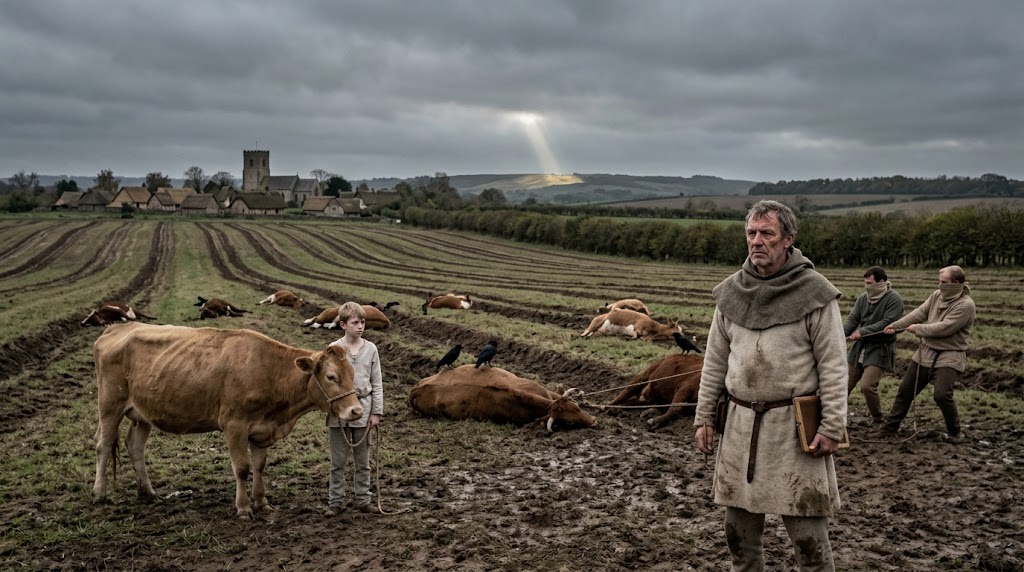
Between 1319 and 1320 a cattle plague, almost certainly rinderpest, moved into Britain from the continent and went through the herds like fire in stubble. Philip Slavin went through the manorial accounts, the workaday parchment where a reeve had to record every animal on the demesne and answer for it, and the figure that comes out is sixty two per cent. Nearly two beasts in three dead across England and Wales in twenty four months. On some manors the loss was total.
In September 1319 Simon Eye, the abbot of Ramsey, wrote to Edward II to say that a sudden pestilence had struck his animals, that they were dead in such numbers that the air was infected with the stench of the carcasses, and that he feared a pestilence among people would follow. St James's Hospital at Westminster wrote in the same year complaining of the mortality of animals.
Rinderpest kills between eight and nine animals in ten once it is into a herd, and it moves on shared water and shared pasture, and in 1319 there was nothing on earth a reeve could do about it but watch and count. The chroniclers describe carcasses lying in the fields because there were not enough living animals left to drag them off.
The ox was the tractor. Fifty five per cent of them went, and you cannot plough with an intention. Horses were bought in as a stopgap, which cost money and gave nothing back, because a horse yields no milk, no cheese and no calf.
And the cow was the dairy. Butter, cheese, buttermilk, whey, curds: the fat and the protein and the calcium that carried an ordinary family through a winter and put growth on a child. Dairy output halved after the pestilence and did not climb back to eighty per cent of its old level until the middle of the 1330s. Cattle numbers reached four fifths of the old figure by the end of the 1320s. Oxen were at eighty five per cent by 1331.
So there is a stretch of about fifteen years in which the children of England grew up in villages where the milk had gone.
Sharon DeWitte and Philip Slavin went to the bones. The skeletal evidence from the decades before 1348 shows chronic shortage of protein, calcium and vitamin B12 running for at least a generation, far longer than the three wet summers usually blamed for it. The famine had already killed the frailest. What the bovine pestilence did was take a population that had survived the famine and raise its children without animal food.
Those children were in their late twenties and thirties when the plague ships tied up in 1348.
What the body had been built out of decided who walked away from 1348, and that is now sitting in the burial record rather than in anybody's theory, and it points at dairy.
The story we tell about the fourteenth century is rain, then rats. Two acts of God, thirty three years apart, with nothing worth mentioning in between.
The thing in between was the loss of two thirds of the cattle in the country, and a generation that grew up without butter.
Here are the most important lessons from the Austrian School of Economics in one post:
The entire edifice of modern economic policy rests on a lie: that a group of planners can manage an economy better than the people living in it.
Start with value. Nothing has value in the abstract. You value a glass of water differently when you're drowning than when you're dying of thirst in the Sahara. Value lives inside individual human minds, not in objects, not in labor hours, not in government decree. Every price control, every subsidy, every centrally administered wage floor ignores this and produces predictable wreckage.
Money didn't come from a government committee. It emerged spontaneously from markets, as traders across centuries converged on commodities like gold and silver because they held value across time and space. Governments didn't invent money; they hijacked it.
Inflation is the expansion of the money supply itself. Rising prices are the symptom. When the Federal Reserve expanded its balance sheet from roughly $4 trillion to nearly $9 trillion between 2020 and 2022, the price explosion that followed wasn't a mystery. It was the direct, mechanical consequence of that expansion. The Fed caused it.
Prices do something irreplaceable: they transmit information across millions of actors simultaneously. When lumber prices spiked in 2021, builders across North America cut waste and sought alternatives without a single bureaucrat issuing a memo. No central planner can replicate that signal, because no central planner possesses the knowledge embedded in it.
This connects directly to the knowledge problem. You know your neighborhood, your suppliers, your customers, your own tolerance for risk. Your competitor knows his. A bureaucrat in Washington knows none of it. The knowledge required to run an economy is dispersed, personal, and contextual. It cannot be extracted, aggregated, and fed into a planning model. The Soviet Union ran that experiment for seventy years and produced chronic shortages of basic goods.
Bad businesses must be allowed to fail. When they fail, they release labor, capital, and resources to producers who will use them more effectively. When Washington handed General Motors $49.5 billion in 2009 to prevent exactly that process, it kept misallocated capital locked inside a failing structure and punished every competitor who had managed their business responsibly.
Every function government performs, a voluntary market arrangement performs better: faster, cheaper, and responsive to actual human preferences rather than political incentives. Education, roads, security, dispute resolution, all of it. Government agencies face no profit and loss signal, no competition, and no mechanism to reward performance. They optimize for budget preservation and political survival, and the people using the service have no exit option.
The political class and the central banking apparatus that sustains it are the villains. Both benefit directly from the idea that expert management beats voluntary exchange. They will not surrender that idea willingly.
What would you add?
Oh boy...
Global yields keep surging.
French and Japanese yields are already at multi-decade highs, while German yields are near 15-year highs...
The rest is following.
All of them are running huge deficits....
None of them can afford persistently higher yields.
The whole developed world increasingly needs to suppress yields.
We don’t own enough hard assets.
https://t.co/rMic6yyD7R 'I apologize for this small explosion of contempt and frustration. I should obviously try harder to be dispassionate. It follows my reading of The August Coup by Robert Service, an excellent, thorough, and thoughtful study of one of the least-examined moments of modern history.'
Osarenkhoe Atutie, a Nigerian national who travelled from London to Edinburgh to track down and attack his estranged wife, was called by some local Scottish media as an “Edinburgh man” “Edinburgh husband.” He literally was in Scotland less than a day.
A textbook case of the wider media practice of selectively suppressing origin, nationality and migration status in crime coverage whenever the perpetrator is non-native nowhere more pronounced than under Scotland’s official “New Scots” dogma.
Jeremy Clarkson lets slip a number on Clarkson's Farm that explains almost everything wrong with British food. A sausage from his own pigs costs 74p. The identical sausage made from imported pig meat costs 18p.
Most people hear that and assume the foreign farmer is simply better at it.
Britain outlawed the sow stall in 1999, alone in Europe bar Sweden, because the public here decided a pregnant animal ought to be able to turn around. The national pig herd then fell by roughly half.
British people did not eat half as much bacon.
Work out where the difference went. Twenty-seven years on, the National Pig Association reckons around 95 percent of the countries selling pork into Britain still permit the stall. Most of the EU allows four weeks of every cycle. Much of America allows the full sixteen-week gestation. Brazil allows it outright.
The sow was never spared. She was moved abroad, into a shed with looser rules and no British inspector, and the farm that would have kept her shut its gate.
Now watch the same thing happen to beef and lamb, on a far bigger scale.
British beef is grass. Native cattle standing out in the rain on ground that grows nothing else, doing what they have done on those hills since before the language was written down. What the NFU says we are being asked to compete against is a feedlot finishing up to 50,000 head on one site, which it called unacceptable here on both moral and environmental grounds.
The deals were signed anyway. Australian and New Zealand beef rises to a quota of 110,000 tonnes by 2033, and after that there is no tariff at all. Lamb runs to 60,000 tonnes this year and climbs from there, and we already import between a quarter and a third of what we eat.
Every one of those deals was announced with a firm assurance that food standards would not fall. That assurance is true, and it is beside the point.
The standards enforced at our border cover what is in the meat. Hormones stay banned, and rightly. What crosses untouched is how the animal lived. There is no border check for a feedlot, no tariff on a gestation crate, no form anywhere asking whether the thing we made illegal here was used to make the thing arriving here.
So a minister can say food standards are protected and back British farming in the same breath, and be telling the truth twice, while signing the document that finishes the job.
The pattern runs through the lot. Barren cages banned here in 2012, egg products still arriving from countries that use them. Force-feeding outlawed in 2007, foie gras on sale every Christmas.
And the campaigners who won those bans never once came back to see what happened next, because the victory was legislative and the consequence was six thousand miles away. Nobody counts sows in Iowa. Nobody films a feedlot in Queensland.
Clarkson absorbs that 56p on every plate that leaves his kitchen, on television, which is the only reason anybody can see the number at all. Inside a supermarket price it has been invisible for a quarter of a century.
Fifty-six pence is what this country charges a man for obeying it.
He is not competing with foreign farmers. He is competing with his own ban, on a shelf, standing next to the version of himself he was forbidden from being.
The Iranian despotate are now on a killing spree executing a series of (truly) brave young people who protested against Khamenei in January.
They are hanged from cranes - craneocide being a special ritual of the Islamic Republic.
Surely this is impossible to ignore, impossible not to protest.
One of the moral tests of our time.
@UN@andyburnham@Ed_Miliband
Europe lost the immigration argument for one reason: it refused to enforce its own rules.
The economics were never seriously contested. The working-age population is shrinking. Pensions, hospitals and care homes already run on people who came from somewhere else. Without migration the arithmetic of the European welfare state does not close, and anyone promising prosperity behind closed borders is selling a demographic fantasy.
But look at what was built alongside that truth. Asylum claims that take years to decide. Rejected applicants who are never returned, because returning them is uncomfortable — so rejection means nothing at all. Meanwhile a qualified engineer with a signed job offer waits eighteen months for a permit, and a trained surgeon drives a taxi because no authority will recognise her diploma.
That is not a generous system. It is an incompetent one — and incompetence radicalised the electorate, not xenophobia.
When a state cannot say who may enter, who must leave, and how fast, citizens conclude nobody is in charge. They are correct. Then they vote for whoever promises control, and the liberal centre acts shocked.
Rules are not the opposite of generosity. Rules are what make generosity survivable in a democracy.
The populists did not steal this issue.
It was left on the table, unattended, for twenty years.
Worth remembering that there are hundreds of Subway franchises, vape shops and newsagents on the 'skilled worker' visa sponsorship licence.
And 77 visa sponsors on Whitechapel Road alone.
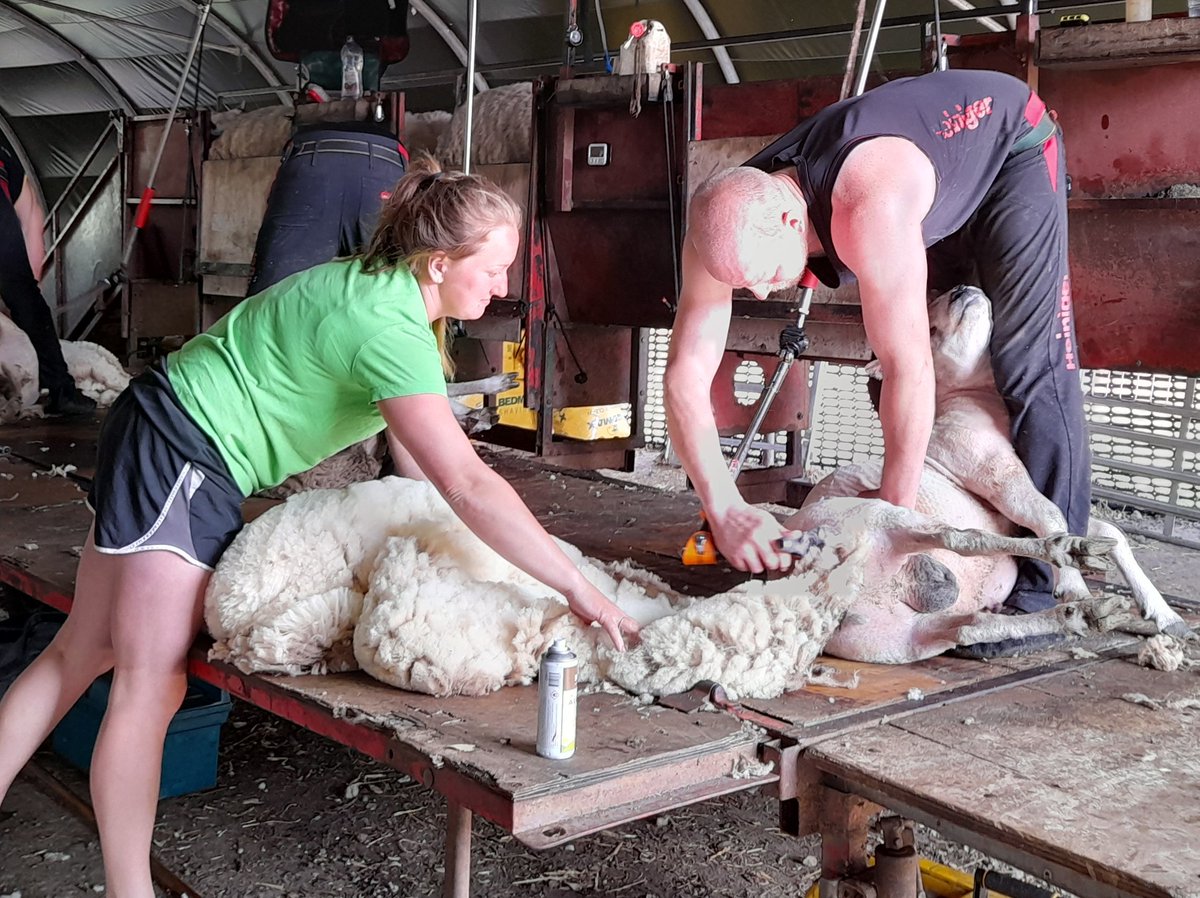
But the 50-75 sheep shearers was where the government drew the line.
Reminder: This is why Western nuclear reactors are delayed and plagued by cost overruns.
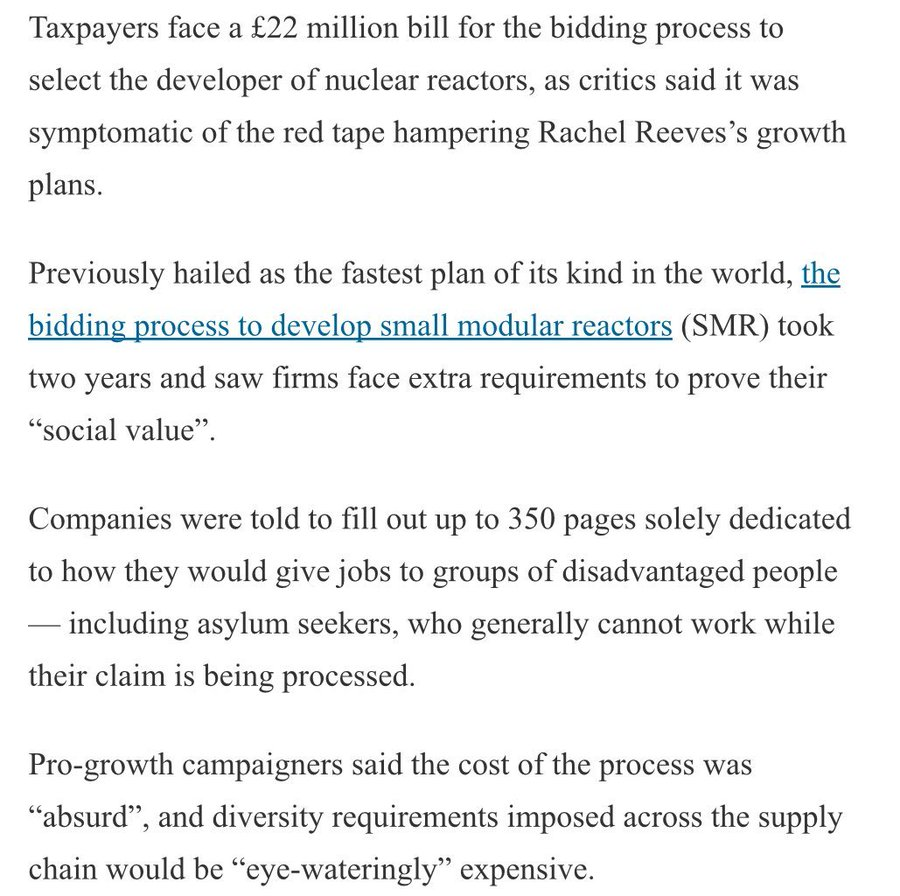
- UK's bidding process to select the developer of nuclear reactors cost £22 million and took 2 years
- It included 350 pages dedicated to hiring disadvantaged groups.
- Firms had to prove their social value.
- 50% of the people working on the contract had to be women.
This is how you regulate yourself into irrelevance.
INCREDIBLE that any media commentators, let alone high profile ones, are still able to make this asinine, factually incorrect statement over and over again unchallenged.
“Liz Truss crashed the economy” is a strong (and banal) take for people who quite clearly never checked when the Bank of England actually announced anything.
The £40bn gilt sale wasn’t “sprung” on anyone “the night before” (as Liz herself has said and blamed on Blairite changes to the way comms happen between various bodies). The MPC publicly voted for QT back in February 2022 and said it again in August and September. The market had known for seven months - just to be really clear. It’s a choice to listen or not to listen to MPC remarks, dryer content than Gandhi’s flip flops - sure; but public and easy enough for anyone to check.
What actually wasn’t disclosed was the size of £45bn in tax cuts with no OBR forecast attached (and look, this is far from being any endorsement of the OBR - which I’d never make because they suck, it’s really much more to say that removing a routine, low cost, previously universal scrutiny step on the biggest unfunded package in a generation was read correctly by the market as the government choosing not to be checked). Which points to a Kwarteng process failure, not a Truss economy failure, and Bailey himself agreed with that - under oath. Worth noting here too, Kwarteng spent years at a hedge fund (JWM Associates, John Meriwether’s fund after LTCM) built on what happens when leveraged bets meet a liquidity shock, so the market reaction to an uncosted package shouldn’t have been the surprise it apparently was. At least not to Kwazi.
The real detonator, of course, was two decades of pension accounting rules forcing schemes into leveraged LDI hedges against gilts. When yields moved, funds had to sell gilts to cover margin, which pushed yields up further, which forced more selling. That loop was loaded years before the spark of September 2022 lit the tinderbox.
Cable hitting 1.0350 gets used as killer proof too. But the dollar was having its strongest year in two decades that same month, DXY was at a 20 year high, the Fed was hiking harder than anyone. Euro went sub-parity the same week for the same reason. Sterling wasn’t the only currency getting run over by the dollar that autumn, it just got run over hardest because it has gilt credibility fears stacked on top of it. And yet barely anyone talks about this longer dollar move. It was a massive contributor.
Gilts were already sliding before the mini budget too, on the back of the Fed and a UK inflation surprise landing on a market running on fumes for liquidity. Again - vanishingly few people comment on this.
An economy that *actually* “crashed” also definitively does NOT retrace in a month on a raft of policy measures that were merely mooted and never realised. It’s just a total nonsense. It is instructive that yields and the pound mostly did retrace once the plan got reversed. What really broke was confidence in the economy for two weeks, not the economy itself. So NOT a crash, by definition.
Truss is still fair game for one thing, as I have often said on here. She announced *that* scale of unfunded cuts with no independent check, which was an unforced error. But. That is not the same claim as the one everyone repeats parrot fashion like Kay has here.
Kay is a great journalist, I’ve often enjoyed her work, but she’s totally wrong here. It’s a tired and incorrect and market-illiterate take that deserves much more due care and attention because of what it suggests - that cuts are bad; any cuts to taxes or spending = bad. Not least because the medicine the British economy needs MOST OF ALL is massive cuts to nominal spending. We need to take our medicine, regardless of how bitter it tastes. It’s an immutable mathematical fact. And repeating this falsehood stifles us from having public conversations that would lead to this much needed reality check.
The world has spent $7 trillion on wind and solar. That global fleet produces an average of around 630 GW.
The same $7 trillion could have built roughly 1,400 modern nuclear reactors, producing around 1,400 GW on average -- so more than twice the power.
Wind and solar generally last around 20 years (a lot less by some estimates), whereas nuclear plants can operate for 80 years or more.
Over 80 years, wind and solar must be built four times -- a cost of $28 trillion to maintain 630 gigawatts.
The same $28 trillion spent on nuclear would deliver roughly 5,600 gigawatts -- nearly nine times the power.
Also, nuclear produces this regardless of the weather, whereas wind and solar require 24-7 backup (usually gas, not included in these calculations).
we are an island surrounded by water with summer droughts and hosepipe bans.
we sit on oil and gas and buy it from norway.
we have wind and tides, we invented civil nuclear power, and we run an extension lead to france.
no other country works as hard as Britain to not use what it has
Wait wait dont tell me....
1) It gets mothballed for 10 years
2) It will be discovered by someone that it was actually a very good thing for Britain to have
3) It will be discovered that when it was shut everything has been corroded and nobody can remember how the software works
4) It will be scrapped
5) A new one will be built in its place for 100x the cost of just maintaining the old one for another 50 years.
The last overseas shearers Britain intends to let in are on the fells right now, working out the final weeks of their leave.
The door shut on 30 June. No vote, no debate, no announcement, just a date passing quietly in a summer when everyone was looking elsewhere. Those still working the Borders this week are here on leave that expires on 1 October, and when they fly out that is the end of it.
Understand what is walking out.
Six New Zealanders spent three months in one Northumberland valley last year and sheared nearly 90,000 sheep. Fifteen thousand head each, across farms from the Scottish Borders down to County Durham. They have been coming into Coquetdale for over thirty years. Since 2011 a concession has let up to 75 of them in each spring, and between them they take the wool off one and a half to two million British sheep in a window a few weeks long.
The Home Office rejected the application on 2 February. Twenty-six days of farmers writing to their MPs got it reinstated on 10 March for one final year, with a line about the sector having had fourteen years to train British workers and now being expected to transition to domestic labour.
Here is what that sentence is standing on. British Wool trains over 800 people a year, most of those courses are basic level, and most of the people on them are sheep farmers learning to do their own flock. Training was never the bottleneck. A top shearer clears a ewe in two or three minutes, calm hands, no panic in the animal, hundreds a day for weeks on end, and reaching that standard takes years of conditioning and a place in a global trade that follows the season around the planet.
Fourteen million breeding ewes. A few weeks to do them all. A sheep left in fleece gets eaten alive by maggots, so the job is not optional and the date is not negotiable.
Next spring those farms make phone calls that nobody answers.
Seventy-five shearers, once a year, and a government that could not find room for them.
There is great confusion about what Decolonization and indeed Colonization means.
The fact is: it means very little except 'a culture or mindset you dont like.' For whatever reason. And that usually means: the West. Since the West decolonized long ago, it really means the Western liberal democracies. It is a smart criticism because it means nothing, and hence it is hard to disagree with nothing and furthermore since the West itself is embroiled in a mix of moral fuddlement, political paralysis and cultural self hatred, you can be sure that Western leaders are very embarrassed by the very use of the word and many in the West will actually agree - even though they are not sure what they are agreeing with. it is a very useful rhetorical tool because Westerns are always going to be worried to answer in any meaningful way other than guilt and shame; and it is a growing industry - perfect for endless conferences. Like this one.
The reality of empires and colonies is something else entirely.
In early modern times, the Ottoman Turks conquered colonized enslaved exploited murdered and forcefully converted millions and ruled a vast tricontinental empire for four centuries; the Western powers led by Spain Portugal France and Britain later joined by Italy Germany Belgium also conquered colonized enslaved exploited murdered and converted using missionaries huge empires across the continents.
The Iberians lost much of their empires first; the Ottoman sultanate-caliphate started to decolonize with the Greek war of independence in 1820s and totally disintegrated in 1918; the British and French decolonized between 1940s and Sixties.
You could argue the Americans and Soviets comported themselves like anti-imperial imperialists during the Cold War and after - and indeed today's America toys at times with neo-tsarist expansionism - Greenland etc .
Thats it - noone in the Legacy Powers Britain or France etc seems keen on colonizing anything now; there are almost no colonizations left to decolonize - though many love to denounce their own country's past which is for some a most enjoyable enriching and virtuous pastime.
But in real life, empire and colonization are happening, often perpetrated by the very proponents of antiWest rhetoric. Russia is attempting to retake its limotrophic empire in Ukraine right now the old -fashioned way: by conquest and killing; a phalanx of Middle East neo-imperial powers are engaged in tournaments of power in failing states like Somalia, Libya and benighted Sudan; Iran established an informal empire across Iraq Syria Lebanon Yemen in its Six Armies strategy - its final destiny as yet undecided on the battlefield of the Third Gulf War; and Turkish leaders now regularly and openly declare their wish to reassert Ottomanist power in former Ottoman vilayets Syria Lebanon Israel, and former Ottoman cities Damascus Beirut Jerusalem....
So imperialism and colonialism just mean: other people, but never you.
UK Civil Service salaries never cease to confuse me, you can either help manage the UK’s nuclear defence for £47k or you can make TikToks for Andy Burnham for £57k