Can someone explain me how the new Kimi can be so insanely good?
The story has been "chinese labs have much less compute but they still stay close to the frontier through distillation". These results seem impossible to explain through distillation alone.
el fundador de una empresa china de IA valorada en más de $20,000,000,000 acaba de dar una clase de 40 minutos sobre enjambres de agentes
la explicación más clara que he visto sobre sistemas de IA a gran escala
cámbiala por tus 2 horas de Netflix de esta noche
1/ Some honest words about PaddleOCR — its performance, its real moat, and where it stands in the age of large models. 🧵
2/ There's a common take online: "PaddleOCR only performs well because it's backed by Baidu's massive private data."
As the tech lead, I find this a little absurd every time I see it.
3/ The truth: we've never shared data with other business teams inside the company. Everything PaddleOCR is today was ground out by our algorithm RDs doing the dirty work.
We prepare data piece by piece, build high-quality data pipelines, and do painstaking annotation and repair. Great models are fed by extreme data engineering 🧪 — not picked up in the greenhouse of a big company's resources.
4/ I'm often asked: "Why do models with similar scores on OmniDocBench feel worlds apart from PaddleOCR in real use?"
Because we put almost no effort into these public benchmarks. To us, public leaderboards are just a quick pre-release sanity check — a way to confirm the model hasn't overfit to our in-house data.
5/ PaddleOCR's real, unbridgeable moat 🛡️ is the high-quality internal evaluation set we've built over 6 years of open source, through deep conversations with tens of thousands of real users.
Evaluation standards born from real, complex scenarios can't be simulated or reproduced by any simple public academic benchmark. That evaluation system itself is our biggest technical barrier.
6/ We ran thorough internal tests against today's flood of open-source OCR and general multimodal LLMs.
Honestly? The only one that truly impressed us — that we hold in awe — is Gemini. 👑 Respect to the Gemini team.
7/ But large models have their battlefield, and we have ours. We never wanted to open-source a behemoth 🦖 with tens of billions of parameters.
For most industrial deployments, sheer size means high compute costs and an insurmountable deployment barrier.
8/ Our obsession is pushing parameters and compute to the limit ⚡ while keeping precision uncompromised. We want the most ordinary users to run the model easily on the most ordinary hardware — instead of staring at a painful GPU bill.
9/ We know that, limited by time and resources, PaddleOCR still has plenty of unsolved pain points and open problems. 🛠️
But our attitude never changes: no empty promises, no storytelling. We face real users' bad cases head-on and keep grinding.
Thank you for 6 years of support. We continue. 🚀
Follow us for updates, and try it yourself 👇
⭐ GitHub: https://t.co/SOT3IhkZMi
A 0.9B model is claiming SOTA for document parsing!
OvisOCR2: 96.58 on OmniDocBench v1.6 — reportedly the first end-to-end model to beat the pipeline systems. Apache 2.0.
Day-1 recipe: OCR any @huggingface dataset to markdown with one command on HF Jobs — no local GPU needed.
My co-worker Jean (x username: jeanghislainbil) posted this earlier but x locked his account and deleted the article.
This is a very interesting project led by Jean. We share our findings, methodology, and dataset with the open-source community.
We wanted Jean to get recognized for his work, but now i have to re-publish it because his account is gone.
@elonmusk@nikitabier
If you're using an LLM to check whether your document parser is doing its job, how do you know the judge itself isn't making mistakes?
We wanted an actual answer to that question, so we built a benchmark where we already know the right answer and then ran eight frontier models through it. False positive rates on clean pairs ranged from 6.5% to 25.5% depending on the model.
Our team wrote up the full methodology and findings here:
I’ve been asked this a lot recently: "Since End-to-End (E2E) document models are getting so powerful, do we even need Layout Analysis anymore?"
My short answer: Absolutely, yes. In fact, it is more critical than ever.
Thrilled to share that our latest work on this, RT-DocLayout, has been accepted to ECCV 2026! 🎉
Let’s look at why this matters from a first-principles data engineering perspective. 🧵👇
1/ The Illusion of E2E ModelsCurrent trendy E2E document parsing models are great at generating raw text directly. But they operate as a "black box." They completely discard spatial anchoring. In high-stakes enterprise workflows (like financial audits, legal contrast, or complex schematics), if you don't know where a specific text block physically resides on the page, the parsed data loses 80% of its reference and verification value.
2/ The Downstream Dilemma & The Geometric BottleneckTo make document data truly actionable for downstream tasks like LLM-RAG or precise knowledge base construction, we must have physical layout coordinates. However, even among the few advanced models that do provide coordinates, 99% of them are strictly limited to traditional rectangular bounding boxes.
3/ Why Rectangles Fail in the WildReal-world documents are messy—featuring page warps, camera tilts, perspective distortions, or highly irregular, dense, non-linear layouts. When you force a rigid rectangle onto a tilted or curved text line, it introduces massive background noise and overlaps with neighboring lines. This single geometric limitation causes catastrophic cascading errors for downstream OCR engines and text-ordering systems.
4/ Enter RT-DocLayout: A World First 🌍 [ECCV 2026]
This is exactly the core bottleneck we solve in our ECCV 2026 paper. RT-DocLayout (also known in the open-source community as PP-DocLayoutV3) is the WORLD'S FIRST document layout analysis model capable of predicting pixel-level multi-point polygon boxes (Multi-point Masks) in the wild!
Instead of fitting rigid rectangles, RT-DocLayout embraces a mask-centric architecture. It wraps around any skewed, bent, or irregular text line with "contour-level" precision.
5/ Speed Meets PrecisionBy reclassifying layout analysis into a single-stage, multi-task learning framework, a single forward pass simultaneously yields:
✅ Pixel-level multi-point contours
✅ High-precision object bounding boxes
✅ Logical reading order tracking
All of this heavyweight capability is packed into a highly efficient 33M parameter network, blasting through inference at an astonishing 132.1 FPS on a single GPU.
E2E models are an exciting branch, but high-fidelity data engineering requires absolute structural precision. Proud of the team's work getting recognized at ECCV 2026. RT-DocLayout is paving the way for the next generation of bulletproof document intelligence. 🚀
🔗 Read our full ECCV 2026 paper on arXiv: https://t.co/EnaO5zAo9p
Synthetic data seems like a huge theme of papers from #ACL2026. Great timing to resurface our ACL 2025 tutorial on it (now on YouTube)! The topics in this tutorial are relevant as ever: fundamental algorithms, applications, and open questions (all still open!).
I hope you find it useful and would love to hear your comments
https://t.co/sk7kNhQgBM
I ran 10 newer OCR models on @allen_ai's olmOCR-bench "old scans" subset.
The ranking flips depending on what you actually want. On the headline score, PaddleOCR-VL beats NuExtract3 (38.6 vs 37.8). But rank by how much of the page each model actually reads, and NuExtract3 is well ahead (41.6 vs 31.2). Same two models, opposite order.
The score rewards dropping boilerplate, i.e. letterheads, stamps, page numbers, so a model that reads the page more faithfully can rank lower.
IMO this is because a lot of VLM-based OCR models were made to provide tokens for training. It's less useful if you want faithful OCR of the whole page, like an archive where the letterhead is part of the record.
Two other things: a 1B model (LightOnOCR-2) has the best raw transcription in the field, and PaddleOCR-VL 1.6 sometimes hallucinates Chinese characters on English scans.
The hard part of training agents is the infrastructure: long rollouts, slow environments, tool calls, API delays, and keeping training compute busy while all of that happens.
Berkeley CS294-196
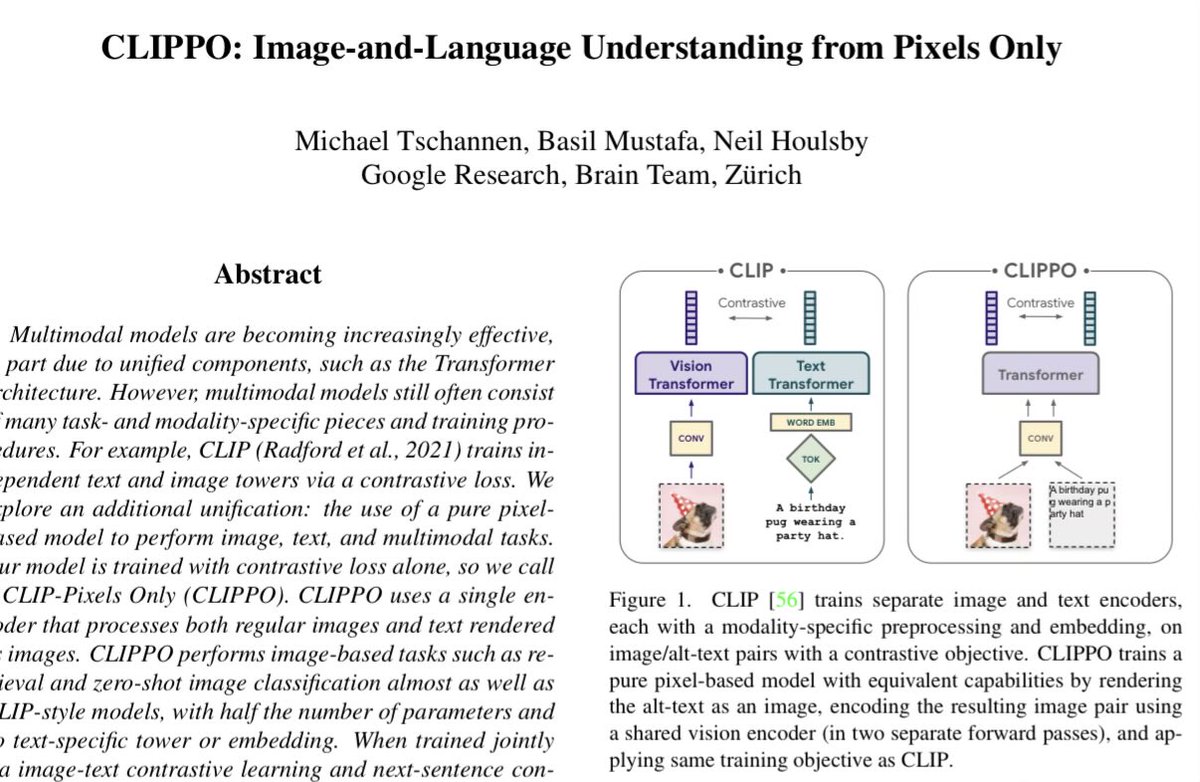
When frontier labs suddenly cut costs, or say "we found a way to dramatically cut inference memory!!"
This is what they found. The secret sauce. Vision always wins!
Of course, my very capable ex-colleagues who now work on Gemini and Claude already found out years ago:





![slimcat0101's tweet photo. I’ve been asked this a lot recently: "Since End-to-End (E2E) document models are getting so powerful, do we even need Layout Analysis anymore?"
My short answer: Absolutely, yes. In fact, it is more critical than ever.
Thrilled to share that our latest work on this, RT-DocLayout, has been accepted to ECCV 2026! 🎉
Let’s look at why this matters from a first-principles data engineering perspective. 🧵👇
1/ The Illusion of E2E ModelsCurrent trendy E2E document parsing models are great at generating raw text directly. But they operate as a "black box." They completely discard spatial anchoring. In high-stakes enterprise workflows (like financial audits, legal contrast, or complex schematics), if you don't know where a specific text block physically resides on the page, the parsed data loses 80% of its reference and verification value.
2/ The Downstream Dilemma & The Geometric BottleneckTo make document data truly actionable for downstream tasks like LLM-RAG or precise knowledge base construction, we must have physical layout coordinates. However, even among the few advanced models that do provide coordinates, 99% of them are strictly limited to traditional rectangular bounding boxes.
3/ Why Rectangles Fail in the WildReal-world documents are messy—featuring page warps, camera tilts, perspective distortions, or highly irregular, dense, non-linear layouts. When you force a rigid rectangle onto a tilted or curved text line, it introduces massive background noise and overlaps with neighboring lines. This single geometric limitation causes catastrophic cascading errors for downstream OCR engines and text-ordering systems.
4/ Enter RT-DocLayout: A World First 🌍 [ECCV 2026]
This is exactly the core bottleneck we solve in our ECCV 2026 paper. RT-DocLayout (also known in the open-source community as PP-DocLayoutV3) is the WORLD'S FIRST document layout analysis model capable of predicting pixel-level multi-point polygon boxes (Multi-point Masks) in the wild!
Instead of fitting rigid rectangles, RT-DocLayout embraces a mask-centric architecture. It wraps around any skewed, bent, or irregular text line with "contour-level" precision.
5/ Speed Meets PrecisionBy reclassifying layout analysis into a single-stage, multi-task learning framework, a single forward pass simultaneously yields:
✅ Pixel-level multi-point contours
✅ High-precision object bounding boxes
✅ Logical reading order tracking
All of this heavyweight capability is packed into a highly efficient 33M parameter network, blasting through inference at an astonishing 132.1 FPS on a single GPU.
E2E models are an exciting branch, but high-fidelity data engineering requires absolute structural precision. Proud of the team's work getting recognized at ECCV 2026. RT-DocLayout is paving the way for the next generation of bulletproof document intelligence. 🚀
🔗 Read our full ECCV 2026 paper on arXiv: https://t.co/EnaO5zAo9p](https://pbs.twimg.com/media/HM3tFhbboAAIJeA.jpg)