Privacy is deeply embedded in our evolution and our culture.
Humans did not evolve to live under constant observation.
For most of history, autonomy and privacy were the default, not something you had to ask for.
A world of permanent surveillance is not a natural state for humans.
Yet modern digital systems normalized monitoring as the price of convenience.
Over time, this quietly eroded personal freedom, choice, and agency.
Reclaiming privacy is not about hiding.
It’s about restoring control, over actions, data, and participation.
This is why crypto-native infrastructure matters.
Systems like Rialo reduce reliance on offchain actors and trusted intermediaries, enforcing logic directly at the protocol level instead of through surveillance-heavy middleware.
When automation and execution are native, fewer entities need visibility into user behavior.
Less observation. Fewer trust assumptions. Stronger autonomy.
Privacy is the foundation of freedom.
And reclaiming it is how we return to systems that respect humans by default, not monitor them.
@RialoHQ , @aqccapital , @Richardx122 , @khant1506
Privacy is deeply baked into our evolution and culture.
We didn’t evolve for a world of constant surveillance.
Reclaiming privacy is how we reclaim freedom.
@harryhalpin (CEO, @nymproject) spoke about this on our recent Privacy Roundtable 👇
gm everyone!
Raw Hash Power Doesn’t Always Create Real Value
Traditional Proof of Work was designed to secure networks through computation.
For years, this model powered major blockchain systems through:
Hash competition
Mining difficulty
Energy-intensive computation
Distributed consensus
And as hardware improved,
miners generated increasingly larger amounts of compute power.
But most of that computation had one purpose:
Finding valid hashes.
Classical Mining: Secure, But Computationally Isolated
In traditional mining systems,
hardware performs repetitive mathematical operations continuously.
The network gains:
Security
Consensus reliability
Attack resistance
But outside the blockchain itself,
the computation produces little reusable output.
This creates a system where:
Massive energy is consumed
Hardware runs continuously
Computation has limited external utility
The network stays secure, but the work itself is mostly isolated from real-world optimization problems.
Where Useful Proof of Work Changes the Model
Useful Proof of Work introduces a different idea.
Instead of using computation only for hash generation,
compute resources can contribute toward solving meaningful optimization workloads.
This includes problems involving:
Resource coordination
Scheduling systems
Graph optimization
Industrial simulations
Computational modeling
The goal becomes:
Securing the network while also generating computational utility.
Why Optimization Problems Matter
Many optimization tasks are extremely difficult because they involve:
Millions of combinations
Dynamic constraints
Continuous state changes
Large-scale decision spaces
Examples include:
Logistics routing
Supply chain balancing
Compute scheduling
AI workload coordination
Financial modeling
These problems require enormous computational exploration.
And that creates an opportunity for distributed compute systems.
Where QUIP Fits In
QUIP explores a framework where distributed computation can support optimization-oriented workloads while maintaining secure orchestration.
Through:
Rule-based execution
Workload isolation
Quantum-oriented coordination
Post-quantum verification
QUIP creates an environment where computational work can become both:
Network-secured
Computationally meaningful
The focus is not only on generating hashes.
It’s about directing compute toward useful computational objectives.
What This Means
Traditional Proof of Work proved that decentralized compute can secure global systems.
Useful Proof of Work expands that idea further.
Instead of compute existing only for validation,
future systems may allow computation itself to contribute toward solving real optimization challenges.
And as computational complexity continues to grow,
that shift becomes increasingly important.
@quipnetwork
gm everyone!
Benchmarking Quantum Performance Isn’t Simple
Classical systems are easy to measure.
For decades, compute performance has been benchmarked through:
CPU frequency
GPU throughput
Memory bandwidth
Parallel processing speed
These metrics helped define performance across traditional infrastructure.
But quantum-oriented systems behave differently.
And that changes how computational performance must be evaluated.
Classical Benchmarking: Measuring Raw Throughput
Traditional benchmarking focuses on hardware output.
Systems are evaluated through:
FLOPS performance
Clock speed
Compute latency
Parallel execution capacity
This works well for deterministic systems.
The faster the hardware,
the faster the computation.
But optimization-oriented workloads introduce a different challenge.
Sometimes efficiency matters more than raw speed.
Why Quantum Performance Is Different
Quantum-oriented computation is not just about faster hardware.
It’s about solving certain classes of problems more efficiently.
Performance depends on factors like:
Optimization quality
State exploration efficiency
Constraint resolution
Workload coordination
In many cases,
the goal is not maximum compute output but reaching better solutions with fewer computational steps.
Where Traditional Metrics Begin To Break Down
A system with higher FLOPS does not automatically produce better optimization results.
Complex workloads often involve:
Massive search spaces
Dynamic constraints
Combinatorial explosion
Multi-variable interactions
Examples include:
Traffic routing
Industrial scheduling
Portfolio balancing
Supply chain coordination
In these environments,
benchmarking shifts from:
“How fast can computation run?”
To:
“How efficiently can complex solutions be discovered?”
How Quantum-Oriented Benchmarking Evolves
Quantum-oriented benchmarking focuses on computational effectiveness.
This includes:
Optimization accuracy
Search efficiency
Parallel state evaluation
Resource coordination quality
The objective becomes smarter computation,
not simply larger compute output.
This creates a new category of performance measurement.
One based on solution efficiency rather than brute-force throughput alone.
Where QUIP Fits In
QUIP provides an infrastructure framework for evaluating and coordinating advanced computational workloads securely.
Through:
Rule-based workload execution
Distributed orchestration
Secure workload isolation
Post-quantum verification
QUIP enables optimization-oriented systems to operate in scalable environments while maintaining computational integrity.
What This Means
The future of benchmarking may no longer revolve entirely around raw hardware speed.
As optimization problems become more complex,
performance increasingly depends on how intelligently systems coordinate computation.
Not just how much power they consume.
And that’s where quantum-oriented performance evaluation begins to matter.
@quipnetwork
gm everyone!
Benchmarking Quantum Performance Isn’t Simple
Classical systems are easy to measure.
For decades, compute performance has been benchmarked through:
CPU frequency
GPU throughput
Memory bandwidth
Parallel processing speed
These metrics helped define performance across traditional infrastructure.
But quantum-oriented systems behave differently.
And that changes how computational performance must be evaluated.
Classical Benchmarking: Measuring Raw Throughput
Traditional benchmarking focuses on hardware output.
Systems are evaluated through:
FLOPS performance
Clock speed
Compute latency
Parallel execution capacity
This works well for deterministic systems.
The faster the hardware,
the faster the computation.
But optimization-oriented workloads introduce a different challenge.
Sometimes efficiency matters more than raw speed.
Why Quantum Performance Is Different
Quantum-oriented computation is not just about faster hardware.
It’s about solving certain classes of problems more efficiently.
Performance depends on factors like:
Optimization quality
State exploration efficiency
Constraint resolution
Workload coordination
In many cases,
the goal is not maximum compute output but reaching better solutions with fewer computational steps.
Where Traditional Metrics Begin To Break Down
A system with higher FLOPS does not automatically produce better optimization results.
Complex workloads often involve:
Massive search spaces
Dynamic constraints
Combinatorial explosion
Multi-variable interactions
Examples include:
Traffic routing
Industrial scheduling
Portfolio balancing
Supply chain coordination
In these environments,
benchmarking shifts from:
“How fast can computation run?”
To:
“How efficiently can complex solutions be discovered?”
How Quantum-Oriented Benchmarking Evolves
Quantum-oriented benchmarking focuses on computational effectiveness.
This includes:
Optimization accuracy
Search efficiency
Parallel state evaluation
Resource coordination quality
The objective becomes smarter computation,
not simply larger compute output.
This creates a new category of performance measurement.
One based on solution efficiency rather than brute-force throughput alone.
Where QUIP Fits In
QUIP provides an infrastructure framework for evaluating and coordinating advanced computational workloads securely.
Through:
Rule-based workload execution
Distributed orchestration
Secure workload isolation
Post-quantum verification
QUIP enables optimization-oriented systems to operate in scalable environments while maintaining computational integrity.
What This Means
The future of benchmarking may no longer revolve entirely around raw hardware speed.
As optimization problems become more complex,
performance increasingly depends on how intelligently systems coordinate computation.
Not just how much power they consume.
And that’s where quantum-oriented performance evaluation begins to matter.
@quipnetwork
gQuip, fam!
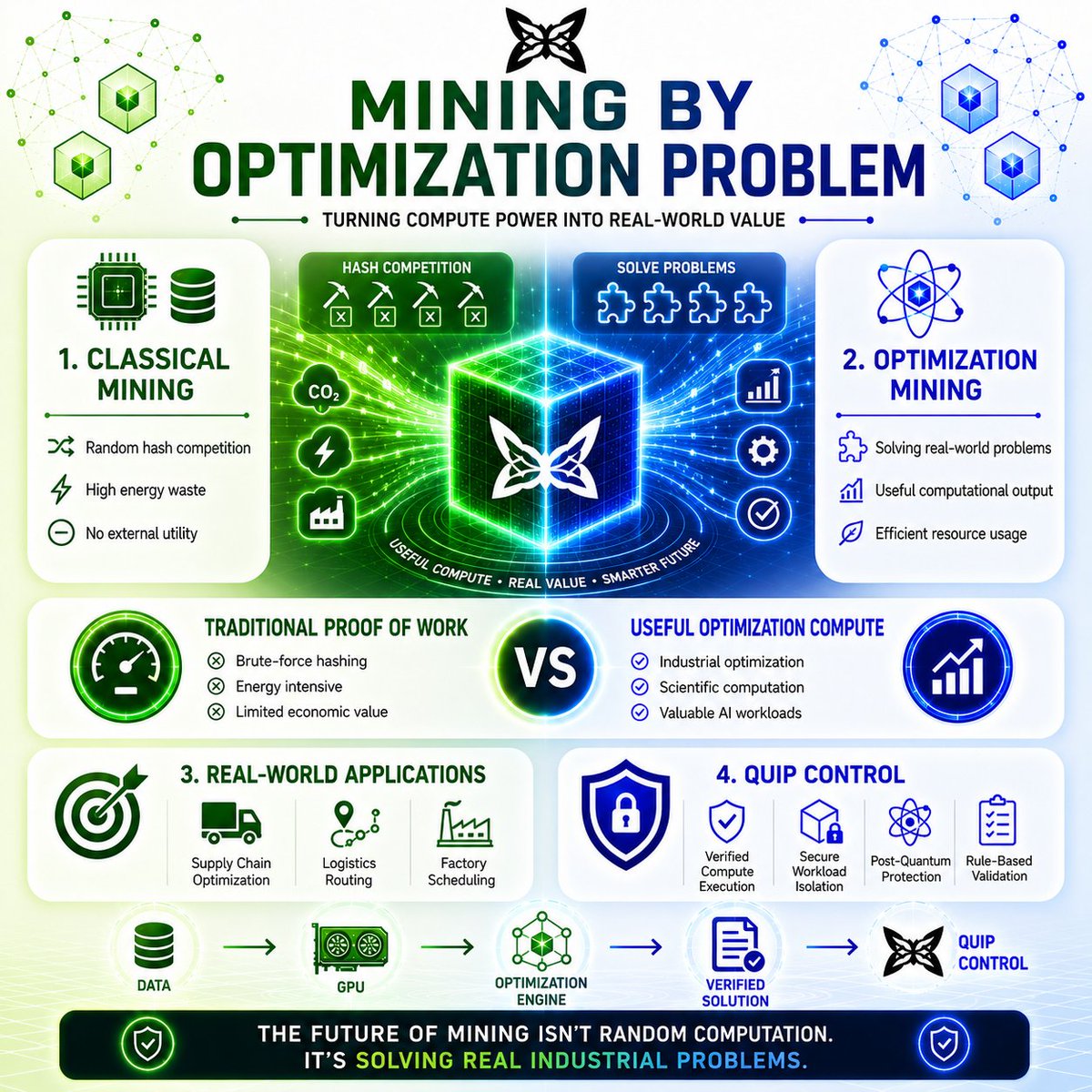
Mining Was Never Designed To Solve Real Problems
Traditional Proof of Work was built around one objective:
Secure the network through computational competition.
For years, this model powered major blockchain systems through:
Hash-based validation
GPU mining farms
Large-scale energy consumption
Competitive block discovery
And while this approach successfully created decentralized security,
most of the computation itself produced no external utility.
The network remained secure—
but the compute output had no real-world value.
Traditional Mining: Secure, But Computationally Wasteful
Classical Proof of Work relies on brute-force computation.
Miners repeatedly perform random calculations in order to discover valid hashes.
This process creates:
Massive hardware competition
High electricity consumption
Constant redundant computation
Limited usefulness outside consensus
The system works because difficulty creates security.
But the majority of compute cycles are discarded immediately after validation.
Where Optimization Problems Change Everything
Not all computation needs to be random.
Some computational workloads produce meaningful outputs while still requiring enormous processing power.
Examples include:
Supply chain optimization
Scheduling coordination
Traffic routing
Portfolio balancing
Industrial resource allocation
These problems become exponentially more difficult as variables increase.
Solving them requires advanced optimization systems capable of evaluating enormous search spaces efficiently.
How Useful Optimization Mining Works
Optimization-based mining shifts computation toward useful workloads.
Instead of competing through meaningless hash repetition,
compute resources contribute toward solving valuable optimization tasks.
This enables:
Real computational utility
Smarter resource usage
Industrial-scale optimization
More efficient compute allocation
The network remains decentralized but the computation itself becomes productive.
The goal is no longer just security.
It becomes security through useful computation.
Where QUIP Fits In
QUIP introduces an infrastructure layer designed for coordinated computational workloads.
Through:
Secure workload execution
Rule-based compute validation
Post-quantum verification
Distributed onchestration systems
QUIP enables optimization-oriented computation to operate securely across decentralized environments.
This creates a framework where compute power can contribute to both:
Network coordination
Real-world computational output
What This Means
Traditional mining proved decentralized systems could work.
But future computational networks may evolve beyond random hash competition.
Not because security becomes less important—
but because computation itself can become economically useful.
And that’s where optimization-based mining begins to matter.
@quipnetwork
gRialo!
Happy Thursday everyone.
As usual, Rialo Builder Hub returned this week at 3PM UTC on Wednesday, and it was great to see the community show up once again.
Around 500 participants joined the session, which is honestly impressive and a strong sign of how much interest and momentum Rialo continues to build.
Every week, more people are coming to learn, share ideas, discuss, and contribute to the ecosystem. Watching the community grow steadily like this is one of the things I enjoy most about Rialo.
To me, this is proof of a strong and healthy community, people consistently showing up because they believe in what is being built.
Don't miss your opportunity to be part of the journey.
Join Rialo, start building, and grow alongside an amazing community.
Get Real. Get Rialo.
@RialoHQ
gRialo, guys
Identity as a Foundational Primitive
Web3 has developed powerful primitives:
assets, smart contracts, decentralized storage.
But one key primitive is still missing: identity.
Without it, every application operates in isolation when it comes to understanding users.
Rialo introduces identity as a shared layer.
A Single Identity, Multiple Applications
Instead of rebuilding identity systems for every app, Rialo enables a unified identity layer that can be reused across the ecosystem.
This reduces fragmentation and creates consistency.
What This Unlocks
Cross-application continuity
Users carry their identity, reputation, and history across platforms.
Reduced onboarding friction
No need to repeatedly verify or recreate profiles.
Composable identity systems
Developers can build on top of a shared identity layer instead of starting from zero.
Identity becomes infrastructure, not an afterthought.
Get Real. Get Rialo.
@RialoHQ
Dario Amodei: AI Policy
> AI is progressing extremely fast, much faster than the policy process was built to handle, and the gap between the two is becoming the central challenge of the technology.
This is why we built https://t.co/P12bb0WAq7
https://t.co/FI4muydS57
REUR is not “just another stablecoin.”
It is Real Euro - built for the financial rails institutions actually need.
Euro-linked.
Compliance-first.
Designed for real-world assets.
Built so serious capital can move onchain without losing trust, structure, or control.
@pauli_speaks said it clearly: when you deal with tangible assets, rules are not optional. They become infrastructure.
REUR is where compliant finance meets programmable money.
RWA, unchained.
gQuip, fam!
Mining Was Never Designed To Solve Real Problems
Traditional Proof of Work was built around one objective:
Secure the network through computational competition.
For years, this model powered major blockchain systems through:
Hash-based validation
GPU mining farms
Large-scale energy consumption
Competitive block discovery
And while this approach successfully created decentralized security,
most of the computation itself produced no external utility.
The network remained secure—
but the compute output had no real-world value.
Traditional Mining: Secure, But Computationally Wasteful
Classical Proof of Work relies on brute-force computation.
Miners repeatedly perform random calculations in order to discover valid hashes.
This process creates:
Massive hardware competition
High electricity consumption
Constant redundant computation
Limited usefulness outside consensus
The system works because difficulty creates security.
But the majority of compute cycles are discarded immediately after validation.
Where Optimization Problems Change Everything
Not all computation needs to be random.
Some computational workloads produce meaningful outputs while still requiring enormous processing power.
Examples include:
Supply chain optimization
Scheduling coordination
Traffic routing
Portfolio balancing
Industrial resource allocation
These problems become exponentially more difficult as variables increase.
Solving them requires advanced optimization systems capable of evaluating enormous search spaces efficiently.
How Useful Optimization Mining Works
Optimization-based mining shifts computation toward useful workloads.
Instead of competing through meaningless hash repetition,
compute resources contribute toward solving valuable optimization tasks.
This enables:
Real computational utility
Smarter resource usage
Industrial-scale optimization
More efficient compute allocation
The network remains decentralized but the computation itself becomes productive.
The goal is no longer just security.
It becomes security through useful computation.
Where QUIP Fits In
QUIP introduces an infrastructure layer designed for coordinated computational workloads.
Through:
Secure workload execution
Rule-based compute validation
Post-quantum verification
Distributed onchestration systems
QUIP enables optimization-oriented computation to operate securely across decentralized environments.
This creates a framework where compute power can contribute to both:
Network coordination
Real-world computational output
What This Means
Traditional mining proved decentralized systems could work.
But future computational networks may evolve beyond random hash competition.
Not because security becomes less important—
but because computation itself can become economically useful.
And that’s where optimization-based mining begins to matter.
@quipnetwork
gQuip!
More Compute Doesn’t Always Mean Better Optimization
Classical computing was designed around sequential logic.
For decades, this approach powered everything:
Enterprise systems
Data processing
Scientific simulation
Industrial automation
And with faster CPUs and larger GPU clusters,
classical systems became extremely powerful.
But as optimization problems grow more complex,
power alone becomes less efficient.
Classical Computing: Fast, But Sequential
Classical systems process information step by step.
Even with parallel hardware,
most optimization tasks still rely on:
Linear evaluation
Iterative search
Trial-and-error computation
This works well for predictable workloads.
But when systems involve millions of variables,
classical optimization begins to slow down rapidly.
Where Complexity Becomes a Problem
Many real-world problems are not simple calculations.
They involve:
Dynamic constraints
Massive combinations
Constant state changes
Competing priorities
Examples include:
Supply chain coordination
Traffic routing
Industrial scheduling
Financial optimization
As these systems scale,
the number of possible outcomes expands exponentially.
This creates a computational bottleneck.
How Quantum Approaches the Problem Differently
Quantum computation is designed to explore complex possibilities more efficiently.
Instead of evaluating one path at a time,
quantum systems can analyze multiple states simultaneously.
This enables:
Faster optimization modeling
Parallel state evaluation
Smarter workload coordination
More efficient resource exploration
The goal is not simply faster computation.
It’s more intelligent computation.
Where QUIP Fits In
QUIP introduces a framework where quantum-oriented computation can operate securely and efficiently.
Through:
Rule-based execution
Secure workload isolation
Post-quantum verification
Coordinated compute orchestration
QUIP creates an environment where advanced computational logic can scale without sacrificing control.
What This Means
Classical computing still powers today’s infrastructure.
But future optimization systems may require a different approach.
Not because classical systems stop working but because complexity keeps growing faster than traditional coordination methods can handle.
And that’s where quantum-oriented computation begins to matter.
@quipnetwork
Web3 is an open world, not just for technology, but for building meaningful connections.
We first met through @SuccinctLabs and that connection has continued to grow over time.
Wishing everyone good health, success in their own journey, and continued growth in the field they are passionate about.
Hope to see you all again someday in the future 🫡
@duykhac_@marsss3399@onnet1001@LgVuhungphi@_twolight
Institutions first. Retail second.
That is how RWA goes from narrative to real financial infrastructure.
In @KevinWSHPod DROPS E37, @valdimitrv breaks down how @RealFinOfficial is building a purpose-built Layer 1 for tokenized real-world assets - bonds, private credit, commodities, real estate, and more.
From EU Parliament policymaking to investment banking to managing €600M+ in EU fund allocations, Valentin, COO of REAL, has seen what traditional finance actually needs.
Now REAL is building it onchain.
Inside the episode:
• Why institutions must come before retail in RWA
• How signed institutional contracts helped secure a Tier 1 exchange listing
• Why business validators stake tokens to secure the network
• How REAL bridges crypto-native tokens and institutional equity
• The path toward a major EU stock exchange listing
• Why the $30T RWA opportunity is crypto’s biggest narrative by 2030
This is not hype.
This is regulated capital markets moving onchain.
RWA, unchained.
Watch full episode here ⬇️⬇️⬇️