Excited to see MIP-9 moving forward! 🚀
Increasing the active validator set from 200 to 300 is a smart, balanced step that perfectly aligns with Monad’s vision of scalable decentralization.
🌐 A ~50% expansion shows exactly the kind of thoughtful engineering and risk-aware governance we expect from the Monad team. 🧠🛡️
Greater participation = stronger fault tolerance, better economic security, and more room for high-quality operators like OnNode to contribute to the network’s long-term health. 💪📈
As OnNode Staking, we’re fully supportive and ready to help!
This change opens the door for broader community participation while keeping performance rock-solid. 💎⚡
Big thanks to @socialforging and the Monad team for driving this forward! 🙌
What do you all think, Monad community? Is the community as bullish on this increase as we are? Let’s discuss and show strong support for MIP-9! 🔥
📖 Full proposal: https://t.co/I4NMitIYfg
#Monad #MIP9 #ActiveSet #Decentralization #Staking #OnNode
Meta Pool Node Studio Program operators, this one’s for you 📣
We just launched a 30-day referral contest 🏆
The node with the most verified mpSOL & stNEAR referrals wins 5,000,000 Voting Power delegated for 1 month.
Contest is live. Your move 👇
→ https://t.co/kGs19HbtOI
This month on Starknet.
1️⃣ Bitcoin privacy is now possible on Starknet
- The Starknet community approved both the strkBTC bridge architecture and its initial signer set, validating the design, trade-offs, and roadmap toward more trust-minimized BTCFi.
- Following this approval, strkBTC officially hit the market, a new Bitcoin wrapper on Starknet, with built-in compliant privacy.
- Among the first users case available today: Shield and unshield strkBTC directly from Xverse and Ready interfaces - Transfer privately inside Starknet’s privacy pool - Bridge Bitcoin to strkBTC on Starknet through Atomiq Labs and GardenFi - Stake and liquid stake strkBTC through Endur - Provide liquidity on Ekubo - Trade it on avnu and Ekubo - Lend and borrow it on Vesu
- Next steps: anonymous swap on avnu & Ekubo, and the full launch of STRK20s on June 9, bringing privacy to all ERC-20 assets, not only Bitcoin.
2️⃣ Starknet is getting ready for the post-quantum era
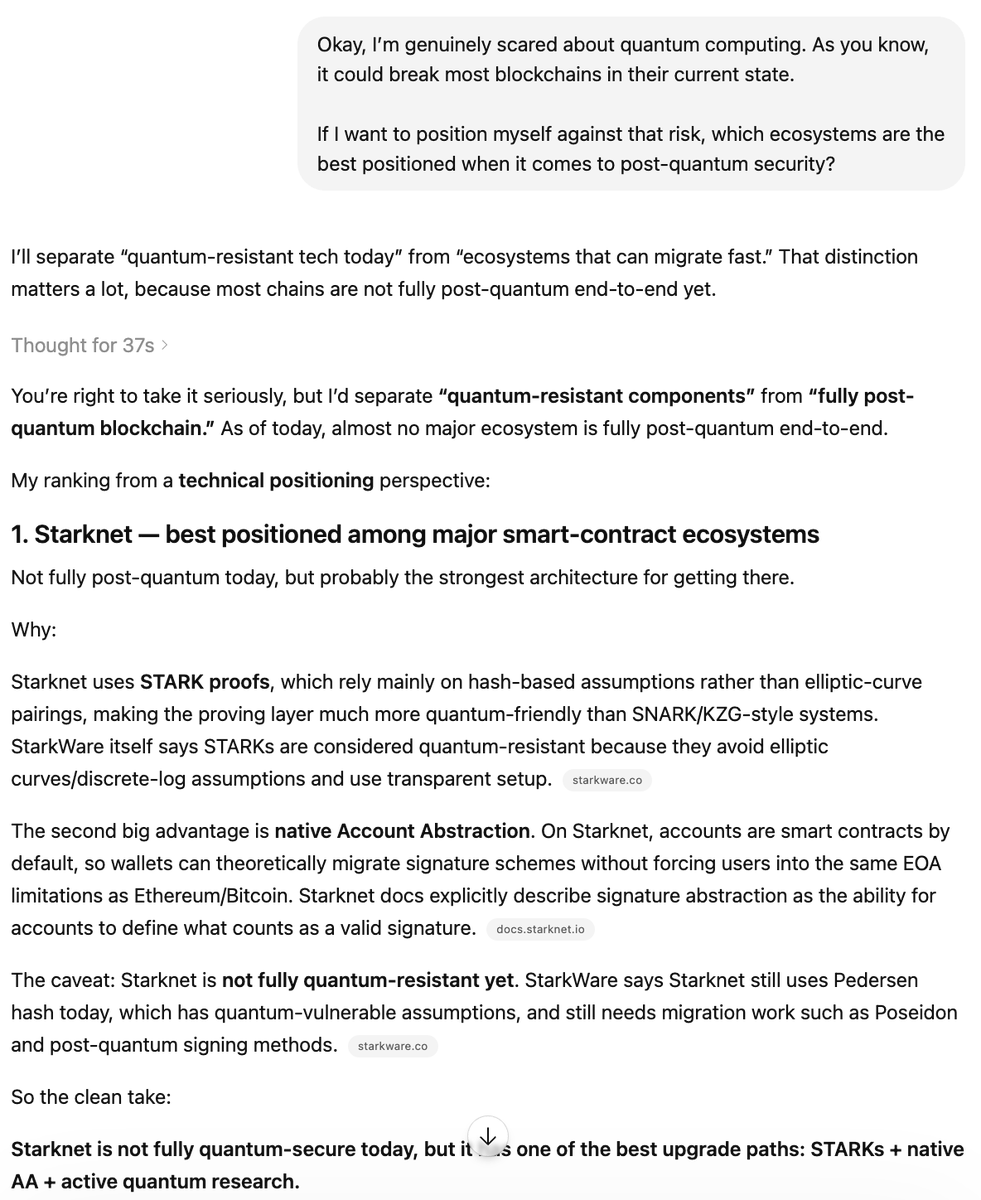
Post-quantum resistance is becoming one of the most important long-term topics in crypto, and Starknet is one of the best-positioned ecosystems:
- Starknet is powered by STARK proofs, a proving system already considered post-quantum secure.
- It also has native account abstraction, making it easier for users to migrate to post-quantum secure wallets (1 click/tx migration)
- Even better: post-quantum wallets are already live on Starknet Mainnet today.
- The remaining pieces would require around 4 to 6 months of engineering work to bring Starknet fully to end-to-end post-quantum resistance.
3️⃣ The ecosystem keeps shipping
- Xverse had a strong month, improving access to Starknet through Due’s Bank Transfer integration, integrating Vesu’s USDC markets directly inside the wallet, and becoming the first wallet on Starknet to support strkBTC shielding on mobile.
- Ready launched Ready Rewards, allowing users to earn points through swaps and Ready Metal card spending, while also making Ethereum yield opportunities accessible directly from the wallet, starting with USD Prime by Morpho and SteakHouse.
- Extended keeps accelerating with Multi-Asset Collateral, allowing traders to use wBTC, ETH, USDT, USDC, and XVS as collateral. The team also shipped email signup, improved onboarding, migrated data feeds to RedStone Live, and launched SpaceX Pre-IPO trading with up to 3x leverage.
- Privily released its SDK, launched its MCP Plugin & Skill for Claude Code, and shipped Disperse Mode, allowing users to send payments to up to 20 recipients in one transaction.
- Native USDC deposits and withdrawals to and from Starknet are also now live on Binance.
- 2 new projects launched on Mainnet: 0dAMM, the first PropAMM on Starknet, now live through avnu & Stark Lens by Aegis, a Bubblemaps-like tool to track token holders and supply movements on Starknet
- And one last alpha: SuperVega is coming very soon to Mainnet, providing users with a new way to trade markets.
4️⃣ The numbers keep improving
- Extended surpassed $25M in total cumulative revenue.
- Starkzap, the SDK allowing builders to integrate Starknet DeFi use cases while abstracting away blockchain complexity, crossed 6,000 downloads.
- STRK staking crossed 1.3B STRK staked, representing around 22% of the circulating supply.
- The Starknet Foundation also opened a new delegation round, with up to 1.7B STRK in voting power available for active community members who want to participate in governance.
We’re definitely getting there.
🚀 Big news for the #Monad fam!
OnNode just dropped Monad Pixel War – our r/place style collaborative canvas built on Monad testnet!
Connect your wallet, grab credits with $MON, and start painting pixels. Every color costs just 0.1 credit… but anyone can overwrite it after 30 seconds 👀
Play & shape the canvas right now 👉
https://t.co/lt1hJrfoZe
Drop your honest feedback on gameplay — we’re building this with the community! Once it’s polished, we’re launching on Mainnet very soon.
Let’s create something epic together 🎨🔥
#MonadPixelWar #OnNode #Web3Gaming
What are you painting first? 👇
Bitcoin is the most sovereign money ever created.
It is also the least private money people have ever used.
strkBTC fixes that. Live on Starknet today.
🧵
strkBTC launches tomorrow.
Here's your guide to getting started:
→ How to bridge
→ Which wallets to use
→ How shielding works
→ What incentives are live at launch
Read on 👇
OnNode has a special gift coming for the Monad community. 🚀🟣
Our exclusive on-chain game built ONLY for Monad.
Dropping very soon.
Clear takeaway: The best infrastructure projects don’t just secure the chain, they build the culture that makes it unstoppable.
Stay tuned 👀
#OnNode #Monad
📢 Monad’s April Roundup = straight FIRE 💜
Monad just turned 5 months old and the ecosystem went nuclear:
• Tokenized US stocks (AAPL, TSLA, NVDA + more) now LIVE on @MondayTrade_ - 24/5 trading settled in USDC
• Tokenized treasury bills from Janus & Apollo hit Monad via @centrifuge
• cbBTC TVL crossed $20M
• @Curvance smashed $100M deposits
Payments stack keeps stacking:
• WalletConnect Pay now live
• @swapperfinance + Chainrails onboard fiat in 20 currencies / 35+ countries
Fresh launches: @AmpleHQ, @Neutrl, @surfcashx, @freysa_ai@fortytwonetwork dropped a monster AI swarm update, @buildanythingso launched for builders, and Foundry Shanghai is coming
April was massive. May is going to be bigger.
What’s your favorite drop? 👀 #Monad
BTC just reclaimed $80K.
Fear & Greed Index still stuck at 40 (Fear).
Shorts keep getting wrecked.
Bears calling top again.
Classic wall of worry.
Clear takeaway: The strongest rallies don’t happen when everyone is euphoric — they happen when sentiment lags price.
Real conviction is quiet.
OnNode nodes don’t chase narratives.
We just deliver uptime through every cycle.
#Bitcoin #BTC #OnNode
This month on Starknet.
1️⃣ Starknet is entering Phase 4
- After years of improving the infrastructure layer, the focus is now shifting from “better infrastructure” to “what can only be built with this infrastructure.”
- To support this new phase, StarkWare also adapted its strategy: more focus, fewer low-signal activities, and a stronger push toward products, adoption, and economic alignment.
2️⃣ Starknet now has the native infrastructure for privacy, and the first use case is ready
- The Shinobi upgrade is live on Starknet Mainnet, introducing the protocol-level changes needed to make native privacy possible on Starknet.
- The first major use case is STRK20s, bringing privacy to all ERC-20 assets.
- Among them: Bitcoin, through strkBTC, a new Bitcoin wrapper from Starknet Foundation and StarkWare.
- The vote to validate the strkBTC bridge structure and signers is live and ends on May 7.
- The vote to make strkBTC eligible for Bitcoin staking is also live and ends on May 7.
3️⃣ The ecosystem keeps shipping
- Privily, the first L3 built on Starknet, is now live in beta, building a privacy-focused neobank.
- Private transactions powered by Paymaster and private swaps are already possible thanks to avnu.
- Private cross-chain swaps to and from Starknet are live through RocketX.
- Ready launched USD Prime, allowing users to access Ethereum yield strategies through their wallet UI without leaving Starknet.
- Share Internet raised a seed round led by Greenfield to build better financial infrastructure in Africa.
- Extended keeps expanding its TradFi markets, with around 30 markets now live across equities, commodities, ETFs, and forex.
- 8 new projects are live on Mainnet: Privily, YieldStark, Nums, Abyss, Midgard, Armored_MMA, Lil Duckies, and GuessMyNFT.
4️⃣ The numbers keep improving
- 248 projects submitted an entry for the latest Re{define} Hackathon on Starknet.
- Starknet is the top chain in the Ethereum ecosystem for onchain developer activity.
- Starkzap crossed 4,000 downloads.
- Ready Card users have already spent $50M IRL.
- Loot Survivor is the 9th most active app across the entire Ethereum ecosystem.
- That same game has already generated 100,000,000 onchain transactions on Starknet.
- Vesu keeps seeing usage metrics go up only.
Can't stop, won't stop.
🔒 URGENT: CRITICAL LINUX KERNEL VULNERABILITY AFFECTING VALIDATOR NODES — CVE-2026-31431 (Copy Fail)
Validator node operators, this one requires immediate attention.
A high-severity local privilege escalation vulnerability (CVE-2026-31431, CVSS 7.8) has been disclosed in the Linux kernel’s cryptographic subsystem — specifically within the algif_aead module. Nicknamed “Copy Fail” by researchers at Theori, the flaw stems from a 2017 in-place optimization in the AF_ALG socket interface that inadvertently allows an unprivileged local user to perform controlled writes into the page cache of any readable file on the system.
In practical terms: any authenticated local process (even without root) can leverage this to corrupt setuid binaries and escalate to full root access — often in seconds using publicly available exploits.
🔹 Why This Matters for Validator Operators Blockchain validator nodes typically run on Linux servers with elevated privileges, persistent key management, and direct exposure to the network. A compromised node doesn’t just risk downtime — it can lead to slashing penalties, private key exposure, or broader network integrity issues. This vulnerability has existed in kernels since 2017 and affects the vast majority of distributions (Ubuntu, RHEL, Amazon Linux, SUSE, etc.). While it requires local access, many validator setups grant shell access to operators or monitoring tools, making the risk non-theoretical.
🔹 Official Interim Mitigation (Recommended Now) Any Linux-based validator should apply this blacklist immediately as root:
echo "install algif_aead /bin/false" > /etc/modprobe.d/disable-algif.conf
rmmod algif_aead 2>/dev/null || true
Verification steps (should show the module is blocked):
echo Verifying...
modprobe algif_aead
lsmod | grep algif_aead | wc -l
rmmod algif_aead 2>/dev/null || true
Expected output confirms the module cannot load. This change persists across reboots and has minimal impact on standard validator workloads (dm-crypt, IPsec, TLS, etc., remain unaffected for the overwhelming majority of setups).
🔹 Long-Term Fix Apply the upstream kernel patch once available for your distribution. In the meantime, the module blacklist serves as the clean interim solution while vendors roll out patched kernels.
Node security has never been optional in this industry — it is the foundation that protects both your stake and the network’s liveness. Regular kernel updates, least-privilege access, and proactive monitoring are no longer nice-to-haves; they are table stakes for professional operators.
Stay vigilant. Infrastructure hygiene directly translates to protocol resilience.
🇺🇸 BITCOIN 2026 WEEK IN REVIEW: Institutional Momentum, Policy Tailwinds, and On-Chain Signals
As the Bitcoin Conference 2026 concludes in Las Vegas (April 27–29 at The Venetian), the global Bitcoin community gathered to discuss adoption, infrastructure, and the evolving role of sound money in a changing macro landscape. The event featured keynotes from industry leaders including Michael Saylor, highlighting Bitcoin’s maturation as a strategic asset.
🔹 Michael Saylor’s Strategy Continues Aggressive Accumulation
Strategy (formerly MicroStrategy) maintained its “buy and hold” discipline with significant Bitcoin purchases in recent weeks. In one filing period (April 13–19), the company acquired 34,164 BTC for approximately $2.54 billion at an average price of ~$74,395. This brought total holdings to 815,061 BTC — roughly 3.88% of Bitcoin’s fixed 21 million supply.
The purchases were primarily funded through its innovative perpetual preferred stock (STRC), which has grown rapidly in market capitalization and liquidity without heavy dilution to common shareholders. Saylor has repeatedly framed this as a long-term corporate treasury strategy, positioning Bitcoin as superior digital capital in an era of fiat expansion.
🔹 Market & On-Chain Observations
Bitcoin has traded in a relatively stable range in April 2026, with on-chain metrics showing continued strength in long-term holder behavior. Exchange balances remain near multi-year lows, while the percentage of BTC held for over one year continues to climb — signaling reduced selling pressure from seasoned participants.
Hash rate has hit new highs, reflecting robust network security and miner confidence. Meanwhile, liquid supply on exchanges is tightening, creating conditions where incremental institutional demand could exert outsized price impact. Market dominance hovers around 59–60%, with selective rotation into altcoins visible in rising volumes.
🔹 Trump Administration’s Tax Policy Moves
President Trump’s “One Big Beautiful Bill Act” (signed in 2025) continues to deliver broad-based tax relief in 2026, including provisions such as no tax on tips, no tax on overtime, no tax on Social Security benefits, and other measures aimed at increasing take-home pay for working families and seniors.
Analysts have described elements of this package as among the most significant tax adjustments in recent U.S. history, with projections of higher average refunds and reduced withholdings supporting consumer spending power. In a pro-growth policy environment, such fiscal measures can indirectly bolster risk assets, including Bitcoin, by enhancing liquidity and confidence at the household and corporate levels.
🔹 Spotlight on Ethereum Innovation: $GWEI Project
On the Ethereum side, the $GWEI token (governance token of the ETHGas protocol) has drawn attention for its focus on blockspace commoditization. The project aims to transform Ethereum’s transaction dynamics by creating forward and futures-style markets for blockspace, potentially accelerating confirmation times and reducing the unpredictability of gas auctions.
Launched on mainnet, ETHGas seeks to make on-chain execution more programmable and predictable — an infrastructure play that could benefit developers and users if adoption scales. As always with early-stage protocols, the long-term value will depend on execution, usage metrics, and integration within the broader Ethereum ecosystem.
Overall Narrative
This week illustrated converging forces: corporate Bitcoin accumulation at scale, a major industry gathering reinforcing network effects, supportive fiscal policy signals from Washington, and continued technical innovation on competing smart contract platforms.
While short-term price action remains range-bound, underlying supply dynamics and institutional structures appear resilient.
⚠️ All content is for informational purposes only and should not be considered as investment advice. Markets are volatile
#Monad just officially cracked the top 10 chains by DEX spot trading volume.
Fresh CoinGecko Q1 2026 data shows it.
In a bear market. After only 5 months since mainnet.
This is not noise — this is real momentum. 👀
It has already overtaken Unichain, Optimism, and several legacy L2s.
While total DEX volume across chains has cooled (from $454B → $183B), Monad’s slice is growing.
• Solana’s dominance is no longer absolute
• Ethereum is quietly regaining ground
• BSC is slipping down the ranks
• New high-performance chains like
Monad are carving out permanent real estate
The DEX meta is rotating — and activity is flowing to chains that actually deliver speed + low fees + real usage.
1/ DeFi just showed the world what real coordination looks like.
After the ~$292M KelpDAO rsETH exploit on April 18, the entire ecosystem didn’t point fingers — it rolled up its sleeves. Welcome to DeFi United: the fastest, most collaborative recovery effort we’ve ever seen. 👀 Let’s break it down.
2/ Quick recap of the incident
• Attacker exploited a LayerZero bridge vulnerability
• Minted ~116,500 unbacked rsETH
• Used it as collateral on Aave → massive bad debt
• rsETH peg broke, markets frozen, $13B+ DeFi TVL wiped in days.
But here’s what matters more: how the ecosystem responded.
3/ The response has been unprecedented.
Leading players didn’t wait for regulators or hope for the best. They built DeFi United — a coordinated rescue fund to fully restore rsETH backing and make users whole. Already raised:
• ~$237M+ (102k+ ETH)
• 116k+ wallets in just days This speed is insane.
4/ Who stepped up? The who’s who of DeFi:
• ConsenSys + Joseph Lubin → up to 30,000 ETH
• Stani Kulechov (Aave) → 5,000 ETH personally
• Lido → 2,500 ETH proposal
• EtherFi → 5,000 ETH
• Kelp DAO → 2,000 ETH
• Mantle → 30,000 ETH (structured financing)
• Golem Foundation + others
Plus Arbitrum DAO now voting to release 30,765 frozen ETH (~$73M) from the attacker directly into the fund.
5/ Aave, Arbitrum, Lido, EtherFi, Mantle, ConsenSys…
Major protocols, foundations, and builders all aligning in real time.
• No one protocol trying to save face alone.
• No toxic maximalism.
• Just pure, coordinated action to protect users and stabilize the ecosystem.
We’ve literally never seen DeFi move this united before. 🤝
6/ Clear takeaway:
In a bear market or during a crisis, the strongest signal isn’t price
it’s trust and coordination. When one bridge fails, the entire ecosystem steps in to contain the damage.
This is DeFi maturing in public. It proves that real builders prioritize long-term security and user protection over short-term optics.
Leading Ethereum stewards @Consensys and @ethereumJoseph have joined DeFi United with up to 30,000 ETH in financial support for the rsETH recovery effort, with ongoing strategic advisory from @Sharplink.
Their contributions are a substantial component of the broader DeFi United effort to restore rsETH's backing and normalize market conditions, and the recovery would not be progressing as it is without them.
DeFi United.
7/ Clear takeaway:
Ethereum staking is in a consolidation + accumulation phase.
Huge entry pressure + low churn = long wait times.
Lower APR but rock-solid network security.
Validators who run clean, high-uptime infrastructure are still winning. This is exactly why enterprise-grade staking matters.
1/ Ethereum staking market just dropped some serious signals.
Entry queue sitting at 3M+ ETH with a 52-day wait. Exit queue only 340k ETH. What does this mean for the network and for stakers?
Let’s break it down with fresh data. 👀
6/ APR trend (7d view):
Rewards have compressed over time, classic maturing market behavior.
Yet the massive entry queue proves yield isn’t the only thing driving capital in.
Security + conviction matter more right now.