Bioengineer. Structural bioinformatics, molecular dynamics, computer-aided drug design, *and* other stuff. Personal account. Tweets in TR/EN. faculty @gtubeng
Open science, open access, open data, open peer review: our latest with @pemoshh at #PLOSONE: Sequence-structure-function relationships in class I MHC: A local frustration perspective https://t.co/3KWO3MnHsu @pemoshh
AI çağında sadece “ben kod yazıyorum” demek giderek zayıf bir pozisyon haline geliyor gibi. Hatta gibi de değil, öyle oldu.
Çünkü kod yazmak artık tek başına çok değerli olmaktan çıktı, bir araç haline geldi. Önemli olan şey artık kod yazma yeteneğini başka bir alanla birleştirebilmek. Bu alanın ne olduğu çok da önemli değil. Çok fazla bakir, keşfedilmemiş, kenarda köşede kalmış alan var. Bu da fırsat demek aslında.
Ürün olur, tasarım olur, satış olur, eğitim olur, finans olur, sağlık olur, medya olur, topluluk olur… bilemiyorum her şet olur.
Bir alanı gerçekten anlayıp, oradaki gerçek problemi görüp, kodu onun üstüne koyduğun zaman bir anda değer ortaya çıkıyor. Böyle olunca kodu sen mi yazdın AI mı yazdı konusu da bir detay oluveriyor.
Elbette yüksek mühendisliğin çok önemli olduğu çok yer var ve hep olacak. Onu karıştırmamak lazım. Ama bu da muhtemelen 80-20 gibi. İşin %80’i gerçekten yüksek mühendislik istemiyor.
Artık yetenek “nasıl yapılıyor” bilgisini geçti, “neyi build etmeye değer?”, “kimin işine yarar?”, “neden önemli?” sorularını da cevaplayabilmek. “Domain bilgisi”, “saha deneyimi” çok daha değerli şeyler artık. Developer’lar farklı alan deneyimleri edindikleri zaman kaybettikleri o değer hissini geri kazanacaklar. Hatta fazlasıyla kazanacaklar çünkü önlerinde keşfedilmeyi bekleyen yepyeni alanlar olacak ve ellerindeki “silah” da eskisinden daha güçlü.
A PhD's success depends more on the fit between the student, the advisor, and the lab than on the specific topic being studied (it barely matters at all).
Similarly, a lab's success depends more on how excited (or miserable) its researchers are than on the precise project they are working on (it could be virtually anything).
This information isn't in papers or in grant proposals, you have to ask the researchers.
Underrated life advice: Let people be wrong about you. You don't need to correct every opinion. You don't need to win every argument. You don't need everyone to understand your choices. The people who matter will figure it out. The rest were never your real friends anyway.
Dergi hakemliği yaparken bazen aklıma gelenler:
Böyle bir çalışma yapılmış olamaz.
Hiç mi alandaki ilgili çalışmaları okumuyorsunuz?
Bunu buraya neden koymuş olabilirler?
Tartışma nerede?
Sebebi neydi acaba?
I've always found it odd when people say that "AI will do all the tedious stuff while scientists and researchers do the advanced stuff." The problem is, you can't really reach the level of doing the advanced stuff without training yourself to do the tedious stuff.
My generation might be the last one who learnt to do the tedious stuff without AI. It's going to be really interesting to see how the next generation handles this challenge.
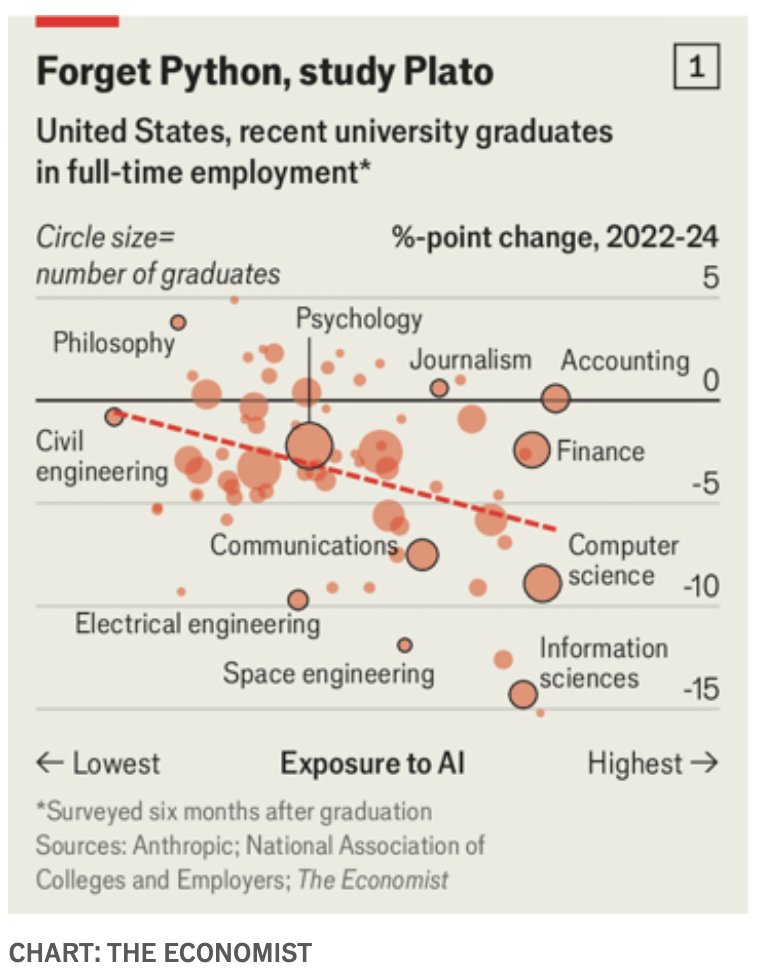
Yapay zekânın ABD'de mezunların iş bulma olanaklarına etkisi ölçülmüş. Eğitim bilimleri, felsefe, inşaat mühendisliği gibi alanlarda dramatik bir değişim gözlenmemiş. Oysa yapay zekânın yoğun kullanıldığı, bilgisayar mühendisliği, bilişim sistemleri vd. alanlarda istihdam yeni mezunlarda %6,6 oranında düşmüş. (bkz. grafik.1)
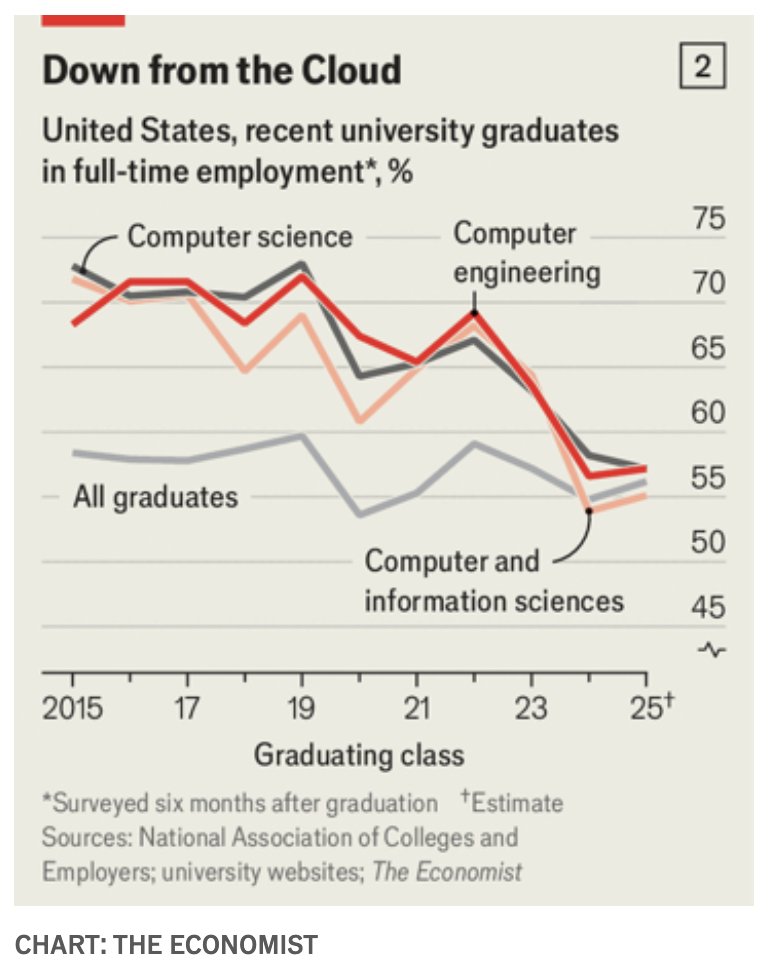
13 üniversitenin bilgisayar ve bilişim alanlarından mezunlarına bakılınca daha dikkat çekici bir tablo ortaya çıkmış. Bu grupta tam zamanlı istihdam oranı üç yıl içinde yaklaşık %70’ten %55’e gerilemiş (bu üç yıl ChatGPT’nin 2022’de piyasaya sürülmesinden sonraki döneme denk geliyor). (bkz. grafik 2)
The Economist dergisi bu araştırmaya kaynak olarak Ulusal Üniversiteler ve İşverenler Birliği mezun anketlerini kullanmış.
Haber: https://t.co/5tDmleSZDN
A Oxford PhD student got flagged for submitting AI-generated work.
His advisor called it the most sophisticated research process he had seen in 20 years.
The student had not used AI to write a single word.
Here is the workflow that got him reported.
He starts every essay with a diagnostic he calls brutal. He dumps his rough argument into Claude and asks one question: what are the three weakest logical jumps in this reasoning, and where would a hostile examiner attack first? The AI does not write his essay. It destroys his draft, and then he rebuilds from whatever survives.
Most students using AI are doing the opposite. They hand Claude a topic and ask it to write. He hands Claude his thinking and asks it to find every place where that thinking falls apart. The difference between those two approaches is the difference between outsourcing your brain and sharpening it.
The second step is the one that made his advisor go quiet. He uploads the five most important papers in his field alongside his draft and asks Claude what claims in his argument contradict or oversimplify what these authors actually found. Most PhD students cite papers they have skimmed once. He cites papers he has been forced to genuinely reckon with, because Claude keeps catching the places where he got them wrong.
The final move is almost unfair. Before he submits anything, he pastes his conclusion and runs one more prompt. He asks what a philosopher of science would say is missing from this argument and what assumptions he is making that he has not defended. His essays come back from reviewers with phrases like unusually rigorous and demonstrates rare critical depth, and his committee has no idea that the depth came from a machine asking him harder questions than any human in his department was willing to ask.
The academic integrity hearing lasted three hours. The panel asked him to rebuild his methodology from scratch in the room. He opened his laptop and showed them exactly how the workflow ran, prompt by prompt. They did not just clear him. They gave him the highest grade in the department's history and asked him to present the process to faculty.
Here is what that story actually means. What took most PhD candidates six months of back-and-forth with advisors, he was compressing into a single session because he had figured out something almost nobody else has. AI does not make your thinking better by replacing it. It makes your thinking better by attacking it faster than any human critic ever would.
He was not using AI to write. He was using it to think harder than he could alone.
The tool is the same one everyone has. The workflow is the part nobody is teaching.
Still think we’re understating the impact of AI on university degrees. A growing numbers of students don’t just lack the inclination to read but the *capacity*. Literally unable to read and absorb difficult sentences for an extended period. Same goes for writing.
It’s estimated that the Protein Data Bank (PDB) cost around $13B to create. Alphafold was only possible because of it. If we want ML to solve biology, we should be funding the creation of databases and the development of new assay technologies. ML is nothing without data.
I don't think people fully realize how badly AI has damaged higher education.
This is not an easy problem to fix. There are two major issues that foster cheating with AI:
1) Friction: It used to be hard to cheat. You had to find another student to copy. Now you just drop a short prompt (or the PDF of your assignment) into a chatbot and you get a complete response. This problem is not going away, it will only get worse as AI answers get harder and harder to detect
2) Social norms: Too many students are using this technology. As more and more students use AI to cut corners, it becomes easier and easier for other students to rationalize it. At some point, you reach a tipping point where cheating (rather than following the rules) feels normative.
Unless you can fix both of these issues, cheating will get worse. Much worse. The problem is that the lack of friction creates worse social norms, which then makes it easier for others to justify cheating. Even students who don't want to cheat will eventually feel that it's necessary to keep up with other students.
Like many professors I know, Princeton is trying to do something to protect the integrity of their educational experience. If they don't, employers will quickly figure it out and the value of a Princeton degree will eventually approximate the value of a degree from a diploma mill. I have had to change my exams and class assignments to reflect this new reality.
Students ask me the same question every year:
"Can I join your group to get some real experience?"
I hesitate and add something they don't expect.
Stop chasing applications. Build in public. Let hiring come to you.
They look at me like I've lost it.
That traditional deal is gone.
Llevo más de 25 años como profesor universitario en innovación y temas de actualidad, y siempre veo la misma dualidad. No importa la materia, asignatura ni la tecnología de turno: al final, los jóvenes se dividen en dos grupos.
El 80% llegan, hacen lo justo, no preguntan y no profundizan. Y no es que rechacen lo nuevo: es que les da igual.
Los otros (el 20%), cuando termina la clase, siguen buscando, probando, preguntándose por qué. No vuelven a casa a descansar: vuelven a aprender.
No los separa el talento ni el origen ni el estrato social. Los separa la curiosidad.
Y eso, después de dos décadas viendo promociones enteras, es lo único que al final marca la diferencia para algunos.
La curiosidad no es un extra: es lo que distingue a quienes se quedan en el mínimo y a quienes se lanzan a aprender por su cuenta.
Ese 20% tiene hambre de entender la innovación por ellos mismos. Porque las cosas no llegan solas. Y no llegan nunca si no se buscan.
Academia in a nutshell:
We are status-seeking chimps searching for status through a tiny number of journals. This is not particularly healthy nor efficient.
@sergeynazarovx DOWNVOTED & CLOSED. This was already discussed in a thread from January 2013. Please use search before you discuss something that has already been resolved.
@dilci_linguist Bir defa kullanmaya başladıktan sonra eskiye dönmek mümkün değil. Sağladığı esneklik, düşünme süreçlerine faydası gerçekten çok fazla. Tabi çok dikkatli ve sorumlu kullanmak, her zaman şüpheci olmak lazım. Aksi takdirde kullanımı oldukça riskli de olabilir.