Excited to share Quail, our new open source AI-SQL engine (a collab with Modal)! By planning queries and LLM inference together, it reaches 1B+ input tokens/min on one H100 for one query 😱🚀
AI-powered data operators create a new, interesting inference workload👇
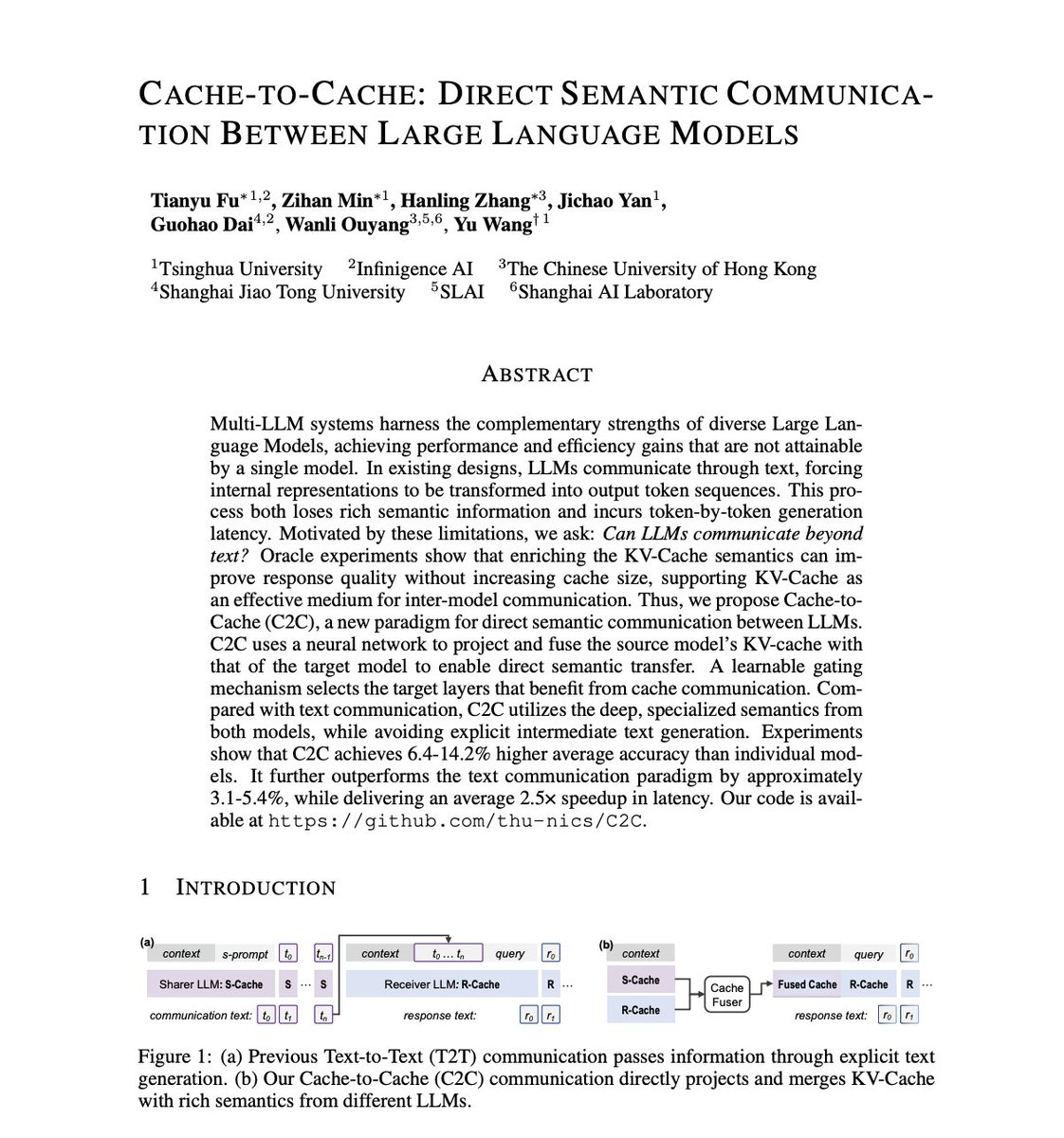
LLMs can now talk to each other without words.
Chinese researchers open-sourced a new paradigm that lets LLMs communicate without generating a single word.
It’s called Cache-to-Cache (C2C) communication.
right now, when multiple ai agents work together, they are forced to translate their internal "thoughts" into human text tokens just to pass a message. this loses rich semantic meaning and causes massive token-by-token latency.
So, instead of spitting out words, c2c uses a neural network to directly project and fuse the source model's "kv-cache" right into the target model. it is pure, direct semantic communication.. they even added a learnable gating mechanism to select exactly which layers benefit most from the cache transfer.
the benchmark results are actually crazy:
- avoids all intermediate text generation latency
- accuracy jumps by up to 14.2% compared to individual models
- beats traditional text-based agent communication by over 5%
- delivers a massive 2.5x speedup in overall speed
we are literally watching llms bypass human language to build their own silent, high-speed neural network..
New DeepSeek Harness release v0.1.6-alpha. This is a big one!
- Terminals in the Web sidebar: multiple tabs, shell selection, recovers after page refreshes
- Experimental Browser Use through Playwright MCP, Chrome DevTools MCP, and Stagehand browser backends
- Experimental Computer Use through Cua Driver MCP or the native driver for local computer interaction and screenshots
- Experimental Auto review mode
Full changelog: https://t.co/JOlAxV4ooN
Yann LeCun has changed the game for robotics.
His team discovered that AI world models are "thinking" in twisted, curved geometry, and every RL algorithm you know has been fighting against it without anyone noticing.
For years, we’ve been trying to teach AI how to navigate the physical world.
And for years, it has stubbornly struggled with complex, fluid robotics.
Now we know exactly why.
Every standard reinforcement learning (RL) algorithm assumes the AI's internal "world map" is flat. Euclidean. Simple straight lines.
But LeCun's team looked inside the latent space of these advanced world models.
The AI wasn't building a flat map. It was building a curved, high-dimensional geometry.
Every time a robot tried to plan a movement, the traditional RL algorithm was forcing a straight line onto a twisted, non-Euclidean space.
It’s like trying to navigate the globe using a flat piece of paper.
The math breaks down. The distances get distorted. The AI gets confused.
The robot was literally fighting its own brain.
So, the researchers did something brilliant. They stopped fighting.
They rewrote the RL algorithms to operate natively in this curved geometry. They aligned the training to the exact shape of the AI's thoughts.
The results are a massive leap forward.
When you let the AI plan in the geometry it actually built for itself, training efficiency skyrockets. Planning becomes fluid.
Robots stop hallucinating impossible physics and start moving with natural, intuitive logic.
We spent billions of dollars trying to brute-force AI into understanding our physical world.
It turns out, the AI already understood it perfectly.
We were just forcing it to think flat.